A single mislabelled carton that leaves your facility can trigger a full product recall costing upwards of $10 million — and that is before factoring regulatory fines, retailer chargebacks, and brand damage that lasts years. Most FMCG packaging lines still rely on manual visual inspection at end-of-line, where human fatigue, shift handovers, and production pressure create the perfect conditions for errors to slip through. Robotic end-of-line inspection eliminates that risk by putting machine vision and automated verification between your production line and your distribution network. If your outbound quality checks still depend on human eyes at 3 AM, keep reading — and when you are ready to track every inspection result inside a live CMMS, start a free trial with Oxmaint or book a demo to see how it connects to your packaging line data.
Robotics & Automation · FMCG Packaging Quality
Robotic End-of-Line Inspection for FMCG Packaging
Automate final quality checks on cartons, pallets, and shipping accuracy before distribution — catching defects at machine speed, not human speed.
$10M+
Average cost of a product recall triggered by packaging defect
99.8%
Detection accuracy achieved by robotic vision inspection systems
3x
Faster inspection throughput vs manual end-of-line checking
68%
Of FMCG recalls trace back to labelling or packaging errors
Connect Inspection Results to Your CMMS — Automatically
Oxmaint links robotic inspection data to work orders, asset records, and GMP audit trails — so every defect detected triggers the right maintenance action, not just a rejection report.
What Is End-of-Line Robotic Inspection?
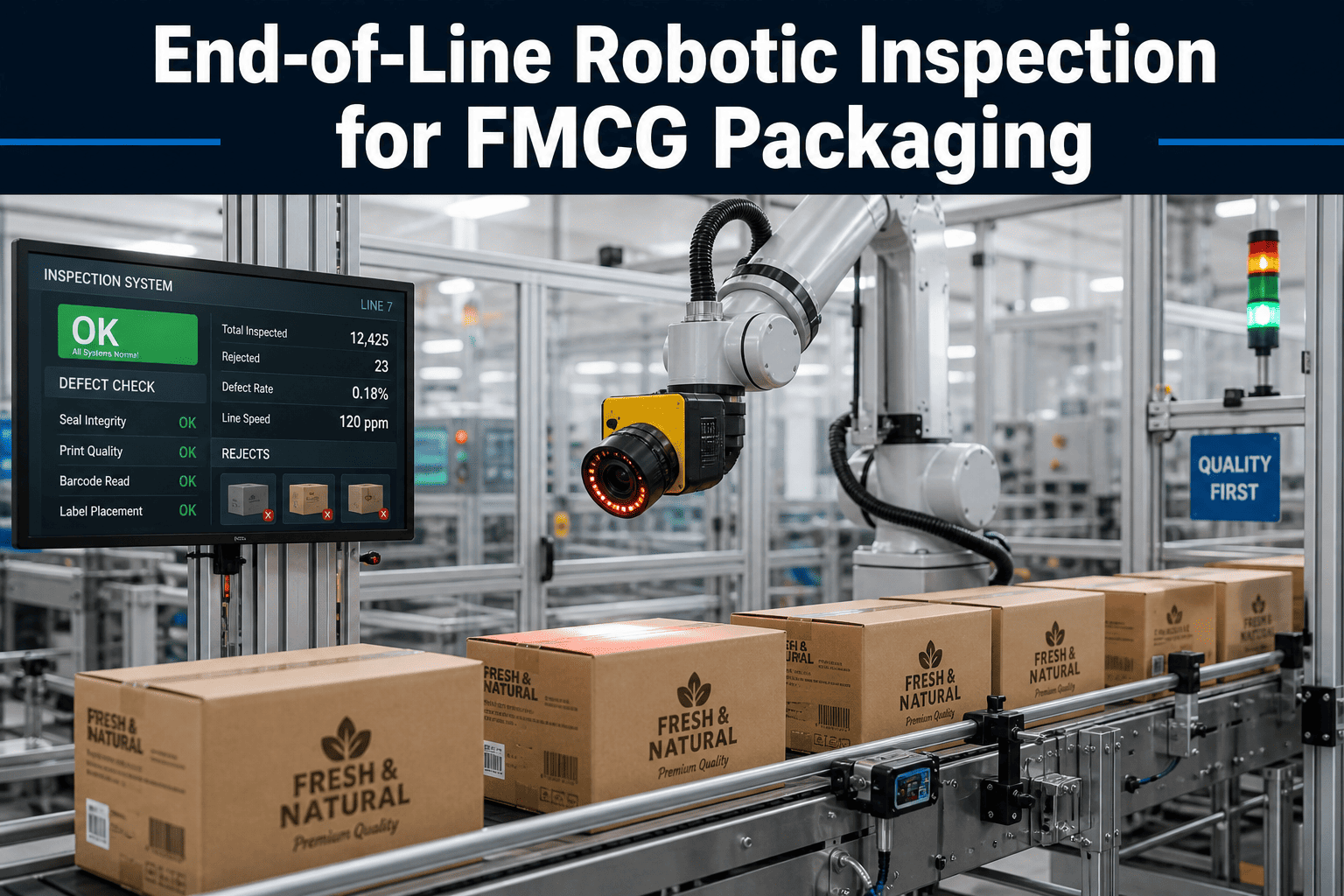
End-of-line inspection is the final quality checkpoint before packaged FMCG products leave the production facility. Robotic inspection systems use machine vision cameras, laser scanners, and AI-powered defect recognition to verify every carton, case, and pallet — at full line speed — before it is approved for dispatch. Unlike manual checking, robotic systems do not tire, do not lose focus at hour six of a twelve-hour shift, and do not miss defects due to production pressure.
01
Carton Integrity Check
Verifies seal quality, crush damage, print legibility, and correct label placement on every individual carton before case packing.
02
Case & Shipper Verification
Confirms correct SKU count per case, case seal integrity, outer case labelling accuracy, and barcode readability for retailer compliance.
03
Pallet Pattern Inspection
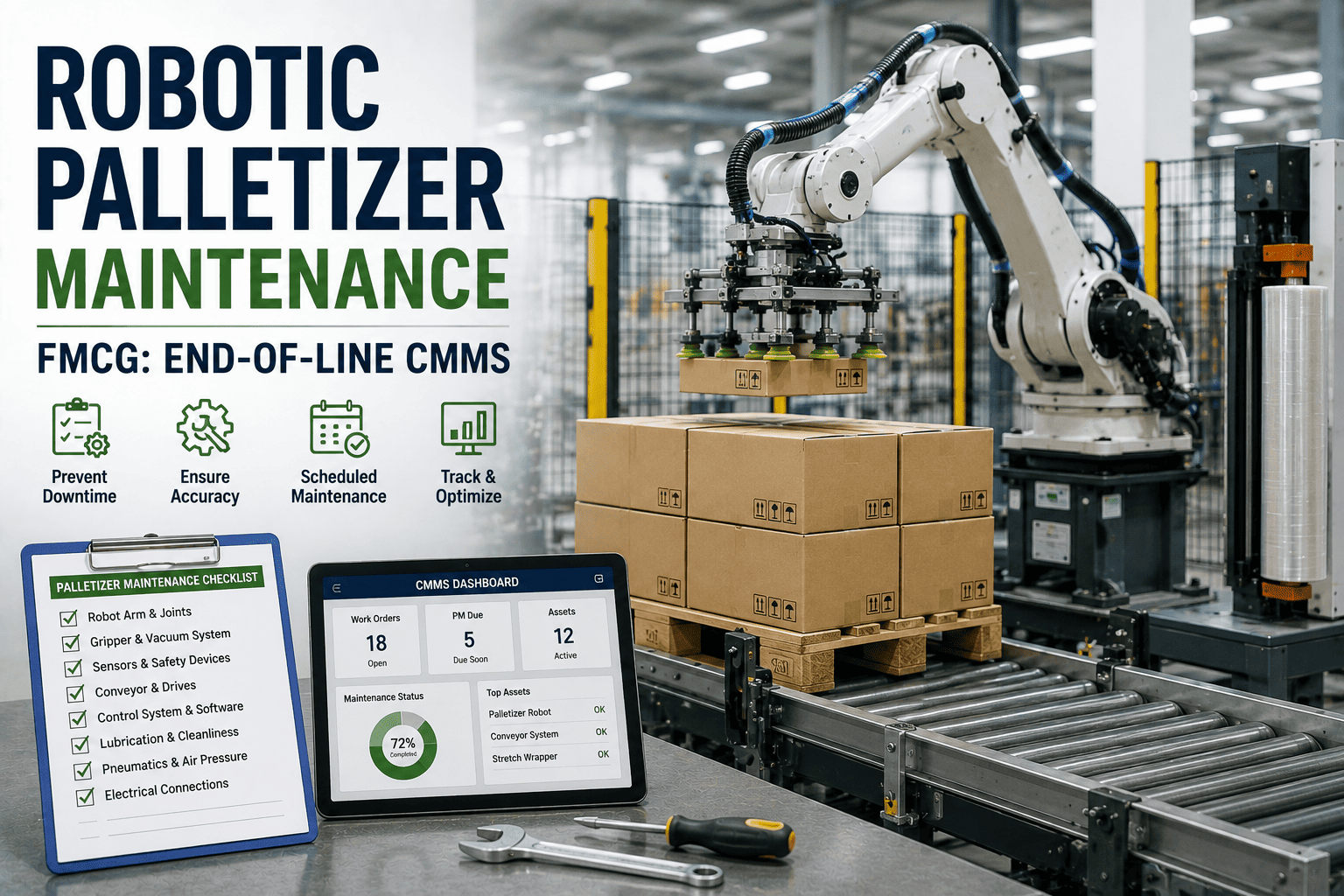
Validates pallet stacking pattern, layer count, stretch wrap coverage, and pallet label accuracy against dispatch order requirements.
04
Shipping Accuracy Confirmation
Cross-references completed pallets against purchase orders and dispatch manifests — zero short-shipped or mis-picked orders leave the facility.
The Cost of Getting End-of-Line Wrong
Manual end-of-line inspection is not failing rarely — it is failing predictably. These are the four most expensive failure modes in FMCG packaging quality control.
68% of FMCG recalls trace to labelling or packaging errors that a robotic vision system at end-of-line would have caught before dispatch. Average recall cost: $10M to $30M.
Major UK, US, and Australian retailers charge 2% to 5% of order value for pallets that do not meet packing specifications. Automated inspection eliminates this exposure.
FDA, FSA, and EU food safety authorities issue fines for labelling non-compliance ranging from $10,000 to $500,000 per incident. Automated inspection provides the documentation evidence to demonstrate due diligence.
LS
Labour & Overtime Cost
Manual end-of-line inspection requires 2 to 4 FTE per shift. In Australia and Germany, where labour costs run 35% above global average, this is a significant and rising cost line that robotic inspection eliminates.
What Robotic Inspection Systems Actually Check
Vision Check
Label Accuracy & Placement
Reads and verifies every label field — product name, batch code, best-before date, allergen declarations, barcode — at up to 1,200 units per minute.
Vision Check
Print Quality Verification
Detects smearing, missing print, incorrect colour registration, and unreadable barcodes that manual inspection regularly misses under production lighting.
Structural Check
Seal & Closure Integrity
Laser and pressure sensors confirm carton and case seals meet specification — detecting micro-leaks and incomplete seals invisible to human inspectors.
Dimensional Check
Crush & Damage Detection
3D vision systems detect dents, crush zones, and deformation that exceed retailer or carrier acceptance tolerances before the product ships.
Count Check
SKU Count & Configuration
X-ray or vision-based counting verifies correct unit count per carton and correct carton count per case — eliminating short-ship complaints from retailers.
Pallet Check
Pallet Stability & Compliance
Automated pallet scanners verify stacking pattern, layer count, overhang, and stretch wrap coverage against retailer and carrier specifications.
How Oxmaint Connects Inspection Data to Maintenance Action
Robotic inspection catches defects — but defects are symptoms of equipment issues. Oxmaint closes the loop by connecting every inspection failure to the maintenance workflow that prevents the next one.
Defect Tracking
Inspection Failures Trigger Work Orders
When inspection rejects exceed threshold, Oxmaint automatically creates a work order on the responsible asset — sealer, labeller, printer — before defect volume escalates.
Asset Linkage
Defects Linked to Specific Equipment
Every inspection failure is attributed to the specific asset that caused it — building a defect history that informs preventive maintenance scheduling and equipment replacement decisions.
GMP Compliance
Audit-Ready Inspection Records
Oxmaint stores every inspection result with timestamp, product lot, and action taken — providing the complete, exportable quality record that food safety auditors require.
OEE Integration
Quality Loss Tracked in OEE Dashboard
Inspection rejection rates feed directly into Oxmaint's OEE quality metric — showing the real production efficiency impact of packaging defects at the line level.
Oxmaint makes the connection between your inspection system and your maintenance team seamless. Every defect becomes a data point. Every data point drives a better maintenance decision. Start a free trial and connect your first inspection dataset today, or book a demo to see how defect-to-work-order automation works in practice.
Manual vs Robotic End-of-Line Inspection
ROI Delivered by Robotic End-of-Line Inspection
99.8%
Defect Detection Rate
Machine vision consistency at full line speed — vs 72–80% for fatigued manual inspectors at end of long shifts
85%
Reduction in Inspection Labour
From 2–4 FTE per shift to 0.5 FTE oversight — freeing headcount for higher-value production roles
$2.4M
Recall Cost Avoided Per Year
Modelled savings for a mid-size FMCG facility eliminating packaging-related recall risk through robotic inspection
18mo
Typical Payback Period
Robotic end-of-line inspection ROI calculated across labour savings, recall avoidance, and chargeback elimination
Frequently Asked Questions
What types of defects can robotic end-of-line inspection detect?
Modern machine vision systems detect label accuracy, print quality, barcode readability, seal integrity, crush damage, incorrect SKU count, wrong pallet patterns, and short-weight products. Detection capability depends on the sensor combination used — pure vision systems excel at labelling and print; X-ray systems handle count and weight; 3D scanners handle dimensional and crush detection. Most end-of-line deployments combine two or three sensing technologies for comprehensive coverage.
How does Oxmaint integrate with robotic inspection systems?
Oxmaint integrates with inspection system data outputs via API and IoT data connectors. When rejection rates on a specific line exceed the configured threshold, Oxmaint automatically generates a maintenance work order on the associated asset — sealer, labeller, filler — and assigns it to the responsible technician. Inspection results are stored against the asset record, building a defect history that drives preventive maintenance scheduling and replacement planning. Most integrations are live within 2 to 4 weeks.
Does robotic inspection work for multi-SKU FMCG lines?
Yes — and this is where robotic inspection delivers the most value versus manual checking. Modern vision systems switch product profiles in seconds during changeover, automatically loading the correct label templates, barcode formats, and pallet configurations for the new SKU. Manual inspectors require briefing time, reference samples, and frequently miss errors during the first production runs after a changeover. Oxmaint's changeover management module can trigger inspection profile changes automatically when a changeover work order is closed.
What documentation does robotic inspection provide for food safety audits?
Oxmaint stores every inspection event with product lot, timestamp, defect type, action taken, and approving technician ID. For GMP, BRC, and FSSC 22000 audits, this provides a complete, searchable, digitally signed quality record that demonstrates due diligence at every production stage. Audit reports can be exported in PDF or CSV format on demand — eliminating the manual paperwork consolidation that currently costs most FMCG quality teams 8 to 12 hours before every external audit.
Start a free trial to configure your inspection audit trail, or
book a demo to see the audit export workflow.
Stop Letting Packaging Defects Reach Your Retailers
Oxmaint connects robotic inspection data to live work orders, asset maintenance histories, and GMP-ready audit documentation — so every defect detected triggers the right action, automatically. No implementation fees. No long onboarding. Live in 30 days.