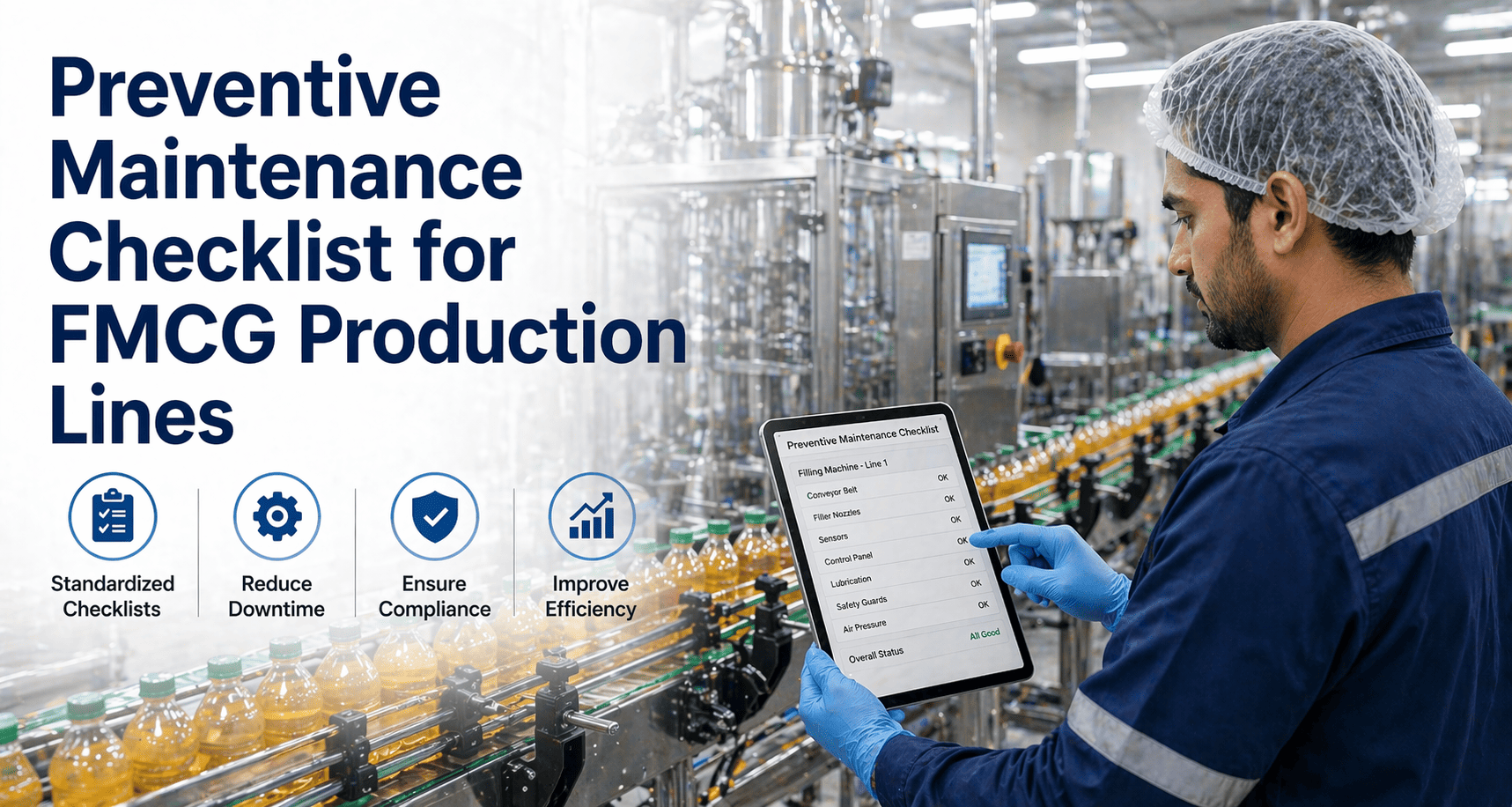
Preventive Maintenance Checklist for FMCG Packaging Lines
By Jean on March 6, 2026
FMCG packaging lines running without structured preventive maintenance lose an average of 340 production hours per
year to unplanned stops — costing $420K–$780K in lost output per line annually. The six critical equipment
categories on modern packaging lines (filling machines, robotic pick-and-place, labeling systems, cartoners, case
packers, and robotic palletizers) each have unique failure modes that require specific PM tasks at daily, weekly,
and monthly intervals. Plants implementing equipment-specific PM checklists tied to a CMMS platform reduce unplanned
packaging downtime by 62% and extend equipment life by 2.3x. Start your free trial to digitize these checklists into automated PM schedules, or book a demo to see how Oxmaint turns static
checklists into living maintenance programs.
340 hrs
Average Annual Unplanned Downtime Per FMCG Packaging Line
62%
Reduction in Unplanned Stops with Equipment-Specific PM Checklists
2.3x
Equipment Life Extension with Structured Preventive Maintenance
$780K
Maximum Annual Cost of Unplanned Packaging Line Downtime
Why Packaging Lines Need Equipment-Specific PM Checklists
Generic maintenance schedules fail on packaging lines because each machine type has fundamentally different wear
patterns, lubrication requirements, and failure signatures. A filling machine's valve seals degrade from chemical
exposure while a robotic palletizer's joints wear from repetitive motion — applying the same PM frequency to both
guarantees one is over-maintained and the other under-maintained. Equipment-specific checklists aligned to
manufacturer recommendations and operating conditions eliminate this mismatch.
Generic PM Schedule vs Equipment-Specific Checklists
Why one-size-fits-all maintenance fails on FMCG packaging lines
Generic PM Schedule
Task Specificity
"Inspect equipment" — no actionable detail
Frequency Basis
Calendar-based — same schedule for all machines
Completion Rate
38% — technicians skip vague tasks
Failure Prevention
22% of breakdowns prevented
Equipment-Specific Checklist
Task Specificity
"Check filler valve torque to 28 Nm" — precise
Frequency Basis
Run-hour and cycle-count based per machine
Completion Rate
94% — clear tasks with acceptance criteria
Failure Prevention
78% of breakdowns prevented
PM Compliance Improvement: 38% to 94% with Specific Checklists
Filling Machine PM Checklist — 12 Critical Tasks
Filling machines are the highest-downtime-risk equipment on FMCG packaging lines — responsible for 34% of all
unplanned stops. These 12 tasks cover daily inspections through monthly overhauls, each with specific acceptance
criteria.
Filling Machine Preventive Maintenance Checklist
Covers volumetric fillers, gravity fillers, piston fillers, and overflow fillers
1
Daily
Inspect all fill nozzles for blockages or residue buildup
Criteria: Zero visible residue, free flow test passes on all nozzles
2
Daily
Verify fill accuracy on 10-unit sample against target weight
Criteria: Within 1% tolerance of target fill volume
3
Daily
Check O-ring seals and gaskets on all product-contact surfaces
Criteria: No cracks, swelling, or deformation visible
4
Daily
Clean and inspect CIP connection points and spray balls
Criteria: Full 360-degree spray pattern confirmed visually
5
Weekly
Calibrate flow meters against certified reference standard
Criteria: Reading within 0.5% of reference value
6
Weekly
Test pneumatic valve response time on all filling stations
Criteria: Open/close cycle under 85ms per valve
7
Weekly
Inspect overflow sensors and level probes for fouling
Criteria: Response to test trigger within 50ms
8
Weekly
Check servo motor alignment and listen for abnormal noise
Criteria: Vibration under 2.5 mm/s, no grinding sounds
9
Monthly
Replace all gaskets on product-contact surfaces
Criteria: New gaskets from approved supplier, torqued to spec
10
Monthly
Full CIP system flow and temperature verification
Criteria: Flow rate within 5% of design, temp within 2 deg C
11
Monthly
Inspect conveyor drive chain tension and wear
Criteria: Chain elongation under 1.5%, tension at OEM spec
12
Monthly
Full electrical panel thermal imaging scan
Criteria: No connection exceeds 15 deg C above ambient
Robotic pick-and-place units handle 120–300 cycles per minute — generating cumulative joint wear, gripper
degradation, and cable fatigue that must be caught before catastrophic failure. These 12 tasks cover the full robot
maintenance lifecycle.
Covers delta robots, SCARA robots, cobots, and gantry pick-and-place systems
1
Daily
Verify gripper suction pressure on all vacuum cups
Criteria: Vacuum holds at -65 kPa minimum under load
2
Daily
Check end-effector alignment to pick/place positions
Criteria: Position accuracy within 0.3mm of programmed point
3
Daily
Inspect cable harnesses and dress packs for chafing
Criteria: No exposed wire, no kinks, no wear marks on sheathing
4
Daily
Test emergency stop response from all e-stop locations
Criteria: Full stop achieved within 0.5 seconds
5
Weekly
Lubricate all joint bearings per OEM specification
Criteria: Correct grease type, quantity per joint spec sheet
6
Weekly
Verify positional repeatability across all programmed positions
Criteria: Repeatability within 0.1mm over 50 test cycles
7
Weekly
Clean vision camera lenses and verify detection accuracy
Criteria: 100% detection rate on 200-unit test run
8
Weekly
Inspect safety light curtains and area scanners
Criteria: Trip response under 30ms at all detection zones
9
Monthly
Replace vacuum cups showing visible degradation
Criteria: Cups with 15%+ hardness change or visible cracks
10
Monthly
Full axis calibration using manufacturer calibration routine
Criteria: All axes within OEM tolerance after calibration
11
Monthly
Inspect servo drives for overheating and fan operation
Criteria: Drive temp under 60 deg C during operation, fans clear
12
Monthly
Backup and verify robot program and configuration files
Criteria: Verified backup matches running program checksum
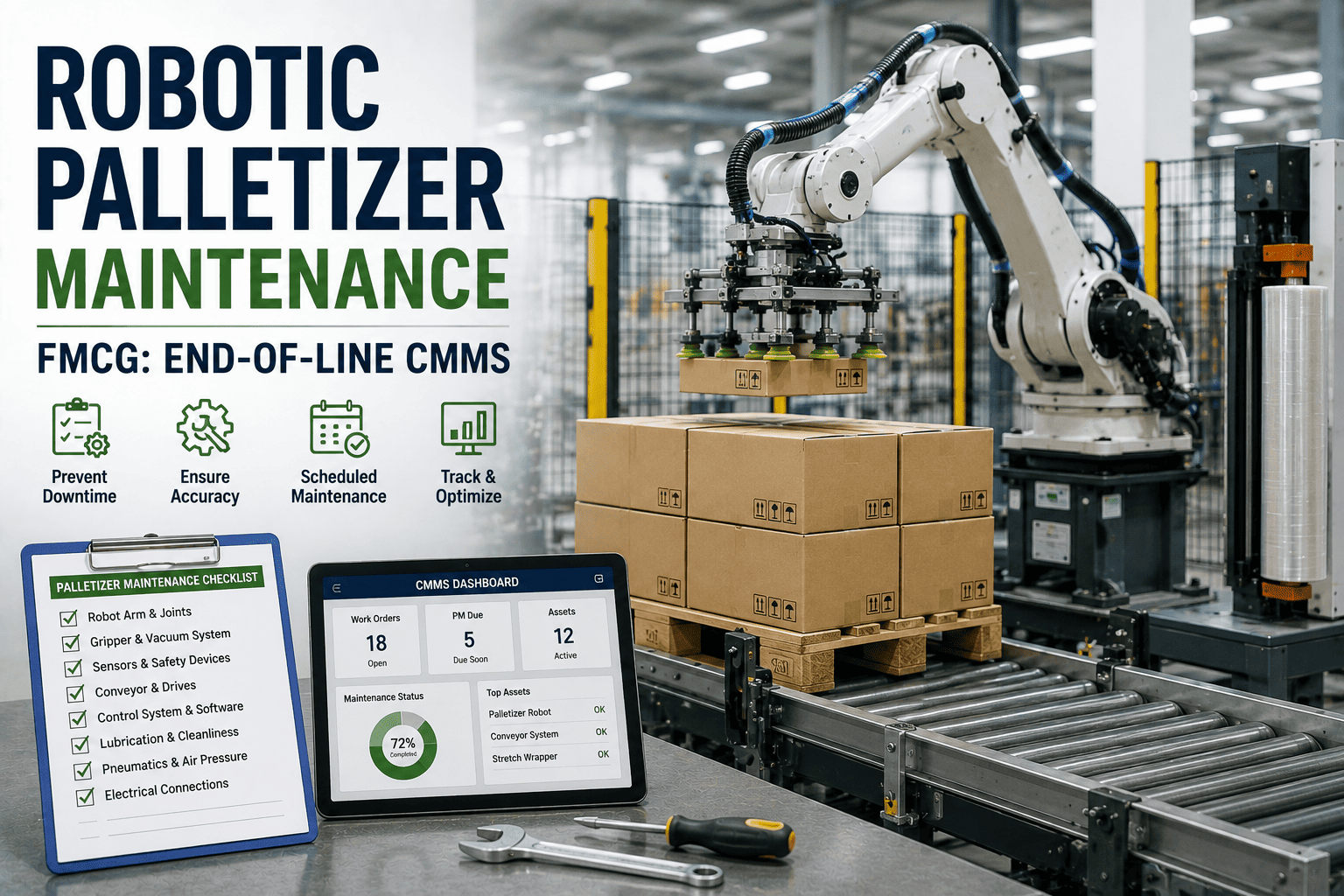
Four More Equipment Checklists: Labelers, Cartoners, Case Packers, Palletizers
Each of these four equipment types has 6 priority tasks that cover the highest-impact failure modes. Full 12-task
checklists for each are available inside Oxmaint's PM template
library — pre-built and ready to assign.
Priority PM Tasks by Equipment Type
01
Labeling Systems
Clean print heads and label sensors daily
Verify label placement accuracy within 1.5mm
Calibrate vision inspection cameras weekly
Inspect label feed tension mechanisms
Replace drive belts with 10%+ stretch monthly
Full encoder wheel cleaning and calibration
Failure Risk: Mislabeling + Compliance
02
Cartoning Machines
Check carton feed magazine alignment daily
Verify glue gun temperature and pattern
Lubricate cam mechanisms weekly
Test carton reject sensor accuracy
Replace worn folding fingers monthly
Inspect main drive gearbox oil condition
Failure Risk: Crushed Product + Seals
03
Case Packers
Inspect case erector vacuum cups daily
Verify tape seal adhesion strength
Lubricate linear guides weekly
Test photoeye case detection accuracy
Replace worn conveyor belts monthly
Full safety guard interlock testing
Failure Risk: Case Jams + Rejections
04
Robotic Palletizers
Inspect gripper clamp pressure daily
Verify pallet pattern accuracy
Lubricate articulation joints weekly
Test layer sheet dispenser alignment
Full robot calibration cycle monthly
Inspect drive controller cooling fans
Failure Risk: Unstable Pallets + Safety
Common PM Execution Failures on Packaging Lines
Even plants with "preventive maintenance programs" lose $180K–$420K annually when checklists are poorly designed,
inconsistently executed, or disconnected from equipment reality. These six patterns are the most expensive PM
failures across FMCG packaging operations.
Six PM Execution Failures That Cost FMCG Plants Millions
!
Checkbox-Only Culture
47% of paper-based PM tasks are checkbox completions with no real work — no photo evidence, no measurements, no accountability for actual inspection quality.
!
Wrong Frequency Settings
PM intervals set by calendar instead of run-hours. A filler running 20 hrs/day needs 2x the frequency of one running 10 hrs — but both get the same monthly schedule.
!
Missing Acceptance Criteria
"Check belt tension" without the acceptable range (12–15 N/m). Each technician applies different judgment — 34% of worn components pass inspection.
!
No Defect Escalation Path
PM finds "bearing noise on station 4" on paper — but no one creates a corrective work order. The bearing seizes 12 days later during peak production.
!
Skipped Under Pressure
58% of FMCG plants defer weekly PM tasks at least once per month during demand peaks — and deferred tasks are rarely rescheduled, creating growing gaps.
!
No Trend Analysis
Vibration readings trending upward over 6 weeks go unnoticed because paper data is never plotted — the bearing fails "suddenly" despite 6 captured warnings.
How Oxmaint Transforms Static Checklists into Living PM Programs
When PM checklists are digitized inside a CMMS platform, every
task becomes traceable, every measurement becomes data, and every missed inspection triggers automatic escalation —
driving PM compliance from 38% to 94%.
Four-Stage Digital PM Checklist System
01
Equipment-Specific Templates
Pre-built checklists for all 6 packaging equipment types
Defined acceptance criteria and measurement ranges
Photo evidence capture for each completed task
Auto frequency adjustment based on run-hours
Output: 94% PM Compliance Rate
02
Smart Scheduling Engine
Auto-generate PM work orders at correct intervals
Assign to qualified technicians by equipment type
Schedule PMs into production gaps automatically
Auto-reschedule deferred tasks within 48 hours
Output: Zero Missed PM Windows
03
Defect-to-Work-Order Pipeline
One-tap defect reporting creates work orders instantly
Auto-prioritize by equipment criticality score
Link findings to spare parts for auto-ordering
Track from discovery to verified repair completion
Output: Defects Fixed Before Failure
04
Trend Analytics Dashboard
Plot measurement trends across PM cycles per asset
Auto-flag readings approaching out-of-spec limits
Compare compliance and breakdown rates by line
Generate equipment health scores from PM data
Output: Predictive Maintenance Ready
94%
PM Task Completion Rate with Digital Checklists vs 38% Paper
28%
Reduction in PM Execution Time Through Mobile Digital Workflows
42%
Fewer Quality Rejections After Calibration-Based PM Programs
30 days
Average Payback Period for Digital PM Checklist Implementation
Frequently Asked Questions
How often should each packaging equipment type receive preventive maintenance?
PM frequency should be based on run-hours and cycle counts, not calendar dates. Filling
machines need daily nozzle and seal checks (10 min), weekly flow meter calibration (45 min), and monthly
gasket replacement (2 hrs). Robotic pick-and-place needs daily gripper checks, weekly joint lubrication, and
monthly axis calibration. High-speed labelers require daily printhead cleaning, weekly vision calibration,
and monthly belt replacement. The key: PM frequency must match operating intensity — a line running 20
hours/day needs 2x frequency vs 10 hours. Oxmaint
auto-adjusts schedules based on actual run-hours.
What should a good PM checklist include beyond task descriptions?
Effective checklists include five elements per task: (1) Specific action with acceptance
criteria ("Check belt tension — 12–15 N/m"). (2) Required tools and materials. (3) Safety lockout/tagout
requirements. (4) Expected time to complete. (5) Defect escalation path — what to do if inspection reveals
an issue. Checklists without acceptance criteria are useless — technicians have no standard to judge
pass/fail.
How does digitizing PM checklists improve compliance from 38% to 94%?
Four mechanisms: (1) Automatic work order generation — tasks appear on mobile devices at
correct intervals. (2) Photo evidence requirements — technicians must capture visual proof, preventing
checkbox-only completion. (3) Real-time escalation — overdue tasks auto-escalate to supervisors within 24
hours. (4) Measurement capture — numeric readings are recorded and trended for predictive analysis. Book a demo to see digital checklists
in action.
Can PM checklists be customized for different packaging line configurations?
Yes — and they must be. Every line has unique equipment combinations, OEM specs,
product-contact materials, and operating speeds. Oxmaint provides equipment-specific templates as starting
points that teams customize based on actual conditions, failure history, and OEM recommendations. The system
supports custom fields, conditional logic (if speed exceeds 200 units/min, add extra seal check), and
multi-language for global operations.
Your Packaging Lines Run 18 Hours a Day. Your PM Checklists Should Work Just as Hard.
Oxmaint transforms static paper checklists into intelligent, automated PM programs —
with equipment-specific templates, photo-verified completion, auto-scheduling by run-hours, and instant
defect-to-work-order conversion. Stop losing $780K per line to preventable breakdowns.


.png)

