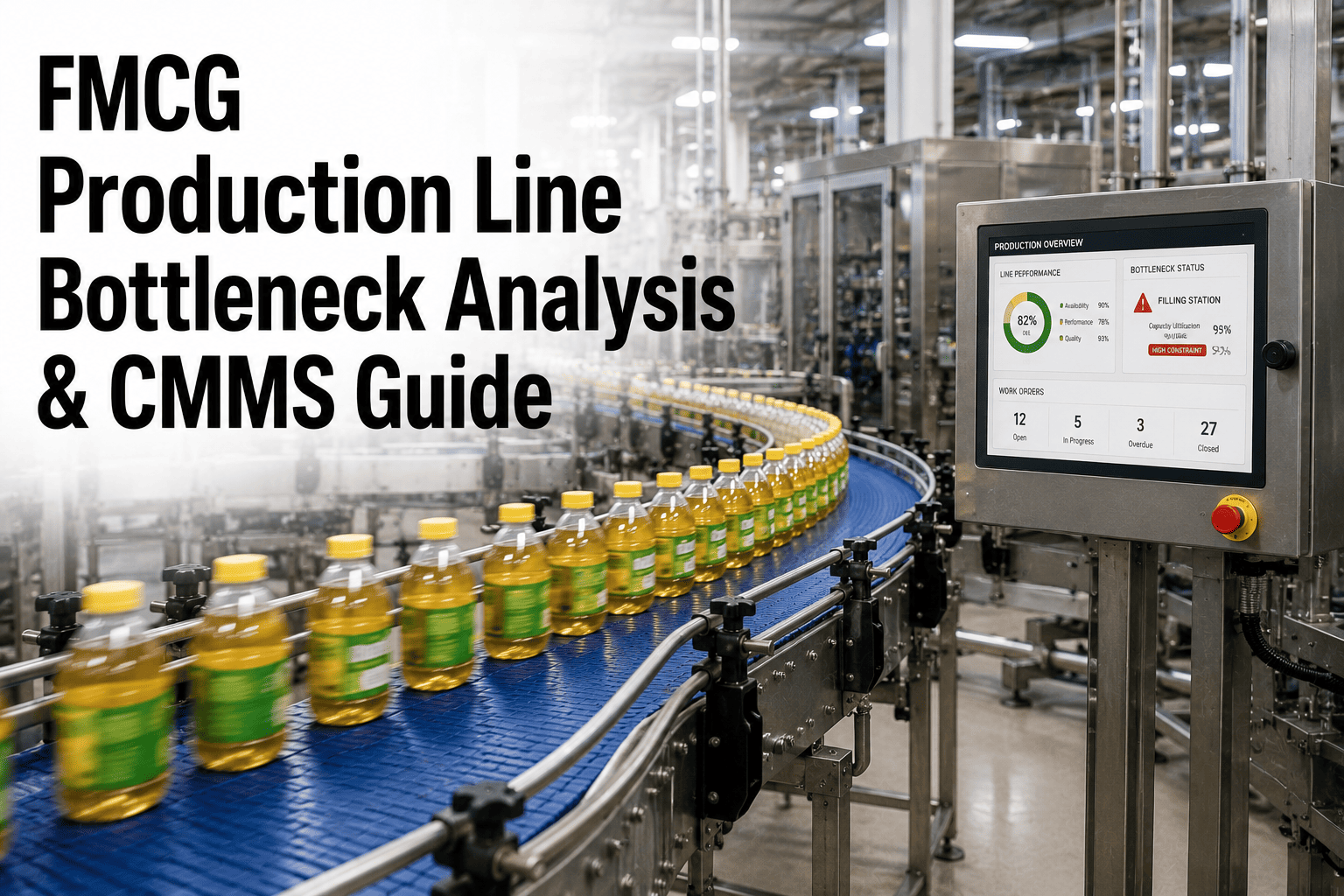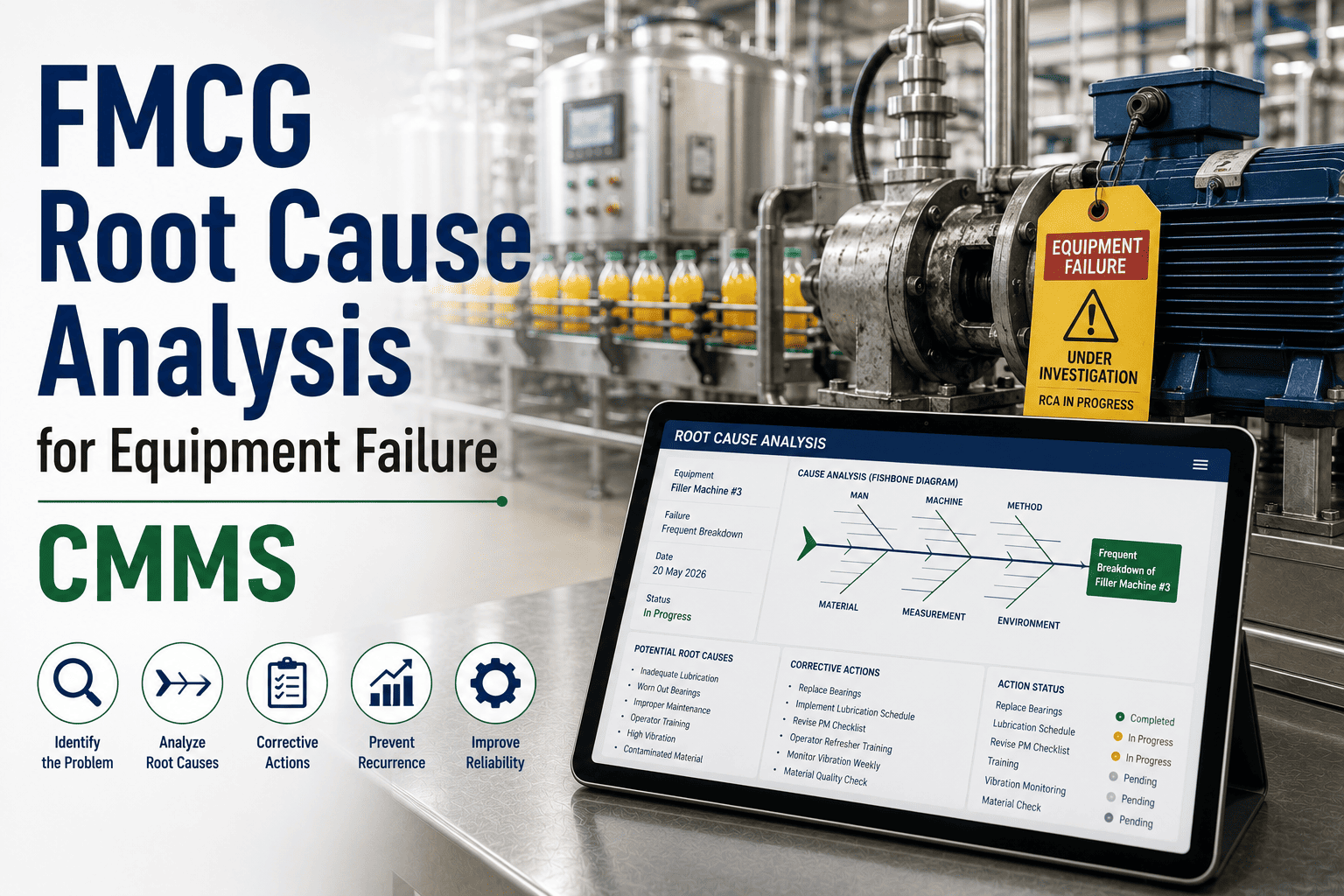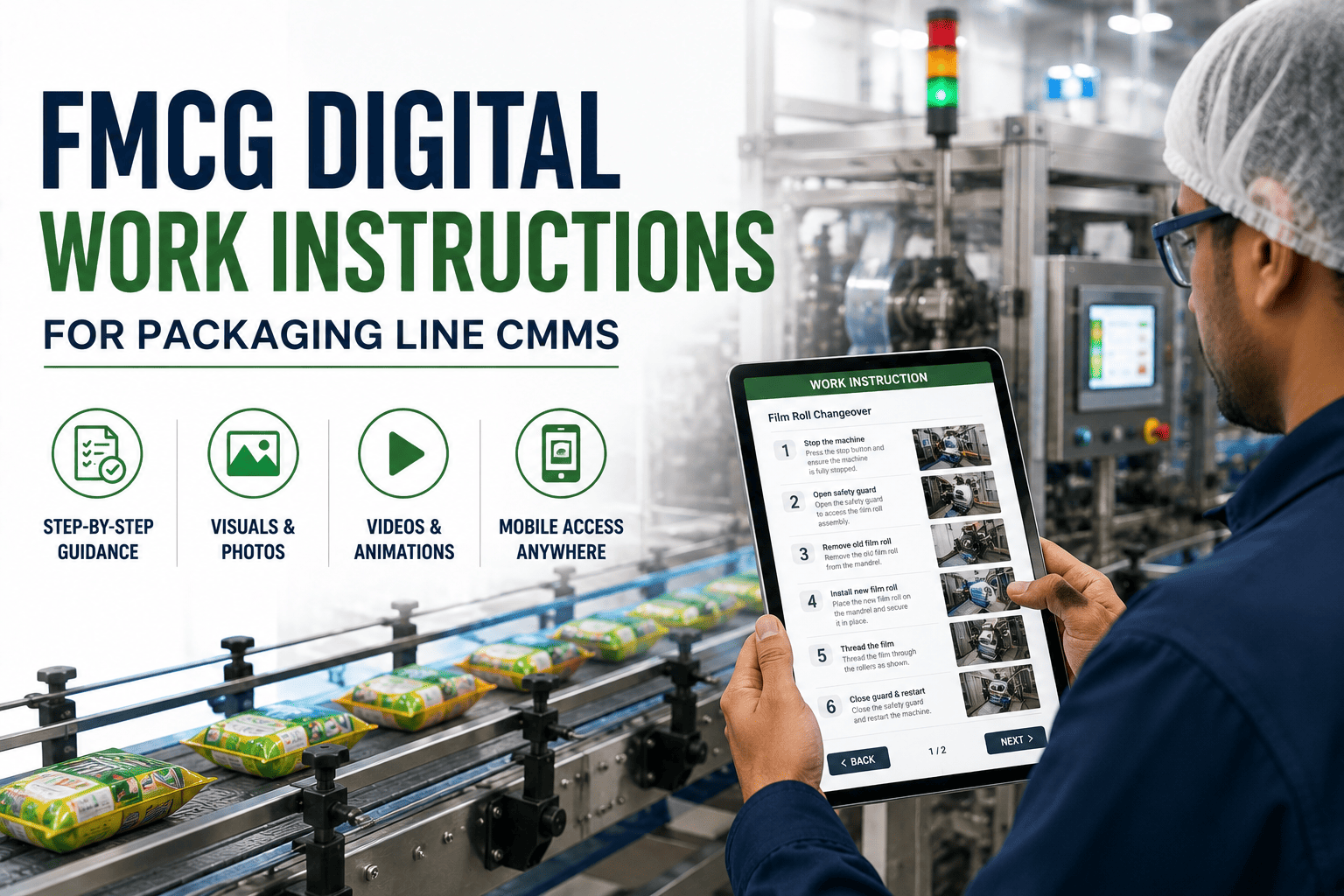
Filling and packaging lines decide whether an FMCG plant has a good day or a bad one. A filler that drips, a sealing jaw that drifts out of temperature or a labeler that skips a cycle rarely fails on the schedule a fixed calendar PM assumed. Reliability-centered maintenance (RCM) begins with what each machine must do, how it can stop doing it and what that failure costs, then keeps only the tasks worth performing. This guide covers an RCM analysis for filling and packaging equipment and shows how a CMMS such as Oxmaint can turn the results into live preventive maintenance tasks and work orders.
RCM Analysis for FMCG Filling Lines and Packaging Equipment
Function-based failure analysis for fillers, sealers, labelers, case packers and conveyors, so every PM task has a reason and every inspection, spare part and stop is tied to a real consequence.
- FillerVolume, drip, nozzle wear
- Capper or SealerSeal integrity, temperature
- LabelerPosition, code legibility
- InspectionHidden failures, rejects
- Case PackerCount, jams, sensors
- ConveyorsChains, guides, drives
Why Calendar PM Falls Short on Packaging Lines
Most FMCG PM plans are inherited from OEM manuals, past habits and audit pressure. They fill a schedule, but they do not always prevent the failures that stop the line.
Calendar-Driven PM
- Tasks copied from manuals and previous plans
- One interval for every machine regardless of duty or product
- Wear parts replaced whether worn or not
- Metal detectors and reject gates rarely tested
- Technicians unsure why a task exists
RCM-Driven Maintenance
- Each task traced to a failure mode and its consequence
- Intervals based on detectable wear and the P-F interval
- Condition checks before parts are replaced
- Protective devices on failure-finding schedules
- Every task documented, justified and open to review
The aim is not more maintenance. It is the right maintenance, with the unnecessary tasks removed so technician time goes where failures actually start.
The Seven RCM Questions Applied to a Filling Line
The SAE JA1011 standard defines RCM through seven questions asked about every asset in its operating context. Here is how each one looks on a packaging line.
- 1What are the functions and performance standards? The filler must dispense the declared volume within tolerance at rated speed.
- 2How can it fail to fulfil them? Underfill, overfill, drip after cut-off or inability to reach line speed.
- 3What causes each functional failure? A worn dosing piston seal, a sticking valve, a drifting flow meter or a clogged nozzle.
- 4What happens when each failure occurs? Giveaway, rejected product, a line stop or a CIP restart.
- 5Why does each failure matter? Consequences are hidden, safety, environmental, operational or non-operational.
- 6What can be done to prevent or predict it? On-condition checks, scheduled restoration, scheduled replacement or failure-finding.
- 7What if no suitable proactive task exists? Redesign, run to failure or change the operating procedure.
Step One: Define Functions Before Failure Modes
Teams often jump straight to what breaks. RCM starts with what the equipment is supposed to deliver, because a failure is simply the loss of a function, partial or total.
| Asset | Primary function | Performance standard | Functional failure |
|---|---|---|---|
| Rotary filler | Dispense declared volume into each container | Within fill tolerance at rated speed | Underfill, overfill, cannot reach rated speed |
| Filling nozzle and valve | Start and stop product flow cleanly | No drip, no foam-over, no contamination | Drips after cut-off, sticks open or closed |
| Sealing machine | Form a complete, specified seal | Seal width and strength within specification | Incomplete, contaminated or wrinkled seal |
| Labeler | Apply label in the correct position | Position within tolerance, code legible | Skewed, missing or unreadable label |
| Case packer | Group and load the correct count | Count and orientation correct | Short count, jam, torn case |
| Conveyor | Move product between stations without faults | Rated throughput, no jams or toppling | Stops, jams, product falls |
| Metal detector or checkweigher | Detect and reject nonconforming product | Detects test piece and rejects reliably | Fails to detect or reject, often unnoticed |
Operating context matters here. A liquid filler running a thin product at high speed fails differently from a viscous product line, so performance standards should reflect real SKUs and speeds, not nameplate values.
Failure Modes and Effects: Filler and Sealer Examples
A failure mode should be specific enough to choose a task. "Filler failure" is not a failure mode. "Dosing piston seal worn, causing underfill" is.
| Failure mode | Local effect | Line effect | Typical consequence |
|---|---|---|---|
| Piston seal wear at the dosing unit | Volume variation | Rejects and giveaway | Operational |
| Nozzle valve sticking from dried residue | Drip or no flow | Container contamination, stoppage | Operational |
| Flow meter or load cell drift | Fill offset | Compliance risk on declared volume | Operational |
| Sealing jaw temperature drift | Weak or burnt seal | Leakers, shelf-life risk | Operational, possible safety |
| Worn protective tape on sealing jaw | Poor heat transfer | Inconsistent seals | Operational |
| Heater cartridge or thermocouple fault | Loss of temperature control | Line stop | Operational |
| Jaw misalignment or low pressure | Partial seal | Product in the seal area | Operational |
| Reject gate actuator seized | Rejects not diverted | Nonconforming product passes | Hidden, then safety or quality |
Classifying Consequences Decides the Task
Consequence category drives how much effort a failure deserves. This is where RCM separates a nuisance from a risk.
Hidden
The failure is not evident in normal operation, such as a metal detector that stops rejecting. Needs failure-finding tests.
Safety and Environmental
Guard interlocks, steam, pressurized air, ammonia or hot jaws. Risk must be reduced to a tolerable level.
Operational
Affects output, quality or cost, such as a stopped labeler. Task must cost less than the failure it prevents.
Non-Operational
Only the repair cost matters, such as a redundant pump. Run to failure is often acceptable.
Selecting Maintenance Tasks: A Decision Ladder
For each failure mode, RCM asks whether a technically feasible and worthwhile task exists. Work down the ladder and stop at the first task that passes both tests.
On-Condition Task
Inspect or measure to find a potential failure. Nozzle drip trend, jaw temperature variance, vibration on a gearbox.
Scheduled Restoration
Rebuild at a fixed interval when wear is age-related, such as a dosing unit seal kit overhaul.
Scheduled Replacement
Replace a part with a known life, like sealing tape, belts or filter elements.
Failure-Finding Task
Test protective functions at an interval, such as metal detector test pieces and reject confirmation.
Redesign or Change Procedure
Modify a nozzle, add a guide or change cleaning steps when no task is effective.
Run to Failure
Accept the failure where consequences are minor and a spare is available.
Matching Task and Interval to the Failure Pattern
Many packaging failures are not age-related, so replacing parts on the calendar can waste money and introduce start-up errors. Intervals should follow how failure develops.
| Failure mode | Task type | Interval basis | Practical example |
|---|---|---|---|
| Nozzle valve wear | On-condition | Shorter than the P-F interval | Drip check and leak test each changeover |
| Sealing tape wear | Scheduled replacement | Observed life in running hours | Replace per hours logged on the work order |
| Jaw heater and thermocouple | On-condition | Temperature variance trend | Compare setpoint with measured value weekly |
| Conveyor chain elongation | On-condition | Measured wear against limit | Measure stretch, then plan replacement |
| Reject gate and detector | Failure-finding | Risk tolerance and audit requirements | Test piece pass at start of shift |
| Gearbox bearings | On-condition | Condition monitoring routes | Vibration and temperature readings |
A practical rule: set an on-condition interval shorter than the P-F interval, the time between a detectable symptom and functional failure. Many teams use about half of it so there is time to plan the repair.
Put Your RCM Tasks Into a Working Maintenance System
Analysis only pays back when tasks reach the technician at the right time with the right checklist. See how Oxmaint structures that for packaging lines.
Protective Devices and Food Safety Records
In FMCG, the most dangerous failures are often the ones nobody notices. Detectors, checkweighers, vision systems and reject gates all protect the consumer.
- Identify protective functions. List every device that detects defects, foreign matter, short fills or missing codes.
- Set failure-finding intervals. Base them on how often a failure can be tolerated, not on convenience.
- Record results. Test outcomes, who performed them and corrective actions should be retrievable for audits.
- Test the whole function. Confirming that a reject gate actually diverts product matters more than seeing a light turn on.
Digital inspection records make this evidence easy to produce during HACCP-based and customer audits, instead of searching paper binders.
Running an RCM Project: From Pilot to Program
Trying to analyze every machine at once stalls most programs. A staged approach keeps the team focused and shows results early.
- Phase 1
Scope and Boundaries
Choose one line or one machine group, define system boundaries and gather manuals, failure history and OEE loss data.
- Phase 2
Criticality Screening
Rank assets by effect on output, quality, food safety and repair cost. Start with the filler, sealer or bottleneck.
- Phase 3
Facilitated Sessions
Bring operators, maintenance technicians, quality and engineering together to complete the worksheets.
- Phase 4
Task Packaging
Group tasks into routes by craft, interval and downtime needed, such as changeover or planned stop.
- Phase 5
Review and Adjust
Compare failures and findings with predictions, then revise tasks and intervals as evidence builds.
How a CMMS Carries the RCM Result
RCM outputs are only useful when they live in the same place technicians work. A CMMS gives each decision an owner, an interval and a record.
Asset Hierarchy
Model line, machine, assembly and component so failure modes attach to the right level.
Preventive Maintenance
Create PM schedules from the selected tasks, by time, running hours or production counts.
Mobile Inspections
Give technicians checklists for on-condition and failure-finding tasks, with readings and photos captured on the floor.
Work Orders and Failure Codes
Log corrective work against the failure mode so analysis improves from real events.
Inventory
Link spares such as seals, tape, heaters and sensors to the tasks that use them.
Dashboards and Reporting
Track PM compliance, repeat failures and downtime by failure mode, then adjust the plan.
Teams ready to try this can book a demo to see RCM tasks built into scheduling and inspections on a sample filling line.
KPIs That Show Whether RCM Is Working
Measure results by failure mode, not just by line, so you can see which tasks are earning their place.
| KPI | What it reveals | RCM connection |
|---|---|---|
| MTBF by failure mode | Whether recurring failures are lengthening | Confirms task and interval choices |
| MTTR | Repair speed and spare readiness | Shows procedure and parts quality |
| Planned vs unplanned work | Shift from reactive to proactive | Indicates program maturity |
| PM compliance | Whether tasks are being executed | Verifies the plan is realistic |
| Findings per inspection | Task effectiveness | Tasks that never find anything need review |
| Minor stops and rework | Hidden OEE loss on filler and sealer | Points to missing failure modes |
Common RCM Mistakes in FMCG Plants
- Analyzing everything at once. Start with the bottleneck or most critical asset.
- Leaving out operators. They often know the early warning signs that manuals never describe.
- Writing vague failure modes. If a mode does not point to a task, it needs more detail.
- Ignoring changeover. Format changes drive many nozzle, guide and sensor problems.
- Treating RCM as a one-time project. Review tasks as products, speeds and equipment change.
Operators Are Part of the RCM Team
Operators see early symptoms that no manual lists: a slightly different sound at the dosing unit, a film that tracks unevenly, a label that drifts before it fails. Their input improves failure mode lists and the practicality of tasks.
- Operator-performed checks. Visual and cleaning checks can move to operators when they are quick, safe and clearly defined.
- Clear limits. Give simple accept and reject criteria, such as a drip tolerance or a seal appearance sample.
- Easy reporting. Abnormalities found during checks should become work requests without extra paperwork.
Matching RCM Output to Food Safety and Quality Systems
RCM does not replace HACCP or quality management. It supports them by showing how equipment failures could affect product and by keeping protective devices dependable.
What RCM Contributes
- Equipment failure modes and their effects on fill, seal and code
- Failure-finding tasks for detection and rejection devices
- Documented reasons for each maintenance task
What Quality Systems Still Own
- Hazard analysis and critical control point decisions
- Product release and deviation handling
- Hygiene, allergen and supplier controls
Involve quality early so maintenance tasks, records and limits agree with controls already defined for the product.
Handling Changeovers and Format Changes in the Analysis
Many FMCG failures begin at changeover, so the analysis should treat it as an operating condition rather than ignore it.
- Include format parts. Nozzles, guides, star wheels and sensors can be failure sources if worn or set incorrectly.
- Add verification steps. A short post-changeover check can catch a setting error before the run.
- Separate by product family. A viscous product can wear seals and clog nozzles differently from a thin one.
RCM for FMCG Packaging: FAQs
Is RCM too heavy for a packaging line?
No, if scoped well. Start with one critical machine and use a streamlined worksheet focused on high-consequence failure modes.
How is RCM different from FMEA?
FMEA identifies and ranks failure modes. RCM goes further by classifying consequences and selecting tasks.
Can a CMMS manage RCM tasks?
Yes. Oxmaint can hold PM schedules, inspections and failure history in one system.
How often should RCM be reviewed?
Review after major failures, equipment changes or new products, and at least annually for critical assets.
Where should we begin?
Pick the line bottleneck, gather failure history and talk with Oxmaint about structuring the work.
Build a Maintenance Plan Your Line Can Defend
Move from habit-based PM to tasks tied to failure modes, with inspections, work orders and records in one system. Start with the machine that stops your line most often.