Robotic palletizers sit at the very last step of every FMCG line — when one stops, finished goods stack on the takeaway conveyor in minutes and upstream production either throttles or stops. This guide breaks down a CMMS-driven maintenance program for robotic palletizers, layer formers, and stretch wrappers so end-of-line throughput stays matched to the line upstream. We cover robot PM, gripper-head service, layer-pattern accuracy checks, and the reliability metrics that justify the program. Ready to operationalize this? Start Free Trial with Oxmaint and configure your palletizer PM schedules in under an hour.
FMCG End-of-Line Reliability
One palletizer down. The whole line behind it.
A single robotic palletizer is a single point of failure for every case, tray, and shrink-pack upstream. This guide shows how a CMMS-driven PM program protects gripper accuracy, layer integrity, and wrapper uptime — before finished goods spill onto the floor.
The Stakes
Why End-of-Line Is Where Margins Vanish
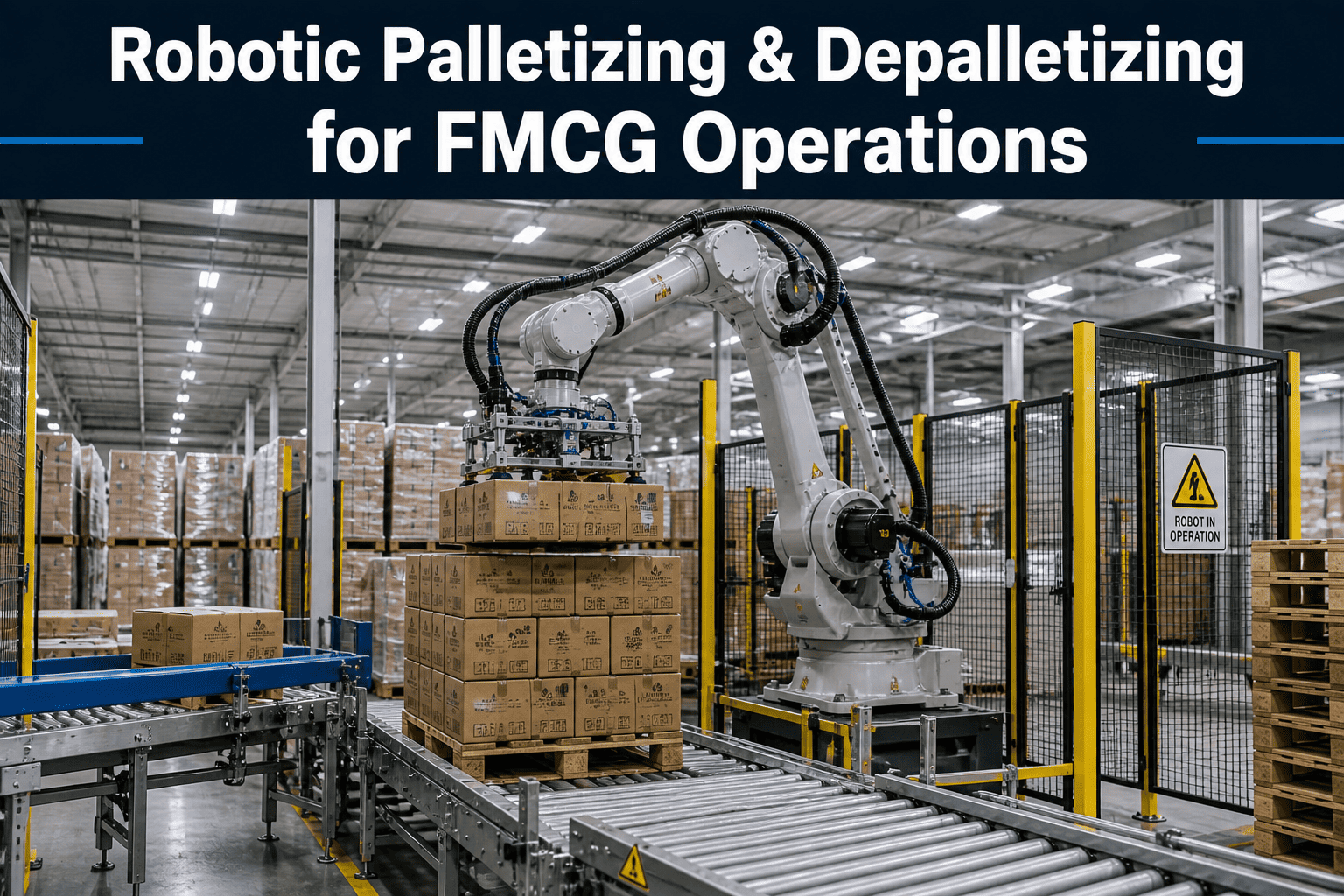
A robotic palletizer running 60 cases per minute moves 3,600 cases per hour. Every hour it sits down, a mid-size FMCG plant loses roughly $14K in delayed shipment value, plus the labor cost of manual recovery stacking.
The pain compounds because end-of-line assets are usually the last to get maintenance attention. Production scheduling prioritizes the filler, the capper, the labeler — the palletizer is treated as "it just stacks." But when the palletizer drops, every upstream asset becomes a buffer that fills in minutes. Most plants discover this at 2 a.m. on a Saturday, when the on-call tech is 40 minutes away and the CMMS has no current spare-parts list for the gripper.
A regional beverage plant running two robotic palletizers at 55 cpm each spent $42K/yr on reactive gripper repairs and lost 312 production hours to layer-forming faults. After implementing a CMMS-driven PM schedule — weekly gripper inspection, monthly layer-pattern calibration, quarterly stretch-wrapper film-track service — unplanned downtime dropped 61% in the first year and spare-parts spend fell to $9K.
Palletizer PM Checklist
The Four-Layer Maintenance Program
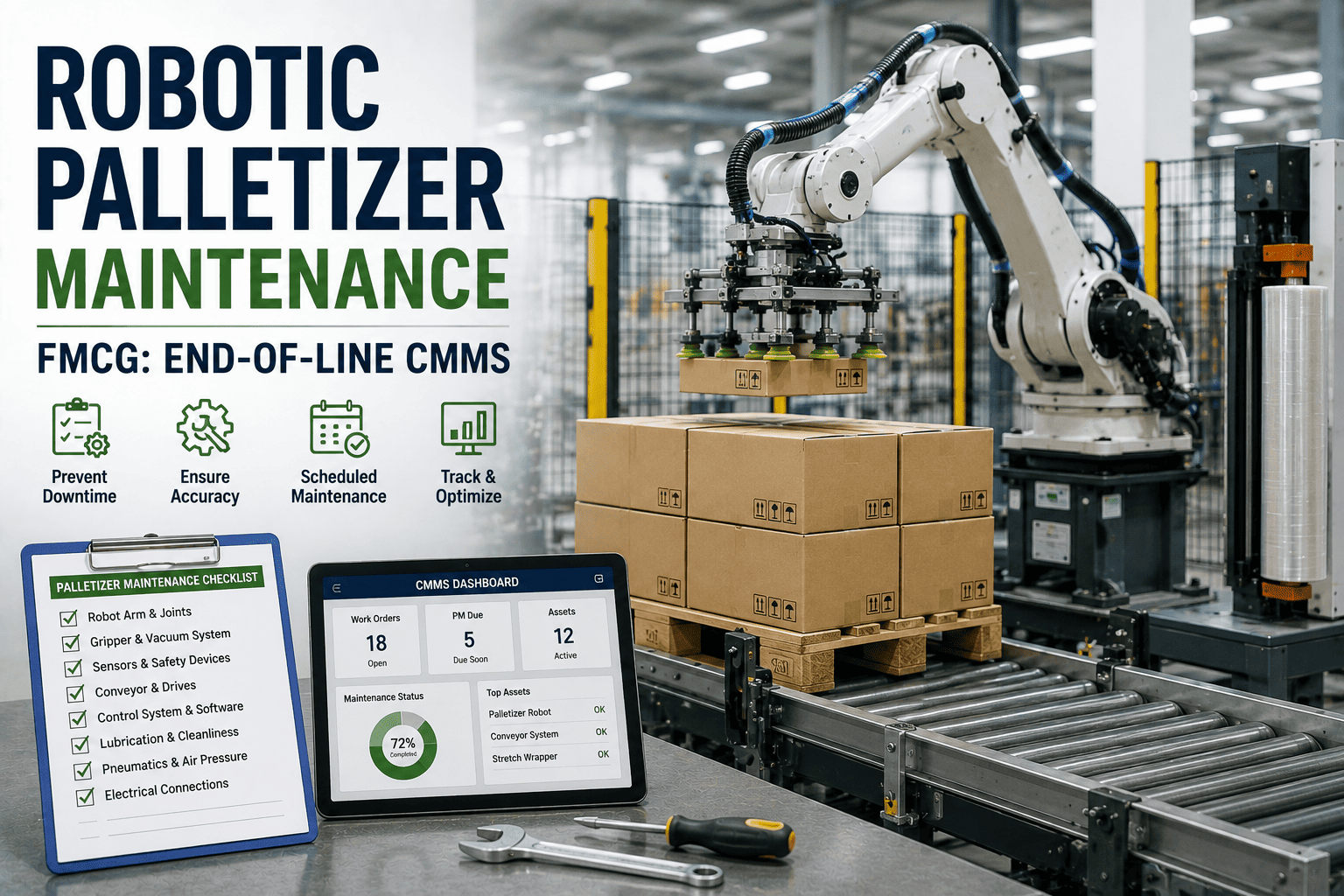
A defensible robotic palletizer PM program covers four asset layers: the robot itself, the gripper head, the layer-forming station, and the stretch wrapper. Each has its own failure signature and its own interval.
Robot Axis & Base
- Grease axis 1–4 per OEM hour-meter schedule (typically every 4,000 hrs)
- Check axis backlash and repeatability within ±0.1 mm
- Inspect cable harness, energy chain, and encoder feedback
- Verify controller cabinet cooling fans and filter condition
Gripper Head Service
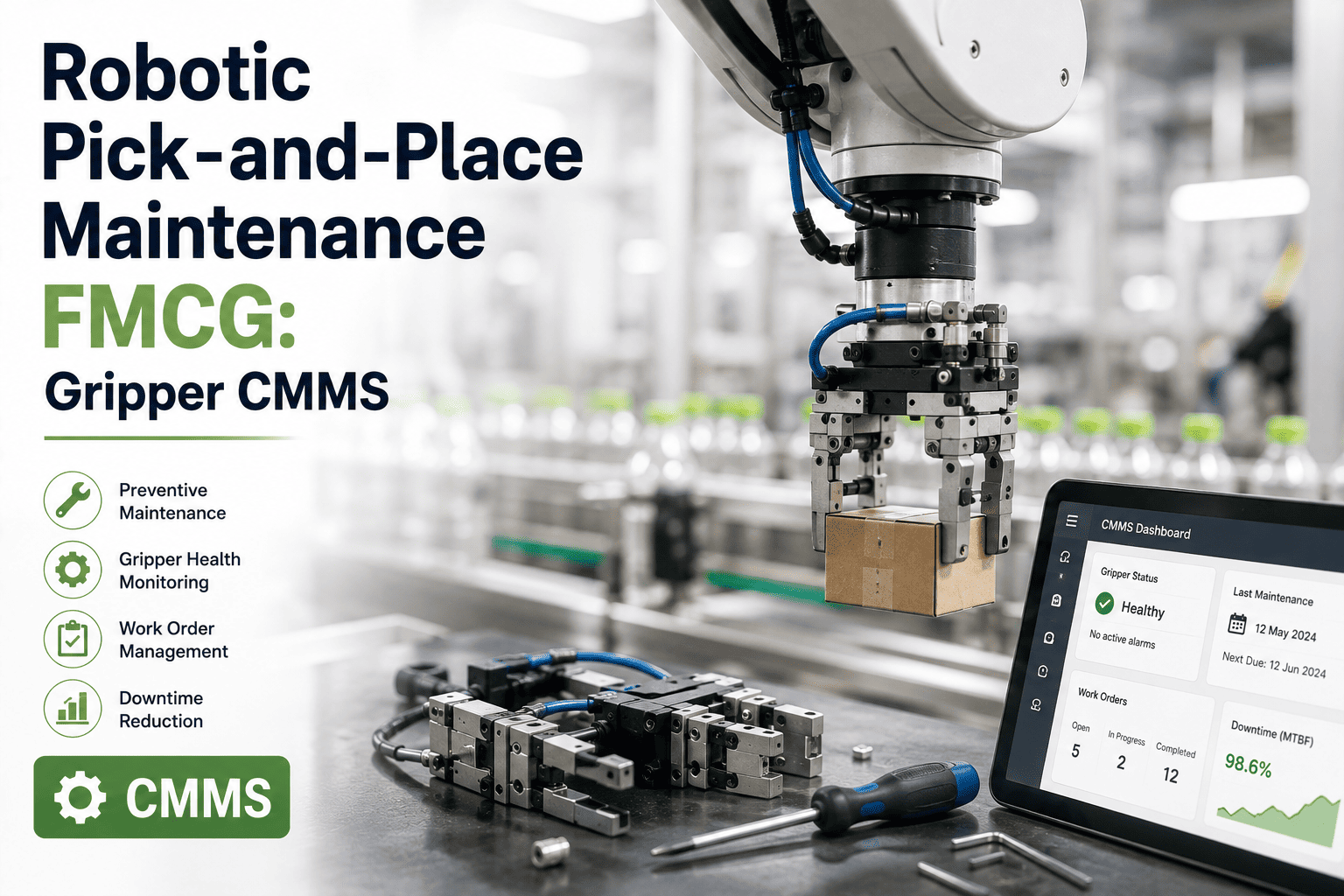
- Inspect suction cups / mechanical fingers for wear and cracks
- Test vacuum generator pressure (target −0.6 to −0.8 bar)
- Check tool changer alignment and locking-pin engagement
- Replace pneumatic lines showing hardness or abrasion
Layer Forming & Pallet Feed
- Verify layer pattern accuracy against recipe (±5 mm tolerance)
- Inspect pallet dispenser stack sensors and separation forks
- Check slip-sheet magazine feed and sheet squareness
- Calibrate case infeed photo-eyes and reject pusher travel
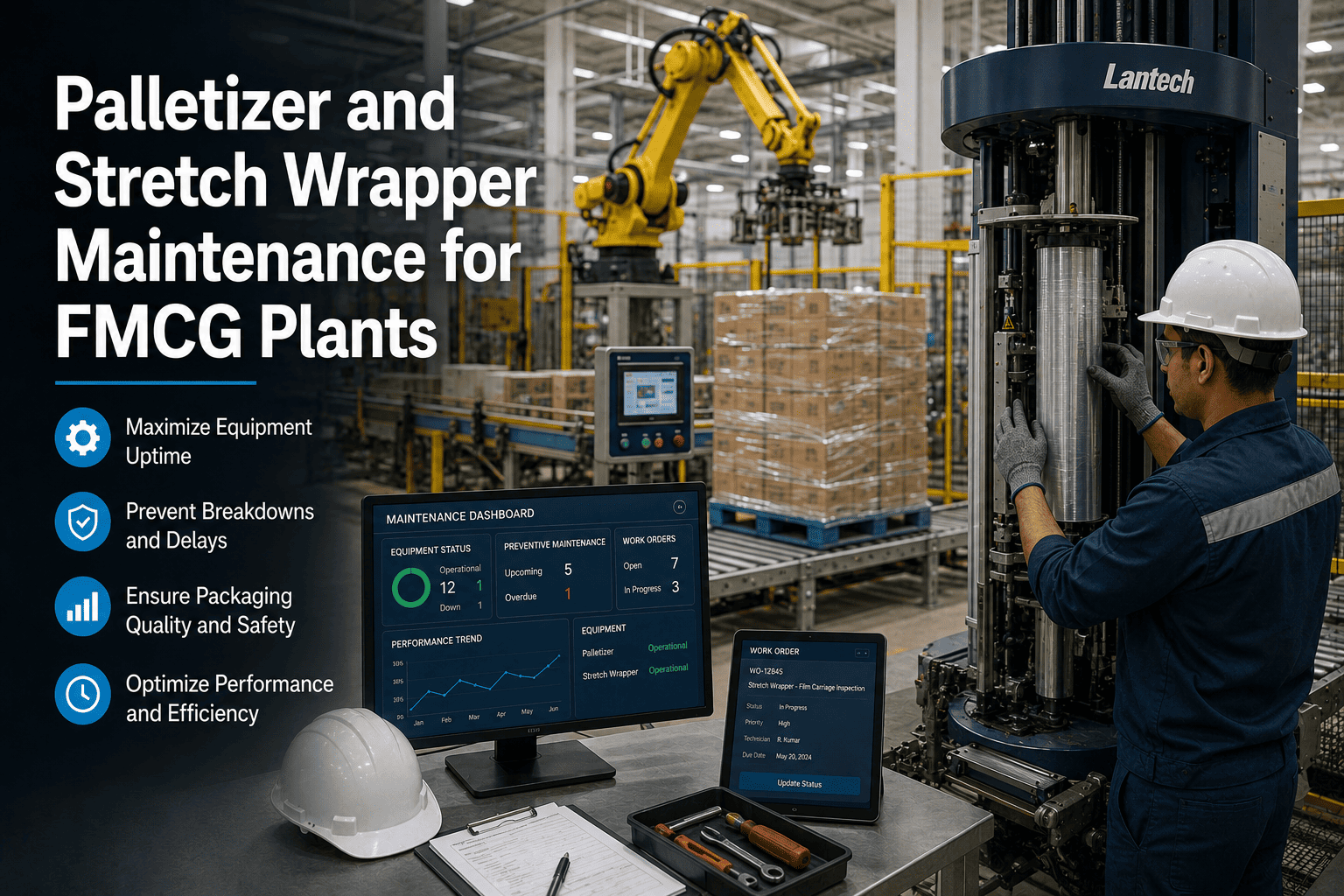
Stretch Wrapper PM
- Clean film carriage rollers and check rotation speed consistency
- Inspect turntable drive chain tension and wear (max 1.5% elongation)
- Verify film tension pre-stretch ratio (target 200–250%)
- Test film clamp / cut mechanism cycle time and blade condition
PM Intervals At a Glance
The Palletizer PM Cadence Table
Every task below belongs in the CMMS with a trigger — runtime hours, cycles, or calendar days — so nothing depends on memory. These intervals reflect typical FMCG two-shift operation; adjust for your actual duty cycle.
| Asset Layer | Task | Interval | Typical Duration | Risk If Skipped |
|---|---|---|---|---|
| Robot Axis | Lubricate gearboxes, check backlash | 4,000 run-hrs | 90 min | Axis drift, position faults |
| Gripper Head | Vacuum test, cup/finger inspect | Weekly | 25 min | Dropped cases, product damage |
| Layer Former | Pattern calibration, sensor clean | Monthly | 45 min | Unstable loads, rework |
| Pallet Dispenser | Fork alignment, magazine sweep | Bi-weekly | 20 min | Mis-feeds, line starve |
| Stretch Wrapper | Carriage clean, chain tension | Quarterly | 60 min | Film breaks, load shift in transit |
| Full Cell | Safety interlock & light curtain test | Monthly | 30 min | Compliance violation, injury |
The Cost Equation
What a CMMS Actually Saves on a Palletizer Cell
The math is simple — and brutal when you run it. Compare the annual reactive cost of a single palletizer cell against the cost of running a disciplined CMMS-driven PM program for the same asset.
Lost production value + emergency repair spend on a two-palletizer FMCG cell running without scheduled PM.
Same cell after CMMS-driven PM: 61% less downtime, predictable parts spend, no emergency call-outs.
The numbers above assume a two-shift FMCG operation. Single-shift plants see proportionally smaller absolute savings but similar percentage gains because the ratio of avoided downtime to PM labor holds steady. The key insight is that payback comes from avoided production loss, not from reduced maintenance spend — a disciplined PM program actually costs slightly more in planned labor than a reactive one, but it saves multiples of that in recovered throughput.
CMMS Build Sequence
Standing Up the Palletizer Reliability Program in 90 Days
A CMMS rollout for end-of-line palletizing should be scoped, asset-bounded, and measured — not a plant-wide mega-project. This 90-day sequence gets a single palletizer cell live and reporting within one quarter.
Days 1–30 · Asset & Criticality
Register every palletizer, layer former, pallet dispenser, and stretch wrapper in the CMMS. Assign criticality (A/B/C) based on downstream impact and historical downtime. Upload OEM manuals, electrical drawings, and current spare-parts BOMs for each asset.
Days 31–60 · PM Schedules
Build PM triggers using runtime hours, cycle counts, and calendar days — not memory. Load the four-layer checklist (robot, gripper, layer former, wrapper) with assigned technicians, estimated durations, and required parts. Set escalation rules for missed PMs.
Days 61–90 · KPIs & Review
Activate dashboards tracking MTBF, MTTR, PM compliance %, and palletizer OEE. Run weekly reliability huddles using CMMS data. Compare actual downtime against the 90-day baseline and adjust PM intervals based on failure-mode evidence.
Stop Losing Lines to Palletizer Faults
Configure your end-of-line PM schedules, spare-parts BOMs, and KPI dashboards in Oxmaint — built for FMCG maintenance teams that cannot afford a single-point-of-failure stop.
Frequently Asked
Robotic Palletizer Maintenance FAQs
How often should gripper suction cups be replaced on an FMCG palletizer?
In a two-shift operation moving 60 cpm, suction cups typically need replacement every 4–6 weeks. Inspect weekly for hardness, cracks, or lip deformation, and replace immediately if vacuum test drops below −0.5 bar. A CMMS with cycle-count triggers catches this automatically sign up to automate it.
What MTBF should a well-maintained robotic palletizer achieve?
A disciplined FMCG palletizer cell running a tiered PM program should target MTBF of 400+ operating hours, with overall palletizer OEE above 92%. Plants without scheduled PM typically see MTBF of 120–180 hours and OEE in the low 80s due to recurring gripper and layer-forming faults.
Can a CMMS track layer-pattern accuracy automatically?
The CMMS tracks the inspection result and triggers the calibration task. Technicians log the measured pattern deviation (in mm) against the recipe tolerance during each monthly check. When deviation trends upward across consecutive PMs, the CMMS flags the asset for engineering review before a quality escape reaches the warehouse.
What is the single highest-impact PM task for stretch wrapper reliability?
Cleaning and inspecting the film carriage rollers. Dust, film residue, and stretched-wrap fragments build up on the rollers within weeks, causing inconsistent film tension and mid-cycle film breaks. A 15-minute bi-weekly carriage clean prevents roughly 40% of stretch-wrapper faults and protects load stability in transit.
How long does it take to implement a CMMS for a palletizer cell?
A focused implementation for a single palletizer cell — asset registration, PM schedules, spare-parts BOMs, and KPI dashboards — takes 30 to 90 days depending on documentation quality. Book a demo to scope a 90-day rollout tailored to your end-of-line assets.
Build Your Palletizer Reliability Program Today
Join FMCG maintenance teams using Oxmaint to keep end-of-line throughput matched to production — every shift, every pallet.
Free 14-day trial · No credit card