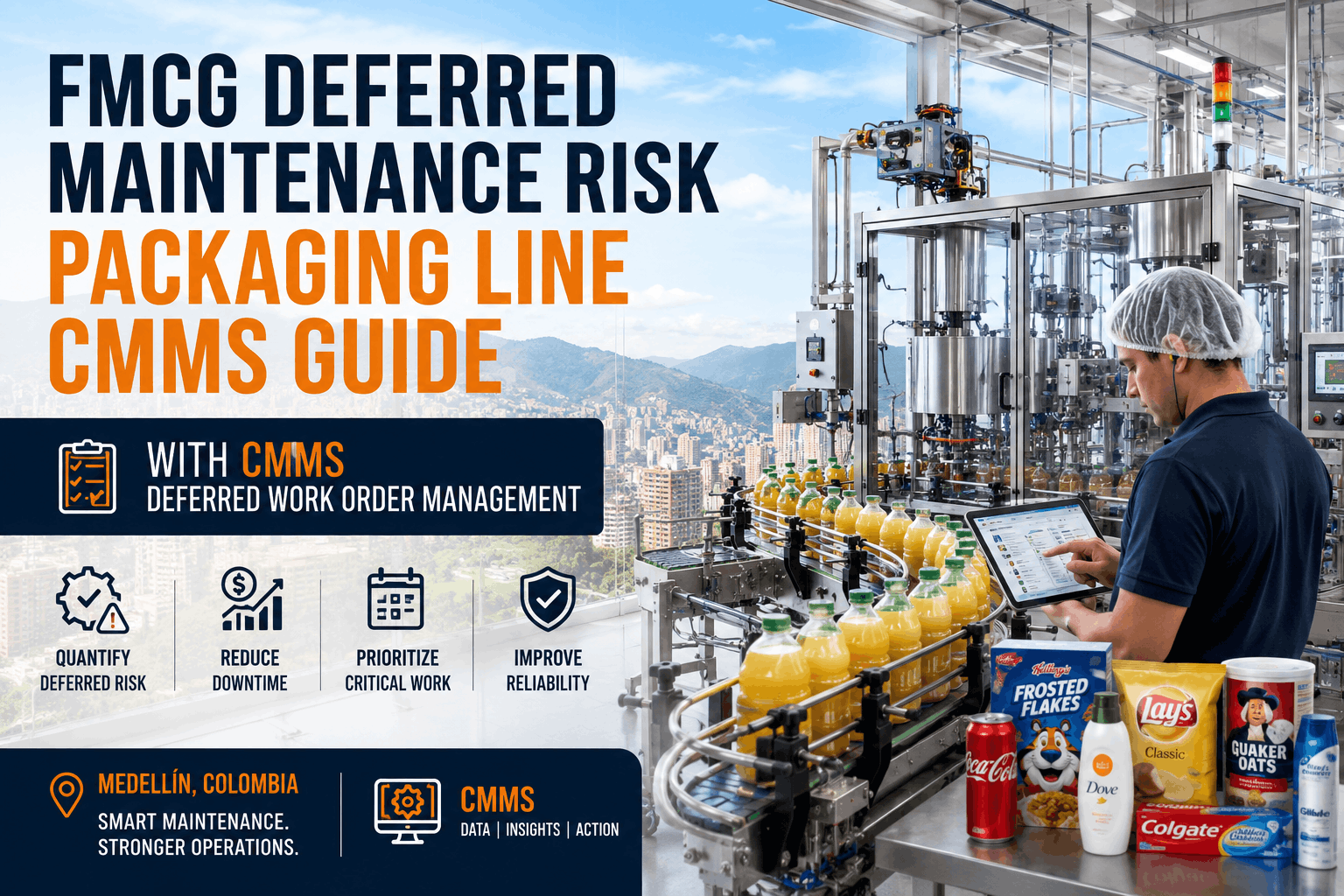
Deferred maintenance is the silent risk that destroys FMCG plant reliability. A filling head wear deferral that costs $1,200 to address proactively costs $48,000 in emergency repair, expedited parts, and lost production when it catastrophically fails mid-shift. A conveyor splice degradation that could have been replaced during scheduled maintenance costs $62,000 in emergency replacement with premium labor rates when it breaks during high-speed production. FMCG plants manage cash flow by deferring maintenance tasks: "We'll do the gearbox rebuild next quarter," or "The motor bearing can wait until the next planned shutdown." That strategy is financially rational on a spreadsheet until the quantified maintenance backlog exceeds 15–20% of annual revenue—at which point the risk of simultaneous failures across multiple assets threatens facility shutdown. OxMaint's deferred maintenance quantification module helps FMCG plant managers visualize maintenance debt, calculate failure probability windows, and make data-driven decisions about which deferrals can wait and which require immediate funding. By connecting deferred tasks to OEE impact and failure cost modeling, plant managers can justify maintenance budget increases to finance leadership with documented ROI evidence instead of maintenance department pleas.
FMCG Deferred Maintenance Risk: Packaging Line CMMS Guide & Cost Quantification
How to quantify deferred maintenance risk in FMCG plants: filling head wear deferral cost analysis, conveyor splice degradation risk modeling, motor bearing replacement windows, and CMMS-based maintenance backlog tracking. Prevent catastrophic failures by making deferred maintenance decisions with full visibility into failure probability, repair cost escalation, and production impact. Transform maintenance backlog from hidden risk into managed asset, prioritize funding based on data, justify emergency repairs vs. planned maintenance to finance leadership with documented evidence of cost avoidance.
Understanding Deferred Maintenance: The Hidden Debt Destroying FMCG Facility Reliability
Deferred maintenance is any planned maintenance task scheduled but not yet executed beyond its ideal window. A motor bearing scheduled for replacement every 18 months that is still running at month 26 is deferred—still functional but operating in degraded condition. A filling head that should be cleaned and wear-checked monthly but is checked only quarterly is deferred by two cleaning cycles. A gearbox that needs synthetic oil change every 12 months but is still running on 18-month-old oil is deferred—technically still lubricated but with reduced film strength and increasing wear rate. For individual tasks, deferral periods measured in weeks or months create minimal risk. For FMCG plants with 200–400 production assets and 50+ critical maintenance tasks per month, accumulated deferrals create systemic risk. If 15–20% of planned maintenance across your portfolio is deferred (which represents typical paper-based or spreadsheet-managed plants), you have created a hidden reliability debt. The mathematics of equipment wear are non-linear: a component operating 20% beyond ideal maintenance interval experiences 40–60% accelerated wear progression. That accelerated wear compounds across multiple deferrals simultaneously. When cash flow pressure causes deferrals of gearbox maintenance, motor bearing replacement, and conveyor splice inspection at the same time, the probability of simultaneous failures increases exponentially. One failing bearing or gearbox stops production for 4–6 hours at a cost of $5,000–$15,000 per hour in lost throughput. Two failures in the same week forces facility shutdown for 12–24 hours. Three simultaneous failures across different production lines can mean week-long closure. FMCG facilities most vulnerable to deferred maintenance risk are those with: paper-based work order systems with no central backlog visibility, no formal prioritization of overdue tasks, maintenance budgets insufficient for both planned and emergency repairs, high production utilization (85%+ of rated capacity) leaving no margin for equipment failure, and aging equipment approaching end-of-life with accelerating failure rates. OxMaint's deferred maintenance module makes maintenance backlog visible, quantifies failure risk, calculates cost escalation windows, and helps plant managers make data-driven deferral decisions—distinguishing "this can wait another quarter" from "this will fail in 60 days if we don't act."
Filling Head Wear Deferral Case Study: $48,000 Cost Escalation from Proactive to Emergency
A bottling FMCG plant in Maharashtra operates five parallel filling lines, each with 16-head filling nozzle cartridges. Filling heads require wear inspection every 60 days and replacement of worn cartridges every 12 months or 15 million doses filled, whichever comes first. Line 3's filling head inspection was scheduled for May 2026 ($1,200 cost, 2-hour changeover during scheduled line shutdown). Cash flow was tight in Q2; the filling head inspection was deferred to July. By late July, Line 3 operators noticed slight fill inconsistency (±2ml variation in fill volume). Maintenance technician visually inspected cartridges and found three of 16 worn (nozzle orifice erosion from abrasive product interaction). At this point, replacement could still be scheduled during next planned maintenance (August shutdown)—cost remained $1,200, timeline moved from May to August. Finance deferred approval, planning to execute in September. In early September, one worn cartridge failed catastrophically during mid-shift production: seal degraded to point of internal valve leakage, filling pressure spiked, cartridge cracked under 80 PSI. Line 3 stopped unplanned at 11 AM Wednesday. Emergency parts were ordered (overnight expedited shipping from supplier: +$800 premium). Technician was called in on emergency overtime (6 hours at 1.5x rate: +$600 labor premium). Equipment replacement and pressure testing took 4 hours, adding 2 hours of production loss beyond the 4-hour repair window. By time Line 3 restarted Thursday morning, 8 hours of downtime had accumulated. Lost production (600 cases/hour x 8 hours) = 4,800 cases = $38,000 retail value. Total emergency cost: $1,200 repair + $800 expedited parts + $600 overtime + $38,000 lost throughput + $300 product waste = $40,900. The deferred task ($1,200 proactive cost in May) would have prevented $40,900 in emergency costs. Cost escalation: 34x. If Line 3 had been caught with all five lines down simultaneously (common in closely-timed equipment failures when deferred maintenance compiles), emergency repair would have included facility shutdown, cascading into 24–48 hour downtime, production delay recovery, and customer penalty payments. Conservative estimate for multi-line failure: $62,000–$128,000. Schedule a consultation to assess deferred maintenance risk in your FMCG packaging lines and model cost avoidance from proactive approach.
Maintenance Backlog Quantification: OxMaint Risk Scoring & Prioritization
FMCG plants using OxMaint can visualize their complete maintenance backlog by deferral age, assigned failure risk probability, and cost escalation multiplier. The platform calculates each deferred task's financial impact if it fails versus the cost to execute proactively. Risk Score = (Deferral Age / Ideal Interval) × Failure Probability × Cost Multiplier × Asset Criticality. A task with Medium deferral age (1–3 months), 25% failure probability, 2x cost escalation, and critical asset status receives higher prioritization than a task with Low deferral age, 5% failure probability, 1.2x cost multiplier, and non-critical asset status. The backlog report shows: list of all deferred tasks ranked by risk score (highest risk top), asset name and failure mode for each deferral, days overdue and projected failure window for each task, cost escalation multiplier (proactive cost vs. emergency cost), estimated production impact if equipment fails (throughput loss per hour, revenue impact), and recommended action window (immediate, 2 weeks, 1 month, next quarter). Finance leaders can see total maintenance backlog risk as a single number: "This plant has $480,000 in deferred maintenance with $1.2M potential failure cost exposure if all high-risk tasks fail." That visibility justifies emergency maintenance budget increases. Plant managers can make data-driven deferral decisions: "If we fund these three high-risk tasks this month ($12K), we avoid $47K in potential emergency costs. It's a 3.9x ROI." Deferred task tracking with quantified risk eliminates the maintenance department's reliance on anecdotal arguments and positions maintenance spending as financial risk management.
FMCG Deferred Maintenance Risk FAQ
"Before OxMaint, we had $180K in deferred maintenance tasks we didn't even know about. The CMMS backlog report showed we had three critical tasks 6+ months overdue with $420K potential failure cost if they all failed simultaneously. That report got finance to approve emergency maintenance budget. We executed the three critical deferrals, avoided a major line failure, and started tracking backlog monthly. Visibility changes behavior."
— Anil Kumar, Plant Manager, FMCG Snacks Manufacturing, Karnataka
Quantify Your Deferred Maintenance Risk & Prevent Catastrophic Failures
OxMaint makes maintenance backlog visible, quantifies failure risk by task, calculates cost escalation multipliers, and prioritizes deferrals by financial impact. Transform deferred maintenance from hidden risk into managed asset. Justify emergency budget increases to finance with documented ROI. Prevent $40K–$128K emergency repairs by executing $1K–$6K proactive maintenance. Deploy in 48 hours, see your complete backlog risk profile immediately.