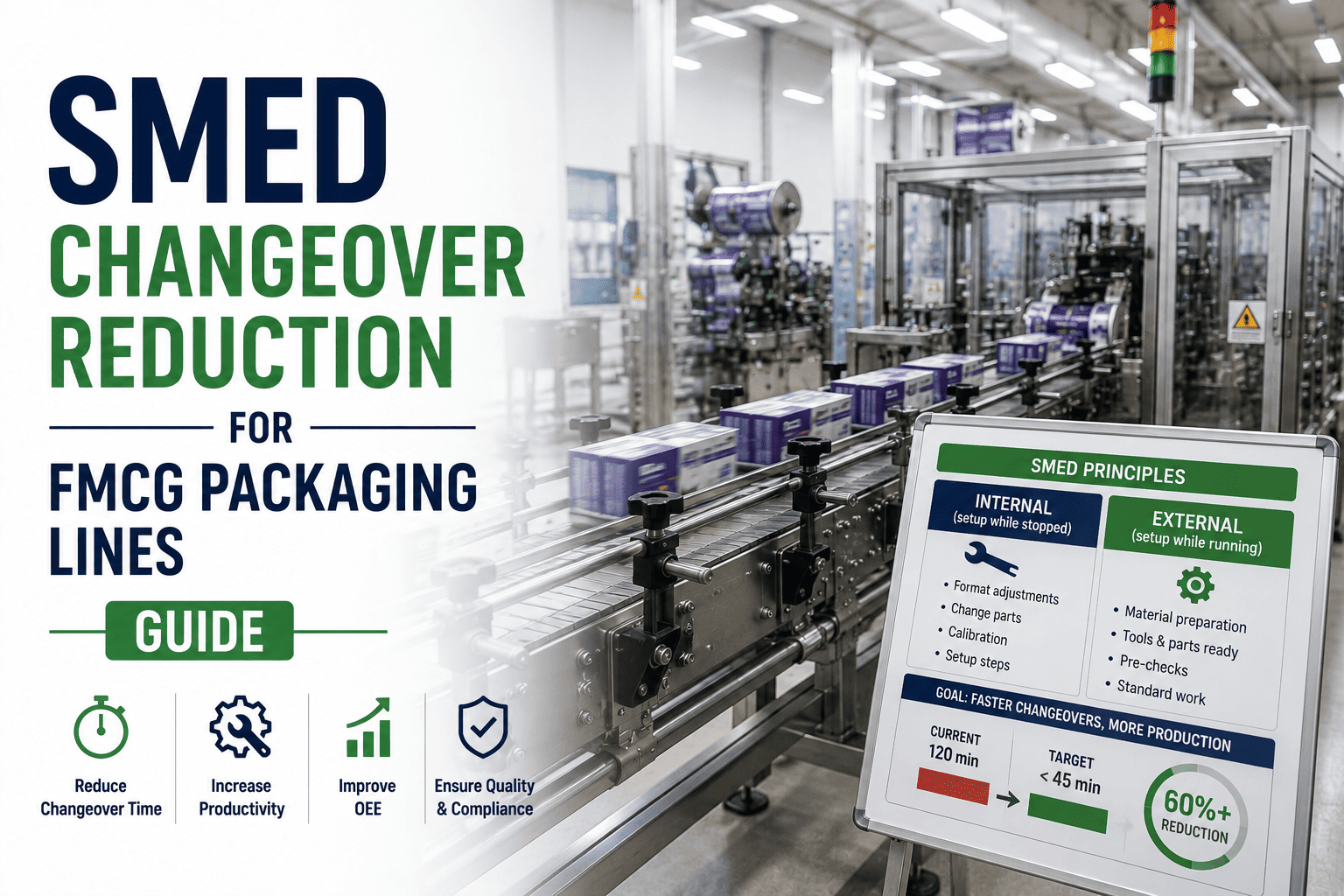
A beverage plant running 8 SKU changeovers per day at 45 minutes each loses 6 hours of production time daily — 2,190 hours per year, worth $1.3M–$2.6M in lost output at $600–$1,200/hr line value. The changeover itself is not the problem. The problem is that 60–70% of changeover time consists of tasks that could be performed while the line is still running but are not — because nobody has separated internal tasks from external tasks, nobody has standardized the sequence, and nobody has measured where the time actually goes. SMED (Single-Minute Exchange of Die) is the proven methodology that makes this separation, and when combined with cobot-assisted automation for repetitive physical tasks, FMCG plants consistently cut changeover times by 50–70% within 90 days. This guide provides the step-by-step framework, the measurement system, and the robotics integration path for FMCG packaging and filling lines. Start your free trial to track changeover times per line and per SKU transition. Book a demo to see OxMaint's Changeover and Setup Time Tracking module in action.
Changeover & Setup Time Tracking
Measure Every Changeover. Find the Waste. Cut It in Half.
OxMaint tracks changeover duration per line, per SKU transition, and per operator — revealing exactly where time hides and which improvements deliver the biggest gains.
60–70%
of changeover time is external work done while line is stopped — pure waste
50–70%
changeover time reduction achievable with SMED + cobot automation
$1.3M–$2.6M
annual production value recoverable from changeover optimization
Why Changeover Time Is the Biggest Hidden OEE Loss in FMCG
FMCG plants obsess over unplanned downtime — and rightly so. But changeover time is the planned downtime that nobody optimizes. On a line running 8 changeovers per day at 45 minutes each, changeover consumes 25% of available production time. That is not downtime from failure — it is downtime by design. And unlike unplanned downtime, changeover time is entirely within your control to reduce.
Waiting for parts, tools, and materials
12 min
External
Walking to storeroom / searching for tooling
8 min
External
Reading changeover instructions / asking colleagues
5 min
External
Adjustments, trial runs, and fine-tuning
10 min
Reducible
Actual mechanical changeover (the real work)
10 min
Internal
The data is remarkably consistent across FMCG plants: only 20–25% of changeover time is actual mechanical work that requires the line to be stopped. The other 75–80% is preparation, searching, waiting, adjusting, and trial-running — all of which can be eliminated, moved to external time, or reduced through standardization. SMED provides the framework. Measurement provides the visibility. Robotics provides the acceleration.
SMED in 4 Steps: The Methodology That Cuts Changeovers in Half
SMED (Single-Minute Exchange of Die) was developed by Shigeo Shingo at Toyota and has been adapted for FMCG packaging and filling lines worldwide. The methodology is deceptively simple — four steps that systematically convert internal time to external time, then compress what remains.
Film and Timestamp Every Task
Video-record 3–5 complete changeovers on the target line. Timestamp every task to the second. Categorize each task as internal (line must be stopped) or external (can be done while running). Most teams are shocked to find 55–70% of tasks are external but performed during line-stop time.
Output: Changeover task map with internal/external classification
Move All External Tasks Before Line Stops
Every task classified as external gets moved to pre-changeover preparation: tools staged, parts kitted, next-format tooling pre-assembled, changeover instructions printed. Nothing that can be done while the line runs should happen after the line stops. This single step typically reduces changeover time 30–50%.
Impact: 30–50% time reduction with zero investment
Convert Internal Tasks to External Where Possible
Challenge every remaining internal task: can it be done externally with a fixture, a pre-set tool, or a parallel operation? Pre-heating molds, pre-setting torque values on spare chuck sets, pre-loading label rolls on a spare unwind shaft — each conversion removes internal time permanently.
Impact: Additional 10–20% reduction through engineering solutions
Eliminate Adjustments and Standardize the Sequence
Replace adjustment-based settings with fixed-position stops, calibrated marks, and recipe-driven automation. Standardize the changeover sequence so every operator follows the same steps in the same order. Eliminate trial runs through precision setup. This is where cobots add the most value — performing the standardized physical sequence faster and more consistently than manual execution.
Impact: Additional 10–20% reduction through precision and automation
The cumulative effect of all four steps: a 45-minute changeover drops to 12–18 minutes. The fastest FMCG plants achieve sub-10-minute changeovers on packaging lines that previously took 40+ minutes — and they do it without replacing equipment, without capital investment in the first two steps, and with cobot assistance only in the fourth step where the ROI is proven.
Track Every Step
You Cannot Reduce What You Do Not Measure
OxMaint timestamps every changeover start, stop, and phase — per line, per SKU transition, per operator. The data reveals which transitions are slowest, which operators are fastest, and which steps consume the most time.
Before and After: SMED Impact on FMCG Changeover Metrics
These metrics are measured across FMCG packaging and filling lines before and after SMED implementation — showing the transformation at each stage of the methodology.
Average changeover time
42 minutes
14 minutes
Changeover time variability (std dev)
±18 minutes
±3 minutes
First-hour reject rate after changeover
4.2%
0.8%
SKU transitions possible per shift
3–4 transitions
8–12 transitions
Annual production time recovered
Baseline
+1,400 hours/yr
OEE Availability component
74%
89%
The most valuable metric is not changeover duration — it is changeover variability. A 42-minute changeover with ±18 minutes of variability makes production scheduling impossible. A 14-minute changeover with ±3 minutes of variability makes scheduling precise. That consistency is what enables FMCG plants to increase SKU flexibility from 3–4 transitions per shift to 8–12 — responding to retailer demand for variety packs, promotional formats, and seasonal SKUs without sacrificing throughput.
Where Cobots Accelerate SMED: The Five Highest-ROI Applications
Cobots do not replace the SMED methodology — they accelerate Step 4 (Streamline) by performing standardized physical tasks faster and more consistently than manual execution. These five applications deliver the highest ROI for cobot-assisted changeovers in FMCG.
01
Format Part Swaps
Cobot picks pre-staged format parts (guide rails, starwheels, filling heads) from a changeover cart and installs them in sequence. Torque-controlled fastening ensures consistent setup without adjustment.
Saves 6–10 min per changeover
02
Label Roll Loading
Cobot loads pre-wound label rolls onto the unwind shaft, threads the web through the label path, and verifies registration mark alignment — eliminating the most skill-dependent manual task in labeler changeovers.
Saves 4–8 min per changeover
03
Recipe-Driven Parameter Setting
Cobot connected to PLC loads the new SKU recipe, verifies critical parameters (fill volume, torque target, label position), and confirms settings match the master recipe before production resumes.
Eliminates trial runs — saves 5–10 min
04
First-Article Verification
AI vision on cobot arm inspects first 5 units after changeover — checking label position, fill level, cap torque, and print quality. Automated pass/fail replaces manual sampling and subjective judgment.
Reduces first-hour rejects by 80%
05
Cleaning Verification
For allergen changeovers, cobot with UV fluorescence camera inspects all food-contact surfaces and documents clearance — replacing the slowest, most compliance-critical manual task in allergen changeover protocols.
Saves 8–15 min on allergen changeovers
The Economics: What Faster Changeovers Are Worth
Changeover reduction ROI is calculated from three sources: recovered production time, reduced scrap from first-hour rejects, and increased scheduling flexibility that enables higher-margin SKU mixes.
Recovered production time
$840K/yr
First-hour scrap reduction
$175K/yr
SKU flexibility margin gain
$250K/yr
Labor efficiency improvement
$85K/yr
SMED implementation + cobot (1 line)$65,000
Annual value delivered$1.35M
21x ROI — SMED Steps 1–3 Cost Zero. Payback on Cobot: Under 3 Months.
The critical financial insight: SMED Steps 1–3 (Observe, Separate, Convert) require zero capital investment — only time, video recording, and disciplined implementation. These steps alone deliver 30–50% changeover reduction. The cobot investment in Step 4 adds another 20–30% reduction on top of the free gains, with payback in under 3 months from recovered production time alone.
Implementation: 90-Day Changeover Transformation
Week 1–2
Baseline: Film and Measure 5 Changeovers
Video-record 5 complete changeovers on your highest-frequency line. Timestamp every task. Calculate current average time, variability, and internal vs external split. Enter baselines into OxMaint for tracking.
Week 3–4
SMED Step 2: Separate External Tasks
Move all external tasks to pre-changeover preparation. Build changeover kits (tools + parts + instructions in one cart). Create standardized pre-changeover checklist in CMMS. Typical result: 30–40% reduction from this step alone.
Week 5–8
SMED Steps 3–4: Convert and Streamline
Engineer internal-to-external conversions (pre-set tooling, parallel operations). Standardize the changeover sequence and eliminate adjustments with fixed-position stops. Deploy cobot on highest-value physical tasks if ROI is proven.
Week 9–12
Sustain: Weekly Changeover Reviews
Track every changeover in CMMS with duration, operator, and SKU transition logged. Weekly review of slowest changeovers with root cause. Set targets per transition type. Changeover time becomes a managed KPI, not an accepted loss.
Frequently Asked Questions
Changeover & Setup Time Tracking
Every Changeover Measured. Every Minute Accounted For. Every Gain Sustained.
50–70%
changeover reduction
$1.35M
annual value recovered
90 Days
to full transformation
Trusted by FMCG production and maintenance teams optimizing changeover performance. No credit card required.