Best FMCG Production Line Robotics for Maximum Throughput in 2026

By Oxmaint on February 13, 2026

best-fmcg-production-line-robotics-for-maximum-throughput-in-2026

A single unplanned stop on a high-speed FMCG packaging line costs between $5,000 and $15,000 per hour in lost output, wasted materials, and recovery labor. Multiply that across 14 robotic cells running three shifts, and the math becomes existential. The best FMCG production line robotics in 2026 aren't just faster—they're designed for maintainability, integrated with OEE analytics software, and built to sustain 95%+ availability across millions of cycles. Consumer goods automation trends are converging around a single truth: throughput without reliability is just expensive motion. This guide breaks down the robotic technologies, maintenance strategies, and analytics frameworks that leading FMCG manufacturers are deploying to maximize throughput while keeping unplanned downtime below 2%. Schedule a consultation to explore how OEE-driven maintenance programs can protect your robotic investment and production targets.

Why Robotics Dominates FMCG Production in 2026

The FMCG sector faces a convergence of pressures that make advanced robotics inevitable: labor shortages exceeding 35% in skilled manufacturing roles, SKU proliferation demanding flexible changeovers, and retailer demands for same-day fulfillment accuracy above 99.5%. Manual and semi-automated lines simply cannot meet these requirements at the speeds and consistency modern supply chains demand. The shift to high-speed pick and place robotics, vision-guided palletizing, and collaborative packaging cells is accelerating—but only organizations that pair robotic deployment with disciplined preventive maintenance for industrial robots capture the full throughput potential.

The FMCG Robotics Imperative: 2026 Market Snapshot
$18.7B
Global FMCG robotics market projected for 2026—driven by packaging automation, palletizing, and high-speed pick-and-place applications across food, beverage, and personal care
1,200+
Picks per minute achievable with latest delta robot configurations—3x faster than manual operations with 99.8% placement accuracy at sustained production speeds
37%
Average OEE improvement when robotic cells are paired with real-time analytics and condition-based maintenance—versus calendar-based PM schedules alone
2.1%
Unplanned downtime benchmark for top-quartile FMCG robotic operations—achieved through predictive maintenance, OEE analytics integration, and automated spare parts management
Want to see how OEE analytics connects to your robotic cells? Request a demo to walk through real-time availability, performance, and quality tracking built for high-speed FMCG production lines.
Request Demo

Top FMCG Production Line Robotics Categories for 2026

Not all robotics deliver equal throughput impact. The best FMCG production line robotics in 2026 fall into distinct categories—each optimized for specific production stages, speed requirements, and product handling characteristics. Selecting the right robotic architecture for each application is the first decision; maintaining it for sustained peak performance is the ongoing challenge that separates leaders from the pack.

Robotic Categories Driving FMCG Throughput in 2026
High-Speed Delta Robots (Pick & Place)
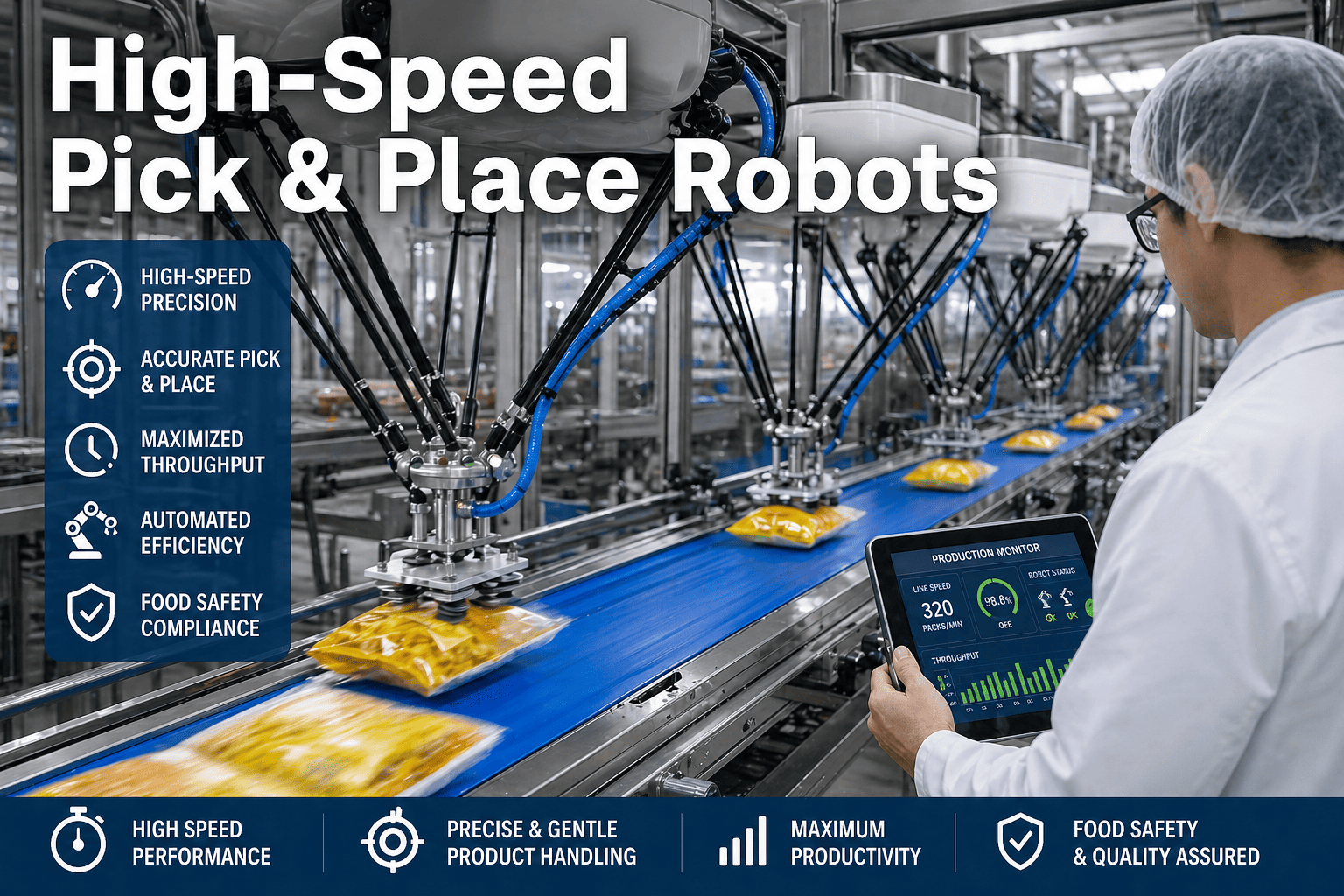
Overhead-mounted delta robots dominate primary and secondary packaging—handling individual products at 80-200+ picks per minute per robot. Vision-guided systems identify product orientation on moving conveyors and place with sub-millimeter accuracy. Key maintenance concerns: belt tension, timing belt wear, servo motor brushes, and vision camera calibration drift over millions of cycles.

Articulated Arm Robots (Palletizing & Case Packing)
Six-axis articulated robots handle end-of-line palletizing, case erecting, and heavy payload manipulation. Modern robotic palletizing systems achieve 30-40 cases per minute with payloads up to 250 kg. Critical maintenance requirements include gearbox lubrication intervals, joint bearing monitoring, cable harness fatigue tracking, and end-of-arm tooling (EOAT) calibration to prevent product damage.

Collaborative Robots (Flexible Packaging & Inspection)
Cobots work alongside human operators in mixed environments—handling label application, quality inspection, tray loading, and variety pack assembly where changeover flexibility outweighs raw speed. Lighter payloads (5-25 kg) and lower speeds mean different maintenance profiles: software updates, force-torque sensor calibration, and safety system verification dominate PM schedules.

Autonomous Mobile Robots (Material Transport)
AMRs replace fixed conveyor infrastructure for inter-process material movement—delivering raw materials to production cells, moving WIP between stages, and transporting finished goods to palletizing stations. Fleet management, battery health monitoring, navigation sensor cleaning, and wheel/drive maintenance are the primary uptime drivers for these increasingly critical material flow assets.

Vision-Guided Robotic Systems
2D and 3D machine vision integrated with robotic cells enables dynamic product recognition, defect detection, and adaptive placement on moving lines. Vision system performance directly impacts robotic cycle times and quality rates. Maintenance priorities include camera lens cleaning schedules, lighting consistency checks, calibration verification, and software model updates as product variations change.

Robotic Cartoning & Wrapping Systems
Integrated robotic cartoners and stretch-wrap systems combine product handling with secondary packaging at speeds exceeding 300 cartons per minute. These systems merge mechanical complexity with robotic precision—requiring synchronized maintenance across servo drives, vacuum grippers, glue application systems, film tension mechanisms, and PLC-controlled sequencing logic.

How OEE Analytics Maximizes Robotic Throughput

Installing world-class robotics without OEE analytics is like buying a Formula 1 car without a telemetry system. You know it's fast, but you can't see the micro-losses accumulating across availability, performance, and quality that prevent it from reaching its potential. OEE analytics software transforms raw production data from robotic cells into actionable visibility—identifying the specific losses that steal throughput and connecting them directly to maintenance actions that restore peak performance.

OEE Analytics: From Robotic Cell Data to Throughput Gains How real-time OEE tracking drives continuous improvement in FMCG robotic operations
01
Automated Data Capture from Every Robotic Cell
PLC integrations and IoT sensors automatically capture cycle times, fault codes, product counts, reject rates, and changeover durations from every robot on the line—eliminating manual data entry and providing second-by-second production visibility without operator intervention.

02
Real-Time OEE Calculation: Availability × Performance × Quality
The platform calculates OEE continuously—breaking total production effectiveness into its three components. A robotic palletizer showing 92% availability, 88% performance, and 99.2% quality delivers 80.3% OEE. Each component reveals different loss categories: availability losses point to breakdowns and changeovers; performance losses expose speed reductions and minor stops; quality losses flag rejects and rework.

03
Loss Categorization & Pareto Analysis
Every minute of lost production is categorized by root cause—mechanical fault, changeover, waiting for materials, speed loss, quality reject. Pareto analysis automatically identifies the top loss drivers across your robotic fleet, showing exactly where maintenance and engineering investments will deliver the highest throughput return.

04
Maintenance-Triggered Actions & Work Orders
When OEE data reveals recurring availability losses or performance degradation trends, the system automatically generates maintenance tasks—connecting analytics insights directly to technician workflows. A delta robot showing gradual cycle time creep triggers a servo tuning work order before it becomes a production-stopping failure. Sign up for OXmaint to connect OEE analytics to automated maintenance actions across your robotic fleet.

05
Continuous Improvement & Benchmark Tracking
Historical OEE trends by robot, line, shift, and product reveal improvement trajectories and regression alerts. Cross-cell benchmarking identifies which robotic configurations deliver the best sustained performance—informing future capital investment decisions, maintenance resource allocation, and operational best practice standardization.

Preventive Maintenance for Industrial Robots: The Throughput Multiplier

The gap between a robot's rated speed and its sustained production speed is almost entirely determined by maintenance quality. A delta robot rated for 200 picks per minute running at 165 because of accumulating mechanical wear, vision drift, and deferred calibration is losing 17.5% of its throughput capacity every shift. Preventive maintenance for industrial robots in FMCG isn't just about preventing breakdowns—it's about maintaining peak cycle times across millions of repetitive operations. Here's what leading manufacturers maintain, how often, and why it matters to OEE.

FMCG Robotic Maintenance Schedule & OEE Impact
Maintenance Task Robot Type Frequency OEE Component Protected
Timing belt tension check & replacement Delta robots Every 2,000 operating hours Performance — prevents cycle time degradation and positional inaccuracy
Gearbox oil analysis & lubrication Articulated arms (palletizers) Every 5,000 hours or 6 months Availability — prevents catastrophic gearbox failure and extended downtime
Vision camera calibration verification All vision-guided systems Weekly or per product changeover Quality — prevents misplacement, missed picks, and reject rate increases
Cable harness inspection (dress packs) All articulated robots Monthly visual; replace per OEM cycle count Availability — cable fatigue causes intermittent faults and unplanned stops
End-of-arm tooling (EOAT) inspection All robots with grippers/suction Daily check; overhaul quarterly Quality + Performance — worn grippers cause drops, misfeeds, and speed reductions
Servo motor current draw trending All servo-driven robots Continuous (via OEE analytics) Availability — rising current indicates bearing wear or mechanical binding
Safety system functional testing All robotic cells Monthly per ISO 10218 / ANSI RIA Availability — failed safety devices force immediate shutdown until verified
AMR battery health & charging cycle analysis Autonomous mobile robots Weekly capacity test; replace at 80% degradation Availability — degraded batteries reduce fleet capacity and create material flow bottlenecks
Organizations tracking these tasks through digital maintenance platforms report 23% higher robot availability and 31% longer intervals between major overhauls compared to paper-based or spreadsheet tracking methods.
Automate your robotic PM schedules today. Request a demo to see how OXmaint generates cycle-count-based maintenance tasks, tracks EOAT wear, and connects OEE losses to specific maintenance actions.
Request Demo

Manual Lines vs. Robotic Automation: The Throughput Comparison

For FMCG plant managers still evaluating the business case, the performance gap between manual/semi-automated lines and fully robotic operations with OEE analytics integration is stark—and widening as labor costs rise and robotic capabilities advance.

Production Performance: Manual vs. Robotic FMCG Lines
Manual / Semi-Automated Lines
  • 60-80 picks/placements per minute (operator dependent)
  • 15-30 minute changeovers between SKUs
  • OEE typically 45-60% on packaging lines
  • Quality reject rates of 2-5% at high speeds
  • Staffing dependent on shift availability and turnover
55% average OEE across manual FMCG packaging operations
Robotic Lines + OEE Analytics
✔️
  • 120-200+ picks/placements per minute (sustained)
  • 2-5 minute recipe-based changeovers
  • OEE consistently 80-92% with analytics-driven PM
  • Quality reject rates below 0.5% with vision guidance
  • Consistent output regardless of shift or labor market
85%+ OEE achievable with robotic automation and condition-based maintenance

Consumer Goods Automation Trends Shaping 2026

The best FMCG production line robotics in 2026 reflect broader consumer goods automation trends that are reshaping factory floors across North America. Understanding these trends helps manufacturers make investment decisions that deliver throughput gains today while building capability for tomorrow's requirements.

Key Consumer Goods Automation Trends for 2026

AI-Powered Predictive Maintenance
Machine learning models trained on servo motor current signatures, vibration patterns, and cycle time trends predict robotic component failures 2-6 weeks before they occur. This shifts maintenance from calendar-based schedules to condition-based interventions—reducing both unplanned downtime and unnecessary PM activities that consume production time.

Digital Twin Simulation for Line Design
Virtual replicas of production lines enable manufacturers to simulate robotic cell configurations, optimize layout for throughput, and test changeover sequences before physical installation. Digital twins also model maintenance scenarios—predicting how PM scheduling affects cumulative OEE and identifying the optimal balance between maintenance frequency and production availability.

Hygienic Design for Direct Food Contact
New-generation robots designed for washdown environments eliminate the protective enclosures that added maintenance complexity and restricted access. IP69K-rated robotic arms with stainless steel surfaces, sealed joints, and food-grade lubricants reduce cleaning time by 40% while enabling robots to operate closer to open food products without contamination risk.

Edge Computing for Real-Time OEE
Processing OEE calculations at the edge—on local devices at the production line rather than in the cloud—delivers sub-second latency for real-time dashboards, immediate fault detection, and faster automated responses. Edge architecture also ensures OEE analytics continue functioning during network outages, protecting data integrity during the shifts that matter most.

OEE Benchmarks for FMCG Robotic Operations

Knowing your OEE number matters less than knowing how it compares to what's achievable. These benchmarks—drawn from FMCG robotic operations across food, beverage, personal care, and household goods—provide realistic targets for manufacturers at different stages of their automation and maintenance maturity journey.

FMCG Robotic OEE Benchmarks by Maturity Level Based on production data from FMCG robotic installations across North American manufacturing facilities
55%
Reactive maintenance, no OEE tracking, manual data collection
70%
Calendar-based PM, basic OEE dashboards, spreadsheet analysis
82%
Condition-based PM, real-time OEE analytics, loss categorization
92%
Predictive AI, integrated OEE + maintenance platform, continuous improvement
See OEE Analytics in Action on Your Production Line
Request a personalized demo to see how OXmaint tracks availability, performance, and quality across every robotic cell—connecting OEE losses directly to automated maintenance workflows that protect throughput and prevent the micro-stops that steal production capacity.

Robotic Palletizing Maintenance: The End-of-Line Bottleneck

Robotic palletizing is the most common—and most neglected—robotic application in FMCG facilities. Because palletizers sit at the end of the line, their downtime cascades upstream, stopping every process that feeds into them. A 30-minute palletizer outage doesn't just lose 30 minutes of palletizing capacity—it backs up the entire line, creating jams, product pile-ups, and cascading resets that can take hours to fully recover. Robotic palletizing maintenance deserves dedicated attention proportional to its outsized impact on line OEE.

Robotic Palletizer Maintenance: Critical Tasks & Failure Consequences
Component Maintenance Task Failure Consequence Recommended Interval
J4/J5/J6 gearboxes Oil analysis, level check, replacement per OEM spec Catastrophic gearbox failure: 8-24 hour repair, $15K-$40K parts cost Oil sample every 3 months; full change per OEM hours
End-of-arm tool (gripper/vacuum) Vacuum cup replacement, gripper finger inspection, air leak testing Dropped cases, damaged product, quality rejects, line jams Daily visual; cup replacement every 500K-1M cycles
Cable dress pack Visual inspection for wear, chafing, and connector integrity Intermittent faults causing unpredictable stops and fault-finding delays Monthly inspection; replace at OEM cycle count threshold
Servo motors & drives Current draw trending, thermal monitoring, fan/filter cleaning Motor failure: 4-16 hour repair depending on spare availability Continuous monitoring; fan cleaning monthly
Conveyor integration points Photoeye alignment, encoder calibration, timing verification Mistimed product delivery causes collisions, jams, and robot faults Weekly alignment check; full calibration quarterly
Safety systems (light curtains, scanners) Functional testing, lens cleaning, alignment verification Failed safety device forces immediate Category 0 stop per ISO standards Monthly functional test; daily lens cleaning in dusty environments
Plants tracking palletizer maintenance through digital platforms report 28% fewer end-of-line stoppages and 15% faster mean-time-to-repair through instant access to fault histories, maintenance records, and spare parts availability.

Implementation Roadmap: From Installation to Maximum OEE

Deploying FMCG production line robotics for maximum throughput isn't a single event—it's a phased journey from installation through optimization. Organizations that follow this roadmap reach target OEE within 6-12 months, while those that skip the analytics and maintenance foundation phases typically plateau 15-20 OEE points below their equipment's rated potential.

Robotics-to-Maximum-Throughput Implementation Timeline
Weeks 1–4
Installation & Commissioning
Robotic cell installation & integration Safety system validation & risk assessment Baseline OEE data collection begins
Weeks 5–12
PM Program & Analytics Setup
OEM-recommended PM schedules digitized OEE analytics platform connected to PLCs Technician training on robotic maintenance
Months 3–6
Loss Analysis & Optimization
Top loss categories identified via Pareto Changeover time reduction initiatives PM intervals refined based on condition data
Months 6–12
Continuous Improvement
Predictive maintenance models activated Cross-cell OEE benchmarking drives standards Target OEE of 85%+ sustained consistently
Ready to build your OEE-driven robotic maintenance program? Request a demo and our team will walk through the analytics dashboards, PM automation, and loss tracking built for high-speed FMCG production environments.
Request Demo

Expert Perspective: Maintenance as a Throughput Strategy

Every FMCG plant I walk into has robots capable of running at 95% OEE. Most are running at 72%. The gap isn't in the robotics—it's in the maintenance execution. Timing belts replaced on calendar instead of condition. Vision systems calibrated annually instead of per-changeover. Gearbox oil changed when it's convenient instead of when analysis says it's needed. When we connect OEE analytics to maintenance workflows, the improvement isn't incremental—it's transformational. Plants see 15-25 OEE points in the first year because they're finally fixing the right things at the right time instead of either too early or too late.
— FMCG Automation Director, North American Consumer Goods Manufacturer

Selecting Robotics Vendors for Maximum Maintainability

Throughput depends not just on which robots you buy, but on how maintainable they are across years of continuous FMCG production. Vendor selection should weight maintainability, spare parts availability, and diagnostic accessibility alongside speed specifications and purchase price.

Robotic Vendor Evaluation Criteria for FMCG Maintainability
Evaluation Criteria Why It Matters for Throughput What to Look For
Spare parts availability MTTR depends on part access speed—every hour waiting for parts is an hour of lost production Regional parts depots, 24-hour delivery SLAs, consignment stock programs for critical components
Diagnostic accessibility Technicians must identify faults quickly—vague error codes extend troubleshooting time Detailed fault code libraries, remote diagnostic capability, predictive health monitoring APIs
OEE integration capability Robots must share cycle data with analytics platforms without custom middleware Standard industrial protocols (OPC-UA, MQTT), open API documentation, PLC data publishing
Hygienic design (food/beverage) Washdown-compatible robots reduce cleaning time and contamination risk IP67/IP69K ratings, stainless steel surfaces, food-grade lubricants, sealed joint designs
Training and certification programs In-house maintenance capability reduces dependence on expensive OEM service contracts Tiered training (operator, technician, advanced), certification tracks, hands-on lab access
Total cost of ownership modeling Purchase price is 30-40% of lifetime cost—maintenance, energy, and consumables dominate Published TCO calculators, maintenance cost data from comparable installations, energy efficiency specs
Maximize Your Robotic Investment with OEE-Driven Maintenance
The best FMCG production line robotics in 2026 only deliver maximum throughput when paired with real-time OEE analytics and disciplined preventive maintenance. OXmaint connects your robotic cells to automated PM schedules, live OEE dashboards, and AI-driven loss analysis—ensuring every robot runs at its rated potential shift after shift. Request a demo to see the platform built for high-speed consumer goods manufacturing.

Frequently Asked Questions

What OEE should FMCG robotic production lines target?
World-class FMCG robotic operations target 85-92% OEE, with top-quartile performers sustaining above 88%. Most facilities starting their analytics journey begin at 55-65% OEE and reach 80%+ within 12 months of implementing real-time OEE tracking connected to condition-based maintenance programs. The key is breaking OEE into its components—availability, performance, and quality—and attacking the highest-impact losses first through Pareto analysis. Request a demo to see how OXmaint calculates and tracks OEE across your robotic fleet.
How often should industrial robots on FMCG lines receive preventive maintenance?
Maintenance frequency should be driven by operating hours and cycle counts rather than calendar intervals. General benchmarks: daily EOAT inspections, weekly vision calibration checks, monthly cable harness and safety system inspections, quarterly gearbox oil analysis, and timing belt replacement every 2,000-4,000 operating hours depending on load and speed profiles. OEE analytics platforms identify when PM intervals should be shortened or extended based on actual equipment condition data—preventing both under-maintenance (leading to failures) and over-maintenance (consuming production time unnecessarily).
What is the ROI of connecting OEE analytics to robotic maintenance?
Organizations that integrate OEE analytics with digital maintenance platforms report 25-37% OEE improvement within 12 months, translating to 15-25% higher throughput from existing robotic assets. In dollar terms, a typical FMCG packaging line producing $500K/day in product recovers $75K-$125K/day in previously lost production capacity. The OEE analytics platform investment—typically $30K-$80K including integration—pays back within 2-4 months through reduced downtime, fewer quality rejects, and optimized maintenance timing. Sign up for OXmaint to start tracking the losses hiding in your production data.
Which robotic type delivers the highest throughput for FMCG packaging?
Delta robots deliver the highest pick-and-place throughput for primary and secondary packaging—achieving 120-200+ picks per minute per robot with vision guidance. For end-of-line palletizing, articulated arm robots handle 25-40 cases per minute with payloads up to 250 kg. For flexible, mixed-SKU operations where changeover speed matters more than peak speed, collaborative robots offer the best throughput-per-dollar when factoring in zero-changeover-time recipe switching. The optimal configuration combines multiple robot types matched to each production stage.
How does robotic palletizing maintenance differ from other robotic applications?
Robotic palletizing maintenance is uniquely critical because palletizers are single-point-of-failure assets at the end of production lines—their downtime cascades upstream, stopping every process that feeds into them. Key differences: heavier payloads create faster gearbox wear and higher joint stress; repetitive patterns cause accelerated cable dress pack fatigue; end-of-arm tooling handles hundreds of thousands of cases requiring frequent vacuum cup and gripper finger replacement; and conveyor integration timing must be maintained precisely to prevent collision faults. Plants that track palletizer-specific PM through digital platforms report 28% fewer end-of-line stoppages. Request a demo to see palletizer-specific maintenance workflows in OXmaint.

Share This Story, Choose Your Platform!