-in-fmcg-a-step-by-step-guide-to-eliminating-recurring-failures.png)
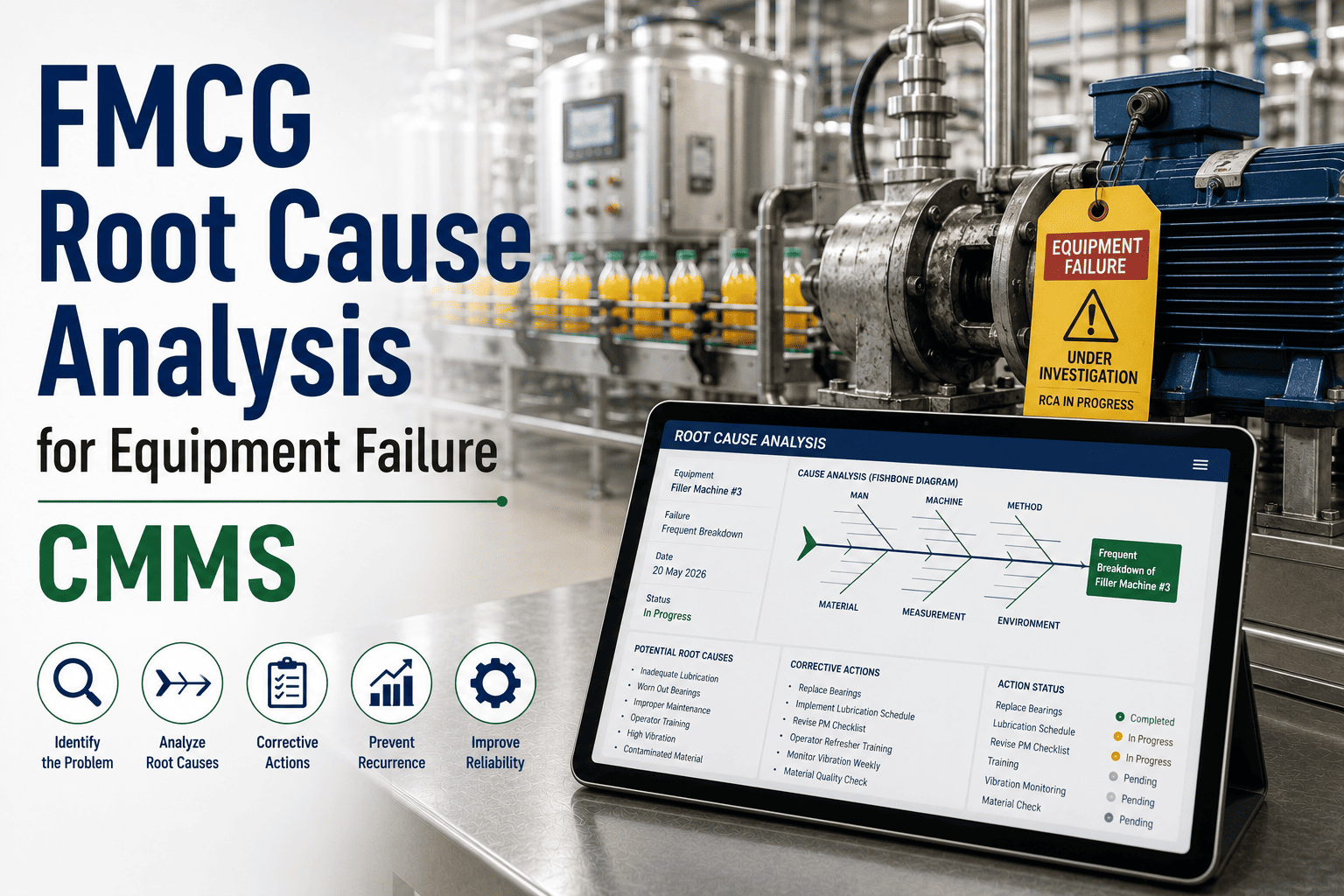
A biscuit manufacturer in Pune replaced the same filling line heat-sealing unit three times in fourteen months — $84,000 in parts and emergency labour — without once asking why it kept failing. Each repair closed the work order. None of them closed the failure. When a cross-functional RCA team finally convened, the root cause emerged in two sessions: a compressed air moisture problem upstream was accelerating seal jaw corrosion, and the maintenance schedule had never been updated after a line speed increase introduced eighteen months earlier. The sealing unit had been running 22% above its original design duty cycle for over a year. Total root cause identification cost: $3,200. Total savings from eliminating the recurrence: $84,000 per repair cycle — indefinitely. Root Cause Analysis is the discipline that separates FMCG manufacturers who break failure cycles from those who fund them permanently. Plants running structured RCA through Oxmaint's integrated RCA module close 3.1× more recurring failure loops than teams using spreadsheet-based investigation methods. Book a demo to see RCA workflows connected directly to your CMMS, PM schedules, and quality systems.
CMMS-Integrated RCA — Oxmaint
Stop Repairing the Same Failures. Start Eliminating Them.
Oxmaint connects structured RCA investigation directly to corrective work orders, PM schedule updates, and verified closure tracking — so every finding becomes a permanent fix, not a filed report that no one acts on.
68%
Of Recurring FMCG Equipment Failures Share a Root Cause That Was Never Formally Identified
3.1×
More Recurring Failures Eliminated When RCA Is Integrated With CMMS vs Standalone Spreadsheets
$84K
Average Cumulative Cost of a Single Unresolved Recurring Failure Across 12 Months
73%
Of FMCG Quality Escapes Are Traceable to Equipment-Related Root Causes Visible in CMMS Data
WHAT IS RCA
Root Cause Analysis in FMCG — What It Is and What It Fixes
RCA identifies the deepest causal factor behind a failure — not just what broke, but why it broke, and what systemic condition allowed it to happen
Root Cause Analysis (RCA) is the structured process of investigating a failure — equipment breakdown, batch rejection, safety incident, or process deviation — to identify the causal factor that, when corrected, permanently prevents recurrence. In FMCG manufacturing, where the same pump bearing, CIP valve, or conveyor seal fails repeatedly across shifts and seasons, RCA is the intervention that breaks the cycle. The distinction between fixing and eliminating: a repair addresses the symptom. RCA addresses the cause. Without it, every work order is a rental — paid again and again. The three RCA levels that matter in FMCG are: physical root cause (what physically failed), human root cause (what decision, action, or omission enabled the failure), and latent root cause (what systemic gap — procedure, design, schedule, training — created the conditions for failure). Fixing the physical root cause stops this failure. Fixing the latent root cause prevents the next ten.
Physical Root Cause
The component or mechanism that failed — worn bearing, cracked gasket, drifted sensor. This is what most repairs fix. Correcting only this stops the current failure but does not prevent recurrence if the deeper systemic cause is never addressed.
Human Root Cause
The decision, action, or omission that triggered or failed to prevent the physical failure — wrong installation torque, skipped inspection step, incorrect lubricant applied. Addressing this requires training updates, procedure revisions, or workflow redesign.
Latent Root Cause
The systemic gap — missing standard, outdated schedule, design shortfall, measurement deficit — that created the conditions for human and physical failures to occur. This is the level that, when corrected, eliminates the failure pattern permanently across all similar assets.
FIVE CORE METHODS
RCA Methodologies Used in FMCG Manufacturing
Each method suits different failure types — choose based on complexity, recurrence pattern, and how much causal data already exists in your CMMS
01
5 Whys Analysis
Best for: single-path failures with clear causal chains — equipment breakdowns, process deviations
Ask "Why?" five times in sequence, each answer becoming the subject of the next question. The fifth answer typically reveals the systemic gap. Fastest method — completed in one session with two to three people who know the process and equipment. Risk: tunnel vision on a single causal path. Combine with fishbone when multiple causes are suspected.
15–60 min · 2–4 people
02
Fishbone (Ishikawa) Diagram
Best for: quality defects with multiple potential cause categories — filling, sealing, labeling escapes
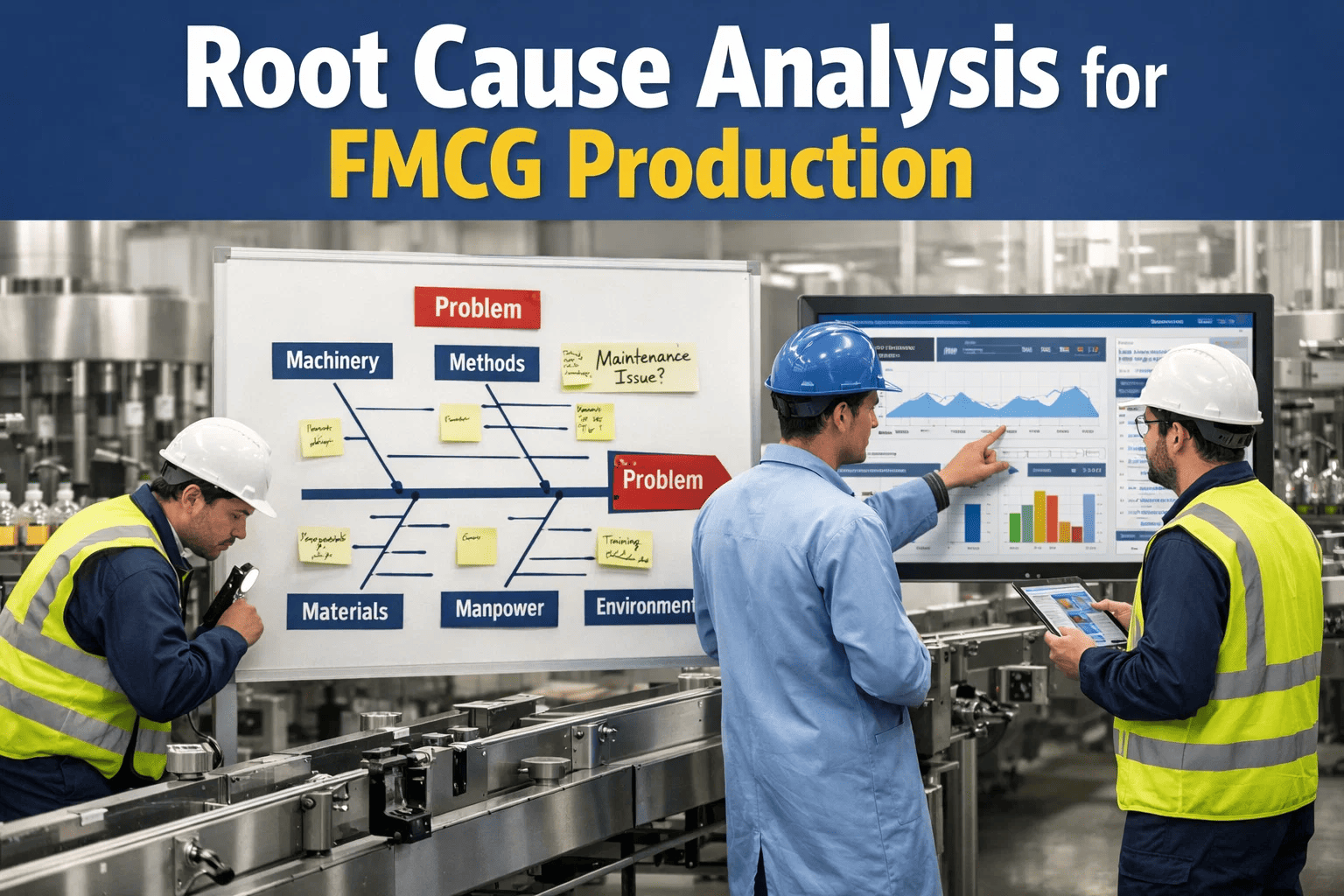
Maps potential causes across six standard categories — Machine, Method, Material, Man, Measurement, Environment. Forces the team to explore all cause dimensions before converging on the most likely root cause. Ideal for cross-functional sessions where quality, maintenance, and production contribute simultaneously.
2–4 hours · cross-functional team
03
Fault Tree Analysis (FTA)
Best for: complex systems with multiple failure paths — utilities, CIP circuits, multi-machine lines
Top-down logic tree that maps all combinations of events and conditions that could lead to a defined failure event. Particularly powerful for safety-critical systems and failures with regulatory consequences. Quantitative version assigns probability to each branch for risk ranking. Requires engineering input and is the most time-intensive method.
4–16 hours · engineering-led
04
PFMEA-Driven RCA
Best for: recurring failures already captured in PFMEA — use existing risk data to accelerate investigation
Cross-reference the active failure against existing PFMEA failure mode entries. If the failure was already identified with a high RPN but corrective action was incomplete, the RCA conclusion is often immediate — the control gap is the root cause. Integrates quality risk data with maintenance history to shortcut investigation time significantly.
1–3 hours · quality + maintenance
05
Bow-Tie Analysis
Best for: safety incidents and near-misses — maps causes and consequences with barrier controls
Combines fault tree (left side, causes) with event tree (right side, consequences) around a central event node. Each barrier between cause and event, and between event and consequence, is mapped and assessed for effectiveness. Standard in food safety incident investigation and regulatory-required RCA for FSSAI, BRC, and FSSC notifications.
4–8 hours · safety + quality + ops
STEP-BY-STEP GUIDE
How to Run an RCA in FMCG — Eight Structured Steps
A repeatable investigation process that works for equipment failures, quality escapes, and safety incidents across any FMCG production environment
01
Define the Problem Precisely
Write a single-sentence problem statement specifying what failed, when, where, and how it was detected. Vague problem statements produce vague root causes. "Filling line went down" is not a problem statement. "Line 3 filling valve failed to open on 14-Mar at 06:22, detected by operator during start-up check, causing 4.5hr unplanned downtime" is. Include production impact, quality impact, and frequency data if this is a recurrence.
Output: Problem statement signed off by operations and quality
02
Preserve Evidence Immediately
Collect physical evidence before the asset is repaired — failed components, wear patterns, fluid samples, SCADA data screenshots, CMMS work order history, batch records, operator logs. 80% of RCA evidence is destroyed or degraded when repair begins before investigation. Photograph everything in situ before removal. Designate a parts quarantine protocol for high-risk assets before the next failure occurs.
Output: Evidence log with photographs, samples, and data extracts
03
Assemble the Right Team
Include the technician who performed the last maintenance (knows physical condition), the operator who detected the failure (knows the sequence of events), the process engineer who owns the line (knows design intent), and the quality team member if there is a product impact. No investigation should be completed by a single person — single-author bias is the most common RCA failure mode in FMCG plants. Convene within 24 hours of failure.
Output: 3–5 person cross-functional investigation team convened within 24 hours
04
Map the Causal Chain
Apply your selected RCA method — 5 Whys for straightforward failures, fishbone for multi-category failures, FTA for complex system failures. For each Why, require evidence — not assumption. A causal step without supporting evidence is a hypothesis, not a finding. Document every branch explored, including those ruled out and why. The causal map is the investigation record, not just the conclusion summary.
Output: Documented causal chain with evidence references at each step
05
Identify All Three Root Cause Levels
Stop only when you have identified the physical, human, and latent root cause. If your investigation stops at the physical cause (worn bearing), ask why it wore prematurely. If it stops at the human cause (wrong lubricant), ask why the correct lubricant was not specified or available. The latent root cause is where durable corrective action lives. Most FMCG RCA programs fail because they stop two levels too early.
Output: Root cause statement at all three levels with evidence links
06
Generate Corrective Actions
For each root cause level, define a specific corrective action with an assigned owner, a due date, and a verification method. Physical root cause: repair or replace with specification upgrade. Human root cause: training update, procedure revision, or poka-yoke implementation. Latent root cause: PM schedule revision, design change, inspection interval update, or management system gap closure. Each action must address the cause it is assigned to — not a related but different issue discovered during investigation.
Output: Corrective action register with owner, due date, and verification method per action
07
Implement and Verify
Implementation without verification is not RCA — it is wishful thinking. Define a specific verification method for each corrective action: re-inspection after next PM cycle, data trend review after 30 days, repeat test under original failure conditions, or PFMEA re-scoring after control improvement. Assign a verification due date distinct from the implementation date. Close the action only when verification evidence is documented — not when the action is merely reported complete.
Output: Verified corrective actions with evidence records per action
08
Communicate and Replicate
Share RCA findings across all lines, sites, or facilities operating similar equipment or processes. The same compressed air moisture issue causing seal jaw corrosion on Line 3 may exist on Lines 1, 2, and 4 — but those lines have not failed yet. Proactive lateral communication prevents the same failure mode from cycling through every line in sequence. Update PFMEA documents, PM task cards, and operator SOPs to embed the learning permanently into the management system.
Output: RCA summary distributed to similar assets, PFMEA updated, SOPs revised
Investigation to Work Order — Automatically
Oxmaint Turns Every RCA Finding Into a Closed-Loop Corrective Action
When your RCA identifies a latent root cause, Oxmaint generates the corrective work orders, PM schedule updates, and verification tasks automatically — so investigation findings never sit in a report waiting for someone to act on them.
COMMON FMCG FAILURE PATTERNS
Recurring Failure Patterns in FMCG — and Their Latent Root Causes
These failure patterns repeat across FMCG plants because the latent root cause — not the physical failure — is never identified or corrected
Recurring Failure
Physical Cause
Latent Root Cause Never Addressed
Recurring Seal / Gasket Failures
Worn or degraded elastomer seal
PM interval set to calendar-time, not cycle-count or process contact hours — seal replaced too late every cycle
Repeated Pump Bearing Failures
Spalled or seized bearing
Cavitation from undersized suction piping — physical cause is the bearing, latent cause is a hydraulic design never corrected after line speed was increased
CIP Cycle Chemical Residue
Incomplete rinse — residual caustic in lines
CIP recipe parameters never updated after a pipe diameter change reduced flow velocity below effective cleaning threshold
Fill Weight Drift
Worn dosing pump diaphragm
Diaphragm condition inspection removed from PM task list during a maintenance optimisation exercise 18 months earlier
Label Misalignment Recurrence
Label applicator head guide wear
No go/no-go gauge for guide wear — technicians rely on visual judgment, creating inconsistent replacement timing across shifts
Pasteuriser Temperature Excursion
Fouled heat exchanger plates
Fouling rate increased when a new milk supplier was introduced — CIP frequency was never recalculated for the higher protein content
In every pattern above, the repair was performed correctly — the latent root cause was never identified
Cycle broken only by RCA
WITHOUT vs WITH
Reactive Repair Culture vs RCA-Driven Maintenance
The difference is not effort — it is method. Both teams work hard. Only one breaks the cycle.
Reactive Repair — No Structured RCA
Failure Investigation
Technician identifies and replaces failed part — work order closed at the physical root cause, latent cause untouched
Recurrence Rate
68% of failures recur within 12 months — same asset, same failure mode, same repair cost, same lost production
Annual Repair Cost
Compounds year-on-year — each recurrence carries full emergency labour, parts cost, and unplanned production downtime
PM Schedules
Static — never updated from failure data, over-maintaining low-risk assets while high-risk ones are under-maintained
Audit Readiness
Unable to demonstrate corrective action effectiveness — repeat nonconformities appear in every ISO and BRC audit cycle
RCA-Driven Maintenance Program
Failure Investigation
Structured 8-step RCA identifies physical, human, and latent root cause — all three levels addressed with verified corrective action
Recurrence Rate
Under 12% recurrence on investigated failures — latent root cause correction eliminates the failure pattern permanently
Annual Repair Cost
Declines year-on-year — each eliminated failure loop reduces the recurring cost baseline permanently across the asset fleet
PM Schedules
Dynamic — RCA findings trigger PM interval updates, inspection additions, and task specification improvements in real time
Audit Readiness
Documented causal chain and verified corrective actions satisfy ISO 22000, FSSC 22000, and BRC CAPA requirements fully
Annual savings from eliminating top 5 recurring failure loops at a mid-size FMCG plant
$280,000 – $620,000
ROI FRAMEWORK
Annual ROI of a Structured RCA Program in FMCG
Mid-size plant — 3 production lines — 120 active assets — 8 recurring failure loops resolved per year
Recurring Repair Elimination
8 failure loops closed × $42K average annual recurring cost per loop — direct maintenance spend eliminated
$336K
Emergency Labour Reduction
60% reduction in emergency callouts — planned repair replaces reactive response on all investigated failure modes
$148K
Quality Escape Reduction
RCA on equipment-linked quality failures reduces batch rejection rate by 1.8 percentage points across all production lines
$186K
Audit Preparation Efficiency
Pre-documented CAPA evidence reduces ISO 22000, FSSC, and BRC audit preparation time by 55% — staff hours recovered
$54K
PM Optimisation Value
RCA-driven PM schedule updates eliminate over-maintenance on 22% of assets — parts and labour rationalised from evidence
$76K
Total Annual Value Delivered
$800K
Program investment: $18K–$36K/year including digital RCA tooling, cross-functional team time, and training. Net ROI: $764K–$782K. Payback period: 3–5 weeks from first failure loop closed.
Frequently Asked Questions
Not every failure warrants a full 8-step RCA — resources must be focused on failures with the highest recurrence cost or consequence. Apply formal RCA to any failure that has occurred more than twice in 12 months on the same asset or failure mode; any failure resulting in a batch rejection, quality escape, or consumer complaint; any failure causing unplanned downtime exceeding 4 hours; any safety incident or near-miss regardless of severity; and any failure generating a corrective action requirement in an ISO 22000, FSSC 22000, or BRC audit. For minor one-off failures, a simplified 5 Whys with documented corrective action is sufficient. The goal is to deploy structured investigation where recurrence or consequence justifies the investment.
Timeline depends on failure complexity and evidence availability. A straightforward equipment failure with a clear causal chain — repeated bearing failure on a known pump — should complete within 2–4 hours using 5 Whys with the right team. A multi-cause quality escape with production, material, and equipment dimensions typically takes one 4-hour cross-functional session. Complex failures involving safety, regulatory consequence, or multi-system interactions may require 2–3 sessions over a week to gather and verify evidence before reaching a defensible root cause conclusion. The critical mistake is rushing to a conclusion without evidence. A fast RCA that stops at the physical root cause is not faster than a thorough one — it is just more expensive when the failure recurs.
RCA and PFMEA are complementary systems operating in opposite directions. PFMEA is prospective — it identifies failure modes before they occur and assigns preventive controls. RCA is retrospective — it investigates failures after they occur and identifies why controls failed or were absent. When an RCA identifies a latent root cause, the finding should trigger an immediate PFMEA update: add the newly discovered failure mode, re-score the Occurrence and Detection ratings based on what the investigation revealed, and add or strengthen the preventive controls. Conversely, when a failure occurs on an asset covered by PFMEA, the existing failure mode library accelerates the RCA — you already know which modes were considered high-risk for this process step. In Oxmaint, RCA findings automatically trigger PFMEA review notifications so the two documents stay synchronised in real time.
The single most common failure mode for FMCG RCA programs is stopping investigation at the physical root cause and treating it as complete. When a bearing fails, the team replaces the bearing, documents "bearing failure" as the root cause, and closes the work order. The causal chain stops after one step. The human and latent root causes — why the bearing failed prematurely, and what systemic gap allowed the conditions for premature failure to persist — are never identified. This produces the 68% recurrence rate seen across reactive FMCG maintenance programs. The second most common failure is completing the investigation but not verifying corrective action effectiveness. An action marked complete without verification evidence is not a closed corrective action — it is an assumption. Digital RCA systems that enforce verification steps before closure prevent both failure modes systematically.
Oxmaint provides a structured digital RCA workflow that integrates directly with the CMMS work order system, PFMEA module, and PM scheduler. When a work order is flagged for RCA, the system pulls the full asset history — all previous failures, parts consumed, PM completion rates, and PFMEA risk entries for that asset — into the investigation record automatically. The RCA template guides the team through problem statement, evidence collection, causal chain mapping, and three-level root cause identification. Corrective actions generated in the RCA automatically create CMMS work orders, PM schedule update tasks, and PFMEA review notifications with assigned owners and due dates. Verification is enforced — actions cannot be closed without documented evidence. RCA summaries are shareable to similar assets across sites for lateral learning across the entire plant network.
RCA Module — Oxmaint CMMS
Stop Funding the Same Failures. Start Eliminating Them.
Oxmaint's structured RCA workflow connects failure investigation to corrective work orders, PM schedule updates, PFMEA reviews, and verified closure — so every investigation produces a permanent fix, not a filed report.
8-Step Guided RCA Workflow — Physical, Human, and Latent Root Cause
Full Asset History Auto-Pulled Into Every Investigation
Corrective Actions Auto-Generate CMMS Work Orders and PM Updates
Verified Closure Enforced — Evidence Required Before Action Can Close
PFMEA Integration — RCA Findings Update Risk Scores Automatically
Lateral Learning — Share Findings Across Similar Assets and Sites
RCA module included on all plans · Cross-functional team onboarding included · No minimum contract