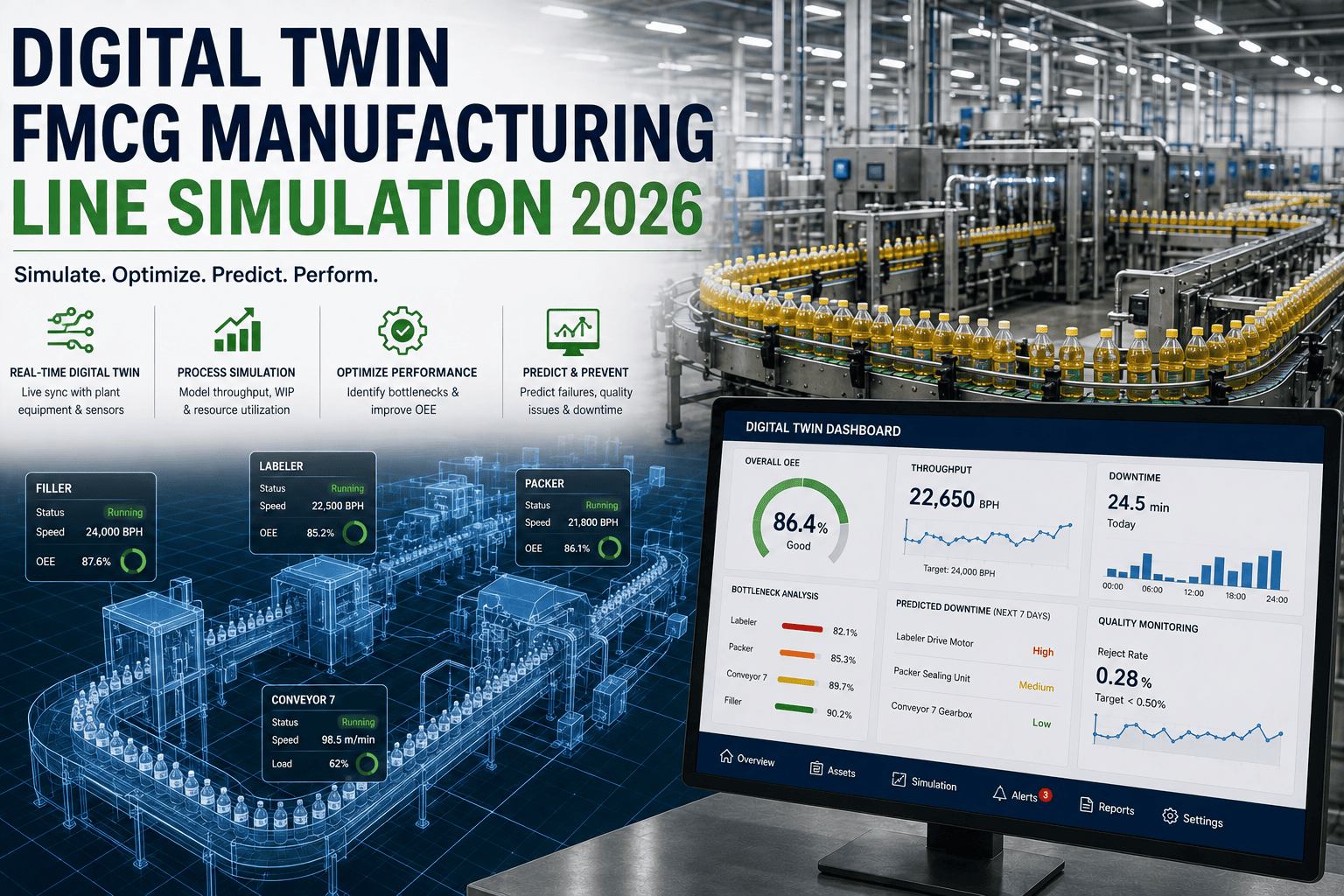
A personal care manufacturer in Germany was running a filling line at 78% OEE — acceptable by industry average, but 14 points below what their equipment was rated to deliver. Engineers had adjusted speeds, swapped components, and rebalanced production schedules for two years without finding the root cause. When they deployed a digital twin of the line, the virtual model identified the problem in 11 days: a thermal interaction between two servo motors running simultaneously at specific load combinations was causing micro-stoppages that manual monitoring had never isolated. The fix cost $4,200. The throughput recovery was worth $680,000 annually. Digital twins are no longer a concept reserved for aerospace or automotive. FMCG manufacturers are deploying virtual equipment models to simulate failure modes before they occur, optimise robotic workflows without stopping production, and predict maintenance needs with 95% accuracy — compressing years of trial-and-error into weeks of simulation. Start your free trial today or schedule a 30-minute demo to see how digital twin integration works with your asset data.
Without Digital Twins vs. With Digital Twins
How virtual equipment models change operational and financial outcomes across FMCG manufacturing facilities
Without Digital Twins
Failure Detection Method
Physical breakdown or sensor threshold breach
Maintenance Decision Basis
Historical schedules and technician judgement
Robotic Workflow Changes
Tested on live production — stoppages accepted
OEE Optimisation Cycle
Months of physical trial-and-error
With Digital Twins
Failure Detection Method
Virtual model predicts failure 3–18 weeks ahead
Maintenance Decision Basis
Real-time condition simulation with remaining useful life
Robotic Workflow Changes
Simulated in virtual environment — zero production impact
OEE Optimisation Cycle
Days of virtual simulation before physical change
FMCG Plants Using Digital Twins Report: 25–38% Reduction in Unplanned Downtime Within 12 Months
DEFINITION
What Is a Digital Twin in FMCG Manufacturing?
A digital twin is a live virtual replica of a physical asset, production line, or entire facility — continuously synchronised with real-world sensor data so that the virtual model reflects the actual operating state of its physical counterpart at every moment. In FMCG manufacturing, digital twins range from single-asset models (a virtual replica of one filling machine) to full production line simulations that mirror every conveyor, robot, packager, and utility system simultaneously. The critical distinction between a digital twin and a simple 3D model or CAD drawing is the live data connection: a digital twin updates in real time as its physical asset operates, degrading, accumulating wear, and behaving exactly as the real equipment behaves. This live synchronisation is what enables predictive capability — the virtual model can be run forward in simulation to project how the physical asset will behave under future load conditions, identify the point at which degradation will trigger a failure, and calculate exactly when intervention is required.
How a Digital Twin Works: The Four-Layer Architecture
Physical Asset → Sensor Data → Virtual Model → Predictive Intelligence
Layer-by-Layer Breakdown for an FMCG Filling Line
1
Physical layer: The real filling machine — motors, bearings, seals, valves, sensors — operating on your production floor in real time
2
Data layer: IoT sensors, PLC outputs, and SCADA feeds stream vibration, temperature, pressure, current, and cycle data every 15–30 seconds
3
Virtual model layer: Physics-based simulation replicates the machine's behaviour using real material properties, wear models, and operating parameters
4
Intelligence layer: AI runs the virtual model forward in time — projecting failure probability, remaining useful life, and optimal maintenance timing with 95% accuracy
The accuracy advantage of digital twins over standard IoT monitoring comes from the physics-based simulation layer. Standard predictive maintenance detects anomalies in current data. Digital twins simulate future states — predicting not just that something is degrading, but precisely when it will reach the failure threshold under specific load and environmental conditions.
Digital Twin Integration — Oxmaint CMMS
Connect Virtual Failure Predictions to Real Maintenance Actions
Oxmaint ingests digital twin failure probability scores and remaining useful life estimates directly — automatically generating work orders, scheduling interventions, and closing the loop between virtual prediction and physical maintenance execution.
95%
Prediction accuracy for gradual-onset failures via digital twin virtual modelling
3–18 wks
Advance warning before physical failure — vs 2–6 weeks for standard IoT monitoring
25–38%
Reduction in unplanned downtime reported by FMCG plants within 12 months of deployment
4–8×
Typical ROI on digital twin programme investment within 18 months for mid-size FMCG plants
SIX APPLICATIONS
Six Ways Digital Twins Prevent Equipment Failures in FMCG Plants
Digital twin capability in FMCG manufacturing is not a single feature — it is a set of six distinct applications, each preventing a different category of equipment failure or production loss
95%
Failure Mode Simulation
Prediction accuracy for gradual-onset failures — virtual model projects exact failure timing under real operating conditions weeks before physical breakdown
Zero Downtime
Robotic Workflow Optimisation
New robotic sequences, speeds, and path changes simulated in the virtual environment and validated before any change touches the live production line
Component Level
Remaining Useful Life Calculation
Physics-based wear models calculate remaining useful life for individual bearings, seals, and actuators — maintenance planned to the day, not the month
Multi-Variable
Thermal & Load Interaction Mapping
Identifies failure modes caused by interactions between multiple systems running simultaneously — the category of root cause that manual inspection consistently misses
30–60 Min Saved
Changeover Simulation
SKU changeover sequences optimised in the virtual model before execution — reducing average changeover time and eliminating micro-damage caused by rushed realignment
Data-Driven
CapEx Scenario Modelling
Virtual models simulate the financial and performance impact of capital equipment investments before purchase — eliminating guesswork from replacement vs. refurbish decisions
ROBOTIC SYSTEMS
Digital Twins for Robotic Systems: A Special Case in FMCG
Robotic systems operate at speeds and precision tolerances where degradation is invisible to human observation until it manifests as a product defect or mechanical failure
Robotic systems in FMCG manufacturing present a unique maintenance challenge. A palletising robot with 0.3mm of bearing wear operates identically to the human observer — but its placement accuracy has degraded by 1.2mm, and seal integrity failures are occurring at 0.08% of packaged units, weeks before any alarm triggers. Digital twins of robotic systems track this sub-visible degradation continuously, simulating the impact of wear accumulation on accuracy, speed, and failure probability before any physical symptom appears.
Robot Type
Key Twin Parameters
Prediction Lead Time
Filling & Dosing Robots
Valve wear, servo torque drift, fill accuracy deviation, cycle time variance
4–10 Weeks
Pick & Place / Delta Robots
Joint wear, path repeatability, gripper force decay, vision system calibration drift
3–8 Weeks
Palletising Robots
Placement accuracy, load cell trending, axis current draw, reach envelope variation
6–14 Weeks
Collaborative Robots (Cobots)
Force sensing calibration, speed consistency, collision avoidance response time, joint temperature
4–12 Weeks
AGVs & Mobile Robots
Battery degradation curve, motor current trending, navigation sensor drift, wheel wear modelling
5–16 Weeks
Inspection & Vision Robots
Camera calibration confidence, illumination consistency, false accept rate trending, arm positioning variance
2–6 Weeks
Robotic Failures Predictable via Digital Twin
92%
The 8% of robotic failures not predictable via digital twin are sudden catastrophic events — power surge damage, physical collision from external causes, or manufacturing defects in new components. Every wear-based, fatigue-based, and calibration-based failure mode produces detectable virtual model divergence weeks before physical failure.
ROI ANALYSIS
Digital Twin ROI for FMCG Manufacturers
Mid-size FMCG plant — 4 production lines — 2 robotic systems — $180M annual output. Five compounding value streams that typically reach 4–8× programme investment within 18 months
Failure Prevention Savings
18 predicted failures × $38,000 avg emergency cost avoided — 95% accuracy rate on critical assets
$684,000
OEE Throughput Gain
3.4% OEE improvement from virtual optimisation of line speeds, robotic paths, and changeover sequences
$520,000
Robotic Maintenance Optimisation
Component-level remaining useful life replaces calendar PM — 42% reduction in unnecessary robotic servicing
$210,000
Quality Defect Reduction
Sub-visible robotic degradation caught before product impact — 65% reduction in quality-related line stoppages
$180,000
CapEx Decision Accuracy
Virtual modelling of replacement vs. refurbish scenarios avoids one premature capital replacement per 2-year cycle
$140,000
Total Annual Value Delivered
$1.73M
Programme investment: $280K–$420K/year including digital twin platform, IoT sensors, integration, and model calibration. Net ROI: $1.31M–$1.45M. Return: 4–6× in year one. Value accelerates in year two as virtual models accumulate facility-specific wear data and simulation accuracy improves.
IMPLEMENTATION
Implementing Digital Twins: From First Asset to Full Facility
The highest-ROI approach starts with a single high-cost, high-risk asset — FMCG plants following this sequence typically achieve positive ROI within the first 90 days of pilot asset deployment
Pilot Asset
Select highest-cost critical asset (filling line or primary robot)
Deploy IoT sensors and connect to PLC/SCADA data
Build initial virtual model and calibrate to physical baseline
First Predictions
Virtual model begins divergence tracking vs. physical asset
First failure probability scores and RUL estimates generated
Maintenance team validates alerts against actual equipment state
Line Expansion
Extend digital twin coverage to full production line
Robotic system twins integrated with inspection data feeds
First changeover and workflow simulations run and validated
Facility Twin
All production lines, robots, and utilities covered
CapEx scenario modelling active for replacement planning
Continuous model refinement as wear data accumulates
DEPLOYMENT BARRIERS
Six Common Digital Twin Deployment Barriers — Solved
Every FMCG plant that has deployed digital twins encountered the same set of implementation obstacles — every one has a proven resolution
OXMAINT INTEGRATION
How Oxmaint Closes the Loop Between Digital Twin and Physical Maintenance
When a digital twin model signals that a filling machine bearing will reach failure threshold in 18 days, Oxmaint automatically generates the work order, sources the parts, schedules the intervention, and documents the validation
01
Real-Time
Twin Signal Ingestion
Digital twin failure probability scores and remaining useful life estimates stream directly into Oxmaint's asset health dashboard — no manual data transfer required.
02
Automated
Auto Work Order Generation
When twin signals risk threshold, Oxmaint creates the work order with pre-populated parts list, priority rating, and recommended intervention window based on production schedule.
03
Optimised
Maintenance Window Scheduling
Interventions aligned to planned changeover windows and production schedules — digital twin prediction lead time ensures nothing needs emergency response.
04
Closed Loop
Post-Intervention Validation
After maintenance, Oxmaint compares virtual model predictions against actual condition found — continuously improving twin accuracy with each validated intervention.
Frequently Asked Questions: Digital Twins in FMCG Manufacturing
Standard IoT predictive maintenance detects anomalies in current sensor data — it tells you that something is behaving differently from its historical baseline right now. A digital twin goes further: it simulates the future state of the equipment using physics-based or data-driven wear models, projecting not just that something is degrading but precisely when it will reach the failure threshold under specific operating conditions. The practical difference is prediction lead time and confidence. IoT anomaly detection typically provides 2–6 weeks of warning. Digital twin failure projection provides 4–18 weeks with 95% accuracy on critical failure modes. For FMCG plants, that additional lead time means the difference between a planned bearing replacement during a scheduled changeover and an emergency Saturday night line seizure.
For a data-driven digital twin (the most practical approach for most FMCG facilities), the timeline from data connection to first useful predictions is 6–10 weeks. Weeks 1–2 are spent connecting PLC, SCADA, and IoT sensor data feeds. Weeks 3–6, the model learns normal operating behaviour across different SKUs, speeds, and shift conditions. By weeks 7–10, the model has enough baseline data to begin detecting divergence patterns that indicate developing failures. Physics-based digital twins — which model equipment behaviour from first principles using material properties and mechanical equations — take 3–6 months to build and calibrate but achieve higher accuracy on complex multi-variable failure modes. Most FMCG plants start with data-driven models for speed-to-value and use physics-based models for their highest-criticality assets.
Yes — and this is one of the highest-value applications for FMCG plants deploying new robotic systems or modifying existing ones. A digital twin of a robotic cell can simulate a new end-of-arm tool, a revised pick-and-place path, an increased operating speed, or a changed product format before any physical change is made. The virtual simulation identifies collision risks, cycle time impacts, joint wear acceleration, and throughput projections under the proposed change — eliminating the trial-and-error downtime that typically accompanies robotic system changes on live production lines. FMCG plants using robotic digital twins for changeover and upgrade simulation report 40–70% reductions in the time required to validate and deploy robotic system changes, with zero production time lost to the validation process itself.
The minimum viable data set for a useful data-driven digital twin is 3–6 months of operational data covering the asset's normal operating range — ideally including at least two or three failure events that the model can learn from. For most FMCG filling lines and packaging machines, this means PLC cycle data, motor current and temperature readings, and throughput counts. Many plants already have this data in their historian or SCADA system and simply have not used it for twin modelling. For robotic systems, joint encoder data, torque readings, and cycle time logs are the primary inputs. Plants with no existing data infrastructure can start fresh with wireless IoT sensors that generate a usable baseline within 6–8 weeks of installation — the absence of historical data delays first predictions but does not prevent a successful deployment.
Digital twins provide two distinct CapEx planning capabilities. First, remaining useful life modelling gives finance and operations teams a data-backed projection of when each major asset will require replacement — replacing the annual "what do we think is going to fail this year" conversation with a rolling, asset-by-asset condition forecast that drives defensible multi-year capital budgets. Second, scenario modelling allows the virtual environment to simulate the performance and financial impact of different capital investment options before any money is committed — comparing the output of a refurbished existing line against a new line investment, or projecting the OEE gain from upgrading a specific robotic system. FMCG manufacturers using digital twin CapEx modelling consistently report 3× faster board approval of capital requests, because the requests are backed by virtual performance evidence rather than engineering estimates.
Digital twins are increasingly viable for mid-size FMCG manufacturers — defined as plants running 2–8 production lines with 50–500 employees. The economics improved dramatically between 2020 and 2024 as cloud-based twin platforms replaced expensive on-premise simulation infrastructure, and as IoT sensor hardware costs dropped 60–70%. A focused single-asset digital twin deployment for a mid-size plant now typically costs $40K–$80K for the pilot phase, with full 4-line coverage achievable at $200K–$350K annually. At those investment levels, a single prevented critical failure on a primary filling line — which typically costs $80K–$200K in emergency repairs, production loss, and quality impact — delivers positive ROI within the first 6 months. The practical starting point for mid-size manufacturers is to identify their one highest-cost recurring failure mode and deploy a targeted digital twin on that asset alone before evaluating broader coverage.
Digital Twin Integration — Oxmaint CMMS
Your Equipment Is Already Generating the Data That Powers a Digital Twin. Start Using It.
Oxmaint connects your existing PLC, SCADA, and sensor data to digital twin intelligence — turning virtual failure predictions into automated work orders, optimised maintenance schedules, and closed-loop validation that continuously improves prediction accuracy. No separate systems. No manual handoffs between platforms.
Real-Time Twin Signal Ingestion — Failure Probability and RUL Direct to Asset Dashboard
Auto Work Order Generation — Parts, Priority, and Window Pre-Populated from Twin Data
Changeover Window Alignment — Interventions Scheduled to Planned Production Stoppages
Post-Intervention Validation — Closes the Loop and Improves Twin Prediction Accuracy
Robotic System Integration — Sub-Visible Wear Tracked Before Product Impact
CapEx Scenario Reports — Remaining Useful Life Forecasts for Capital Budget Planning
Free trial includes Digital Twin Integration module · No minimum contract · Full implementation support included