Production failures in FMCG don't repeat themselves by accident — they repeat because the root cause was never properly identified, only the symptom was treated. A filling machine that causes underfill three times in a month isn't an unlucky machine: it's a system with an undiagnosed root cause consuming your team's time, your line's uptime, and your customers' confidence. Research shows that FMCG plants spending more than 40% of maintenance time on reactive repairs are typically running on a 3–5 unresolved root causes that resurface every quarter. If your team is solving the same problems repeatedly, start a free OxMaint trial and begin building a failure history that makes root cause visible — or book a demo to see how OxMaint structures RCA workflows for food manufacturing teams.
FMCG Operations · Quality & Reliability
Root Cause Analysis for FMCG Production Failures
5-Why, fishbone diagrams, fault tree analysis, and AI-assisted pattern detection — the complete RCA toolkit for food and consumer goods manufacturing teams who are done fixing the same problems twice.
62%
Of FMCG production failures are repeat events with the same root cause
3–5
Unresolved root causes driving the majority of reactive maintenance spend
45%
Reduction in repeat failures after structured RCA and corrective action programs
$280K
Average annual cost of a single unresolved chronic failure mode in mid-size FMCG plant
The 4 Levels of Failure — Where Most FMCG Teams Stop Short
Effective RCA means diagnosing failure at the right level. Most maintenance teams stop at Level 2 — they fix the component but miss the system or organizational cause that made the failure inevitable. Level 4 root cause elimination is what stops recurrence permanently.
Level 4
Latent Root Cause
Organizational, process, or management system failure that allowed the physical cause to go undetected. Example: No PM schedule for sealing jaw wear because no one owned the PM program for that asset class.
Permanent elimination
Level 3
Human Root Cause
Decision, omission, or error that triggered or allowed the physical failure. Example: Technician skipped torque verification during last changeover because the checklist wasn't enforced.
Training + procedure fix
Level 2
Physical Root Cause
The specific component or material condition that caused the failure. Example: Sealing jaw surface worn beyond tolerance, causing incomplete seal bond.
Most teams stop here
Level 1
Symptom
The visible failure event. Example: Seal integrity failure on packaging line — pouches leaking after sealer station.
Where investigation begins
RCA Methodology Comparison: Choosing the Right Tool
No single RCA method works for every failure type. FMCG quality and maintenance teams need a toolkit — and the judgment to know which method the failure demands.
5-Why Analysis
Best for: Simple, single-cause failures
Ask "why" five times to drill from symptom to root cause. Fast to execute, requires minimal tools. Most effective for equipment failures with a clear causal chain.
Limitation: Can miss multi-cause failures or branch causes
Fishbone (Ishikawa)
Best for: Complex failures with multiple contributing causes
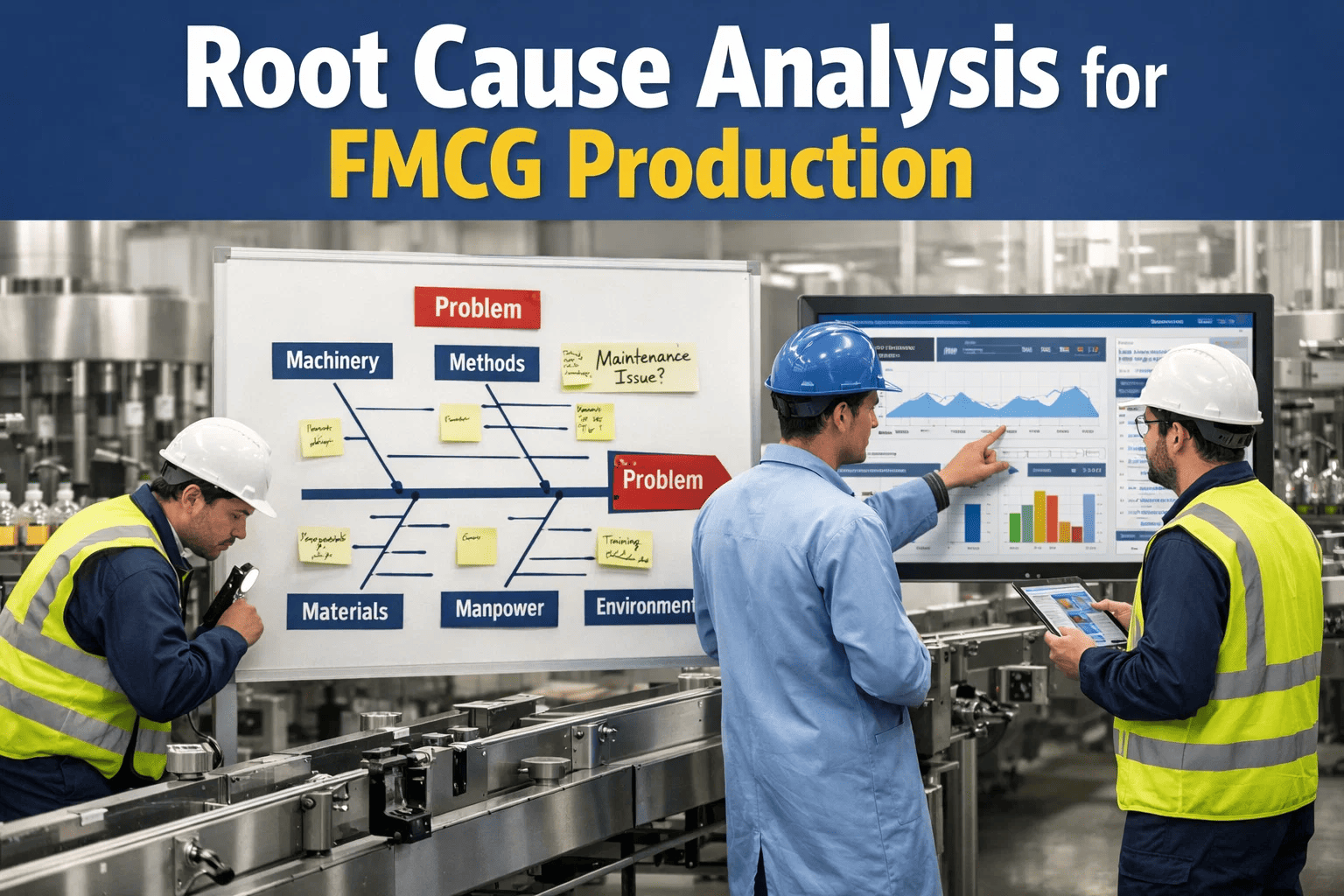
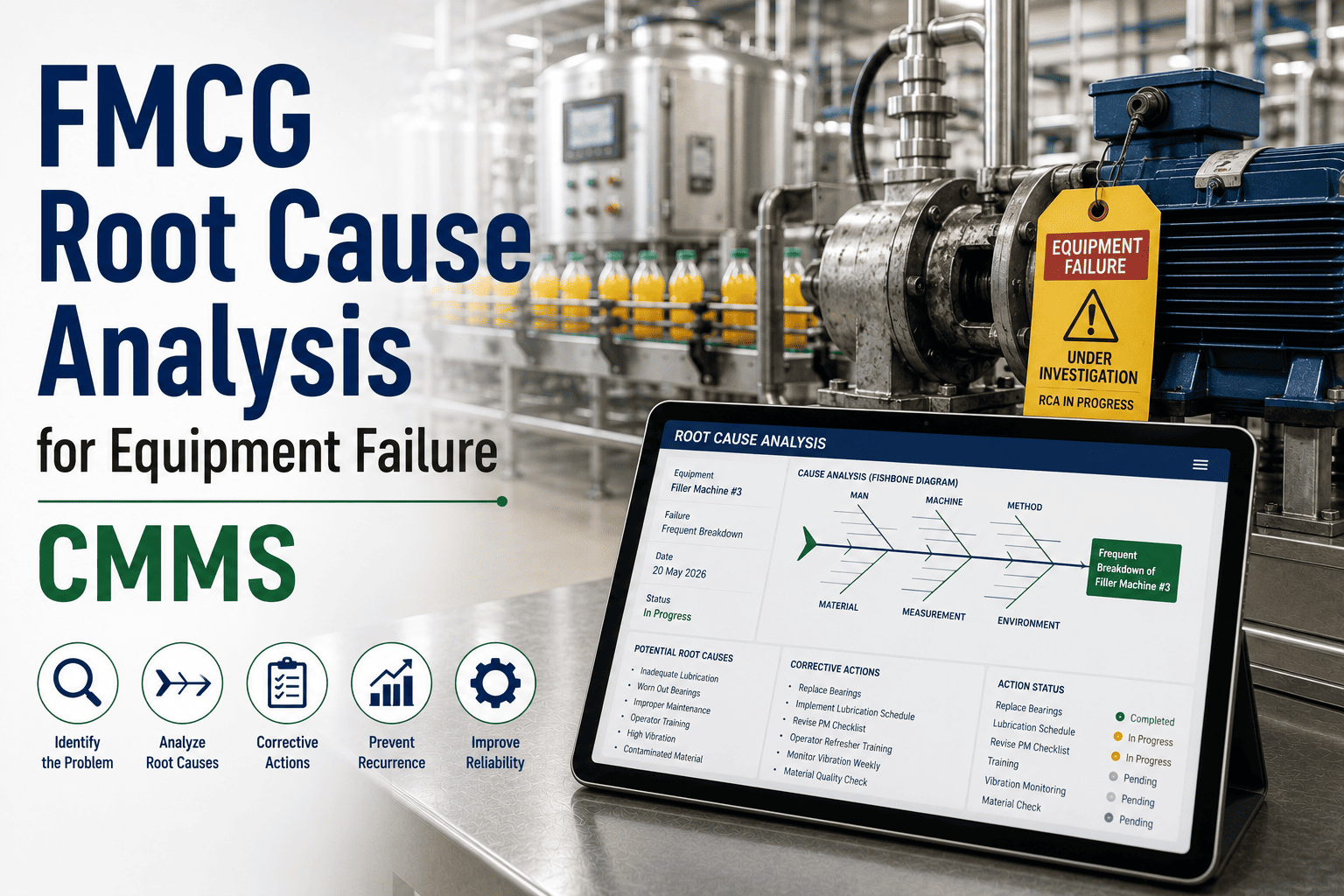
Structures causes across 6M categories: Man, Machine, Method, Material, Measurement, Mother Nature. Ideal for team-based analysis of recurring defects.
Limitation: Can become too broad without disciplined facilitation
Fault Tree Analysis
Best for: High-severity events, regulatory investigations
Top-down logic diagram mapping all possible paths leading to a critical failure event. Used for HACCP critical control point failures and safety incidents.
Limitation: Time-intensive; requires trained facilitator
Pareto Analysis
Best for: Prioritizing which failures to investigate first
Identifies the 20% of failure modes causing 80% of production losses. The essential first step for chronic failure programs — tells you where to invest RCA effort for maximum return.
Limitation: Doesn't identify cause — only priority order
The 6 Most Common FMCG Root Causes — By Category
Across food and consumer goods plants, these six root cause categories account for over 80% of production failures. Understanding which category drives your failures shapes which corrective actions will actually stick.
Machine
Wear Beyond PM Interval
Drives 78% of equipment-related failures
Fix: Condition-based PM intervals, not calendar-based
Method
Undocumented Changeover Steps
Present in 65% of quality escapes following changeover
Fix: Digital checklists with mandatory completion before line release
Material
Supplier Material Variation
Involved in 52% of packaging-related failures
Fix: Incoming quality inspection records linked to batch traceability
Man
Skill Gap at Critical Operations
Cited in 44% of shift-based failure investigations
Fix: Task-specific training records tied to asset assignments
Measurement
Calibration Lapse on Control Instruments
Root cause in 38% of process parameter excursions
Fix: Calibration schedules and records in CMMS, not spreadsheets
Environment
Temperature and Humidity Excursion
Contributing factor in 29% of microbial quality failures
Fix: Environmental monitoring logs linked to batch records
Reactive vs. Structured RCA: The Operational Difference
How OxMaint Powers FMCG Root Cause Investigations
Good RCA requires data. OxMaint provides the failure history, asset context, and maintenance records that transform RCA from guesswork into evidence-based diagnosis. Ready to stop solving the same failures twice? Start your free trial today or book a demo to see how RCA workflows run inside OxMaint.
HIST
Full Asset Failure History for Pattern Analysis
Every work order in OxMaint is logged against a specific asset. When a failure occurs, the investigating team sees the complete history: every previous failure, every PM completed or skipped, every component replaced. The pattern that was invisible in spreadsheets becomes immediately apparent — failure frequency increasing, interval shortening, multiple failures on the same component type.
WO
Work Orders as RCA Documentation
OxMaint work orders capture failure descriptions, technician observations, parts replaced, time to repair, and corrective actions taken — in structured digital format. For RCA purposes, this creates an audit trail from failure event through investigation to corrective action verification. BRC and SQF auditors have what they need without spreadsheet reconstruction.
PM
PM Compliance Linked to Failure Analysis
The most common hidden root cause in FMCG is PM non-compliance — the maintenance that was scheduled but not completed, or completed late. OxMaint shows PM compliance rate per asset and per technician. When a root cause investigation asks "was PM up to date?", the answer is in the system with timestamps — not dependent on who was working that shift.
CA
Corrective Action Closure and Verification
An RCA without verified corrective action closure is a wasted investigation. OxMaint creates work orders directly from RCA corrective actions, assigns them to specific technicians with due dates, and tracks completion. The system flags overdue CAs and prevents them from falling through the cracks that email chains and verbal commitments create in high-pressure production environments.
RCA Program Results: Measurable Impact on FMCG Operations
45%
Fewer repeat failures
Average reduction in recurrence rate when RCA is structured and CA verified
62%
Of failures are repeats
In plants without structured RCA — the scale of preventable loss
28%
Reduction in unplanned downtime
When chronic failure modes are eliminated through systematic root cause programs
3–6mo
Time to measurable impact
Typical timeframe to see repeat failure reduction after structured RCA implementation
Frequently Asked Questions
When should we use 5-Why vs fishbone in FMCG investigations?
Use 5-Why when the failure has a single, clear causal chain — a machine stops because a component fails because it wasn't maintained because the PM was missed. Use fishbone when the failure has multiple potential contributing causes across different categories: the same defect appearing on different lines, different shifts, or different materials. For FMCG, fishbone is more appropriate for recurring quality defects (sealing failures, fill weight variation, contamination events), while 5-Why suits single equipment breakdown investigations. The key rule: if you reach your root cause in fewer than 3 "why" steps, you probably stopped at a symptom, not the cause.
How do we prioritize which production failures to investigate with formal RCA?
Apply a tiered approach. Tier 1 — mandatory RCA for any event: food safety incident, customer complaint, product recall, regulatory non-conformance, or production loss exceeding a defined threshold (typically 2+ hours unplanned downtime). Tier 2 — RCA if the same failure mode recurs three or more times in 90 days. Tier 3 — optional investigation for minor one-time failures. The 80/20 rule applies: most plants have 3–5 chronic failure modes driving the majority of production loss. Pareto analysis of your work order data identifies these quickly — and OxMaint's reporting makes this visible without manual spreadsheet work.
What does a complete RCA documentation record need to include for food safety audits?
A BRC-compliant or SQF-compliant RCA record requires: description of the nonconformity or failure event with date, time, and product/batch affected; the investigation method used and team involved; identified root cause at physical and systemic level; corrective actions implemented with assigned ownership and completion dates; verification evidence that the corrective action worked (e.g., no recurrence in subsequent production runs); and update to the PFMEA or HACCP where the failure mode wasn't adequately controlled. OxMaint structures work orders to capture all of this digitally, linked to the specific asset and batch records — making audit preparation a retrieval exercise rather than a reconstruction effort.
How does AI help with root cause analysis in FMCG manufacturing?
AI in FMCG RCA works primarily through pattern recognition across historical data sets — identifying correlations between failure events and operational variables that human analysts miss because the data volumes are too large to review manually. Practical applications include: correlating line speed changes to defect rate increases, identifying supplier batch numbers that appear disproportionately in quality event records, detecting PM schedule drift that precedes equipment failures by 2–4 weeks, and flagging abnormal work order frequency before failures become critical. OxMaint's structured data architecture — every work order tied to a specific asset, time, technician, and part — creates the clean data foundation that AI-assisted analysis requires. The AI doesn't replace structured RCA investigation; it tells your team where to look first.
End the Repeat Failure Cycle
Root Cause Analysis Requires Data. OxMaint Is Where That Data Lives.
Complete asset failure history. PM compliance records. Corrective action work orders with verified closure. Digital inspection records linked to batch history. Everything an FMCG quality team needs to investigate failures properly — and prove to auditors that root causes were found and fixed, not just worked around.


-in-fmcg-a-step-by-step-guide-to-eliminating-recurring-failures.png)
-in-fmcg-monitoring-production-quality-in-real-time.png)