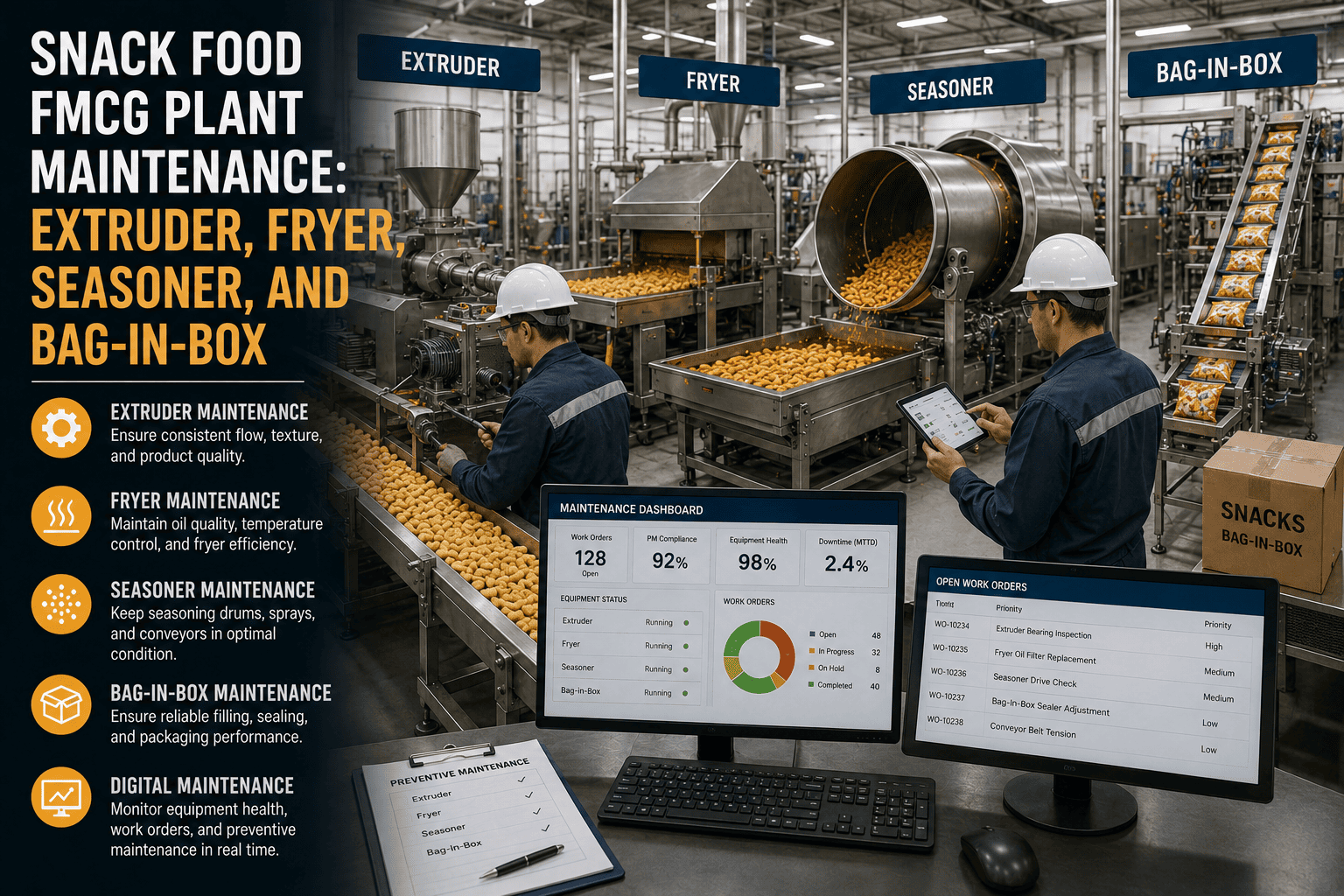
Snack Food FMCG Plant Maintenance: Extruder, Fryer, Seasoner, and Bag-In-Box

By Jack Edwards on May 20, 2026

snack-food-fmcg-plant-maintenance-extruder-fryer-seasoner

A snack-food plant is a high-speed sequential machine. Extruder, fryer, seasoner, and bag-in-box packaging operate as four stations of one continuous line — where the upstream output dictates the downstream condition, and any drift on station one propagates through stations two, three, and four within minutes. Most snack plants still treat the four assets as independent maintenance units: extruder PM on calendar, fryer PM on calendar, seasoner PM on visual inspection, packaging PM on operator complaint. That separation is the single largest reason snack-line OEE sits at 60-65% when the world-class benchmark is 85%. The plants that have closed the gap manage the whole line as one continuous asset chain inside Oxmaint Maintenance Management — with tonnage-counter triggers on extruder PMs, FFA-trended fryer PMs, drift-alerted seasoner PMs, and timing-based bagger PMs, all rolled up into a single line-level OEE dashboard. Inside this guide, every section maps directly to an Oxmaint capability — Preventive Maintenance, Work Order Management, Parts & Inventory, OEE Analytics, and Inspection Management — so you see exactly which feature solves which failure mode before you book a demo.

See your line OEE in 30 minutes
Most snack plants leak 20-35% of capacity to micro-stops nobody logs. Quantify yours and see how Oxmaint closes the gap.
Snack Plant Operating Reality

The 4 Numbers Every Snack Plant Manager Should Know

30%
of extruder downtime caused by human-error events a structured CMMS prevents
60-65%
average snack-plant OEE vs. 85% world-class benchmark for discrete manufacturing
4.8X
cost of reactive repair vs. planned PM on the same extruder, fryer, or bagger
40%
downtime reduction reported on IoT-fed predictive maintenance for extruder lines

What Snack-Line Maintenance Actually Means

Snack-line maintenance is the discipline of managing four sequential, mechanically distinct systems as one continuous failure chain. The extruder grinds starch slurry under tonnage-based screw and barrel wear. The fryer holds 175-185°C with continuous oil filtration, FFA drift, and burner load. The seasoner tumbles fragile product through abrasive powder coatings that destroy bearings, seals, and drum slats. The bagger weighs, forms, fills, and seals at multihead-weigher tolerances measured in tenths of a gram. Each station fails differently — and each failure changes what the next station sees.

Oxmaint maps the full chain into a single asset hierarchy: Plant > Line > Station > Component. Each component carries its own PM cadence, spare-parts link, digital SOP, and OEE contribution — so you can start a free trial with pre-built snack-line templates loaded, or book a demo to walk through the hierarchy on your actual line layout.

The 4-Station Snack Line: How Each Asset Fails Differently

A linear view of the chain — each station with its dominant failure mode and the Oxmaint capability that closes it. Click through any station and you arrive at a different module of the platform.

01
Extruder
Tonnage-based screw and die wear
Oxmaint Preventive Maintenance triggers PMs by tonnage counter, not calendar. Dimensional measurements logged at every pulldown via Inspection Management.
>
02
Fryer
FFA creep, polar compound buildup, burner drift
Oxmaint Shift Logbook captures FFA readings each shift. OEE Analytics trends polar compounds against fryer load.
>
03
Seasoner
Drum slat abrasion, feeder calibration drift
Oxmaint Work Order Management raises a WO automatically when seasoner coverage falls outside spec. Parts pre-staged via Parts & Inventory.
>
04
Bag-in-Box
Multihead weigher giveaway, VFFS jam micro-stops
Oxmaint OEE Analytics auto-captures every micro-stop with root cause. PLC Integration feeds live weigher data into the line dashboard.

This is the model auditing and operations teams adopt when they start a free trial on a single snack line — and the same template scales across multi-site rollouts. To see your current pain points mapped onto this chain, book a demo.

A 40-second VFFS jam every 8 minutes consumes 8% of bagger capacity — invisible without Oxmaint OEE Analytics capturing every micro-stop.

Pain Points That Compound Across the Chain

These are the six recurring failures every reactive snack plant carries — each one stacks into a larger OEE leak that only becomes visible when the line is instrumented inside a CMMS.

P1
Untracked Screw Wear
Screws degrade by tonnage, not days. Calendar PM either replaces a good screw too early or runs a worn screw to die fracture — both outcomes destroy line economics. Oxmaint Preventive Maintenance fixes this with tonnage-counter triggers.
P2
Fryer Oil Drift Discovered by QA
Free fatty acid creep degrades product before any visible breakdown. By the time QA flags the colour, the entire shift's output is suspect. Oxmaint Shift Logbook captures FFA per shift and trends the slope.
P3
Seasoner Coverage Variance
Worn drum slats and drifted feeders produce flavour inconsistency the consumer notices first. Oxmaint Inspection Management forces a visual coverage check every shift, with photo evidence attached to the WO.
P4
Bagger Micro-Stops Nobody Logs
A 40-second VFFS jam every 8 minutes consumes 8% of capacity. Multihead weigher giveaway adds 2-4% in pure material cost. Oxmaint OEE Analytics auto-captures every event with root cause.
P5
Changeover Drag on SKU Variety
Plants running 12+ SKUs per line lose 3-6 hours per changeover to undocumented parameters. Oxmaint Smart Document Management locks setup recipes per SKU so every shift starts from the same baseline.
P6
Spare Parts Stock-Outs
A missing die o-ring or seasoner bearing turns a 45-minute swap into a 6-hour wait. Oxmaint Parts & Inventory auto-triggers reorders at minimum stock, linked to every asset that consumes the part.

These pain points compound across shifts and stack into the OEE gap between top-quartile snack plants and the rest — which is why structured teams start a free trial to baseline the leak first, or book a demo to see the line-level dashboard.

How Oxmaint Closes Each Gap on the Chain

Six Oxmaint modules combine to convert the reactive snack line into a planned operation. Each module maps directly to a station-level failure mode.

Tonnage-counter PM triggers on extruder screws and dies. Calendar plus production-based intervals on every asset class. Auto-scheduled, auto-assigned.
Mobile digital checklists for every fryer oil check, seasoner coverage inspection, and bagger calibration. Required measurement fields, photo gates, offline-capable.
Critical extruder, fryer, and seasoner spares linked to assets with minimum-stock thresholds. Consumption drops trigger auto-reorder before stock-out.
Every corrective action raised as a tracked WO with priority, parts, technician, and SOP attached. Mobile sign-off, audit-ready close-out.
Real-time line-level OEE, MTTR, MTBF, and PM compliance dashboards. Micro-stop capture, downtime Pareto, root-cause categorization.
Live extruder torque, fryer temperature, bagger weigher data feeds into Oxmaint to trigger maintenance events before operator notices the drift.
A 1% OEE lift on a single snack line is worth Rs.35-60 lakh per year — recoverable inside 90 days with structured Oxmaint PM.

Reactive Snack Plant vs. Planned Snack Plant on Oxmaint

The operating gap is not technology — it is process discipline captured in one system that every shift uses identically.

Operational Dimension Reactive Snack Plant Planned Plant on Oxmaint
OEE Performance 60-65%, no shift-level visibility 78-87%, real-time line dashboards
Extruder Screw Changes Calendar-based, premature or overdue Tonnage-triggered, dimensional logged
Fryer Oil Quality Reactive to QA reject events FFA logged per shift, trended live
Seasoner Drift Discovered via consumer complaint Visual coverage PM each shift
Bagger Micro-Stops Unlogged, invisible to leadership Auto-captured with root cause
Changeover Time 3-6 hours, operator-dependent 1.5-3 hours, SOP-locked
Spare Parts Stock-outs discovered at need Auto-reorder before minimum
Audit Readiness 2-3 days of pre-audit scramble Audit-ready every day, exportable

ROI & Outcomes From Structured Oxmaint Deployment

These are the outcome metrics snack plants reach inside 12 months of unified Oxmaint deployment across the full extruder-to-bagger chain.

+22%
OEE lift
Average improvement within 12 months of full-line Oxmaint deployment
-45%
unplanned downtime
Across extruder, fryer, and seasoner combined
-38%
reactive repair spend
As cost ratios shift from reactive to planned
2.7X
PM compliance
Mobile digital SOPs vs. paper checklists
-32%
changeover duration
SKU recipes locked into Oxmaint Smart Document Management
90 days
typical payback
On a single-line Oxmaint deployment

These are the numbers maintenance leaders bring to their VP Operations to scale across the portfolio — which is why so many teams start a free trial on a single line first, or book a demo for the multi-site rollup view.

Snack Plant Maintenance FAQ

What PM cadence does Oxmaint recommend for a snack extruder screw
Screw wear is tonnage-based, not calendar-based. Oxmaint Preventive Maintenance schedules a dimensional inspection every 800-1,500 tonnes of throughput and a full pulldown at 3,000-5,000 tonnes — adjusted automatically based on starch type and abrasive load.
How does Oxmaint capture fryer oil quality drift
Oxmaint Shift Logbook captures free fatty acid readings every 4-8 hours during continuous operation. OEE Analytics trends FFA against fryer load and triggers a filtration system PM when the slope steepens — well before the absolute reading breaches spec.
Does Oxmaint integrate with PLC and SCADA on a snack line
Yes. Oxmaint PLC Sensor Integration pulls live extruder torque, fryer temperature, multihead weigher data, and VFFS jam events directly into the Oxmaint asset record — triggering maintenance events automatically rather than waiting for operator notification.
How long does Oxmaint deployment take for a snack line
A single snack line typically goes live in 5-10 working days using Oxmaint pre-built FMCG asset templates. The first digital PM is completed before the end of week one, with full team adoption inside 30 days.
Decision Point

Stop Losing Millions to Reactive Snack-Line Maintenance

Turn every extruder, fryer, seasoner, and bagger into a predictable, trackable system with Oxmaint. Used by operations teams managing 10,000+ assets. Live in days, not months.

Real-time asset visibility
Predictive failure alerts
5-10 year CapEx forecasting
No heavy implementation. Works across multi-site portfolios. Measurable results in 30 days.

Share This Story, Choose Your Platform!