A biscuit plant in Punjab runs three tunnel ovens, two fryer lines for namkeen, and a confectionery coating drum that runs 16 hours a day. Each of these asset types fails in completely different ways, requires different PM intervals, generates different food safety risks when neglected, and demands different documentation for FSSAI and BRC audits. Most CMMS implementations treat all of them as generic "equipment" — same work order template, same PM frequency logic, same inspection fields. The result is maintenance that looks complete on paper and fails on the floor: oven burner fouling missed because the checklist asked about conveyor speed, fryer oil degradation uncaught because no one tracked heat exchanger differential, coating drum seal wear undetected until product contamination forced a line stop. Food manufacturing equipment maintenance is equipment-type-specific or it is not maintenance — it is paperwork. This guide covers the specific PM requirements, failure modes, food safety intersections, and allergen management considerations for bakery ovens, snack fryer lines, confectionery coating equipment, and the packaging systems that serve all three.
73%
Of food production downtime traced to just four asset types: ovens, fryers, depositors, and packaging lines
4.8×
Emergency repair cost multiplier vs. planned maintenance — in food manufacturing, production loss compounds this further
60–80%
Of food equipment failures are preceded by detectable degradation signals 2–8 weeks before breakdown
$150K–$340K
Average cost of a single unplanned oven or fryer stoppage in a mid-size Indian FMCG bakery or snack plant
Equipment-Specific PM Templates — Bakery, Snacks & Confectionery
Stop Using Generic Checklists on Food-Grade Equipment
Oxmaint's food manufacturing templates include oven, fryer, coating drum, and packaging line PM checklists built for FSSAI and BRC compliance — with allergen clearance fields, CIP sign-off, and food safety inspection steps baked into every work order.
Bakery Oven Maintenance: Tunnel, Deck & Rotary Systems
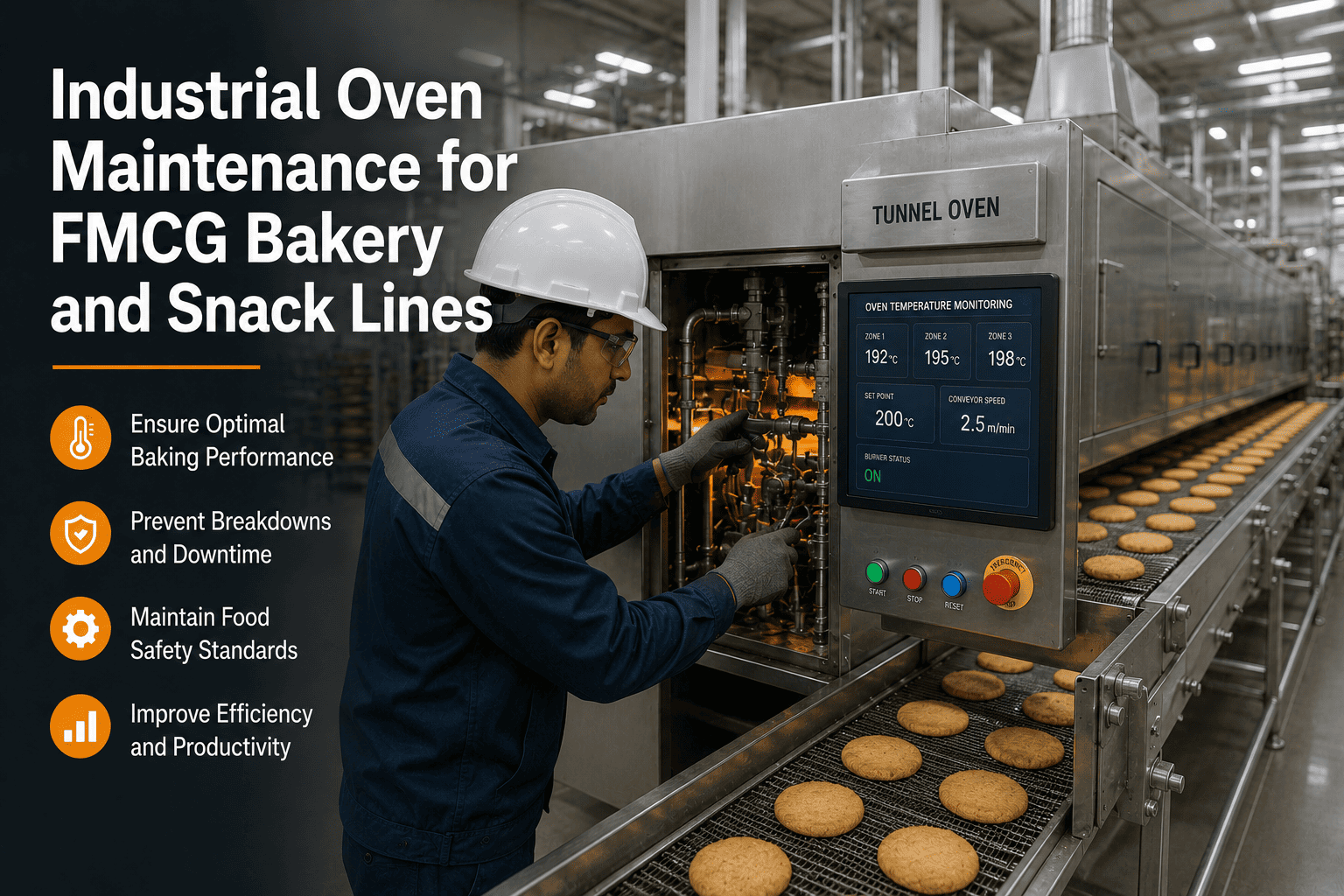
Bakery ovens are the highest-value, highest-consequence assets in any biscuit or bread manufacturing plant. A tunnel oven running 20 hours a day at 220–280°C accumulates fouling, burner degradation, conveyor wear, and insulation loss at rates that directly affect product quality — colour consistency, moisture content, bite characteristics — long before they trigger an obvious fault. Oven maintenance is also food safety maintenance: fouled burner assemblies, cracked insulation, and blocked exhaust paths are both efficiency problems and contamination risks.
Daily
Burner & Combustion
Every production shift
Visual burner flame check — colour, shape, uniformity across all zones; gas pressure reading vs. setpoint
Flue temperature differential — inlet vs. outlet; deviation >15°C from baseline indicates fouling or burner issue
CO and CO₂ reading at exhaust — combustion efficiency indicator; CO >100ppm requires immediate burner inspection
Zone temperature profile log — all zones against product spec; deviations documented with corrective action
Food Safety: Document all temperature deviations with corrective actions for FSSAI records
Weekly
Conveyor & Drive System
Every 5–7 production days
Conveyor belt tension check — sag measurement at mid-span; retension if >15mm deviation from spec
Drive chain lubrication — food-grade lubricant application; verify no excess that could drip onto product zone
Belt splice and seam inspection — visual check for fraying, loose welds, or foreign material entrapment risk
Drive motor current reading — compare against baseline; increase >8% indicates conveyor drag or bearing load
Food Safety: Food-grade lubricant only — document batch number for HACCP traceability
Monthly
Insulation & Refractory
Every 30 production days
External casing temperature mapping — infrared gun across full oven length; hot spots >60°C indicate insulation loss
Refractory panel visual inspection during scheduled cool-down — crack formation, spalling, or gap development
Door seal condition check — compression measurement; degraded seals cause zone contamination and efficiency loss of 4–8%
Expansion joint inspection — ceramic fibre condition, gap uniformity; failed joints allow internal atmosphere escape
Energy: Insulation degradation typically costs $100K–$220K/yr in excess gas consumption before visible failure
Quarterly
Burner & Control System
Every 90 production days
Full burner strip and clean — ceramic injectors, mixing chambers, pilot assemblies; photograph condition before and after
Gas valve actuator function test — open/close response time, leak-off test at rated pressure; failed actuators are safety incidents
Temperature controller calibration — RTD/thermocouple accuracy verification against NIST-traceable reference; document offset values
Safety interlock functional test — over-temperature trip, loss-of-flame detection, purge timer verification; all must be recorded
Compliance: Safety interlock test records required for insurance and regulatory audit — cannot be deferred
Burner Fouling
Rising gas consumption (typically 6–12% above baseline), uneven zone temperatures, increased CO at exhaust, product colour variation across belt width — all detectable 3–6 weeks before burner failure
Strip & Clean — 3-month cycle
Conveyor Belt Failure
Drive motor current increase (8–15% above baseline), audible scraping or clicking on belt return path, visible belt wander during operation, splice tension loss visible at startup elongation — 2–4 weeks warning
Weekly tension + monthly splice
Insulation Degradation
External casing temperature rise (hotspot development), increased gas consumption to maintain zone setpoints, longer heat-up time from cold start, inconsistent humidity profile across oven length — 6–18 months degradation curve
Monthly IR mapping — replace panels >70°C
RTD / Thermocouple Drift
Product quality variation (over/under-bake) without visible equipment fault — PID controller compensating for drifted sensor rather than real temperature. Calibration verification against reference thermometer detects 1–3°C drift
Quarterly calibration verification
Door Seal Degradation
Visible heat shimmer at door edges, localised floor heating near entry/exit zones, higher energy consumption in end zones, moisture escape causing condensation on surrounding structure — typically 6–9 month degradation cycle
Monthly check — replace when <40% spec
BRC Global Standard clause 4.6.2 requires documented preventive maintenance for all equipment that could affect product safety or quality. Tunnel ovens fall under both categories — PM records must be available and complete at audit.
Snack Fryer Line Maintenance: Batch & Continuous Systems
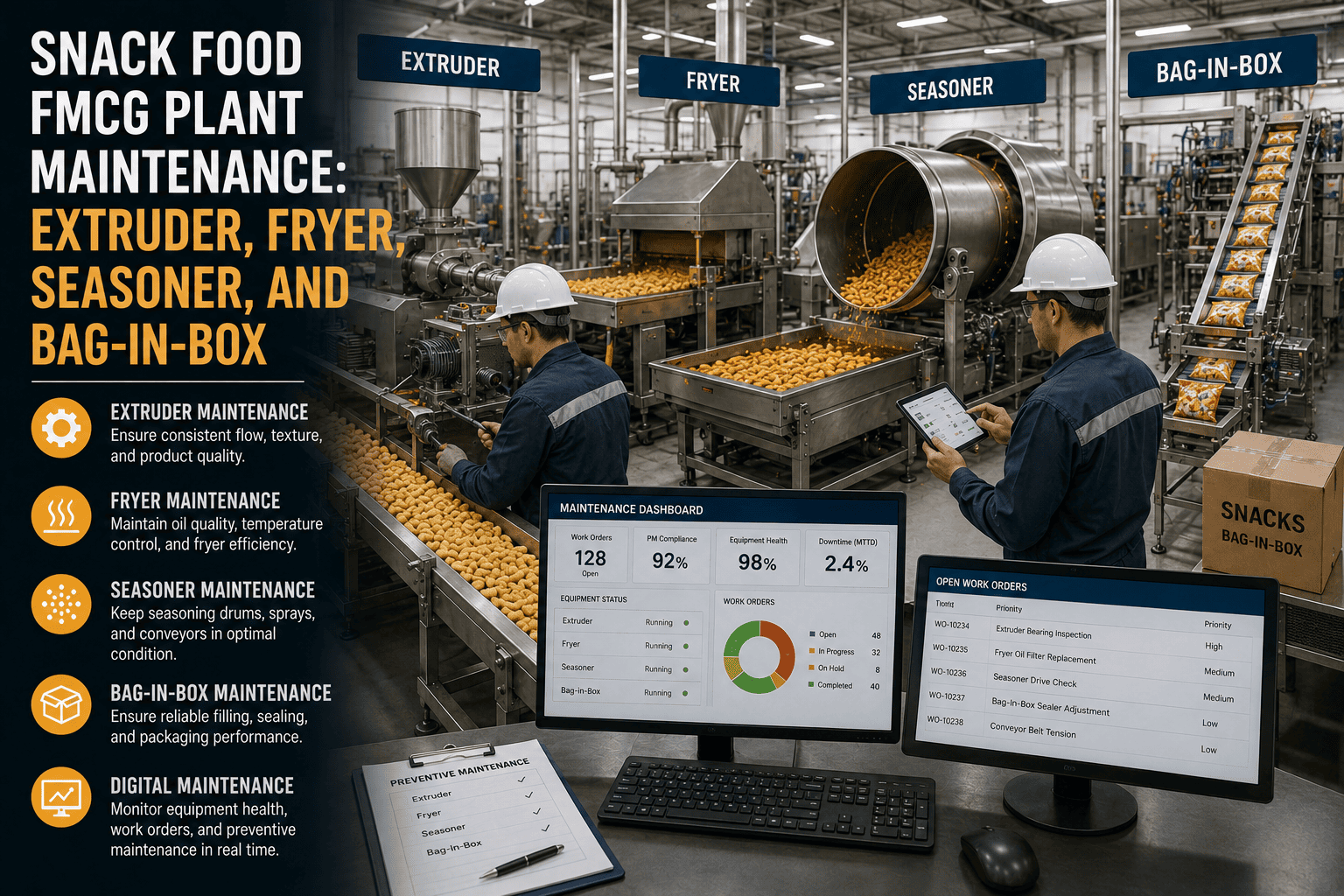
Continuous fryers for potato chips, namkeen, and extruded snacks operate under conditions that combine high heat, oil chemistry degradation, steam, and product residue accumulation in ways that no other food production asset replicates. Fryer maintenance is simultaneously a mechanical challenge (heat exchanger fouling, chain and conveyor wear, seal degradation), a food safety challenge (cross-contamination risk, allergen management, oil turnover), and a product quality challenge (free fatty acid buildup, temperature uniformity, residence time consistency). These three dimensions must be addressed in the same PM programme — not as separate workstreams.
01
Heat Exchanger
Daily + Monthly Deep
Oil-side fouling buildup reduces heat transfer efficiency by 3–8% per week without cleaning. Daily: oil temperature differential monitoring. Monthly: chemical clean with food-grade caustic followed by acid rinse and full flush. Document all chemical batch numbers for HACCP traceability.
02
Product Zone Conveyor
Daily Inspection
Fryer conveyor chains operating in hot oil require daily tension check and food-grade lubricant application to exposed chain sections outside the oil bath. Weekly: full chain stretch measurement — replace when elongation exceeds 2% of pitch. Chain failure in a running fryer creates a line-stop and product contamination event.
03
Oil Circulation Pumps
Weekly Condition Check
Pump seal degradation in hot oil systems creates dual risk: mechanical seal failure causes oil leakage (fire risk, product contamination) and pump cavitation causes temperature distribution failure across the fryer bed. Weekly: seal face temperature check via IR gun. Monthly: full seal inspection and mechanical seal lubricant replenishment.
04
Oil Level & Quality
Every 4 Hours
Free fatty acid (FFA) content above 1.0% causes product quality deterioration and accelerates heat exchanger fouling. Polar compound content above 25% is a food safety indicator requiring oil discard. Every 4 hours: FFA strip test and log. Weekly: lab analysis for polar compounds, smoke point, and colour. Oil turnover records are FSSAI-audited.
05
Temperature Control System
Daily Calibration Check
Fryer temperature uniformity across bed width is the primary product texture and colour consistency parameter. Daily: verify all zone RTD readings against reference thermocouple; document any >3°C deviation. Quarterly: full PID controller calibration with NIST-traceable reference. Out-of-spec temperature is both a quality and food safety record entry.
06
Exhaust & Vapour Recovery
Weekly Inspection
Fryer exhaust systems accumulate oil vapour condensate and polymerised deposits that create both fire risk and potential contamination of the exhaust air stream. Weekly: condensate drain clearance and oil trap inspection. Monthly: full duct inspection including deposit thickness measurement. Blocked exhaust causes fryer hood pressure buildup affecting product moisture.
Fryer PM Templates — FSSAI & BRC Compliant
Oil Quality Logs, CIP Records, and Allergen Clearance — One Work Order
Oxmaint's fryer maintenance templates combine mechanical PM, oil quality tracking, and food safety documentation in a single mobile work order — with photo capture, digital signature, and automatic audit trail generation for every completed inspection.
Confectionery Coating Line Maintenance: Pans, Drums & Enrobers
Confectionery coating equipment — whether chocolate enrobers, sugar panning drums, or compound coating lines — combines temperature-sensitive materials, high-precision dosing systems, and food safety requirements in ways that demand maintenance programmes specifically designed for confectionery processing conditions. Chocolate tempering systems, coating drum drive assemblies, and recirculation pumps all fail in confectionery-specific ways — and the consequences include product rejection, allergen cross-contact events, and audit non-conformances if maintenance records are incomplete.
Chocolate Enrobers
Daily + Weekly + Monthly
Daily: Tempering curve verification (temperature at each tempering stage ±0.5°C), chocolate viscosity check via flow cup test, curtain uniformity visual check, blower pressure at coating zone. Weekly: Full drain, clean, and restart with virgin chocolate trial — record temper index. Monthly: Drive gearbox oil sample, tunnel cooling section coil inspection, chocolate pump mechanical seal check. Allergen critical: Full allergen changeover CIP protocol with swab testing before different nut or dairy SKU run.
Sugar Panning Drums
Per Batch + Weekly
Per batch: Drum RPM verification, syrup spray nozzle flow rate check (all nozzles), air supply temperature and humidity at drum inlet, drum tilt angle vs. recipe spec. Weekly: Drum interior inspection for coating buildup, polymer residue hardening, and surface condition — buildup >3mm affects batch consistency. Drive motor current baseline comparison. Monthly: Full drum stripdown clean, nozzle calibration with graduated cylinder, drive shaft bearing lubrication with food-grade grease.
Compound Coating Lines
Daily + Monthly + Quarterly
Daily: Coating temperature at tank, pump, and application point — spec is ±2°C across all three points; viscosity via Bostwick or Zahn cup every 2 hours. Monthly: Tank heating element resistance check, agitator seal inspection, coating recirculation pump mechanical seal. Quarterly: Full tank CIP, heat exchanger descaling (compound lines attract calcium buildup in water-cooled jackets), all temperature sensor calibration. Allergen swab protocol after each changeover.
Changeover Protocol
Full documented CIP before every allergen changeover — from nut-containing to nut-free, or milk-chocolate to dark. Work order must capture: cleaning agent used, contact time, rinse volumes, and final rinse pH. Photos of critical contact surfaces required before sign-off.
Required
Swab Testing
Allergen swab of all product-contact surfaces after CIP and before first production run — enrober curtain, drum interior, pump heads, pipework connections, nozzle assemblies. Swab results logged in CMMS work order with batch number and pass/fail result.
Every changeover
Gasket & Seal Replacement
Food-grade gaskets in coating systems trap allergen residue in micro-cracks invisible to visual inspection. Replace all product-contact gaskets on the PM schedule — not when they visibly fail. Document gasket material specification and replacement date for HACCP records.
Quarterly minimum
Maintenance Tool Colour Coding
All tools used inside product-contact zones must be allergen-colour-coded and stored in designated locations. Maintenance team must not cross-use tools between allergen-containing and allergen-free lines. Tool issue and return logged in CMMS with technician sign-off.
Every work order
Failed Seal Response
Any seal or gasket failure on a coating line during production requires immediate line stop, product quarantine from the last verified clean inspection, and allergen investigation protocol. Work order must be created as an emergency with food safety flag — not closed without QA sign-off.
Immediate stop
Average Cost of an Allergen Recall in FMCG Food Manufacturing
$1M–$55M+
The maintenance team's allergen documentation is not a bureaucratic exercise — it is the defence against an outcome that ends production lines, careers, and sometimes companies. Every gasket replacement, CIP completion, and swab result must be in the CMMS before the line restarts.
Food Packaging Equipment Maintenance: Wrappers, Sealers & Cartoners
Packaging lines serving bakery, snack, and confectionery production share a common set of failure modes — jaw seal wear, film tension inconsistency, reject mechanism drift — but their PM requirements are shaped by the product type they handle. Biscuit packaging must handle fragile product and crumb contamination. Snack packaging must manage film static and electrostatic sealing issues at high speed. Confectionery packaging must handle temperature-sensitive product and high-speed twist-wrap mechanics. A single packaging line PM template does not serve all three.
Bakery / Biscuit Packaging Lines
Primary Failure Mode
Crumb accumulation in jaw seal faces causing incomplete seals — daily crumb purge is non-negotiable
Film Tension
Humidity sensitivity — film roll storage and tension settings must be adjusted seasonally
Product Handling
Fragile biscuit — guide rail clearance and in-feed timing must be adjusted per SKU weight; worn guides cause 3–8% product breakage
Seal Quality Check
Hot jaw temperature and pressure every 2 hours — biscuit shelf life is directly dependent on seal integrity
Contamination Risk
Crumb and oil residue on sealing surfaces — weekly full jaw stripdown and clean required, not just wipe-down
Snack / Confectionery Packaging Lines
Primary Failure Mode
Snack: electrostatic film issues at high speed. Confectionery: twist-wrap timing drift and wrapper material jamming at speed >800 ppm
Film Tension
Snack: static discharge management — ioniser bar cleaning weekly. Confectionery: twist-wrap film tension critical — ±5g deviation affects wrapper twist count
Product Handling
Snack: seasoning and oil residue on product sensors — cleaning and recalibration every 4 hours at high-oil SKUs
Seal Quality Check
Snack: nitrogen flush verification — O₂ residual <2% checked every 2 hours. Confectionery: wrapper twist count verification
Contamination Risk
Snack: seasoning powder ingress into servo drives — compressed air purge daily. Confectionery: temperature-controlled cleaning protocol
Packaging Line OEE Target: 88–92% on well-maintained food FMCG lines vs. 68–74% industry average on reactive maintenance
Per Shift
Sealing System
Every 6–8 hours
Jaw temperature verification against spec — both jaws to within ±3°C of setpoint; log reading and corrective action if out
Seal pressure check — pneumatic pressure at jaw actuator vs. spec; low pressure causes incomplete seals and product returns
Seal integrity sample — burst pressure test on 5 packs per shift; document results against minimum spec
In-feed guide clearance check — adjust per current SKU weight and dimensions; worn guides = product damage
Quality: Seal records are customer audit evidence — must be logged every shift without exception
Daily
Drive & Film System
After each production run
Film registration sensor clean — product dust accumulates on photocell faces; clean with IPA wipe and verify registration accuracy
Film tension roller inspection — bearing condition check by rotation feel; rough rotation indicates bearing load increase
Reject mechanism function test — manual trigger of reject gate; verify all rejected packs exit line cleanly
Full crumb and residue purge — compressed air clean of all product contact and sensor zones; log completion
Contamination: Daily residue purge is required for HACCP compliance — not optional
Weekly
Jaw & Tooling
Every 5 production days
Full jaw stripdown — remove jaw inserts, clean all sealing surfaces, inspect PTFE coating for wear patches; replace PTFE tape when <70% intact
Jaw alignment verification — parallelism check across full jaw width; misalignment >0.3mm causes partial seal lines
Cutting blade inspection — blade edge condition, mounting torque check; dull blades cause seal tearing rather than clean cut
Servo drive parameter check — cycle count against PM trigger; bearing lubrication at prescribed cycle intervals
Performance: Jaw PM is the highest-leverage maintenance task on any packaging line — 80% of seal defects originate here
Monthly
Full Electrical & Pneumatic
Every 30 production days
All pneumatic cylinder condition check — stroke smoothness, seal leak-off test, solenoid response time; sluggish cylinders cause timing faults at speed
Servo motor current baseline comparison — current above 110% of baseline indicates mechanical load increase
Control panel interior inspection — connection tightness, cooling fan condition, dust accumulation; overheating causes intermittent faults
Line speed accuracy verification — tachometer check against machine setpoint; speed drift affects fill weight and seal quality simultaneously
Reliability: Monthly electrical PM reduces packaging line fault stops by 35–45% vs. reactive-only maintenance
CIP and Sanitation in Food Equipment Maintenance
Clean-in-place is not a separate function from maintenance — it is maintenance. CIP system effectiveness directly determines allergen control, microbiological risk management, and equipment longevity. CIP pump seal wear, spray ball blockage, and heat exchanger fouling all degrade cleaning performance in ways that are invisible to quality testing until the failure is acute. Maintenance teams must own CIP system integrity as a core PM obligation, not delegate it entirely to sanitation teams without mechanical oversight.
CIP Pumps
Weekly: mechanical seal face temperature via IR gun (elevated temp = impending seal failure). Monthly: full seal inspection, impeller clearance check, motor current baseline comparison. Annual: complete pump overhaul. Seal failure during CIP causes diluted chemical solution — cleaning failure with no visible indicator.
Weekly + Monthly
Spray Balls & Nozzles
Per CIP cycle: visual rotation verification (rotating spray balls must be seen to rotate — blocked nozzles cause dead zones in cleaning coverage). Weekly: full spray ball removal, inspection, and flow test. Replace when orifice wear causes >10% flow deviation. Blocked spray balls cause HACCP non-conformances.
Per cycle + Weekly
CIP Heat Exchangers
Monthly: temperature differential monitoring across heat exchanger — fouling increases differential by 2–5°C per month without cleaning. Quarterly: full chemical descale. Fouled heat exchanger causes CIP solution to reach circuit at below-spec temperature — cleaning effectiveness critically reduced.
Monthly + Quarterly
Chemical Dosing Systems
Daily: conductivity verification at circuit entry point (confirms correct chemical concentration). Weekly: dosing pump calibration check with graduated cylinder. Monthly: dosing pump seal and diaphragm inspection. Wrong concentration — either direction — creates cleaning failure or chemical residue risk in product-contact surfaces.
Daily + Weekly
CIP Valves & Pipework
Monthly: all CIP butterfly valve seat inspection — worn seats cause cross-contamination between clean and dirty circuits. Quarterly: full pipework inspection including gasket condition in all CIP manifold connections. Annual: full circuit pressure test. Dead legs and gasket pockets are the primary sources of biofilm formation in food CIP systems.
Monthly + Quarterly
Every CIP cycle completion — chemical concentration, contact time, temperature, and rinse conductivity — must be logged with timestamp and operator ID. FSSAI inspectors look at CIP records as a primary indicator of food safety management system maturity.
Building a Food Equipment Maintenance Programme That Passes Audits
A maintenance programme that keeps equipment running but cannot demonstrate it at audit is a partial programme. Food manufacturing audits — BRC, FSSAI, FSSC 22000, customer-specific — evaluate maintenance as a food safety control, not just an operational function. The documentation that auditors look for goes beyond work order completion rates.
01
PM Schedule Compliance Rate
BRC Clause 4.6.2
All scheduled PM tasks completed within the defined window — not deferred without documented justification and sign-off from food safety team. 100% compliance rate is the audit expectation. Deferrals must show risk assessment, not just note the delay.
02
Allergen Changeover Records
HACCP Critical Control
Complete CIP records with chemical batch numbers, contact times, temperatures, and swab results for every allergen changeover. Gap in records = line release cannot be confirmed. Auditors cross-check changeover records against production schedule — timing must align.
03
Calibration Certificates
FSSC 22000 Req.
All temperature sensors, weight checkweighers, metal detectors, and pressure gauges must have current calibration certificates traceable to national standards. Expired calibration on a critical process instrument creates a product safety incident — all product since last valid calibration must be risk-assessed.
04
Food-Grade Lubricant Records
HACCP Prerequisite
Every lubricant application in a food production area must use a documented food-grade lubricant (NSF H1 or equivalent). Work orders must capture: lubricant name, NSF registration number, and quantity applied. Non-food-grade lubricant found in a product zone is a critical non-conformance.
05
Foreign Body Risk Assessment
BRC Clause 4.9
Maintenance activities that introduce foreign body risk — glass, metal shards, fasteners, tool fragments — require pre-task risk assessment and post-task verification. All fasteners and tools must be counted out and counted back in. One missing bolt in a product zone is a production halt and product quarantine event.
06
Safety Interlock Test Records
OSHA / Factory Act
Oven over-temperature trips, fryer flame-out safety, packaging line guard interlock tests — all must be tested at defined frequency and results recorded. Bypassed or untested interlocks are both an insurance issue and a regulatory enforcement risk. Records must show the test result, not just that the test was scheduled.
07
Contractor Maintenance Records
BRC Clause 4.6.3
All third-party maintenance contractors must sign food safety rules, use only approved food-grade materials, and have their work documented in the CMMS under the relevant asset record. Verbal contractor sign-off is not acceptable — auditors require the same documentation standard for contractors as for internal technicians.
08
Spare Parts Food Safety Compliance
HACCP Prerequisite
Replacement seals, gaskets, lubricants, and food-contact components must meet the same food safety specification as the originals — and the specification must be documented in the CMMS parts master. An OEM-equivalent part is only acceptable if its food safety compliance is confirmed in writing — not assumed from visual similarity.
Audit-Ready Maintenance Documentation
Every Work Order. Every Sign-Off. Every Record — Ready for BRC and FSSAI.
Oxmaint generates complete audit evidence packages for BRC, FSSAI, and FSSC 22000 — PM compliance rate reports, calibration certificate records, allergen changeover logs, and food-grade lubricant traceability, all linked to asset records and retrievable in minutes.
Frequently Asked Questions
What is the minimum PM frequency for a continuous bakery tunnel oven running 20 hours per day?▼
For a continuous tunnel oven running 20 hours per day, the minimum PM schedule is: burner flame and zone temperature check every shift (not every day — every shift), drive motor current reading and conveyor tension check weekly, external casing infrared temperature mapping monthly, and full burner strip, safety interlock functional test, and RTD calibration verification quarterly. The quarterly safety interlock test is non-negotiable under most insurance policies and national factory acts regardless of whether a BRC or FSSAI audit is pending. Plants that skip the quarterly interlock test on the grounds that the oven is running well are accumulating insurance and regulatory risk, not saving maintenance cost.
How do we handle allergen changeover documentation in a CMMS for a coating line that runs multiple nut-containing SKUs?▼
The correct approach is to create a dedicated allergen changeover work order type in the CMMS — separate from routine PM — that is triggered by the production schedule whenever an allergen-boundary changeover is planned. This work order must include mandatory completion fields for: CIP chemical used (with batch number), solution concentration verified by conductivity meter, contact time at temperature, final rinse conductivity (must meet spec before proceeding), and allergen swab results for each defined test location. The work order must require QA digital sign-off before the line release step can be completed. In Oxmaint, this workflow is built with conditional fields that cannot be bypassed — the line release step is locked until all mandatory fields are completed and QA sign-off is obtained. This creates an automatic audit trail that maps every changeover to the production records before and after it.
What are the most common causes of snack fryer downtime and how can PM reduce their frequency?▼
The four most frequent causes of unplanned snack fryer downtime are, in order: conveyor chain failure (typically from insufficient tension monitoring and lubrication), heat exchanger fouling causing temperature control loss (prevented by weekly oil differential monitoring and monthly chemical clean), oil circulation pump seal failure (prevented by weekly IR seal temperature check), and temperature sensor drift causing product quality failure that is only caught at quality check (prevented by daily reference thermocouple comparison). Of these four, conveyor chain failure and pump seal failure are the two most expensive because they cause immediate production stops with oil system contamination risk. A PM programme that includes daily chain tension check, weekly chain stretch measurement, and weekly pump seal IR check will reduce these two failure types by 70–85% within the first 6 months of consistent implementation.
How does Oxmaint handle multi-line food manufacturing plants where each line runs different products with different PM requirements?▼
Oxmaint's asset hierarchy model is designed specifically for multi-line food manufacturing plants. Each production line is set up as a separate asset group within the plant, with its own PM schedule, checklist templates, allergen profile, and maintenance history — completely independent from other lines even within the same physical facility. At the equipment level within each line, PM tasks are configured per asset type: the oven on Line 3 has oven-specific tasks, the fryer on Line 3 has fryer-specific tasks, and the packaging line has packaging-specific tasks — each with different frequencies, different mandatory fields, and different sign-off requirements. Where a plant runs allergen-containing product on some lines and allergen-free product on others, Oxmaint's work order system enforces tool colour-code requirements and allergen changeover protocols as conditional fields that appear only on the relevant lines.
What documentation do BRC auditors specifically look for in food manufacturing maintenance records?▼
BRC auditors examining maintenance records under clause 4.6 typically look for six things: first, that a documented PM schedule exists for all equipment that could affect product safety or quality — not just production equipment but utilities, CIP systems, and environmental controls too. Second, that completion rates against that schedule are tracked and any deferrals are documented with risk assessment sign-off. Third, that all food-contact lubricants are NSF H1 registered and the registration number appears in work order records. Fourth, that safety interlocks are tested at the documented frequency and the test results (not just the test schedule) are recorded. Fifth, that allergen changeover records are complete, timestamped, and include swab results linked to the production records immediately following the changeover. Sixth, that foreign body risk assessment is documented for any maintenance activity that introduces potential foreign body materials into a product zone. Verbal confirmation of any of these is not acceptable — BRC auditors require documented evidence in the CMMS or equivalent system.
Equipment-Specific Templates for Bakery, Snacks & Confectionery
Maintenance That Keeps Lines Running and Audits Passing
Oxmaint's food manufacturing CMMS includes pre-built PM templates for tunnel ovens, continuous fryers, coating drums, enrobers, and packaging lines — with allergen changeover workflows, CIP sign-off fields, food-grade lubricant tracking, and calibration records built into every work order. Deploy in 48 hours. FSSAI, BRC, and FSSC 22000 audit-ready from day one.
✓
Oven, fryer, coating & packaging PM templates — asset-type specific, not generic
✓
Allergen changeover workflows with mandatory CIP sign-off and swab result capture
✓
Food-grade lubricant tracking with NSF registration number fields on every applicable work order
✓
Multi-line plant support — independent PM schedules and allergen profiles per production line
✓
FSSAI, BRC, and FSSC 22000 audit trail — every work order timestamped with digital technician sign-off
✓
Mobile-first — technicians complete work orders on the production floor, not in the office two days later




.png)

