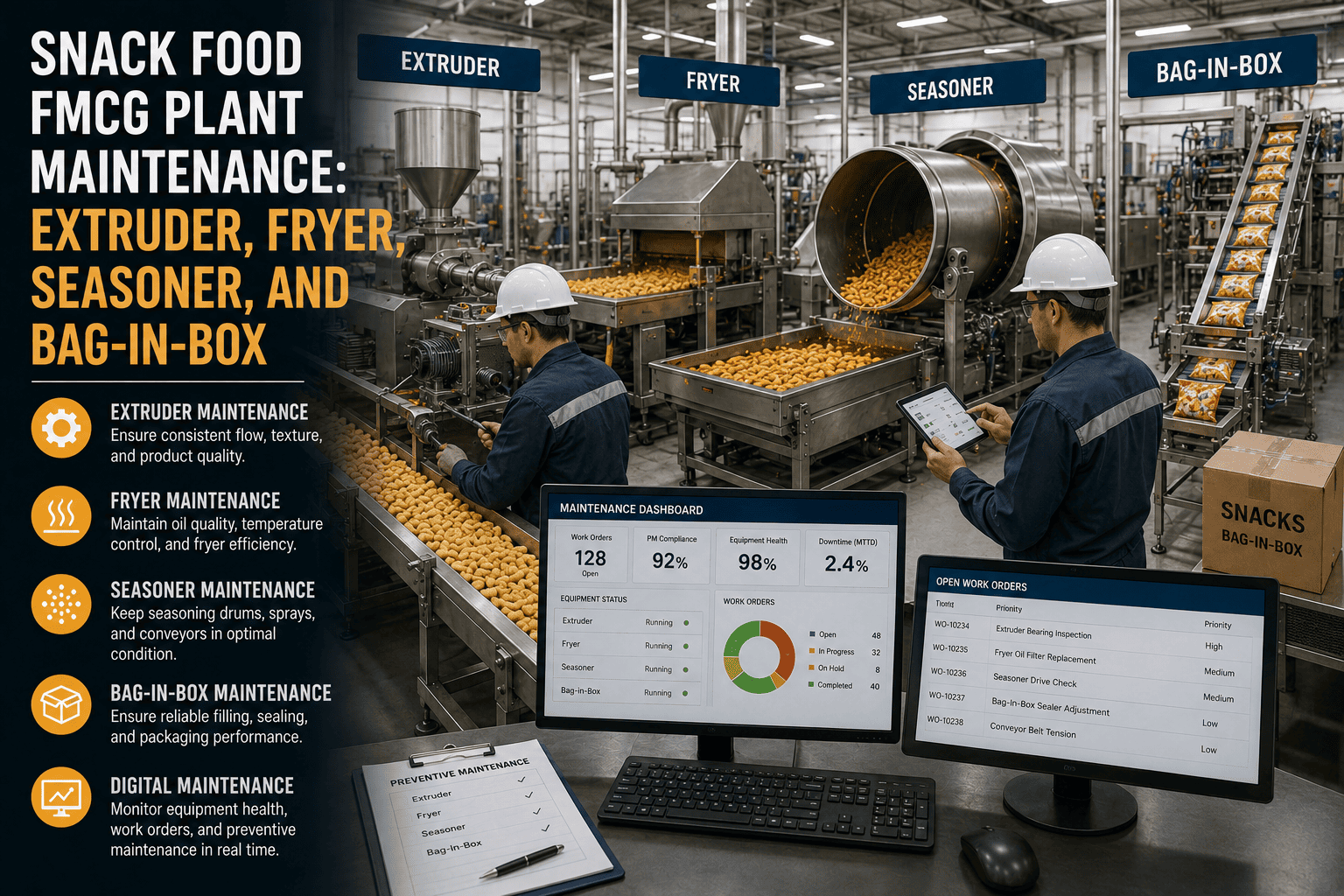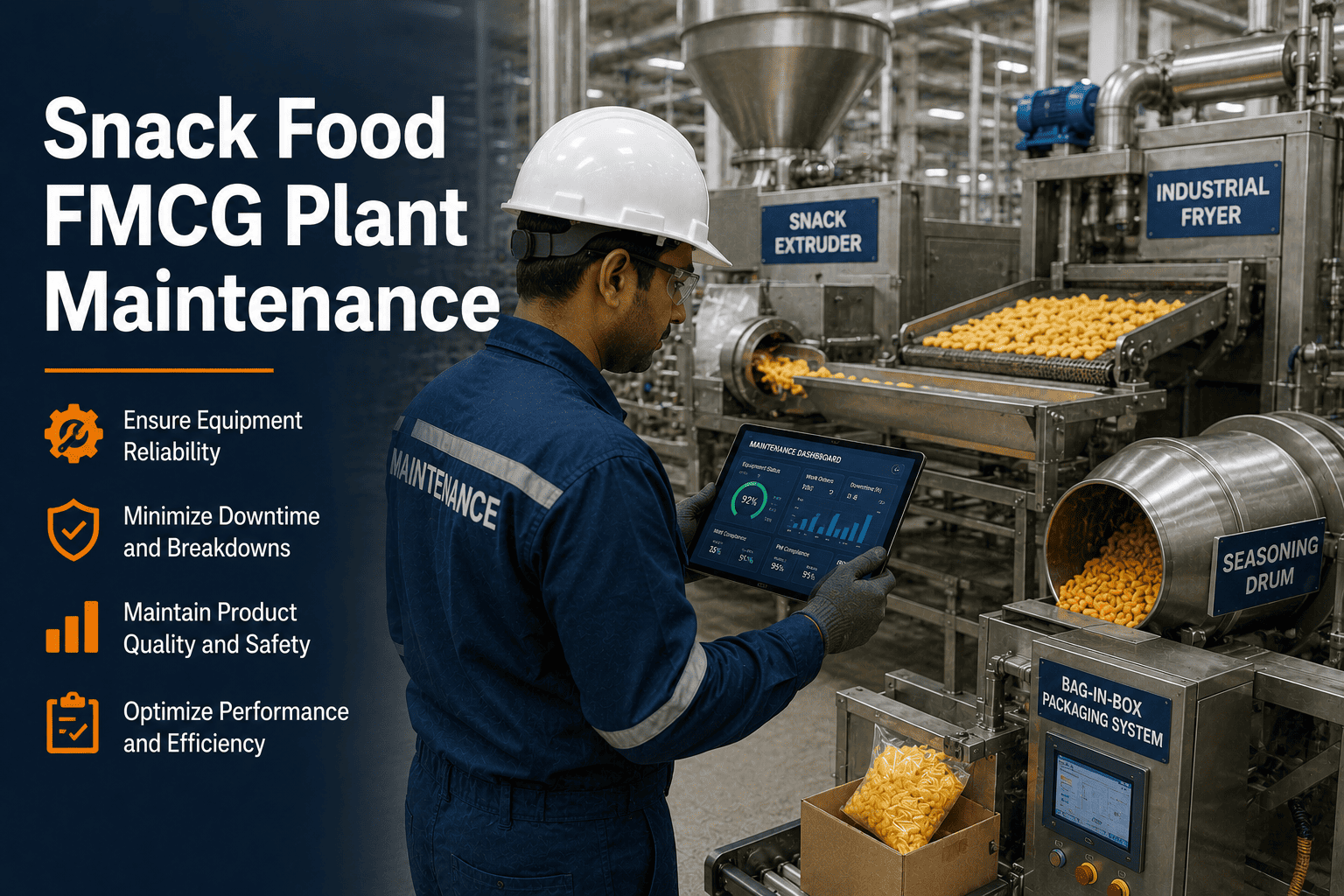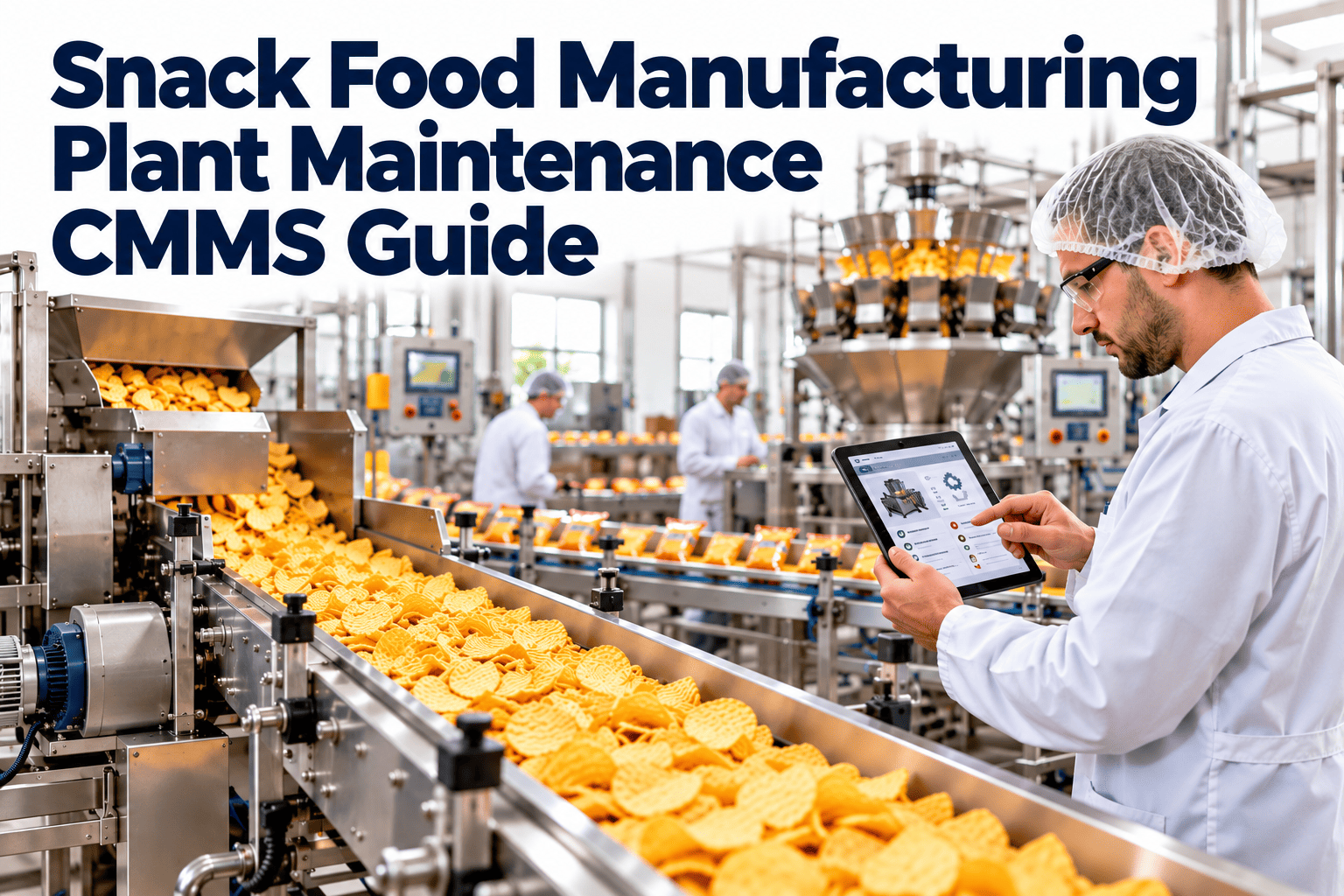
A snack plant turns raw potatoes, corn, or dough into crisp, seasoned, sealed bags at a pace that leaves little room for error. The fryer sits at the center of the process, and what it does to oil, product color, and moisture decides whether everything downstream is right. Seasoning has to be even, the bag has to seal on a dusty surface, and the line must be cleaned and changed over without allergen mix-ups. This guide walks through the equipment that most often limits a snack line and how a CMMS can keep preventive work, inspections, and repair history organized across it.
Snack Food Manufacturing Plant Maintenance: Fryers, Seasoning and VFFS Packaging
Hot oil, fine powder, and high-speed bagging make snack lines unforgiving. Plan the maintenance around the three places where quality and downtime are decided.
Why a Snack Line Fails Where It Does
Snack lines are mostly continuous, so one weak asset sets the pace for the rest. The pain points cluster in the hot, the dusty, and the fast sections.
Fryer System Maintenance
A fryer is heating equipment, a filtration system, and a food safety control at the same time. Its maintenance should be planned with each role in mind.
| Fryer element | What can go wrong | Effect on product or plant | Preventive action |
|---|---|---|---|
| Heat source and heat exchanger | Fouling, burner faults, or thermal fluid problems | Unstable temperature, slow recovery, color variation, safety risk | Inspect and clean exchangers, check burners and safety interlocks, verify controls |
| Temperature sensors and controllers | Drift or failure | Under or over-fried product and wasted energy | Calibrate on a schedule and compare redundant probes |
| Oil filtration and circulation | Blocked filters, pump wear, or leaks | Fines remain in oil, quality falls, and downtime rises | Change filters on condition, check pump and seals, record oil changes |
| Conveyors and paddles inside the fryer | Chain wear, bearing failure, or misalignment | Uneven cooking, product clumping, or an unplanned stop | Inspect drives, chains, and bearings, and measure wear against limits |
| Exhaust hood and ducting | Grease and residue buildup | Poor extraction and elevated fire risk | Clean on a defined schedule and inspect dampers and fans |
| Fire protection and safety systems | Missed testing or blocked access | Reduced protection when it is needed most | Test and inspect according to site and insurer requirements, and record results |
Oil quality belongs in the maintenance record
Seasoning Applicator Maintenance
Seasoning is applied by a tumble drum, a spray, or a dusting system, and evenness depends on the product flow, the dosing feeder, and the drum condition. Powders also bring humidity, bridging, and dust hazards.
Vertical Form Fill Seal Maintenance
A vertical form fill seal machine forms film into a tube, fills it, and seals it, often with gas flush. Each of these steps wears in a different way, and snack dust makes sealing harder.
Common VFFS faults
- Leaking or weak seals caused by worn jaws, wrong temperature, or product in the seal.
- Film not tracking, causing crooked seals or wasted packs.
- Dust and crumbs on the jaws, which prevent a clean weld.
- Inconsistent bag weight from weigher or feeder issues.
Maintenance responses
- Replace jaw covers and cutters on a cycle or condition schedule.
- Check film path alignment and sensors during every PM.
- Add jaw cleaning to shift routines and record it against the machine.
- Verify weigher cells and vibratory feeders during planned stops.
Allergen and Food Safety Records Around Maintenance
Maintenance work can introduce foreign material or disturb cleaning. Plants typically manage this through hygiene procedures and records, and the details depend on local regulations and customer requirements.
Controls often expected
- Tools and parts controlled in food areas, with removal checks after work.
- Cleaning and verification after maintenance on product-contact equipment.
- Metal detector and checkweigher verification records.
- Calibration records for oven, fryer, and packaging instruments.
How a CMMS helps
- Tasks can include hygiene steps and sign-off before returning an asset to service.
- Inspection templates can store verification results with dates.
- Calibration tasks are scheduled and visible by instrument.
- Records are available when a customer or auditor asks.
Before and After: Running Snack Lines on Memory or on Records
Relying on experience alone
- The fryer is cleaned and inspected when someone remembers.
- Seal complaints are fixed by changing settings, not by finding the worn part.
- Seasoning faults are blamed on the operator.
- Downtime reasons are not recorded in a way that can be compared.
With organized maintenance data
- Fryer, seasoning, and VFFS tasks are scheduled and tracked.
- Seal faults connect to jaw, film, or heater findings.
- Feeder and drum condition are inspected on a routine.
- Downtime by asset and cause supports improvement decisions.
Operational Impact of Fryer, Seasoning, and Sealer Problems
Conveying, Weighing, and Metering Upstream of the Bagger
Many bag weight problems begin before the weigher. Vibratory conveyors, feeders, and scales are mechanical and electrical assets that need their own schedules.
| Asset | Typical issue | Effect on the line | Preventive task |
|---|---|---|---|
| Vibratory conveyor or feeder | Spring fatigue, loose mounts, or drive wear | Uneven product flow and bridging at the weigher | Inspect springs, mounts, and drive settings, and record amplitude |
| Multihead or linear weigher | Load cell drift, product buildup, or gate wear | Weight spread and giveaway | Calibrate, clean, and inspect gates and hoppers |
| Metal detector | Sensitivity drift or reject mechanism fault | Missed detection or false rejects | Verify with test pieces, and log results as required by your quality plan |
| Checkweigher | Calibration drift or belt wear | Incorrect rejects and inaccurate data | Verify with test weights and inspect belts and sensors |
Compressed Air, Nitrogen, and Packaging Gases
Why they deserve a schedule
- Pneumatic jaws, cutters, and reject devices depend on clean, stable air.
- Gas flush systems need correct purity, flow, and leak-free connections.
- Moisture and oil in compressed air can contaminate packaging and damage components.
- Pressure drops from leaks can cause intermittent faults that are hard to trace.
What to check and record
- Filter, dryer, and regulator condition at the machine and at the plant level.
- Gas flush flow and residual oxygen checks, if your quality plan requires them.
- Leak surveys on hoses and fittings.
- Pressure readings at the VFFS during normal operation.
Training Operators to Support Maintenance
Spare Parts Priorities for a Snack Line
Review parts consumption each quarter against failures by asset. Parts that are used often deserve a stock level and a task, and parts never used may be taking up space and money better spent elsewhere.
KPIs for Snack Plant Maintenance
Where Snack Plant Maintenance Is Heading
Shutdown and Changeover Checklist
- Fryer temperature probes verified and controls checked.
- Oil filters, pumps, and seals inspected.
- Exhaust hood and ducting cleaned and inspected.
- Safety interlocks and fire protection tested and recorded.
- Seasoning feeder calibrated and hopper checked for bridging.
- Tumble drum flights, bearings, and seals inspected.
- VFFS jaws, cutters, and film path inspected.
- Metal detector and checkweigher verification recorded.
Start with the fryer, the seasoning feeder, and the VFFS sealing station, since these three assets account for most quality and downtime discussions, then extend the same task and record structure to conveying, weighing, and end-of-line equipment.