Vision Systems & AI for FMCG Quality Inspection: From Cameras to Models
By Oxmaint on February 17, 2026
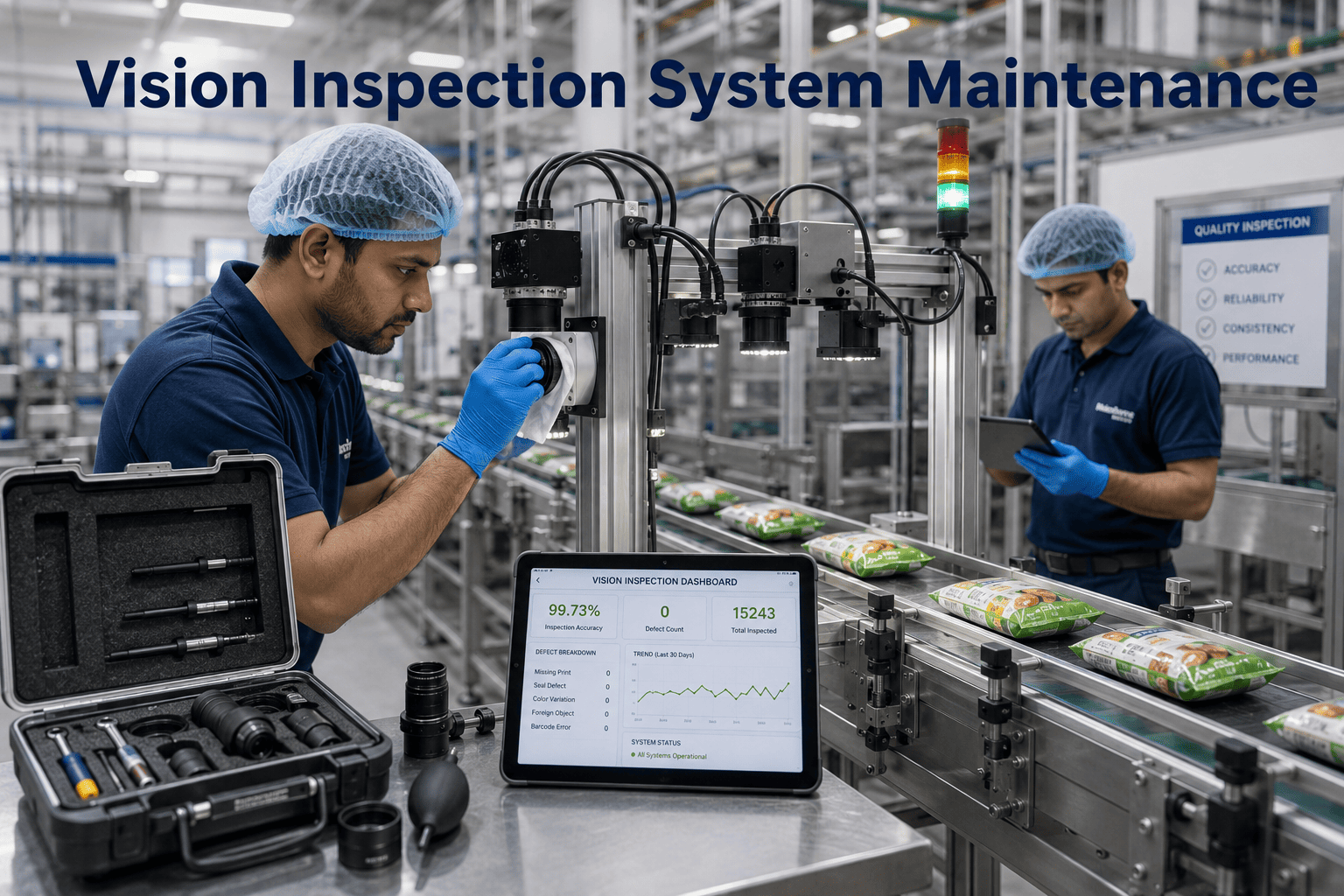
A beverage bottling plant in North Carolina was running 14 vision cameras across four filling lines — inspecting fill levels, label placement, cap torque indicators, and date code legibility at a combined throughput of 1,200 bottles per minute. The system had been installed three years earlier and was still using the original AI classification models. Nobody had recalibrated a single camera in eight months. When the QA team audited reject data, they found the defect escape rate had drifted from the validated 0.2% to 1.7% — an eightfold increase that had been invisible because the vision system was still reporting "pass" on units it could no longer see clearly. Two cameras had developed condensation hazing on the lens housing. One had a backlight LED bank operating at 62% of original intensity. The AI model for label inspection had never been retrained after the brand introduced a matte-finish label stock that changed the reflectance profile. The plant traced $340,000 in customer complaints, trade returns, and retailer chargebacks over the prior six months directly to vision system degradation that a structured camera health monitoring and model drift tracking program would have caught within the first week. Schedule a consultation to see how Oxmaint manages vision system maintenance alongside your production assets.
$340K
in quality losses traced to unmonitored vision system degradation at one plant
1,200/min
inspection throughput where a 1% escape rate means 12 defective units every minute
0.2→1.7%
defect escape drift over 8 months with no camera health or model monitoring
72 hrs
time to detect drift with structured CMMS-integrated monitoring vs. months without
Your vision system is an asset — maintain it like one. Oxmaint tracks camera health, model performance, and calibration schedules alongside every other production asset in your plant.
A production-grade FMCG vision inspection system is not a camera — it is a layered technology stack where each layer introduces failure modes that must be monitored and maintained independently. Understanding this architecture is the prerequisite for building a maintenance program that prevents the invisible quality erosion most plants discover only through customer complaints.
01
Illumination Layer — Lighting Sources and Geometry
Structured lighting — LED bars, backlights, dome diffusers, and dark-field arrays — creates the contrast conditions that make defects visible to cameras. Lighting degrades silently: LED output drops 15–30% over 20,000 hours, color temperature shifts as phosphor ages, and dust accumulation on diffuser panels reduces uniformity. When lighting fades below the threshold the AI model was trained on, the model starts misclassifying good product as defective and — worse — passing defective product as good. Most plants never monitor light intensity after initial commissioning.
LED DegradationIllumination Uniformity
02
Imaging Layer — Cameras, Lenses, and Sensors
Area-scan and line-scan cameras capture images at production speed — 30 to 200+ frames per second depending on line throughput. Lens contamination from product splash, condensation, and airborne particulates degrades resolution progressively. Sensor pixel response drift and hot-pixel development change the baseline image the AI processes. Focus drift from vibration and thermal cycling shifts the plane of sharpness. Each of these degradation modes produces subtle image quality changes that the AI model was never trained to compensate for.
Lens ContaminationSensor Drift
03
Processing Layer — Edge Compute and AI Inference
GPU-accelerated edge processors run AI inference models at line speed — classifying every image as pass/fail within 5–50 milliseconds. Thermal throttling under sustained load reduces inference speed and can cause frame drops that mean uninspected product reaches the pack station. GPU memory degradation and driver compatibility issues after firmware updates create intermittent classification failures that are extremely difficult to diagnose without structured monitoring.
GPU Thermal ManagementInference Latency
04
AI Model Layer — Classification, Detection, and Segmentation
Deep learning models trained on historical defect images perform the actual quality decision. Model drift is the most insidious failure mode in the stack: the model performs perfectly on the data it was trained on, but production changes — new packaging materials, seasonal ingredient color variation, supplier label stock changes, lighting degradation — shift the input data distribution away from training data. The model's accuracy erodes silently because it still produces a confident classification on every image — it is just increasingly wrong.
Model DriftData Distribution Shift
05
Specialty Imaging — Hyperspectral, X-Ray, and 3D Profiling
Beyond standard RGB cameras, FMCG plants increasingly deploy hyperspectral imaging for foreign object and contamination detection in food products, X-ray systems for density and fill-level verification, and 3D laser profiling for seal integrity and dimensional measurement. Each modality adds sensor-specific calibration requirements, reference standard validation schedules, and regulatory compliance documentation that must be tracked systematically. A drifted hyperspectral calibration can miss allergen contamination — a safety-critical failure, not just a quality issue.
Food SafetyRegulatory Compliance
Camera Health Monitoring: What Degrades and When
Every component in the vision stack has a degradation signature. Plants that track these signatures against operating hours and environmental conditions catch quality erosion weeks before it reaches the customer. Plants that do not track them discover degradation through complaints, returns, and audit findings.
Vision System Component Degradation Map
1
LED Lighting — 15,000–25,000 hr service life
Output intensity drops 15–30% before visual appearance changes. Color temperature shift alters product appearance in images. Measure with lux meter at commissioning and track decline quarterly. CMMS trigger: lux reading below 80% of baseline or 5,000 operating hours since last measurement.
2
Camera Lens — Contamination and Focus Drift
Product splash, condensation haze, and dust reduce sharpness and contrast. Vibration-induced focus drift shifts the focal plane. Inspect weekly in wet environments, monthly in dry. CMMS trigger: MTF (modulation transfer function) test below specification or environmental alert from humidity sensor.
3
Image Sensor — Pixel Response and Thermal Noise
Hot pixels, dead pixels, and response non-uniformity develop over years of continuous operation. Thermal noise increases in high-ambient environments. Annual flat-field calibration identifies sensor degradation before it affects classification accuracy. CMMS trigger: annual calibration schedule or defect rate anomaly.
4
GPU/Edge Processor — Thermal Throttling and Latency
Dust accumulation on heatsinks and fan degradation raise GPU temperatures, triggering thermal throttling that slows inference below line speed. Frame drops mean uninspected product. CMMS trigger: GPU temperature above 85°C, inference latency exceeding frame interval, or fan RPM below threshold.
5
Enclosures and Cabling — Environmental Protection
IP-rated enclosures protect cameras from washdown, product spray, and temperature extremes. Seal degradation allows moisture ingress that fogs lenses internally. Cable connector corrosion and flex fatigue cause intermittent signal loss. CMMS trigger: enclosure seal inspection every 6 months, cable continuity test annually. Start tracking vision system health — sign up free.
AI Model Drift: The Silent Quality Killer
Model drift is the most dangerous failure mode in AI-powered inspection because the system continues to operate — it continues to inspect every unit, classify every image, and report metrics — while its accuracy degrades invisibly. There is no alarm, no flashing light, no obvious symptom until the quality data reveals a problem that has been accumulating for weeks or months.
01
Data Distribution Shift — When Production Changes Outpace the Model
Every AI model is trained on a specific dataset that represents "normal" production conditions at a point in time. When production changes — new label stock with different reflectance, seasonal color variation in food ingredients, a supplier switch on packaging film, or even a new cleaning chemical that leaves a different residue pattern — the images the model sees shift away from its training data. The model does not know it is wrong. It applies the same classification logic to fundamentally different input data and produces increasingly unreliable results with full confidence scores.
Covariate ShiftProduction Variability
02
Concept Drift — When the Definition of "Defect" Evolves
Quality standards change. A customer raises the threshold for acceptable label misalignment from 2mm to 1mm. Regulatory requirements redefine minimum date code legibility. A new retailer audit standard classifies a previously acceptable fill-level variation as a defect. The model continues classifying against the original definition while the business has moved on. Without a structured process to update model training data and retrain when quality standards change, the gap between what the model accepts and what the customer accepts widens over time.
Standards EvolutionRetraining Triggers
03
Monitoring Model Health — Metrics That Catch Drift Early
Effective model drift detection requires tracking classification confidence score distributions, reject rate trends by defect category, false positive and false negative rates against ground-truth samples, and input image quality metrics. When the average confidence score for "pass" classifications drops below a threshold, or the distribution of confidence scores shifts shape, drift is occurring — even if the overall pass/fail rate has not yet changed visibly. These metrics must flow into the CMMS to trigger model review work orders before accuracy erosion reaches the customer.
Confidence MonitoringStatistical Process Control
Catch model drift before your customers do. Oxmaint links vision system performance metrics to automated work orders — so camera cleaning, recalibration, and model review happen on schedule, not after a quality crisis.
CMMS Integration: Vision Systems as Maintainable Assets
The fundamental shift is treating every camera, light source, edge processor, and AI model as a maintainable asset in the CMMS — with defined service intervals, degradation triggers, spare parts catalogs, and compliance documentation — the same way plants already manage motors, pumps, and conveyors.
85%
Reduction in defect escape rate with structured camera health monitoring
72 hrs
Model drift detection time with CMMS-tracked performance metrics
98%+
Vision system uptime with preventive maintenance on all stack layers
$340K
Annual quality loss avoidable with camera health and model drift monitoring
Defect Reporting: Closing the Loop Between Detection and Action
Vision systems detect defects. What happens after detection determines whether the plant achieves zero-defect manufacturing or just generates reject data nobody acts on. The defect reporting workflow must connect vision system output to production response, maintenance action, and root cause resolution.
Defect Detection to Root Cause Resolution Workflow
1
Real-Time Defect Classification
Vision AI classifies each defect by type — label misalignment, fill-level deviation, cap torque indicator, seal integrity, date code legibility, foreign object — and assigns severity. Critical defects trigger immediate line stop; minor defects log for trend analysis.
2
Reject Rate Trend Analysis
CMMS monitors reject rates by defect category, line, shift, and time window. When a defect category exceeds its statistical control limit, the system auto-generates an investigation work order — catching process drift before cumulative rejects trigger a quality hold.
3
Root Cause Correlation
The CMMS correlates defect spikes with maintenance events, equipment changes, material lot changes, and operator shifts — surfacing the probable cause and linking it to the corrective action workflow.
4
Corrective and Preventive Action
Maintenance and quality teams execute the corrective action — equipment adjustment, material rejection, model retrain — and the CMMS tracks completion, verifies defect rate returns to baseline, and stores documentation for audit. Start building your defect reporting workflow — sign up free.
Implementation Roadmap: Vision System Maintenance Program
Most FMCG plants can build a comprehensive vision system maintenance program within 12–16 weeks by layering camera health monitoring, model drift tracking, and defect reporting onto their existing CMMS infrastructure.
Vision System Maintenance Program Deployment
Weeks 1-3
Asset Inventory & Baseline
Register every camera, light source, processor, and AI model in CMMSRecord baseline lux readings, focus MTF, and model accuracy metricsMap spare parts — lenses, LED bars, enclosure seals, cables
Weeks 4-8
PM Schedules & Triggers
Configure operating-hour and calendar-based PMs for each componentSet reject rate thresholds that auto-generate calibration work ordersBuild model drift monitoring dashboards with confidence score tracking
Weeks 8-12
Defect Reporting Integration
Connect vision system defect output to CMMS trend analysisActivate auto-investigation triggers for reject rate exceedancesBuild root cause correlation between defects and maintenance events
Weeks 12-16
Optimization & Audit Readiness
Refine PM intervals based on actual degradation dataComplete model retraining workflow documentationVerify audit-ready compliance records for all calibration and validation
Your Vision System Inspects Every Unit. Who Inspects the Vision System?
Oxmaint treats every camera, light source, edge processor, and AI model as a maintainable asset — with operating-hour PMs, reject rate triggers, model drift alerts, and calibration tracking that prevent the invisible quality erosion that costs FMCG plants hundreds of thousands in customer complaints and returns.
How do we detect AI model drift before it affects product quality?
Monitor three metrics continuously: classification confidence score distributions, reject rate trends by defect category, and false positive/negative rates against periodic ground-truth sampling. When average confidence scores for "pass" classifications drop below a defined threshold — or the shape of the confidence distribution changes — drift is occurring even if the headline pass rate looks stable. Oxmaint tracks these metrics and auto-generates model review work orders when thresholds are breached. The key is catching distribution shifts before they accumulate into escape rate changes visible to customers. Book a demo for a walkthrough of model drift monitoring.
What camera health checks should we perform and how often?
Lens cleaning and visual inspection weekly in wet or dusty environments, monthly in clean environments. Lux meter readings on all lighting quarterly — or every 5,000 operating hours — compared to commissioning baseline. Focus MTF verification quarterly. Flat-field sensor calibration annually. Enclosure seal inspection every six months. GPU temperature and inference latency monitoring continuously. Each of these maps to a CMMS work order with defined acceptance criteria, so the technician knows exactly what "pass" looks like. Sign up free and start building your camera PM program.
Can Oxmaint manage both vision system maintenance and production equipment maintenance?
Yes — that is the core advantage. Vision cameras, light sources, and edge processors register as assets in the same CMMS that manages your fillers, cappers, labelers, and conveyors. This means a single platform tracks all PMs, spare parts, work orders, and compliance documentation. More importantly, when vision system defect data correlates with production equipment maintenance events — a filler adjustment causes a fill-level reject spike — the CMMS connects the dots across both asset categories automatically.
What about hyperspectral and X-ray systems — does the same maintenance approach apply?
The principle is identical — treat the system as a layered asset stack and maintain each layer against operating data — but the specific calibration requirements differ. Hyperspectral systems require wavelength calibration against certified reference standards at intervals defined by your food safety plan. X-ray systems require annual radiation safety certification and dosimetry calibration under FDA 21 CFR 1020.40. Oxmaint manages these as compliance-driven PMs with mandatory documentation, photo-verified completion, and audit-trail storage.
How quickly does a vision system maintenance program deliver ROI?
Most plants see measurable return within 90 days. The first prevented defect escape event — a customer complaint, a retailer chargeback, a quality hold — typically justifies the program cost for the entire first year. The North Carolina plant in our opening case study lost $340,000 over six months from unmonitored vision degradation. A structured maintenance program with quarterly lux checks, monthly lens inspections, and continuous reject rate monitoring would have caught the issue within the first week for a total intervention cost under $2,000.