Food manufacturing is running out of the people who keep it running. As of 2024, there were 74,000 open jobs in food manufacturing specifically — and 622,000 across all of manufacturing. The hardest positions to fill are maintenance technicians, QA leads, and sanitation supervisors: the exact roles that determine whether your lines run safely and your audits pass. Every experienced technician who retires takes years of institutional knowledge with them — knowledge that cannot be replaced by hiring alone. The plants that survive this shift are not the ones hiring fastest. They are the ones making every technician they have dramatically more effective. AI maintenance systems are becoming the primary tool for doing exactly that — turning a team of three into the operational output of five, and a single experienced technician into the knowledge anchor for an entire shift.
Labor Optimization · Operational Strategy · 2026
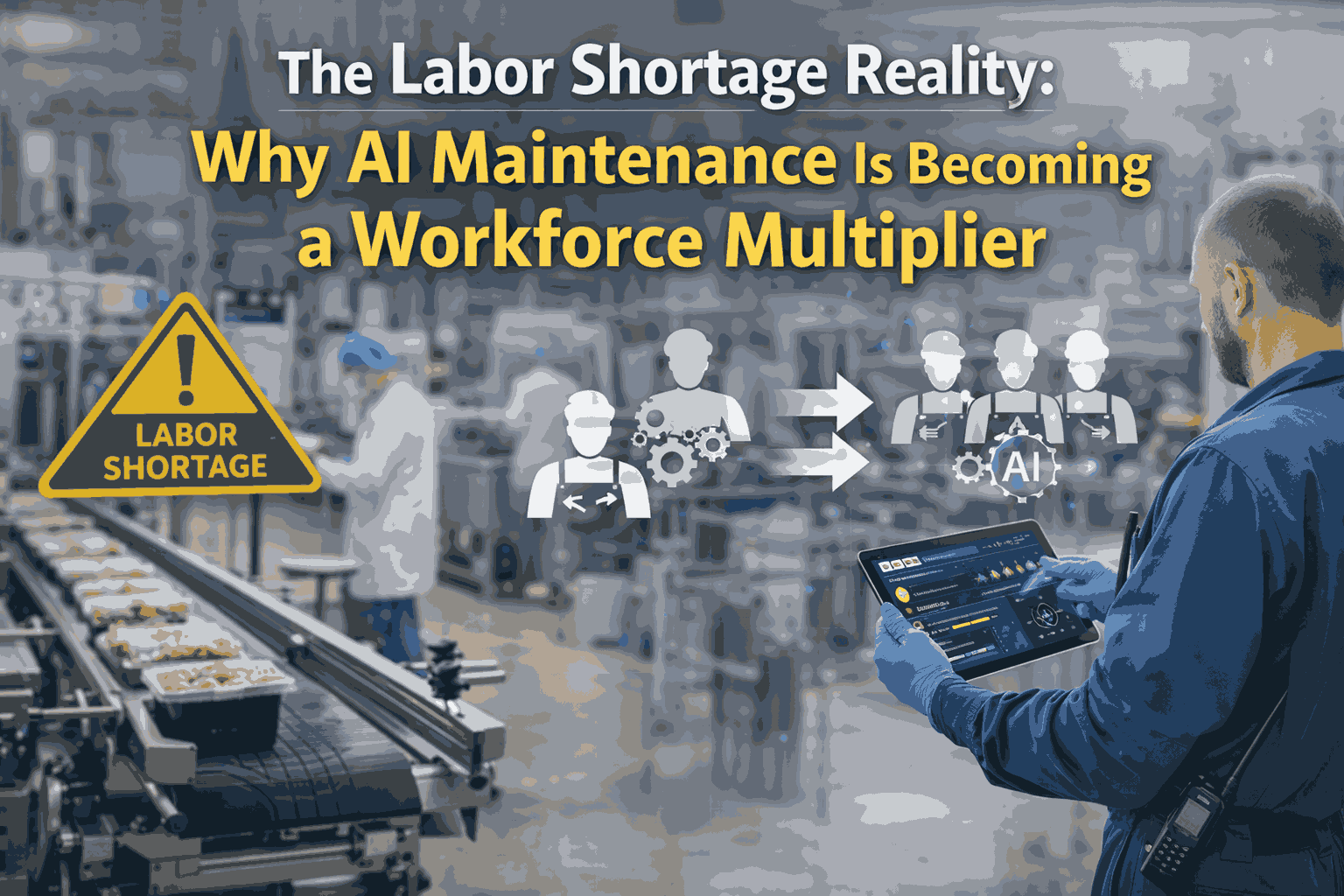
The Labor Shortage Reality: Why AI Maintenance Is Becoming a Workforce Multiplier
You cannot hire your way out of a structural talent gap. But you can make every technician you have do the work of two — without burning them out. Here is how food plants are doing it right now.
622K
Open manufacturing jobs in the US as of early 2024
40%
More technician capacity when AI handles routine maintenance decisions (McKinsey, 2025)
1.9M
Manufacturing jobs projected to go unfilled by 2033 — Deloitte & Manufacturing Institute
The Workforce Crisis — By the Numbers
What the Labor Shortage Looks Like Inside a Food Plant Right Now
The food manufacturing labor shortage is not a temporary hiring problem. It is a structural shift driven by an aging workforce, a skills gap in technical roles, and competition from industries with easier working conditions. Understanding the shape of the crisis is the first step to knowing what to do about it.
Biggest challenges reported by food manufacturing operations leaders (Food Industry Executive, 2024)
Lack of qualified maintenance & technical candidates
Labor shortage forcing increased overtime
Reduced production capacity due to staffing gaps
Compensation demands from remaining skilled workers
Source: Food Industry Executive LinkedIn Poll, July–September 2024, 1,000 US adults surveyed
The core problem
You cannot hire your way out of this. Even if every unemployed worker filled an open manufacturing job, positions would still go unfilled. The answer is not more people. It is making the people you have capable of doing more — without working them harder.
2.8M
jobs opening from retirements alone between 2024–2033 in manufacturing
What a Workforce Multiplier Does
How AI Maintenance Turns 3 Technicians Into the Output of 5
A workforce multiplier is any tool, process, or system that increases the productive output of an existing team without adding headcount. In maintenance, this means replacing the activities that consume technician time without requiring their expertise — so their expertise can be deployed where it actually matters.
Traditional Plant
45%
Reactive repairs and emergency callouts
20%
Paperwork, records, documentation
15%
Searching for parts, manuals, work history
20%
Actual preventive and skilled maintenance work
AI-Powered Plant
15%
Reactive repairs (predicted and prevented, not firefighting)
5%
Documentation (automated by the platform)
5%
Searching (mobile access to all history instantly)
75%
Skilled maintenance, improvement projects, and training
McKinsey 2025
AI maintenance systems give technicians 40% more effective capacity — without adding a single person to the team.
Your team is spending 80% of their time on tasks AI can handle
Give them back the time to do the work only they can do.
6 Ways AI Multiplies Your Workforce
Exactly How AI Maintenance Extends the Capacity of Every Technician You Have
These are not abstract benefits. Each of these is a specific category of technician time that AI eliminates, redirects, or amplifies — recoverable hours that go directly back into productive maintenance work on the shift you deploy.
01
Saves 2–4 hrs/tech/week
Automated Work Order Generation
AI creates, assigns, and prioritizes work orders based on equipment condition signals, schedule triggers, and historical failure patterns. Technicians arrive for their shift knowing exactly what to do, in what order, and why — without a supervisor spending an hour assembling the list manually each morning.
02
Eliminates 90% of paperwork
Mobile Digital Documentation
Every inspection, checklist, and maintenance record is completed on a mobile device in real time. No transcribing from paper later. No lost records. No compliance gaps because a technician was pulled away before they could finish the form. Documentation takes seconds instead of 20–30 minutes per shift.
03
Cuts search time by 70%
Instant Equipment History at Their Fingertips
When a technician walks up to a piece of equipment, they can pull the full maintenance history, last calibration date, open faults, parts list, and repair manuals from their phone in seconds. What used to require a trip to the filing room or a call to a senior tech is now immediate — and available to every shift, including newer team members.
04
Preserves retiring knowledge
Institutional Knowledge Capture
Every repair note, every observed failure pattern, every equipment-specific workaround that an experienced technician records becomes searchable knowledge available to the entire team. When that technician retires, the knowledge stays. New hires access years of plant-specific expertise through the platform rather than discovering everything the hard way — alone, at 2am during a breakdown.
AI-Guided Troubleshooting
When equipment fails unexpectedly, AI surfaces the most likely causes based on the asset's history, recent maintenance events, and pattern matches from similar failure signatures. A technician who might spend 45 minutes diagnosing a problem they have not seen before can resolve it in 15 minutes with AI-guided root cause analysis — reducing mean time to repair across every skill level on your team.
06
40% fewer emergency callouts
Predictive Scheduling That Eliminates Overtime
Unplanned breakdowns at 11pm are the primary driver of emergency technician callouts — and the primary driver of burnout in food plant maintenance teams. When AI predicts failures and schedules interventions during normal working hours, overnight callouts drop dramatically. Your team works a predictable shift. Retention improves. And the cycle of chronic understaffing driven by turnover begins to break.
The Retirement Wave Problem
The Most Dangerous Thing About the Labor Shortage Is Not the Empty Positions
It is the knowledge walking out the door when experienced technicians retire. When a 25-year maintenance veteran leaves, they take with them thousands of hours of equipment-specific observations that were never written down: which pump vibrates differently before it fails, which conveyor belt always slips during hot weather, which temperature controller reads slightly low and needs manual correction. Without a system that captures and surfaces that knowledge, every new hire starts at zero — and the knowledge gap costs you in breakdowns, in quality failures, and in the time it takes newer technicians to reach competence.
26%
of manufacturing workforce age 55+, retirement wave actively underway
12–24
months to fully ramp a replacement maintenance tech — if you can find one
$0
cost to preserve that knowledge digitally — if you start capturing it now
Before vs. After
The Same Team — Two Completely Different Operational Outcomes
Without AI Maintenance
Technicians spend 45% of time on reactive firefighting
Emergency overnight callouts drain team morale and retention
New hires take 12–24 months to reach productivity without knowledge access
PM compliance at 52% — missed tasks create compounding equipment risk
Audit prep consumes 3–4 hours of senior technician time per inspection
Retiring technicians take institutional knowledge with them permanently
Result: Team operates at 40–50% of its true potential capacity
VS
With Oxmaint AI Maintenance
Technicians spend 75% of time on skilled, planned maintenance work
Predictive scheduling eliminates emergency callouts and overtime
New hires access full plant knowledge from day one through mobile platform
PM compliance at 94%+ — automated scheduling and mobile alerts
Audit documentation generated in under 60 seconds — any time
Every repair note and observation captured digitally and preserved forever
Result: 40% more effective technician capacity from the same headcount
Common Questions
What Operations Leaders Ask About AI as a Workforce Multiplier
Will AI maintenance replace our technicians?
No — and this is the most important distinction to make when discussing AI maintenance with your team. AI cannot replace the physical judgment, mechanical skill, and contextual experience that a trained technician brings to a repair. What AI replaces is the administrative overhead, manual scheduling, paper documentation, and reactive firefighting that currently consumes the majority of a technician's shift. The result is that the skilled work your technicians were hired to do gets more of their time — not less. The plants using AI maintenance are retaining technicians more effectively because the job becomes less reactive, less stressful, and more satisfying. AI is a tool that makes technicians better at their jobs, not a substitute for them.
How quickly can a new technician become productive with Oxmaint?
This is one of the most significant workforce benefits that plants report after going live. In a traditional plant, a new maintenance technician spends 12 to 24 months learning the quirks of specific equipment, the history of past failures, and the informal workarounds that experienced team members carry in their heads. With Oxmaint, a new hire on day one can pull the complete maintenance history of any asset from their mobile device — including previous repair notes, calibration records, observed failure patterns, and photos from past maintenance events. Time to competency drops significantly, and the institutional knowledge your team has built over years is not lost when people change roles or retire.
Our team is resistant to new technology. How do we get buy-in?
The most effective approach is to frame AI maintenance as a tool that works for technicians rather than being used to monitor them. The specific benefits that resonate most with plant floor teams are the ones that make their daily work less frustrating: no more hunting for paper records or calling the office for equipment history, no more handwriting the same documentation on multiple forms, no more being the last person called at 11pm for a breakdown that could have been prevented. When technicians see that AI eliminates the parts of their job they find least rewarding — the paperwork, the reactive chaos, the knowledge gaps — adoption typically happens faster than leadership expects. Oxmaint deploys in 48 hours, and most plants see team adoption in the first two to three weeks.
What happens to institutional knowledge when experienced technicians retire?
Without a digital maintenance platform, it leaves with them. Every observed equipment quirk, every failure pattern, every equipment-specific repair shortcut that was never written down disappears when that person walks out. With Oxmaint, every work order completion, repair note, and observation is captured digitally and tagged to the specific asset. Over time, this builds a plant-specific knowledge base that is searchable, mobile-accessible, and permanently available to every technician on every shift. The retirement of a 25-year veteran no longer creates a capability crater — their knowledge remains in the system and continues to benefit the team they leave behind.
Your Team Is Already Doing More Than They Should Have To
Stop Asking 3 People to Do the Work of 5. Use AI to Make That Math Work.
Oxmaint gives your maintenance team automated scheduling, mobile documentation, instant equipment history, AI-guided troubleshooting, and predictive failure alerts — from day one. Live in 48 hours. Every hour saved is an hour your team can spend on the work that actually needs them.
40%
More effective technician capacity
6–10x
First-year ROI typical