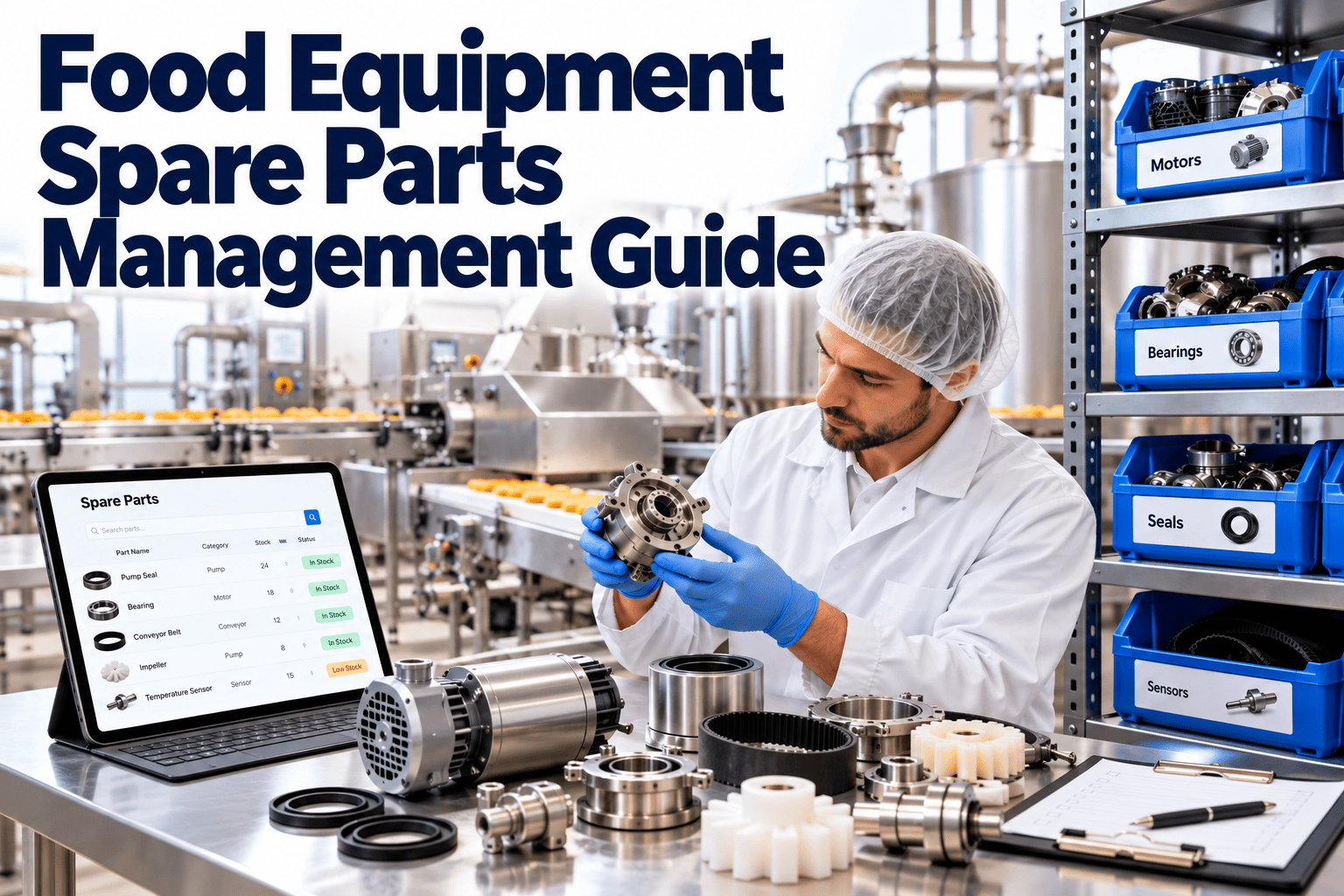
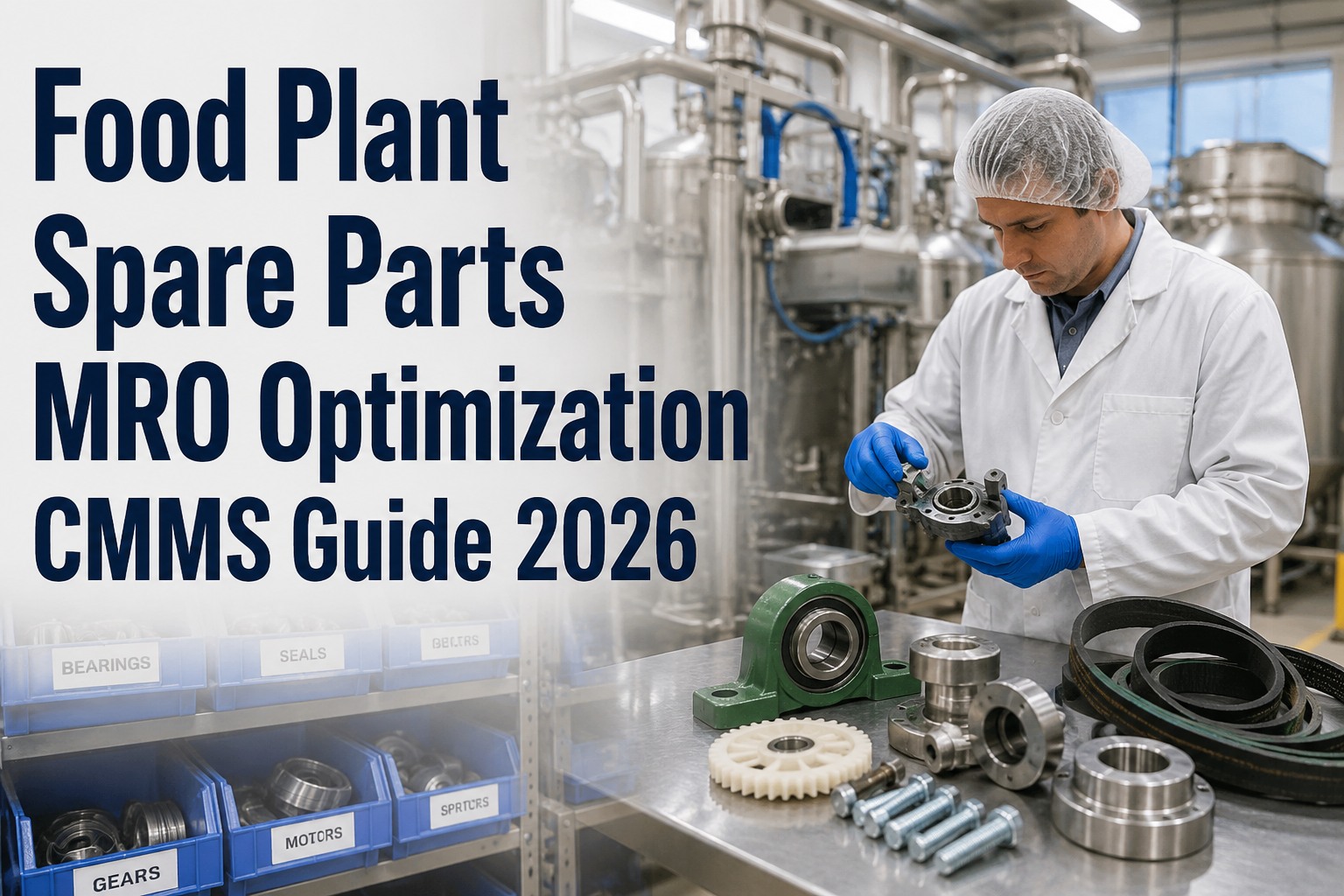
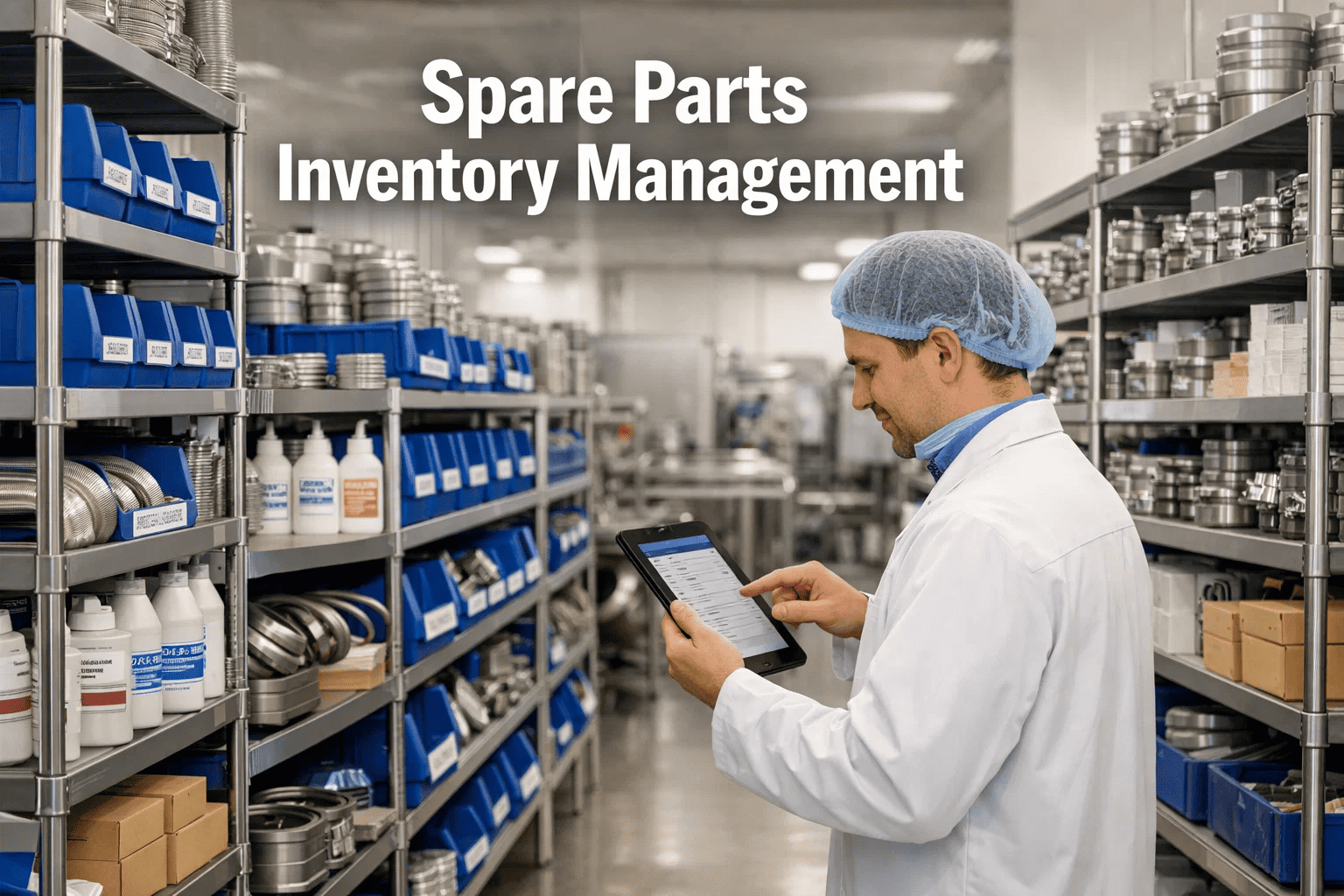
Food manufacturing plants run on margins of 3–7% — margins that disappear in a single unplanned equipment failure. The average food processing facility loses 326 hours of production annually to unplanned downtime, at a cost of ₹8–12 lakhs per hour. FDA's New Era of Smarter Food Safety, FSMA records requirements, and increasingly rigorous SQF, BRC, and FSSC 22000 audit standards have made manual maintenance documentation not just inefficient but legally inadequate. Paper HACCP logs, handwritten calibration records, and reactive work orders cannot produce the timestamped, continuous audit trail that 2026 food safety regulations require. OxMaint's food manufacturing CMMS was built specifically for this environment — mobile-first, IP69K sensor-compatible, compliant with FDA 21 CFR Part 11, and capable of predicting equipment failures 7–14 days in advance with 88–92% accuracy. The result is 70% fewer unplanned production stops, 80–88% OEE, and ₹8–15 crore in annual savings — all from a platform that deploys in weeks, not months. For a facility-specific compliance gap assessment, talk to our food manufacturing team directly.
Food Manufacturing · CMMS · Compliance 2026
Preventive Maintenance and Food Safety Compliance: How CMMS Transforms Food Manufacturing Operations
FDA FSMA, HACCP, GMP, and SQF compliance all depend on documented maintenance records your team generates daily. OxMaint's mobile-first CMMS captures every inspection, work order, and asset event automatically — turning your maintenance team into a compliance documentation engine that runs without extra administrative effort.
$1.1T
Global food and beverage manufacturing market — maintenance failure is the leading cause of unplanned downtime
23%
Average production uptime improvement when food plants move from reactive to preventive maintenance programs
$2.8M
Average cost of a food product recall — most triggered by equipment failures detectable with proper PM schedules
4.8x
ROI delivered by structured preventive maintenance programs in food and beverage processing operations
The Hidden Revenue Drain
Why Reactive Maintenance Is Bleeding Revenue That Food Plants Are Not Measuring
Most food plants track OEE, energy costs, and ingredient waste with precision. Almost none quantify the full financial impact of reactive maintenance — a gap that compounds silently until an emergency repair, a product recall, or a failed audit forces the calculation.
2–5x
Higher total maintenance spend
Organizations relying primarily on reactive maintenance spend 2–5 times more than those operating proactive PM programs — premium parts, overtime labor, expedited shipping, and emergency contractor rates all compound the base repair cost.
₹8–12L
Lost per hour of unplanned downtime
A single conveyor failure during peak production doesn't just cost repair time — it triggers downstream losses in labor utilization, raw material spoilage, rescheduling overhead, and customer delivery penalties that multiply the direct repair cost.
15–25%
Increase in product defect rate
Inconsistent equipment performance from deferred maintenance creates quality variation that reactive teams discover at final inspection — not at the point of cause. Defect-driven waste directly compresses the 3–7% margins food plants already operate on.
₹50L+
Minimum cost of a small food recall
FDA, HACCP, and FSMA violations triggered by equipment maintenance gaps — contamination from failed seals, temperature deviations from uncalibrated sensors, foreign material from worn conveyor belts — generate recall costs that dwarf any maintenance investment.
Revenue-Centric KPIs
Four Pillars of Revenue-Centric Maintenance Metrics for Food Manufacturing
Shifting from activity metrics (completed work orders, wrench time) to financial impact metrics (revenue protected, OEE improvement, recall exposure avoided) is the structural change that separates world-class food plants from average performers.
01
Production Throughput Impact
Revenue Per Operating HourTotal production revenue divided by available equipment hours — the most direct maintenance ROI metric
Maintenance Cost Per UnitTotal maintenance spend relative to units produced — falling with every prevented failure
OEE Financial ValueOEE percentage multiplied by theoretical maximum revenue capacity — quantifies upside of each 1% OEE gain
02
Quality and Margin Protection
Equipment-Related Defect RatePercentage of quality failures traceable to equipment degradation — eliminated by PM compliance
Maintenance-Prevented WasteFinancial value of waste reduction through consistent equipment performance and calibration compliance
Gross Margin StabilityMargin consistency linked directly to equipment reliability — quantifies the cost of variation
Asset Return on InvestmentRevenue generated per rupee of equipment capital deployed — improved directly by OEE gains
Equipment Life Extension ValueFinancial impact of extending asset lifespan through proactive maintenance vs. failure-triggered replacement
Avoided Capital ExpenditureDelayed replacement costs through predictive maintenance — a direct balance sheet improvement
Compliance Maintenance ROICost of automated compliance documentation vs. recall exposure — typically 200–400x return ratio
Safety Incident PreventionFinancial value of accidents avoided through proactive equipment inspection and auto-block workflows
Supply Chain Reliability ScoreOn-time delivery performance directly attributable to equipment reliability — quantifies customer retention value
OxMaint Turns Your Maintenance Team Into a Compliance Documentation Engine — Automatically.
Every inspection, work order, and asset event generates FDA 21 CFR Part 11, HACCP, FSMA, and SQF audit records as a byproduct of daily operations. No extra admin. No paper logs. Audit-ready in seconds.
AI-Powered Predictive Maintenance
How OxMaint AI Translates Equipment Data Into Financial Protection — 7–14 Days Before Failure
Revenue-centric maintenance becomes practical at scale only with AI that continuously translates equipment sensor data into financial risk projections. Food plants deploying OxMaint's predictive maintenance achieve 80–88% OEE vs. the 65–72% industry baseline — converting equipment intelligence directly into measurable margin improvement.
01
Continuous Sensor Monitoring — IP69K Rated for Washdown Environments
IP69K food-safe sensors collect vibration, temperature, and performance data continuously from critical assets — conveyors, motors, pumps, packaging lines, mixing equipment, and refrigeration systems. Unlike standard IoT sensors that fail within 3–6 months in food manufacturing environments, OxMaint-compatible sensors are rated for 2+ years under daily high-pressure washdown, temperature extremes, and chemical sanitizer exposure. Data feeds directly into the OxMaint platform without manual transcription or IT integration projects.
IP69K food-safe rated2+ year sensor lifespanReal-time data streaming
02
Predictive Failure Detection — 7–14 Day Advance Warning at 88–92% Accuracy
OxMaint's machine learning models analyze sensor data patterns to detect early failure signatures — bearing wear, belt tension degradation, temperature drift, abnormal vibration frequency — 7–14 days before the equipment reaches a failure state. Maintenance coordinators receive prioritized alerts ranked by financial impact, not just technical severity. A conveyor with a $2M/day production impact receives higher priority than a secondary motor even if its technical degradation index is lower. This financial prioritization is what separates OxMaint from generic CMMS platforms.
88–92% prediction accuracy7–14 day advance warningFinancial impact prioritization
03
Automated Work Order Generation — Planned Maintenance in Scheduled Windows
When the AI detects a predicted failure, OxMaint automatically generates a work order, assigns it to the qualified technician based on skills and shift availability, and schedules the intervention during the next planned downtime window — not during peak production. Parts requirements are pre-flagged to inventory management, preventing the parts-unavailability delays that extend emergency repairs from hours to days. The entire workflow — detection to repair completion — is documented automatically, generating the maintenance record that FSMA preventive controls and FDA 21 CFR Part 11 require without any additional administrative step.
Auto work order generationShift-scheduled interventionParts pre-flagged to inventory
04
Compliance Documentation — HACCP, FSMA, FDA Records Generated Automatically
Every OxMaint maintenance action generates compliance-relevant records simultaneously with operational records. Equipment inspection checklists generate HACCP critical control point verification logs. Calibration work orders generate FDA 21 CFR Part 11 electronic records. Refrigeration temperature monitoring generates FSMA preventive controls documentation. SQF and BRC audit trails are assembled from daily operational data — retrievable in under 60 seconds for any audit window. The same sensor data that enables predictive maintenance generates the compliance documentation that manual systems require hours of preparation to produce.
FDA 21 CFR Part 11 auto-generatedHACCP CCP monitoring recordsSQF/BRC audit trail — 60 sec retrieval
Measurable Results
What OxMaint Customers Measure Within 90 Days of Go-Live in Food Manufacturing
70%
Reduction in Unplanned Stops
AI-predicted maintenance interventions eliminate 70% of unplanned production stops — converting emergency downtime into scheduled maintenance windows that don't disrupt production commitments or customer delivery schedules.
80–88%
OEE Achievement
Food plants deploying OxMaint move from the industry baseline of 65–72% OEE to 80–88% — a 5–8% OEE improvement that translates directly to ₹50+ lakhs in annualized revenue protection at mid-scale facilities.
40–50%
Reduction in Maintenance Spend
Proactive interventions replace emergency repairs — eliminating premium parts costs, overtime labor rates, expedited shipping, and emergency contractor fees that drive reactive maintenance costs 2–5x above planned maintenance equivalents.
₹8–15 Cr
Annual Savings Potential
Combined impact of prevented downtime, reduced maintenance spend, improved OEE, waste reduction, and avoided compliance penalties — quantified at ₹8–15 crore annual savings for mid-to-large food processing facilities.
8–14 mo
Full ROI Payback Period
OxMaint customers achieve full platform payback within 8–14 months of go-live — a return profile that accelerates when a single avoided recall, FDA citation, or major production failure is included in the calculation.
100%
Audit Documentation Coverage
Every maintenance event — inspection, work order, calibration, repair, sanitation log — is timestamped, person-attributed, and retrievable in under 60 seconds. No manual assembly for FDA, HACCP, or SQF audits.
Real-World Impact
Ham Processing Plant: From Recurring Blade Failures to 100% Unplanned Failure Elimination
The Challenge
Recurring blade failures every 3–4 months — each failure causing full production line stoppage, emergency repair costs at 3x standard rates, raw material spoilage, and delayed customer shipments. Paper inspection logs provided no advance warning and no pattern data to identify root cause.
OxMaint Solution Deployed
Vibration monitoring sensors on slicing equipment detecting early blade fatigue signatures
Product temperature tracking during cutting cycles for thermal stress analysis
Blade frequency analysis identifying abnormal resonance patterns 2–3 weeks before failure
Predictive models trained on 18 months of historical failure data for continuous improvement
Measurable Results Achieved
100%
Elimination of all unplanned blade failures — zero emergency production stops in 12 months post-deployment
30–40%
Reduction in unexpected downtime events across all production lines during the same period
20–30%
Lower total maintenance costs through planned vs. emergency intervention shift
Compliance as Revenue Protection
Food Safety Compliance Is Not an Administrative Burden — It Is a ₹50L+ Revenue Protection Mechanism
The financial impact of a recall, FDA warning letter, or HACCP violation dwarfs any maintenance platform investment. OxMaint treats compliance documentation as an automatic byproduct of maintenance operations — generating the records regulators require without the labor overhead manual documentation demands.
₹50L+
Minimum cost of a small-scale food recall including logistics, replacement product, regulatory response, and brand damage
One prevented recall pays for years of OxMaint subscription cost
OxMaint Automated Compliance Coverage
FDA
21 CFR Part 11 electronic records auto-generated from every sensor data point and maintenance activity — timestamped, person-attributed, tamper-evident
HACCP
Critical control point monitoring with automatic alerts when equipment parameters drift from safety specifications — real-time corrective action triggers
FSMA
Preventive controls documentation showing proactive maintenance schedules and completion records for all food contact equipment — full supply chain traceability
SQF/BRC
Audit trails demonstrating continuous monitoring and rapid corrective action — all standard third-party certification documentation assembled automatically
90-Day Implementation
90-Day Roadmap to Revenue-Centric Maintenance in Your Food Manufacturing Plant
OxMaint deploys in structured 30-day phases that prove ROI at each stage — minimizing disruption while building operational confidence through measurable results that stakeholders can see in the dashboard before the next phase begins.
Days 1–30
Foundation and Baseline
Conduct equipment criticality analysis linking each asset to production revenue impact — identifies top 5 revenue-critical assets for priority sensor deployment
Establish baseline OEE and calculate current financial losses from unplanned downtime — creates the ROI baseline for 90-day performance comparison
Deploy IP69K sensors on highest-revenue-impact equipment — typically packaging lines, primary conveyors, and refrigeration systems
Configure OxMaint with production data integration for real-time financial calculations per equipment event
Expected outcome: Clear visibility into top 5 revenue-critical assets and their current financial performance gaps
Days 31–60
Prediction and Prevention
Train predictive models on historical failure data and live sensor streams — first AI predictions available within 2–3 weeks of sensor deployment
Implement first predictive maintenance interventions based on AI recommendations — document financial value of each prevented failure event
Launch real-time financial dashboards showing equipment health translated to revenue risk — visible to maintenance, production, and operations leadership simultaneously
Begin mobile app training for technicians and operators — 2–4 hour onboarding covers inspections, work orders, and compliance documentation workflows
Expected outcome: First documented prevented failures with quantified financial value of avoided downtime
Days 61–90
Scale and Optimization
Expand sensor deployment to next tier of revenue-critical equipment based on 60-day criticality data refinement
Refine maintenance scheduling based on production demand forecasts, seasonal patterns, and margin optimization targets
Activate automated compliance documentation — HACCP, FSMA, FDA, SQF records generated automatically from daily maintenance operations
Calculate and present full 90-day ROI including prevented losses, OEE improvement, reduced emergency costs, and compliance overhead reduction
Expected outcome: 5–8% OEE improvement translating to ₹50+ lakhs in annualized revenue protection
Transform Your Food Plant Maintenance from Cost Center to Revenue Driver
OxMaint delivers the complete revenue-centric maintenance platform purpose-built for food manufacturing environments. IP69K food-safe sensors, 88–92% prediction accuracy, automated FDA/HACCP/FSMA compliance documentation, and 8–14 month ROI payback. Deploy in weeks — not months.
IP69K food-safe sensors for harsh washdown environments
88–92% prediction accuracy with 7–14 day advance warning
FDA, HACCP, FSMA compliance automation included
₹8–15 crore annual savings potential · 8–14 month payback
Frequently Asked Questions
Food Manufacturing CMMS and Predictive Maintenance — What Plant Managers Ask First
Have a question specific to your facility, equipment type, or compliance requirement? Talk to our food manufacturing team for a facility-specific assessment.
How does OxMaint handle food manufacturing's harsh washdown environments — will sensors survive daily sanitation cycles?
This is the most common barrier to predictive maintenance adoption in food plants, and it is entirely legitimate — standard industrial IoT sensors typically fail within 3–6 months in food manufacturing environments due to high-pressure washdown, chemical sanitizers, temperature extremes, and steam exposure. OxMaint integrates with IP69K-rated sensors specifically designed for food manufacturing — rated for high-pressure, high-temperature water jets, certified food-safe, and field-validated for 2+ years of continuous service in active food production environments. The IP69K rating is the highest ingress protection standard for water and dust, and it is the minimum specification OxMaint recommends for any food processing deployment. During deployment, OxMaint's food manufacturing onboarding team reviews your sanitation program, equipment layout, and washdown schedules to ensure sensor placement and enclosure specifications match your specific environment.
Book a demo to discuss sensor specifications for your equipment types.
What specific compliance documentation does OxMaint automatically generate — and which food safety standards does it cover?
OxMaint generates five categories of compliance documentation automatically as a byproduct of daily maintenance operations — without any separate reporting step. FDA 21 CFR Part 11 electronic records: every sensor data point, maintenance action, and inspection result is recorded with timestamp, operator ID, and digital signature — satisfying FDA electronic records requirements without paper reconstruction. HACCP critical control point records: temperature, pressure, and sanitation parameters at CCPs are monitored continuously, with automatic alerts when parameters exceed defined limits and automatic corrective action documentation when alerts are resolved. FSMA preventive controls documentation: scheduled maintenance records for all food contact equipment — conveyors, slicers, packaging lines, mixers — demonstrate the proactive maintenance program that FSMA's Preventive Controls for Human Food rule requires. SQF and BRC audit trails: all inspection frequencies, work order completion rates, calibration records, and corrective action close-outs are assembled from operational data — retrievable in under 60 seconds for third-party certification audits. GMP sanitation logs: digital sanitation checklists with photo evidence, operator attribution, and completion timestamps satisfy Schedule M, GMP, and BRC sanitation documentation requirements.
Talk to our compliance team about documentation requirements specific to your certifications.
How does OxMaint integrate with legacy food processing equipment — do we need to replace machines to get predictive capabilities?
Replacing legacy equipment to achieve predictive maintenance capabilities is neither necessary nor cost-effective — and OxMaint is designed to avoid this requirement entirely. The platform uses a sensor-agnostic retrofit approach: external IP69K sensors attach to existing equipment surfaces and collect vibration, temperature, and operational data without any modification to the machine itself, no firmware changes, and no PLC integration required for basic predictive monitoring. For equipment that already has PLC outputs — newer production lines, automated packaging equipment, modern refrigeration systems — OxMaint's PLC integration module ingests existing data streams directly, eliminating redundant sensor hardware. For truly legacy equipment from the 1990s and early 2000s with no digital outputs, external vibration and temperature sensors provide sufficient data for the most valuable predictive signals: bearing wear, motor stress, and refrigeration performance degradation. OxMaint's food manufacturing onboarding team conducts a pre-deployment equipment audit to map the optimal sensor strategy for your specific asset mix — typically a combination of PLC integration for newer equipment and external sensors for legacy assets.
Book a demo to discuss your equipment inventory and integration options.
How quickly can OxMaint deploy across a food manufacturing facility — and what does the implementation process require from our team?
OxMaint deployments in food manufacturing facilities follow a structured 90-day phased approach, but the platform is operationally active — generating work orders, inspection checklists, and compliance records — within the first 2–3 weeks of go-live. The deployment requires minimal internal IT involvement. Phase 1 (Days 1–14): OxMaint's onboarding team conducts the equipment criticality analysis, configures the platform with your asset registry, supplier list, and compliance documentation templates, and installs the first priority sensor set on your highest-revenue-impact equipment. Your maintenance manager is the primary internal contact — no IT department project is required. Phase 2 (Days 15–30): mobile app training for maintenance technicians, operators, and supervisors — 2–4 hours per role. The platform's mobile-first design means most users are proficient within their first full shift. Phase 3 (Days 31–60): first AI predictions become available as the models train on your equipment's operational data. Your team validates or dismisses predictions with brief explanations — this human-in-the-loop feedback accelerates model accuracy improvement and builds technician confidence simultaneously. OxMaint is cloud-based with no server infrastructure to install, no hardware procurement beyond sensors, and no extended IT project timeline.
Talk to our team about your specific facility size and deployment timeline.
What is the realistic financial ROI for a mid-size food manufacturing plant deploying OxMaint — and how is it calculated?
The ROI calculation for a food manufacturing CMMS deployment has five independent components that each stand without the others. Prevented downtime value: a plant running 20 production hours/day at ₹8 lakhs/hour that prevents just 5 unplanned stops per month — each averaging 2 hours — recovers ₹80 lakhs monthly in protected throughput. Maintenance cost reduction: shifting from reactive to preventive maintenance reduces total maintenance spend by 40–50% — eliminating emergency contractor rates, expedited parts shipping, and overtime labor that inflate reactive repair costs 2–5x above planned equivalents. OEE improvement revenue: a 5% OEE improvement on a line generating ₹5 crore/month in throughput protects ₹25 lakhs/month in revenue that was previously being lost to avoidable performance losses. Compliance overhead elimination: manual HACCP and FDA audit preparation typically requires 4–8 staff-hours per audit event — OxMaint reduces this to under 30 minutes of dashboard navigation. Recall avoidance: a single prevented recall saves a minimum of ₹50 lakhs — a figure that, for a mid-size facility, alone covers the full OxMaint subscription cost for multiple years. Full platform payback across all five components is typically 8–14 months. For facilities that experience a major downtime event or audit action in their first year, payback often occurs in the first 3–4 months.
Book a demo for an ROI model built around your facility's specific production volume and equipment profile.
How does OxMaint handle multi-site food manufacturing operations — and can it manage facilities across different countries and compliance frameworks?
OxMaint is built as a multi-site platform from the ground up — a single deployment covers all facilities in your portfolio under one dashboard with site-specific configuration. Each site maintains its own equipment registry, inspection checklists, PM schedules, compliance documentation templates, and user access controls — while sharing a unified reporting layer that gives corporate operations and quality leadership cross-facility visibility. For multi-country food manufacturing operations, OxMaint's compliance documentation framework is configured to local regulatory requirements for each site. In India, the platform supports Schedule M GMP documentation, FSSAI traceability requirements, and BIS standards. In the US, FDA 21 CFR Part 11, FSMA, and HACCP documentation are standard configuration. In the EU, it covers EFSA requirements and BRC/IFS certification documentation. In Southeast Asia, CODEX HACCP and local food safety authority requirements are supported. The underlying data model — timestamped, person-attributed records for every maintenance event — satisfies all of these frameworks from the same operational dataset, without separate documentation workflows per facility. For food manufacturing groups with plants in multiple countries, this means a single compliance reporting standard across all sites regardless of local regulatory variation.
Talk to our team about multi-site configuration for your facility network.
Ready to Shift From Reactive to Revenue-Centric Maintenance?
OxMaint's food manufacturing CMMS is purpose-built for your environment — IP69K sensors, automated FDA/HACCP/FSMA compliance, AI failure prediction, and mobile-first workflows that technicians adopt in a single shift. ₹8–15 crore annual savings potential. 8–14 month payback. Deploy in 90 days.