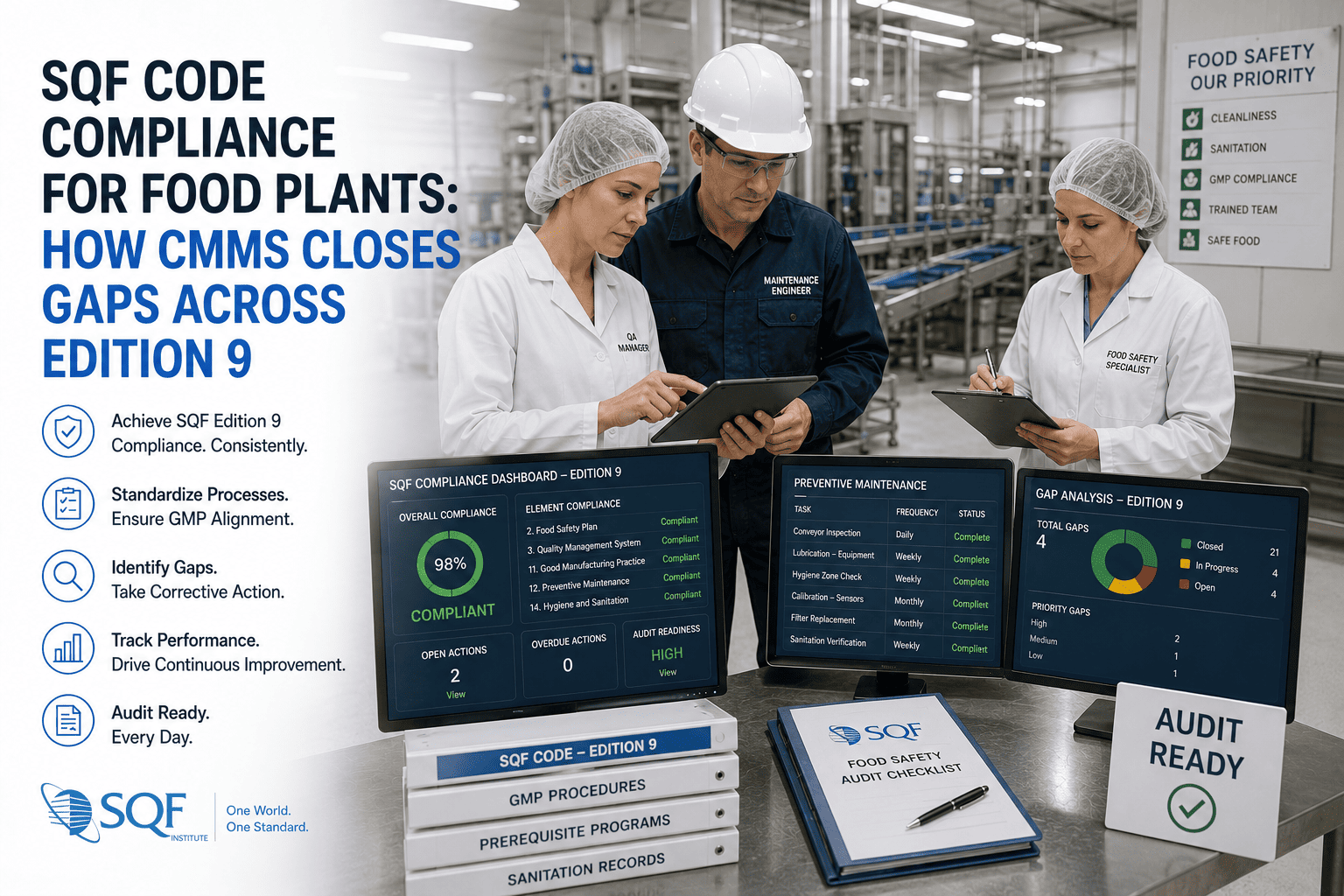
Food manufacturers chasing SQF Edition 9 certification are discovering the same uncomfortable truth: the standard does not reward good maintenance programs — it rewards documented ones. A technician who has been servicing your filling lines flawlessly for eight years is invisible to an SQF auditor if his work is recorded in a paper logbook, a personal spreadsheet, or nowhere at all. Edition 9 raised the evidentiary bar across Module 2 system elements and Module 11 GMP requirements, demanding timestamped completion records, traceable corrective actions, and ongoing management review evidence that most facilities simply cannot produce from their current systems. The gap between what your team does and what you can prove is where SQF certifications stall, downgrade, or fail entirely. Start a free trial to see how Oxmaint closes SQF Edition 9 compliance gaps from day one, or book a demo and walk through your specific audit exposure with our compliance team.
SQF Code Edition 9 · Food Plant CMMS · GMP Compliance
SQF Code Compliance for Food Plants: How CMMS Closes Gaps Across Edition 9
SQF Edition 9 non-conformances are rarely caused by bad maintenance — they are caused by missing records, open CAPAs, and undocumented GMP inspections. Oxmaint gives food manufacturers the structured, audit-ready documentation system that Edition 9 demands.
No heavy implementation required · Live in days, not months · Multi-site portfolio ready
SQF Edition 9 Readiness Score
Edition 9
SQF's most stringent version, tightening evidence requirements across all module elements
62%
of SQF non-conformances trace to missing or incomplete maintenance and GMP documentation
4.8x
higher cost of emergency repairs versus planned maintenance interventions
30 days
average time to measurable compliance improvement after structured CMMS implementation
Understanding the Standard
What Is SQF Code Edition 9 and What Does It Demand from Maintenance Operations?
The SQF (Safe Quality Food) Code is a GFSI-recognized food safety and quality management standard used by food manufacturers supplying retailers, foodservice operators, and distributors across North America, Australia, and increasingly the UK and EU. Edition 9 is the current version, and it is the most documentation-intensive iteration the standard has produced. Unlike previous editions where demonstrating intent was sometimes sufficient, Edition 9 requires verifiable evidence of execution — scheduled tasks completed on time, findings documented and resolved, and ongoing management oversight evidenced through real data, not assertions.
Module 2 governs the SQF system elements including document control, internal audit, management review, and corrective action management. Module 11 covers GMP requirements for food manufacturing facilities — equipment condition, maintenance schedules, pest control, and hygiene monitoring. Both modules converge on a single compliance requirement: your maintenance operations must be traceable, timestamped, and retrievable on demand. An auditor asking for the last twelve months of preventive maintenance records for your pasteurizer should receive a complete, timestamped digital trail in under two minutes — not a box of paper logbooks assembled over three days.
The facilities that consistently achieve SQF Gold and Platinum certifications are not necessarily running better maintenance programs than their peers. They are running better documentation systems — and the difference is structural. Start a free trial to see how Oxmaint builds that documentation structure into every work order automatically, or book a demo to benchmark your current SQF readiness against Edition 9 requirements.
SQF Edition 9 does not grade your maintenance program. It grades your ability to prove your maintenance program existed.
Key Framework
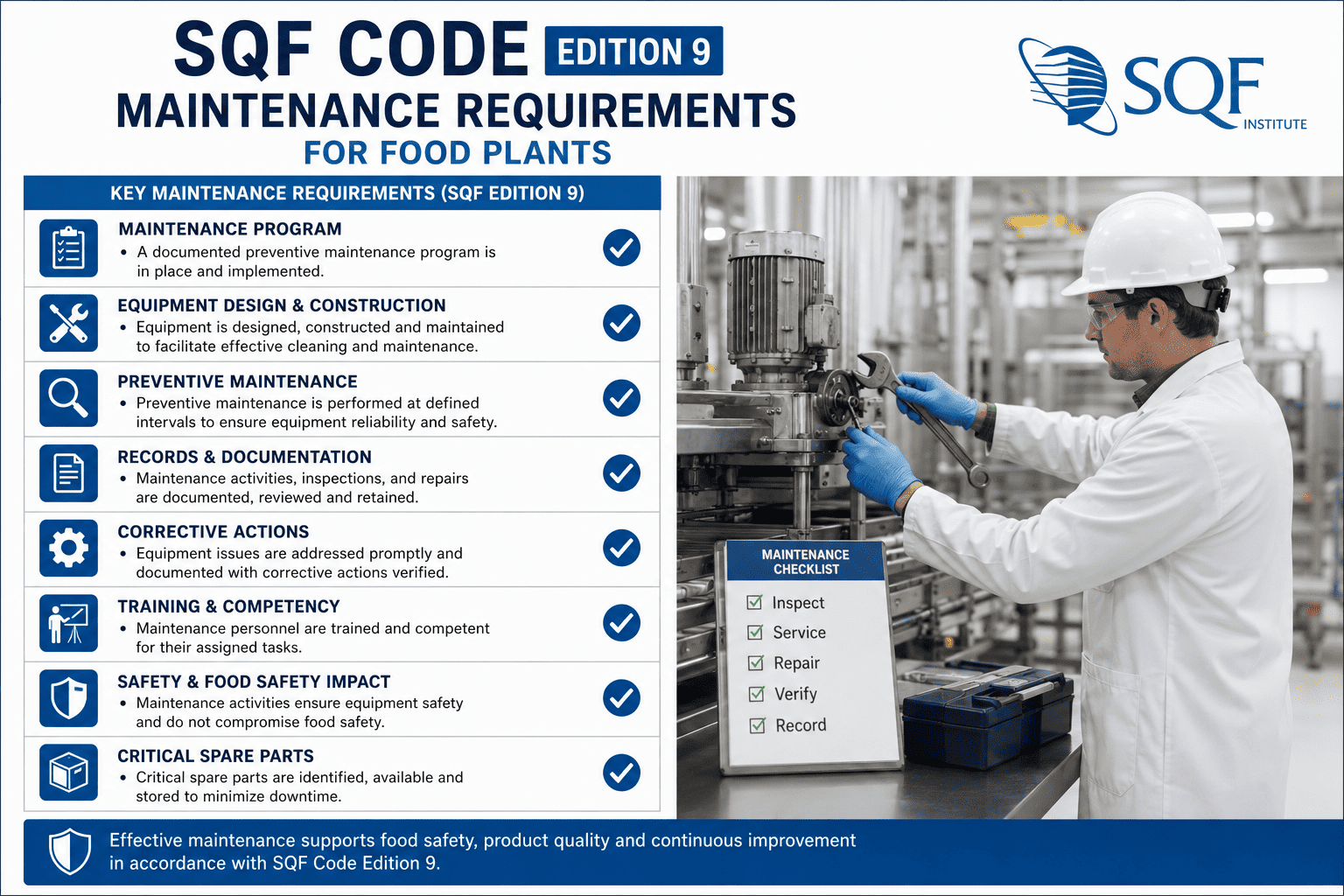
8 SQF Edition 9 Requirements That CMMS Directly Addresses
SQF Edition 9 compliance obligations span Module 2 system elements and Module 11 GMP requirements. Each clause below maps to a specific documentation gap that paper-based and spreadsheet-dependent facilities consistently fail to close — and that a structured CMMS eliminates by design.
2.1
Management Commitment and Review
Senior management must demonstrate active review of food safety and quality performance through documented meetings, KPI analysis, and follow-up actions — not just attendance records.
2.4
SQF System Document Control
All documents supporting the food safety system must be version-controlled, accessible to relevant personnel, and retrievable on demand. Paper-based PM schedules stored in binders fail this requirement.
2.5
Corrective and Preventive Actions
Every identified non-conformance requires a documented corrective action with root cause, assigned owner, completion deadline, and verified closure. Open CAPAs at audit time are a primary non-conformance trigger.
2.9
Internal Audit Schedule and Evidence
Facilities must maintain a risk-based internal audit schedule covering all SQF system elements, with documented findings and traceable corrective actions for every deficiency identified.
11.3
Equipment Maintenance Program
All food contact equipment must have a documented preventive maintenance schedule with evidence of execution. Frequency must reflect food safety risk and equipment criticality — not convenience or budget cycles.
11.4
Calibration of Measuring Equipment
Temperature sensors, checkweighers, metal detectors, and other safety-critical measuring devices must be calibrated on schedule with certificates linked to specific equipment records and traceable to national standards.
11.5
GMP Inspection and Hygiene Monitoring
Scheduled GMP inspections, equipment condition assessments, and hygiene monitoring activities must be documented with findings and linked corrective actions — not just noted informally and resolved verbally.
11.6
Contractor and Approved Supplier Control
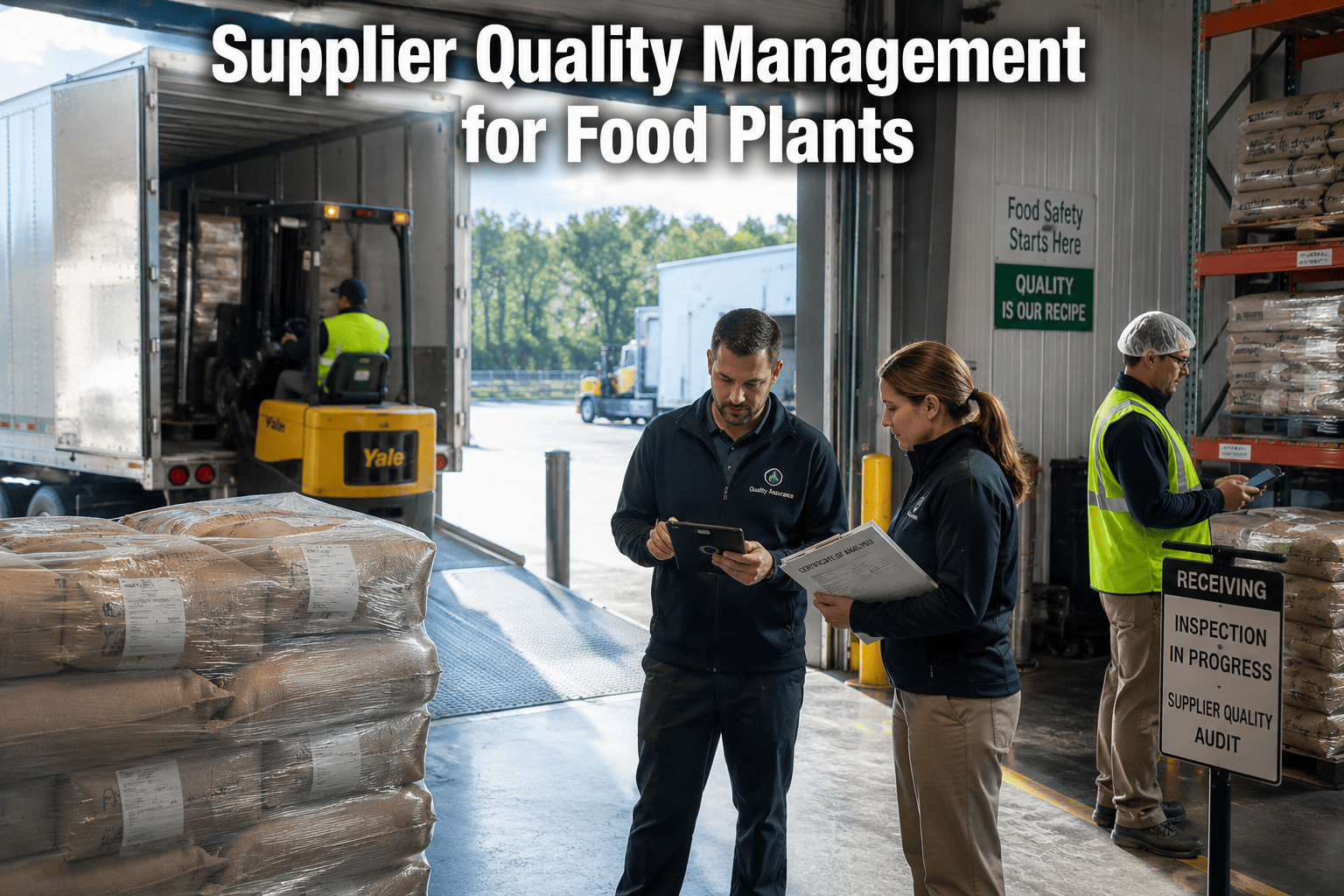
All maintenance work performed by contractors must be documented with scope, competency verification, and formal return-to-service authorization. Undocumented contractor work is a direct Module 11 non-conformance.
Industry Pain Points
Why Food Plants Fail SQF Edition 9 Despite Competent Maintenance Teams
The most common SQF Edition 9 failures are not technical breakdowns — they are documentation breakdowns. Auditors find equipment well-maintained but records incomplete, CAPAs verbally resolved but undocumented, and inspections conducted but not traceable. These patterns repeat across facilities of every size, and they share a single root cause: no structured system for turning maintenance execution into compliance evidence. If your team is experiencing any of these, start a free trial to see how Oxmaint eliminates each one by design, or book a demo to review your SQF audit exposure in detail.
01
PM Schedules Exist — Completion Records Do Not
Maintenance managers can show an auditor the PM schedule they built — but cannot produce timestamped completion records proving those tasks were actually executed. The schedule is not evidence. The closed work order is.
02
Calibration Overruns Found During Audit Week
Metal detectors, temperature probes, and checkweighers drift past calibration due dates with no automated alert. By the time the auditor flags the overrun, product has been produced on out-of-calibration equipment — a potential recall trigger.
03
CAPA Closure Is Verbal, Not Documented
Previous audit findings and internal inspection deficiencies get resolved in practice but never formally closed in a traceable system. Repeat findings from the same root cause signal to SQF auditors that the corrective action system itself is non-functional.
04
GMP Inspections Conducted but Not Traceable
Supervisors walk production areas regularly and informally resolve observed issues. But without a documented inspection record showing date, scope, findings, and corrective actions, the activity is invisible to Edition 9 requirements under Clause 11.5.
05
Management Review Has No Supporting Data
Senior managers meet regularly but cannot demonstrate review of maintenance KPIs, CAPA trends, or equipment condition data. SQF Edition 9 requires evidence that management acts on food safety performance data — not just that they attended a meeting.
06
Pre-Audit Scramble Consuming Weeks of Staff Time
Food safety managers spend 2–4 weeks before every SQF audit manually assembling records, chasing technicians for paperwork, and reconstructing maintenance histories. This is a symptom of reactive compliance — and it still produces gaps that auditors find.
Most food plants lose 20–40% of SQF audit preparation time assembling records that a CMMS would have made permanently available.
How Oxmaint Solves It
How Oxmaint Converts SQF Edition 9 Obligations into Automated Compliance Workflows
Oxmaint is built for food manufacturers where maintenance documentation is a regulatory obligation, not an administrative courtesy. Every PM task, calibration, CAPA, and inspection generates structured, timestamped, auditor-ready evidence automatically — with no pre-audit assembly required.
Module 11.3
Risk-Based PM Scheduling with Completion Evidence
Build equipment PM schedules by criticality and food safety risk. Work orders auto-generate on schedule, require technician sign-off, capture parts used, and record exact completion timestamp — the evidence trail Edition 9 requires.
Module 11.4
Automated Calibration Tracking and Certificate Management
Set calibration intervals per equipment record. Oxmaint alerts responsible personnel before overrun, stores calibration certificates directly against asset records, and flags any equipment in use past its calibration date with escalation workflows.
Module 2.5
Closed-Loop CAPA Management
Every non-conformance — from internal inspection, audit finding, or equipment deficiency — generates a CAPA with owner assignment, root cause fields, action deadline, and closure evidence. No open loops. No repeat findings.
Module 11.5
Digital GMP Inspection Checklists
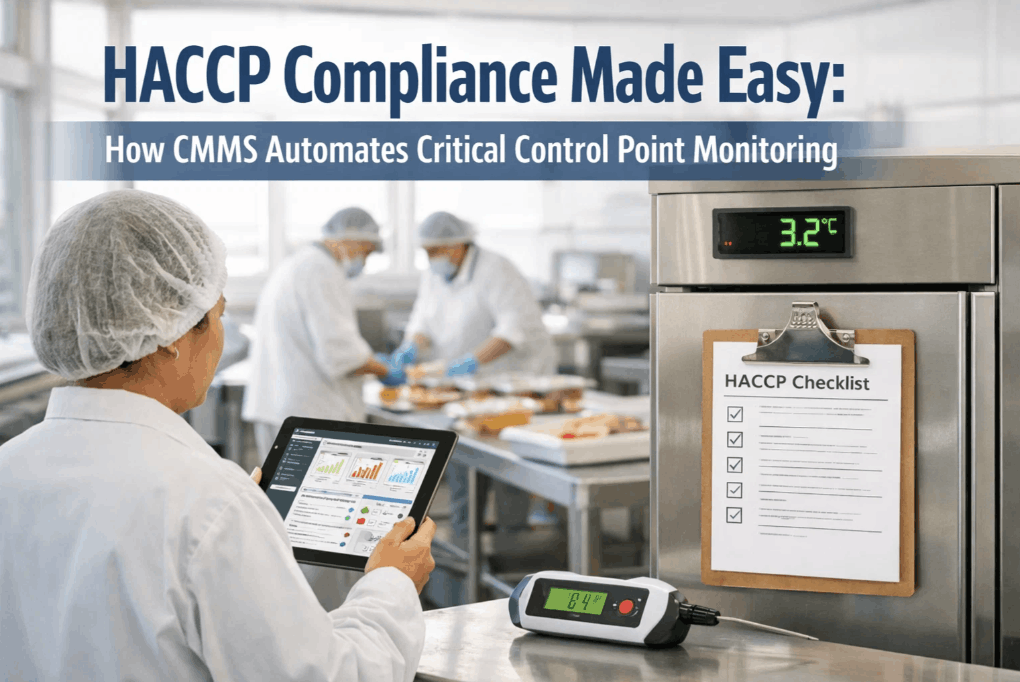
Schedule and execute equipment condition inspections, hygiene assessments, and internal SQF-aligned audits within Oxmaint. Every inspection is timestamped, assigned, and any finding automatically generates a linked work order or CAPA.
Module 11.6
Contractor Work Order Documentation
External maintenance contractors receive documented work orders with scope definition, competency fields, and mandatory return-to-service sign-off. Clause 11.6 compliance is built into the workflow — not assembled after the fact.
Module 2.1
Management Review Dashboards with Live KPIs
Give senior management real-time visibility into PM completion rates, overdue calibrations, CAPA status, and audit readiness scores. Management review obligations are met by data already in the system — no manual reporting cycles required.
Before vs After
Reactive Maintenance Records vs Oxmaint-Structured SQF Compliance
The table below maps every major SQF Edition 9 compliance failure mode against the structural change Oxmaint makes. Each row represents a finding that repeats across food plant audits — and the system-level shift that eliminates it.
| SQF Requirement |
Without CMMS (Reactive) |
With Oxmaint (Structured) |
| PM Evidence (11.3) |
Schedules exist, completion records incomplete or on paper |
Timestamped work order completions, retrievable instantly by asset |
| Calibration (11.4) |
Spreadsheet reminders, overruns undiscovered until audit |
Automated alerts, certificates stored per asset, zero silent overruns |
| CAPA Management (2.5) |
Findings verbally resolved, no formal closure documentation |
Every CAPA assigned, dated, root-cause documented, closed with evidence |
| GMP Inspections (11.5) |
Informal walkthroughs, findings resolved informally, not traceable |
Scheduled, executed, findings auto-trigger work orders or CAPAs |
| Contractor Control (11.6) |
No formal scope, competency, or return-to-service documentation |
Contractor work orders with full documentation trail and sign-off |
| Management Review (2.1) |
Meeting minutes only, no KPI evidence or documented action items |
Live dashboard data drives review, actions captured in system |
| Internal Audit (2.9) |
Annual or ad hoc, findings not linked to formal corrective actions |
Scheduled risk-based audits, every finding generates a CAPA automatically |
| Audit Preparation |
2–4 week pre-audit document assembly, gaps still surface |
Always audit-ready — records continuous, no pre-audit scramble |
ROI and Results
What Structured SQF Compliance Delivers in Operational and Financial Terms
SQF certification protects retailer relationships, premium pricing, and market access — and the cost of losing it dwarfs any CMMS investment. The numbers below reflect outcomes from food manufacturers who shifted from reactive, paper-based maintenance documentation to structured CMMS programs. Teams making this shift stop leaving money on the table through emergency repairs, audit penalties, and lost contracts — start a free trial to model your own ROI with your actual asset base, or book a demo to walk through the financial case with our team.
40%
Fewer Maintenance-Related Non-Conformances
Food manufacturers using structured CMMS documentation report 40% fewer Module 11 non-conformances after 12 months, directly protecting SQF Gold and Platinum status.
4.8x
Lower Cost of Planned vs Emergency Repairs
Every reactive breakdown triggered by a missed PM costs 4.8 times more than a planned intervention — and generates the kind of failure evidence SQF auditors treat as systemic non-conformance.
3 weeks
Eliminated from Pre-Audit Preparation Cycles
Plants previously spending 3+ weeks assembling documentation before audit report near-zero pre-audit preparation time after CMMS implementation. Compliance becomes continuous, not periodic.
25%
Reduction in Unplanned Equipment Downtime
Structured PM programs enabled by CMMS reduce unplanned downtime by 25% on average within 12 months, protecting production throughput alongside certification status.
Frequently Asked Questions
SQF Edition 9 Compliance and CMMS Common Questions
What are the most common SQF Edition 9 non-conformances in food plant maintenance?
The three most common Modules 11 and 2 non-conformances are: PM schedules that exist on paper but lack verifiable completion records, calibration overruns on safety-critical measuring equipment, and CAPAs that were actioned verbally but never formally closed with documentation. A fourth common finding is internal audit schedules that exist but whose findings are not linked to traceable corrective actions. A CMMS eliminates all four by making documentation a mandatory part of every workflow rather than an optional administrative step.
Book a demo to map your specific SQF gaps to Oxmaint workflows.
How does Oxmaint handle SQF-required GMP inspection checklists and findings?
Oxmaint allows you to build custom digital inspection checklists aligned to SQF Module 11 GMP requirements — equipment condition assessments, hygiene monitoring, foreign body risk checks, and internal audit schedules. Each inspection is timestamped and assigned to a responsible person. Any finding automatically generates a linked work order or CAPA, creating the documented, closed-loop evidence trail that Edition 9 requires.
Start a free trial to build your first SQF GMP inspection checklist today.
Can Oxmaint manage SQF compliance across multiple food manufacturing sites simultaneously?
Yes. Oxmaint operates on a Portfolio greater than Property greater than System greater than Asset hierarchy, meaning a multi-site food manufacturer can manage SQF compliance across all facilities from a single dashboard while maintaining site-level drill-down visibility. Regional managers and corporate food safety directors see PM completion rates, open CAPAs, overdue calibrations, and SQF readiness scores across every site in real time — providing the management review evidence Edition 9 demands without manual reporting aggregation.
Does Oxmaint produce the documentation package an SQF practitioner or auditor will review on site?
Oxmaint structures all maintenance records so that audit evidence is continuously current — not assembled under deadline pressure. For any asset, an SQF practitioner can pull its complete PM history, calibration record, CAPA trail, inspection findings, and contractor documentation from a single asset record view. There is no pre-audit documentation sprint because the records are maintained as a standard operating condition. This is the structural shift that converts SQF preparation from a weeks-long project into a standing state of readiness.
SQF Edition 9 · Food Plant CMMS · Free to Start
Stop Losing SQF Grades to Documentation Gaps
Turn every PM task, calibration, and corrective action into Edition 9-ready evidence — automatically, continuously, without pre-audit scramble.
Real-time asset and compliance visibility
Automated calibration and CAPA tracking
5–10 year CapEx forecasting built in
Used by operations teams managing 10,000+ assets · Measurable results in the first 30 days · Limited onboarding slots available this quarter
See how much SQF audit risk you can eliminate from your maintenance operations in 30 minutes.