Ammonia refrigeration is the backbone of cold chain integrity in food manufacturing — but it is also one of the most heavily regulated, high-consequence systems a plant manager will ever operate. A single compliance gap can trigger OSHA citations exceeding $500,000, EPA enforcement under the Risk Management Program, and unplanned plant shutdowns that shred production schedules. Start a free trial with Oxmaint to build a PSM-grade mechanical integrity and maintenance record system from day one, or book a 30-minute demo to see how ammonia plant compliance is tracked across multi-site portfolios.
Food Manufacturing · Ammonia Refrigeration
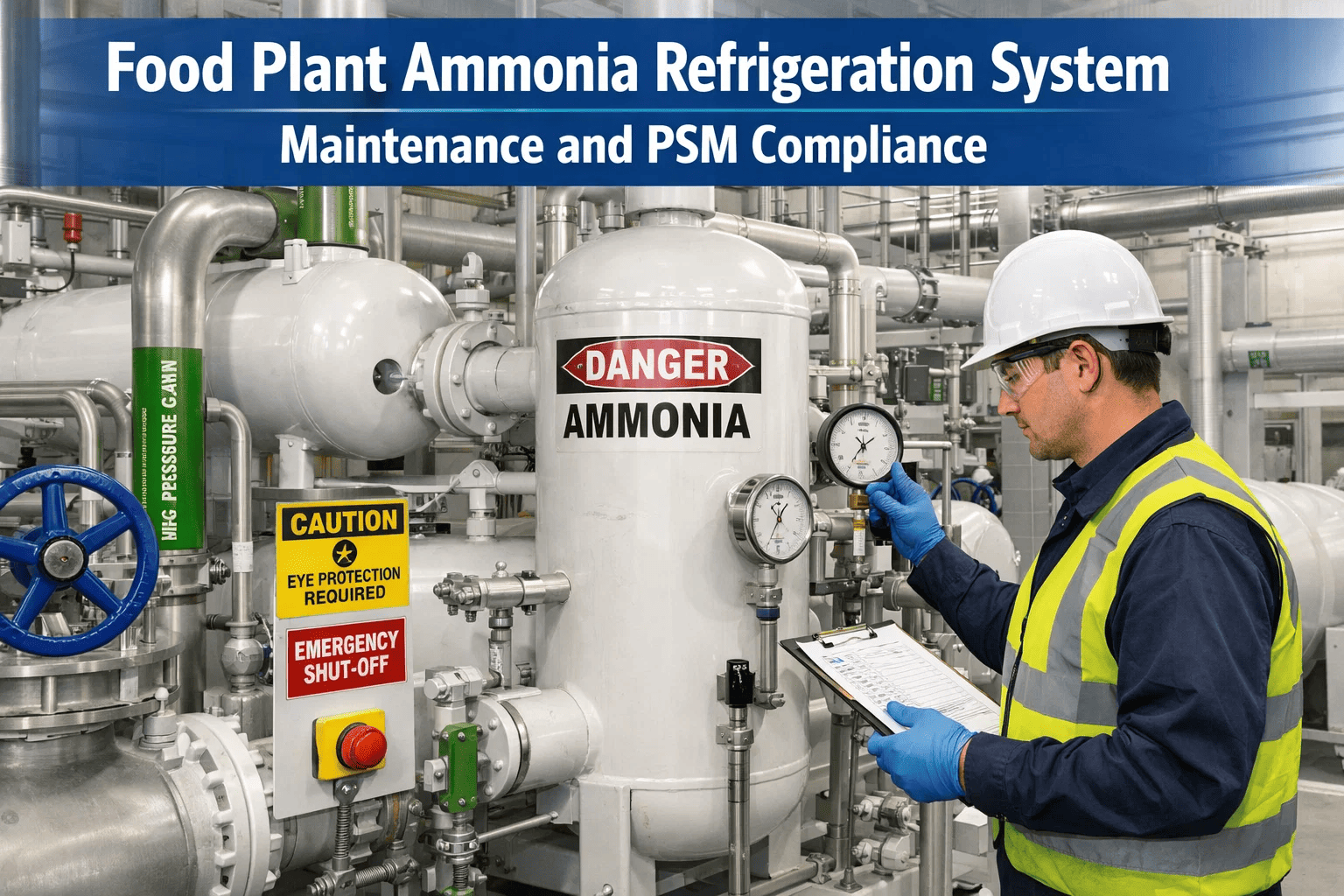
Ammonia Refrigeration Plant Maintenance and PSM/RMP Compliance
Over 10,000 lbs of anhydrous ammonia on site triggers simultaneous OSHA PSM and EPA RMP obligations — 14 program elements, 3-year audit cycles, and mechanical integrity records that must survive regulatory inspection at any moment. This guide covers what plant and maintenance managers must track, document, and prove.
10,000
lbs NH3 threshold for OSHA PSM + EPA RMP dual obligation
$27,500
EPA maximum fine per violation per day under RMP (40 CFR Part 68)
3 yrs
Mandatory PSM/RMP compliance audit cycle (OSHA/EPA)
14
PSM program elements every covered facility must document and implement
What Is Ammonia Refrigeration PSM/RMP Compliance?
OSHA's Process Safety Management standard (29 CFR 1910.119) and the EPA's Risk Management Program (40 CFR Part 68) are two overlapping federal frameworks that apply to any food manufacturing facility storing 10,000 lbs or more of anhydrous ammonia in a refrigeration system. PSM focuses on worker safety — requiring 14 documented program elements including process hazard analysis, mechanical integrity, management of change, and incident investigation. RMP extends the obligation outward, requiring facilities to assess worst-case and alternative release scenarios, develop prevention programs, and maintain emergency response coordination with Local Emergency Planning Committees (LEPCs).
Together, PSM and RMP create a documentation burden that is continuous, not periodic. Mechanical integrity records, PHA revalidations every five years, operator training logs, MOC documentation, and compliance audit reports must be complete, current, and immediately accessible. Facilities that treat these as paper exercises — rather than live operational records — face citation risk not only during inspections but during insurance audits, M&A due diligence, and any incident investigation. Start a free trial to see how Oxmaint structures PSM documentation into a CMMS-native workflow.
Most food plants have the ammonia system. Far fewer have the documentation system that proves it is being maintained correctly.
The 8 PSM Elements That Drive Maintenance Obligations
01
Process Safety Information (PSI)
Complete documentation of all process chemicals, technology, and equipment — P&IDs, equipment specifications, relief valve design basis, and material safety data for anhydrous ammonia — must be current and accessible before any work order is opened.
02
Process Hazard Analysis (PHA)
Formal hazard review (What-If, HAZOP, or checklist methodology) required before initial startup and revalidated every five years. IIAR recommends 215+ What-If questions specific to ammonia refrigeration systems for adequate coverage.
03
Mechanical Integrity (MI)
Inspection, testing, and preventive maintenance for all pressure vessels, piping, relief devices, controls, and pumps. Written procedures, qualified technician documentation, and deficiency tracking records are all required by OSHA PSM.
04
Management of Change (MOC)
Any change to equipment, procedures, or operating parameters — including refrigerant charge adjustments and equipment replacement — requires documented MOC review before implementation. Undocumented changes are among the most cited PSM deficiencies.
05
Operating Procedures
Written procedures for startup, normal operation, temporary operations, emergency shutdown, and startup after emergency must exist and be certified as current annually. Operator sign-off and version control are required.
06
Training & Operator Certification
Initial and refresher training on covered process procedures, with written documentation of comprehension. IIAR operator certification programs (RETA CARO/CIRO) are widely recognized as RAGAGEP-compliant standards for ammonia refrigeration operators.
07
Incident Investigation
Every release or near-miss must trigger a formal investigation within 48 hours, with a written report including contributing factors and corrective actions. Reports must be retained for 5 years and findings shared with affected employees.
08
Emergency Response Planning
Facilities must maintain a written emergency response plan coordinated with local fire departments and LEPC. Plan must address evacuation routes, shelter-in-place procedures, emergency notification, and first responder information for anhydrous ammonia releases.
The Pain Points That Create PSM Exposure
01
Incomplete Mechanical Integrity Records
Inspection dates, technician qualifications, test results, and deficiency resolutions scattered across spreadsheets and paper forms. When OSHA arrives, gaps in MI documentation constitute a serious violation regardless of whether the equipment was actually maintained.
02
Overdue PHA Revalidations
PHA revalidation every five years is a hard regulatory deadline. Plants operating on paper-based or siloed tracking systems routinely miss the revalidation window, creating immediate PSM non-compliance that survives even a clean physical inspection of the refrigeration system.
03
Undocumented Management of Change
Equipment swaps, refrigerant charge adjustments, and pipe reroutes performed without MOC documentation are among the most common PSM citations issued in food manufacturing. A single undocumented change invalidates the PSI record for that system.
04
Training Records That Cannot Be Produced
Operator training completion, comprehension verification, and refresher cycles must be documented per employee. Plants with high turnover — common in food processing — often cannot produce compliant training records for all personnel operating covered processes.
05
Reactive Maintenance on Safety-Critical Equipment
Relief valves, pressure vessels, and compressor seals managed reactively fail without warning. A 2024 OSHA action against a pork processing facility resulted in $528,441 in proposed penalties after workers were exposed to ammonia gas during unplanned compressor seal maintenance.
06
No Audit Trail for Compliance Audits
PSM/RMP compliance audits are required every three years. Without a system that timestamps every inspection, work order, and corrective action, facilities must reconstruct compliance history manually — a process that routinely surfaces gaps during regulatory review.
A 2024 OSHA enforcement action at a food processing facility: 43 violations, $528,441 in proposed penalties — triggered by two workers exposed to ammonia during maintenance on a refrigeration system.
How Oxmaint Closes the Ammonia Compliance Gap
Mechanical Integrity Workflow
Schedule and track all PSM-required inspections and tests for pressure vessels, relief devices, piping, and compressors. Each work order captures technician ID, inspection date, results, and any deficiency with automatic escalation until resolved. Full MI record always accessible.
MOC Documentation Module
Open a Management of Change record directly from any asset in Oxmaint. Capture change description, affected PSI, PHA implications, required approvals, and pre-startup safety review completion. MOC records are linked to the asset and surfaced automatically during audits.
PHA Revalidation Tracking
Set 5-year PHA revalidation deadlines per covered process with automated alerts at 12 months, 6 months, and 30 days before due date. Attach completed PHA reports and HAZOP documentation directly to the process asset record for immediate auditor access.
Compliance Audit Readiness Dashboard
Real-time view of open deficiencies, overdue PMs, incomplete work orders, and training record gaps across all covered processes. One dashboard gives plant managers and VP Ops the audit posture of the facility before the auditor arrives — not after.
Operator Training Records
Track initial and refresher training completion by operator, by covered process, with certificate upload and expiry alerts. Never face a PSM audit without a complete training record for every qualified operator on the ammonia system.
Incident Investigation Workflow
Launch a structured incident investigation from any release or near-miss in Oxmaint. Capture timeline, contributing factors, corrective actions, and employee notifications. Investigation reports are retained in the system and linked to the asset for the 5-year statutory retention period.
Reactive vs. Planned: What PSM Compliance Actually Costs
| Compliance Area |
Reactive / Undocumented |
Planned / Oxmaint-Managed |
| Mechanical Integrity |
Paper logs, missed inspections, no deficiency tracking. OSHA cites missing records as serious violations even if equipment is functional. |
Scheduled PMs per IIAR RAGAGEP, digital records with technician sign-off, auto-escalation of open deficiencies until resolved. |
| PHA Revalidation |
Tracked in a shared spreadsheet, missed 5-year deadline, no alert system. First notice of gap is the auditor's finding. |
Automated countdown per covered process, alerts 12 months and 30 days out, PHA documents attached to asset record. |
| Management of Change |
Equipment swap handled informally, no MOC opened, PSI not updated. Invalidates the record for that asset. |
MOC triggered from any asset change, approval workflow enforced, PSI updated, pre-startup safety review linked to work order. |
| Incident Investigation |
Release documented in a Word file, no corrective action tracking, no 5-year retention, no sharing protocol with affected employees. |
Structured investigation workflow, corrective actions tracked to closure, report retained and linked to asset for full statutory period. |
| Compliance Audit Prep |
2–4 weeks of manual document gathering. Gaps surface during the audit itself. Average OSHA penalty per citation: $16,000+. |
Dashboard shows open items in real time. Audit preparation measured in hours, not weeks. No gap surprises. |
ROI of Structured Ammonia Maintenance Programs
$528K
Proposed OSHA penalties in a single 2024 food plant enforcement action for ammonia refrigeration PSM violations
4.8×
Higher cost of emergency ammonia system repairs vs. planned preventive maintenance on equivalent work scope
5 yrs
Statutory retention period for PSM incident investigation reports — digital systems eliminate retrieval risk during audits
60%
Reduction in compliance audit preparation time reported by multi-site food manufacturers using structured CMMS-based PSM tracking
Facilities using Oxmaint for PSM program management report audit-ready documentation in hours — not weeks. Measurable results within the first 30 days of onboarding.
Frequently Asked Questions
What CMMS records does OSHA require for mechanical integrity under PSM?
OSHA PSM (29 CFR 1910.119(j)) requires written procedures for maintaining the ongoing integrity of process equipment, including inspection and testing procedures consistent with RAGAGEP. Records must document each inspection and test, including the date performed, the name of the person who performed the inspection, the serial number or other identifier of the equipment, a description of the inspection or test, and the results. Deficiencies found must be corrected before further use or in a safe and timely manner when necessary. Oxmaint captures all required fields per work order and links each record to the individual asset in the hierarchy — ensuring the documentation structure OSHA inspectors expect.
Start a free trial to configure your ammonia MI workflow.
How does the EPA RMP differ from OSHA PSM for ammonia refrigeration plants?
OSHA PSM is a worker protection standard focused on internal process safety management — it governs how facilities manage hazards to prevent releases and protect employees. EPA RMP (40 CFR Part 68) extends the obligation to the surrounding community, requiring facilities to assess worst-case and alternative release scenarios, develop and submit a risk management plan to EPA, and coordinate emergency response with local first responders and the LEPC. Both programs apply simultaneously to facilities with 10,000 lbs or more of anhydrous ammonia. The core prevention program under RMP Program 3 largely mirrors PSM's 14 elements, meaning a well-structured PSM program substantially satisfies RMP prevention requirements — but RMP adds distinct submission, registration, and community notification obligations that PSM does not cover.
Book a demo to see how Oxmaint maps PSM and RMP requirements to a unified maintenance and compliance workflow.
What is RAGAGEP and why does it matter for ammonia refrigeration maintenance?
RAGAGEP stands for Recognized and Generally Accepted Good Engineering Practices — the industry standards and codes that define acceptable design, operation, inspection, and maintenance practices for ammonia refrigeration systems. For PSM and RMP compliance, OSHA and EPA use RAGAGEP as the benchmark for evaluating whether a facility's mechanical integrity program meets the standard of care. The primary RAGAGEP sources for ammonia refrigeration are IIAR standards (IIAR 2, IIAR 6, IIAR 9), ASHRAE standards, ASME Boiler and Pressure Vessel Code, and applicable sections of NFPA. When inspectors evaluate whether your MI procedures, inspection frequencies, and relief valve testing intervals are adequate, they compare them to these RAGAGEP sources. Oxmaint's PM scheduling system allows maintenance managers to set inspection frequencies per asset that align with IIAR and ASME requirements, creating an auditable record of RAGAGEP-compliant maintenance intervals.
How should food plants track Management of Change for ammonia refrigeration equipment?
Under OSHA PSM, any change to process chemistry, technology, equipment, procedures, or operating conditions — other than a replacement in kind — requires a documented MOC review before implementation. For ammonia refrigeration, this includes equipment replacements with different specifications, refrigerant charge increases, pipe rerouting, control system changes, and procedure revisions. The MOC record must document the technical basis for the change, the safety and health implications, required modifications to operating procedures, authorization, and the date when affected employees were informed and trained. Pre-startup safety review (PSSR) is required before returning a modified system to service. Oxmaint allows maintenance managers to initiate an MOC workflow directly from any asset record, route approvals to the required stakeholders, and link the resulting procedure updates and PSSR completion back to the asset — maintaining a complete, linked audit trail that satisfies both OSHA PSM and EPA RMP MOC requirements.
Ammonia Refrigeration · PSM Compliance · CMMS Records · EPA RMP
Stop Managing PSM Compliance in Spreadsheets
Oxmaint gives your food plant a CMMS-native PSM program — mechanical integrity records, MOC workflows, PHA revalidation tracking, operator training logs, and audit-ready dashboards — all linked to individual assets in your ammonia refrigeration hierarchy. Used by ops teams managing 10,000+ assets. Live in days, not months.
Real-time audit readiness dashboard — no manual document gathering
Mechanical integrity records tied to every vessel, valve, and compressor
MOC, incident investigation, and training records in one linked system
No heavy implementation · Works across multi-site food manufacturing portfolios · Limited onboarding slots this quarter