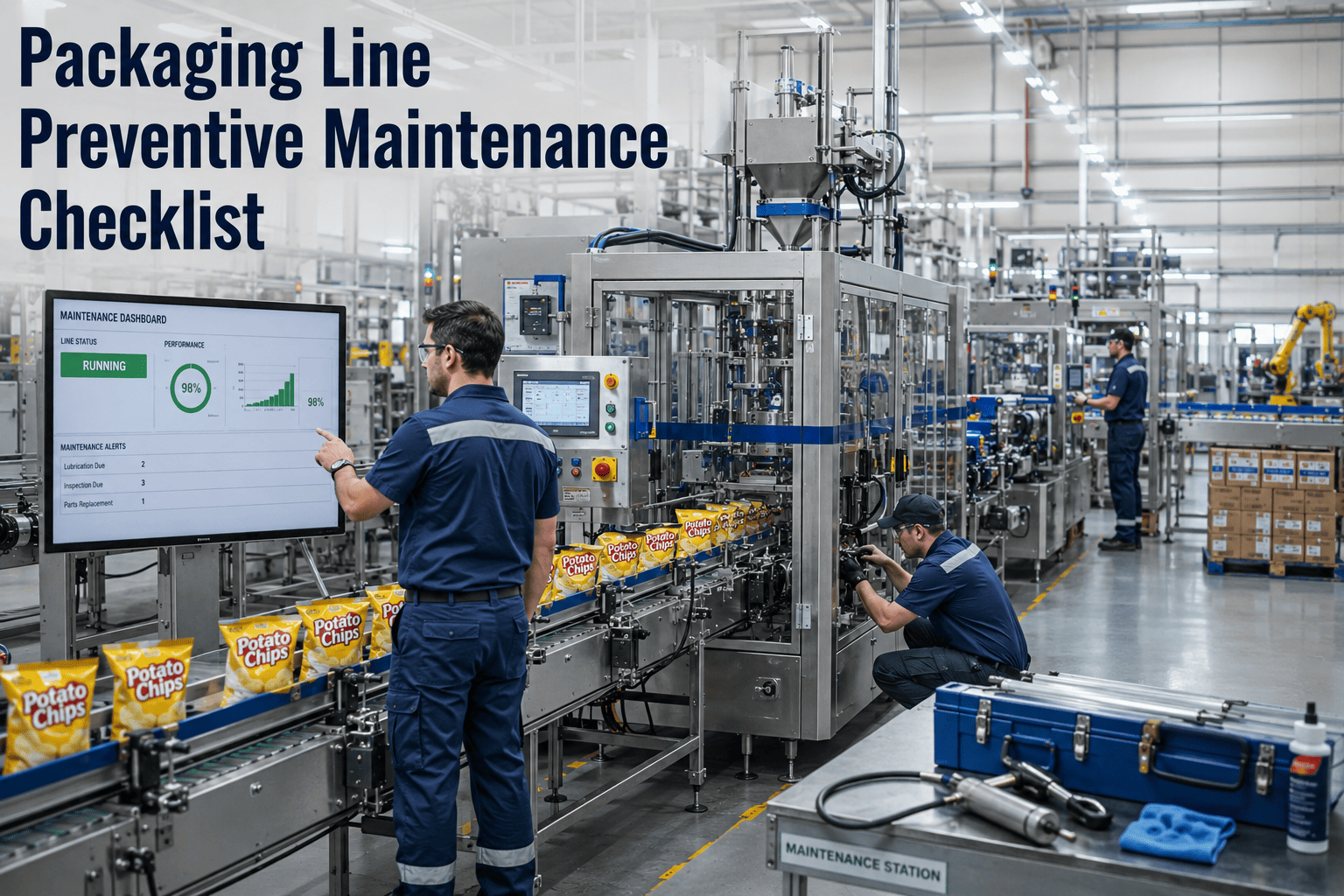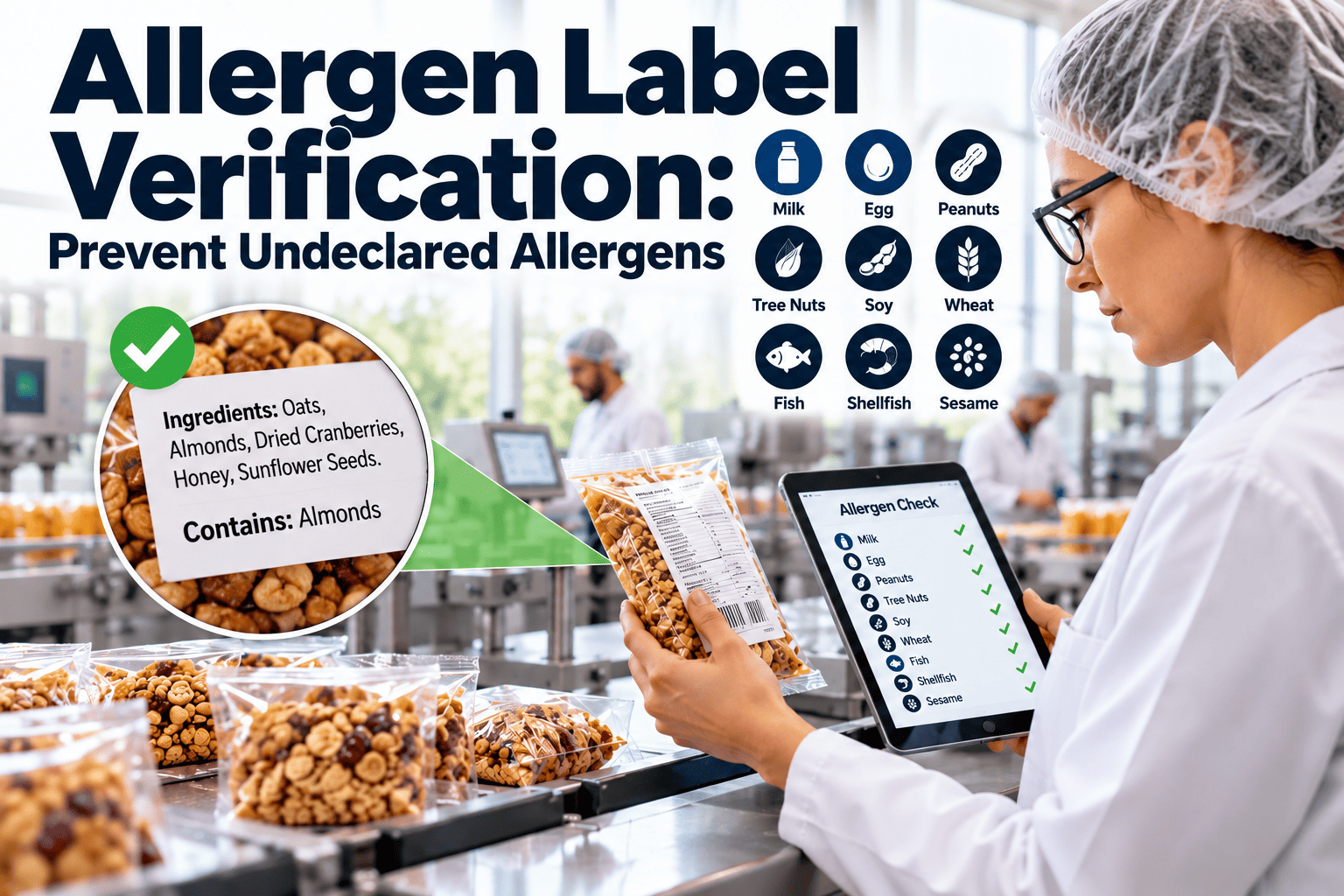
A label can be printed perfectly and still be wrong for the product inside the pack. A roll left on the unwinder from the last run, artwork never updated after a recipe change, or a rushed start-up can put an allergen in a package that does not declare it. Allergen label verification checks every label against the approved formula at setup and during the run. It is a direct way to prevent undeclared allergens, and a maintenance management platform supports it by keeping packaging equipment reliable.
Allergen Label Verification: Prevent Undeclared Allergens
Check labels against formulas at setup and during runs, record every check and keep packaging equipment ready to run the right label on the right product.
Undeclared allergens are a labeling failure with serious consequences
Undeclared allergens are consistently among the leading reasons for food recalls in the United States. Many trace back to labeling and packaging errors rather than ingredients alone.
Six ways the wrong label reaches the pack
Knowing the failure modes tells you where a check will do the most good.
| Failure mode | Typical trigger | Control that catches it |
|---|---|---|
| Leftover labels from the previous run | Changeover not cleared, spare rolls left near the line | Line clearance with label removal sign-off |
| Outdated artwork | Recipe or supplier change not sent to packaging | Change control linking formula to artwork version |
| Wrong roll loaded | Similar designs, rushed roll change | Second-person check at every roll change |
| Wrong product in wrong pack | Pre-printed film or cartons mixed up | Verification of film, carton and product code at setup |
| Printed date or code error | Wrong data entered into the coder | First-article inspection and periodic print checks |
| Label or print degraded | Smudging, misalignment or peeling | In-run sampling and equipment maintenance |
Verify at setup and again during the run
A single check at start-up is not enough. Roll changes, breaks and operator handovers all create fresh opportunities for error.
Before the first pack
- Confirm product code and formula version
- Compare the label text with the approved allergen declaration
- Check the artwork version number against the master list
- Verify film, carton and label stock match the product
- Remove all labels and packaging from the last run
- Run a first-article sample and keep it with the record
While product is running
- Check labels at every roll or film change
- Sample packs at a defined interval, such as hourly
- Re-check after every stoppage, break or shift handover
- Confirm print quality, date code and legibility
- Compare a finished pack with the product in it
- Stop the line and hold product if a mismatch is found
What you are actually comparing
A label check is a three-way comparison. Each side must agree, and a record should show that someone looked.
Approved formula
The current recipe with every allergen-containing ingredient, including sub-ingredients and processing aids.
Label or artwork
The ingredient list and allergen statement printed on the pack, including its version number.
Product on the line
The product actually being packed, identified by code, lot number and appearance.
Mismatch in any pair is a stop condition. Hold the product, find the cause and correct it before packing resumes.
A practical start-up label verification checklist
Use a written checklist so the check is the same on every line and every shift. Adapt the items to your packaging format.
Make every label check a recorded, repeatable task
Build packaging checklists, schedule equipment upkeep and keep sign-offs in one workflow.
What a compliant allergen declaration needs to show
In the United States, packaged food labels must identify major food allergens in plain language. Confirm current requirements for every market you sell into.
Ingredient list approach
The allergen source is named in the ingredient list, with the common name in brackets where the ingredient name does not already show it.
Contains statement approach
A separate statement lists each major allergen present, placed near the ingredient list and worded consistently.
Complete coverage
Every allergen in the formula must appear, including those from compound ingredients, flavors and processing aids.
Sesame became a major allergen in the United States on January 1, 2023. Older artwork created before that date should have been reviewed against current ingredient sources.
Keep formula changes and artwork changes locked together
Many undeclared allergen events start before the packaging line, at the moment a recipe or supplier changes. A simple chain of approvals closes the gap.
Change is proposed
New ingredient, supplier, formula or process aid is requested by product development or purchasing.
Allergen review
Quality checks the new allergen profile and decides whether artwork, allergen matrix or cleaning must change.
Artwork update and approval
New artwork receives a version number and is approved by quality and regulatory contacts.
Old stock removed
Previous labels, film and cartons are withdrawn, counted and destroyed or segregated.
First run verified
The first production run gets a full setup check with extra attention to the new version.
Situations that raise label risk
Some packaging scenarios deserve tighter controls because the chance of a mix-up is higher.
| Situation | Why it is risky | Extra control |
|---|---|---|
| Variety or multipack assortments | Several products and labels run into one outer pack | Verify each component and the outer pack label separately |
| Look-alike flavors or sizes | Similar artwork makes wrong rolls easy to load | Distinct roll storage and a second-person identity check |
| Rework added to a product | Rework may carry allergens not in the recipe | Allow only approved rework with matching allergens |
| Multiple language labels | Translations may drift between versions | Control all language versions under one change record |
| Co-packing and private label | Customer-supplied packaging arrives with their artwork | Verify customer artwork against your formula on receipt |
| Short runs and frequent changeovers | Setup is repeated many times per shift | Use a short, strict checklist and dedicated label storage |
What a label verification record should capture
An auditor or customer will want proof that checks happened as written, not just a procedure on paper.
- Date, time, line, product code and production order number
- Formula version and artwork version verified
- Name and signature of the checker and the second verifier
- A sample label or pack attached or photographed with the record
- Results of in-run checks, with times and any deviations
- Label reconciliation counts at the end of the run
- Actions taken for any mismatch, including product held and root cause
Records are only useful if they can be found. Store them by line and date so a recall investigation can pull the right checks within minutes.
Track a few measures that show whether checks are working
Trends reveal weak spots before they become incidents. Keep the list short and review it regularly.
Choose a sampling rhythm that matches the risk
Sampling frequency should reflect how often something can change. Higher-risk products and manual label handling justify tighter intervals.
Start of run
Full verification with first-article approval by a second person.
Every roll or film change
Re-check label identity, version and print quality before restart.
Set interval during the run
Sample finished packs and compare them with the formula and product code.
After any stoppage or handover
Repeat the identity check, since mix-ups often follow interruptions.
End of run
Reconcile used and unused labels, and remove or destroy leftovers.
Count your labels in and out
Reconciliation shows whether any label has gone missing or ended up on the wrong product.
- Record the number of labels or packs issued at the start of the run
- Record the number used, the number rejected and the number returned
- Investigate any difference before the line is cleared
- Destroy printed material that cannot be reused and record the disposal
- Store unused labels in a controlled area away from the line, by product code
Reconciliation works best when printed packaging is issued in controlled quantities, not left in open bins beside the line.
Where barcode and vision verification add value
Automated checks reduce reliance on human attention, especially on fast lines and long runs.
- Barcode scanners can confirm that the printed code matches the product scheduled on the line
- Vision systems can read label text, date codes and print quality on every pack
- Rejected packs can be diverted automatically for inspection instead of relying on spot checks
- Test the system at each start-up with a known good and a known bad sample
- Treat automation as an added layer, since it still depends on correct master data and maintained hardware
Packaging equipment condition affects label accuracy
Even a perfect procedure fails if the labeler, coder or scanner behaves unpredictably. Maintenance is part of the control.
Labelers and applicators
- Check sensors, rollers and peel plates
- Inspect drive belts and tension
- Verify label gap and placement settings
Coders and printers
- Clean print heads and nozzles
- Replace ribbons and inks on schedule
- Confirm data entry and templates after changes
Vision and barcode scanners
- Clean lenses and lighting
- Test with good and bad reference samples
- Check the reject device operation
Film and carton handling
- Inspect unwinders and splicers
- Check guides and feed alignment
- Keep spare rolls away from the line
Connect label controls to maintenance workflows
Oxmaint does not read labels or approve artwork. It organizes the maintenance and inspection work that keeps packaging lines dependable.
Make the right label the easiest label
Good systems reduce reliance on memory. A few design choices make errors harder to commit.
Fragile practices
- Storing many similar rolls beside the line
- Relying on one person to verify their own setup
- Handwritten notes for artwork versions
- Starting production before sign-off
- Skipping checks when the schedule is tight
Robust practices
- Issuing labels by production order
- Independent second-person verification
- One controlled master list for artwork versions
- Line interlocks or sign-off before start
- Barcode or vision checks where practical
Train operators to treat a mismatch as a stop
Procedures only work if people feel able to halt the line. Make the stop rule clear and protect those who use it.
- Train packaging operators, line leaders and maintenance staff on why undeclared allergens are dangerous
- Show real examples of look-alike labels and wrong-version artwork
- Define the actions to take on a mismatch, including who to call and how to hold product
- Refresh training after any procedure change or incident, and record attendance
Allergen label verification questions
How often should labels be checked during a run?
At setup, at every roll change, after stoppages and at a set interval. Choose the interval based on risk.
Who should verify the label at setup?
A second trained person, not the operator who prepared the line. Independent checks catch more errors.
What should happen when a mismatch is found?
Stop the line, hold product since the last good check and investigate. Record the findings and corrective action.
Can maintenance software help with label verification?
It can schedule equipment upkeep and store checklists. Start with Oxmaint to build those workflows.
Does Oxmaint verify label content?
No. It supports the maintenance side. Book a demo to see how it fits your packaging lines.
Keep packaging lines reliable and label checks on record
Bring inspections, equipment upkeep and sign-offs together so undeclared allergens have fewer places to hide.