Brewery Maintenance: Brewhouse, Fermenters, Bright Tanks, and Filtration PM
By Josh Turley on May 14, 2026
The U.S. beer industry generated $129.3 billion in retail revenue in 2024, yet the craft segment continues to close at a rate of roughly 4% annually — and the primary operational differentiator between thriving breweries and those that close is maintenance discipline. Reactive maintenance costs 4.8 times more than planned maintenance, and in a margin-compressed market where every batch must ship on time and on-spec, unplanned downtime is not just an operational inconvenience — it is a direct threat to brand survival. Brewhouse systems, fermenters, bright tanks, filtration circuits, CIP loops, glycol chillers, and packaging lines all require documented preventive maintenance programs aligned with FDA 21 CFR Part 110, FSMA Part 117, and TTB 27 CFR Part 25 to protect both quality and regulatory standing. Start a free trial to register your entire brewery asset inventory in Oxmaint, or book a demo to see how brewery PM scheduling and compliance documentation works in practice.
See how Oxmaint eliminates reactive brewery failures and keeps every tank, line, and CIP system audit-ready.
Craft breweries operating in the US (Brewers Association 2024)
4.8x
Higher cost of reactive vs planned maintenance (Senseye Industrial Maintenance Report)
38%
Fermenter and bright tank gaskets found past service interval in pre-CMMS brewery audits
5–10%
Of annual revenue recommended for brewery equipment maintenance (industry benchmark)
What Brewery Preventive Maintenance Covers
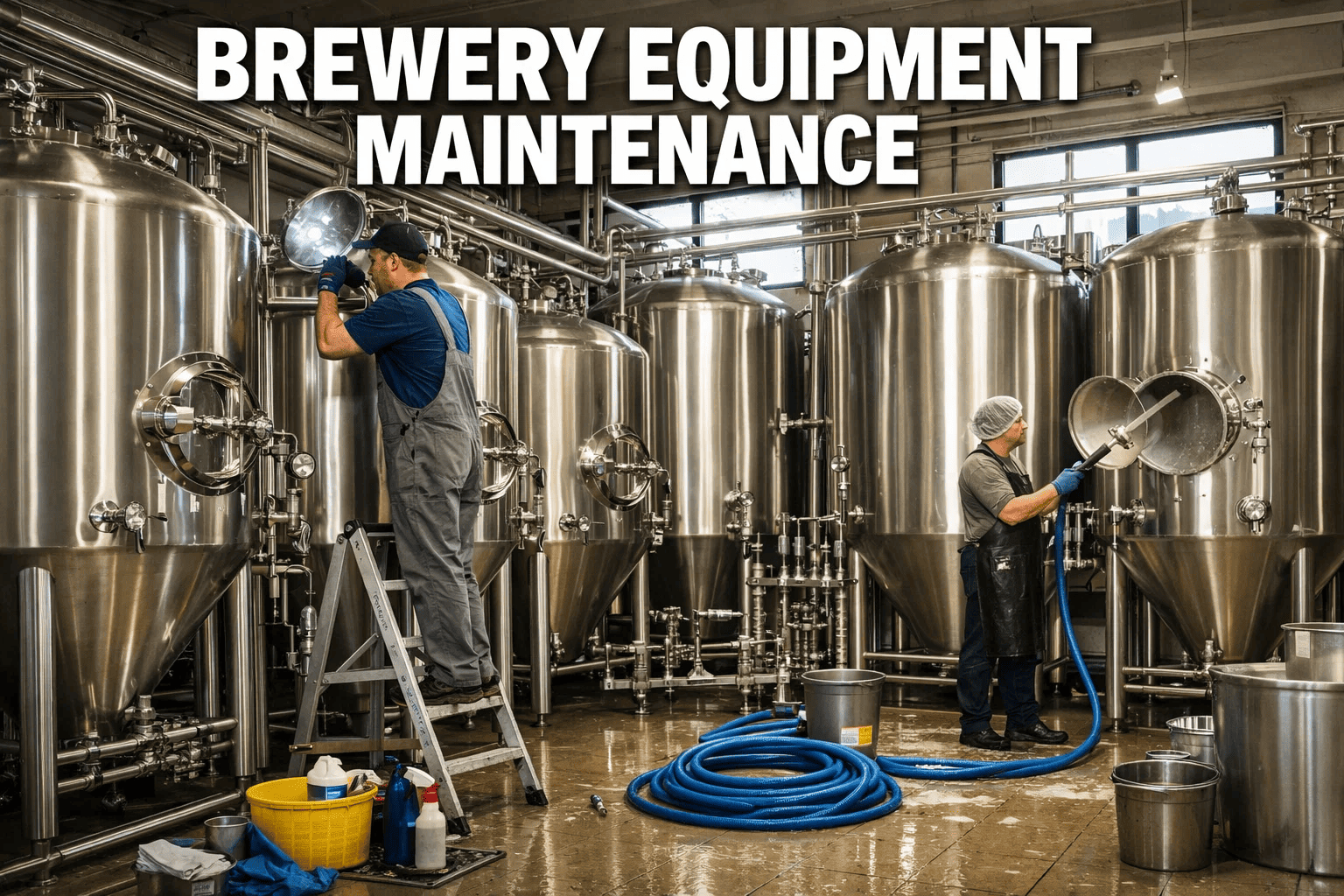
Brewery preventive maintenance (PM) is the scheduled, documented program of inspections, calibrations, cleaning validations, and component replacements that keeps every production asset operating within specification — before failures occur. Unlike general manufacturing PM, brewery maintenance is uniquely intersected with product quality at every equipment touchpoint. A failed CO2 pressure relief valve affects carbonation. A worn fermenter butterfly valve seal introduces oxygen. A degraded CIP spray ball leaves biofilm that compromises the next batch at the microbiological level. PM in a brewery is not just asset protection — it is product protection, brand protection, and regulatory compliance protection simultaneously.
Effective brewery PM spans six major asset categories: the brewhouse (mash tun, lauter tun, brew kettle, whirlpool, heat exchangers), fermentation cellar (fermenters, yeast management vessels), bright beer cellar (bright tanks, carbonation systems, CO2 recovery), filtration and clarification systems, CIP infrastructure, and production utilities (glycol chillers, boilers, RO water systems, compressed air). Each category carries its own regulatory compliance obligations under FDA, FSMA, and TTB frameworks, and each requires a structured work order history to survive regulatory inspection. Teams that rely on paper logs and tribal knowledge are one audit away from citations — start a free trial to build a digital PM program that puts every brewery asset under scheduled coverage.
Most breweries lose 20–40% of maintenance budget to untracked reactive repairs — each one costing 4.8x more than a scheduled PM task would have.
Core Brewery PM Framework: Six Asset Categories
01
Brewhouse Systems
Mash tun agitators, lauter tun rakes, brew kettle heating elements, whirlpool tangential inlets, and wort heat exchangers. Plate HX gasket condition directly impacts wort infection risk and thermal efficiency.
02
Fermentation Vessels
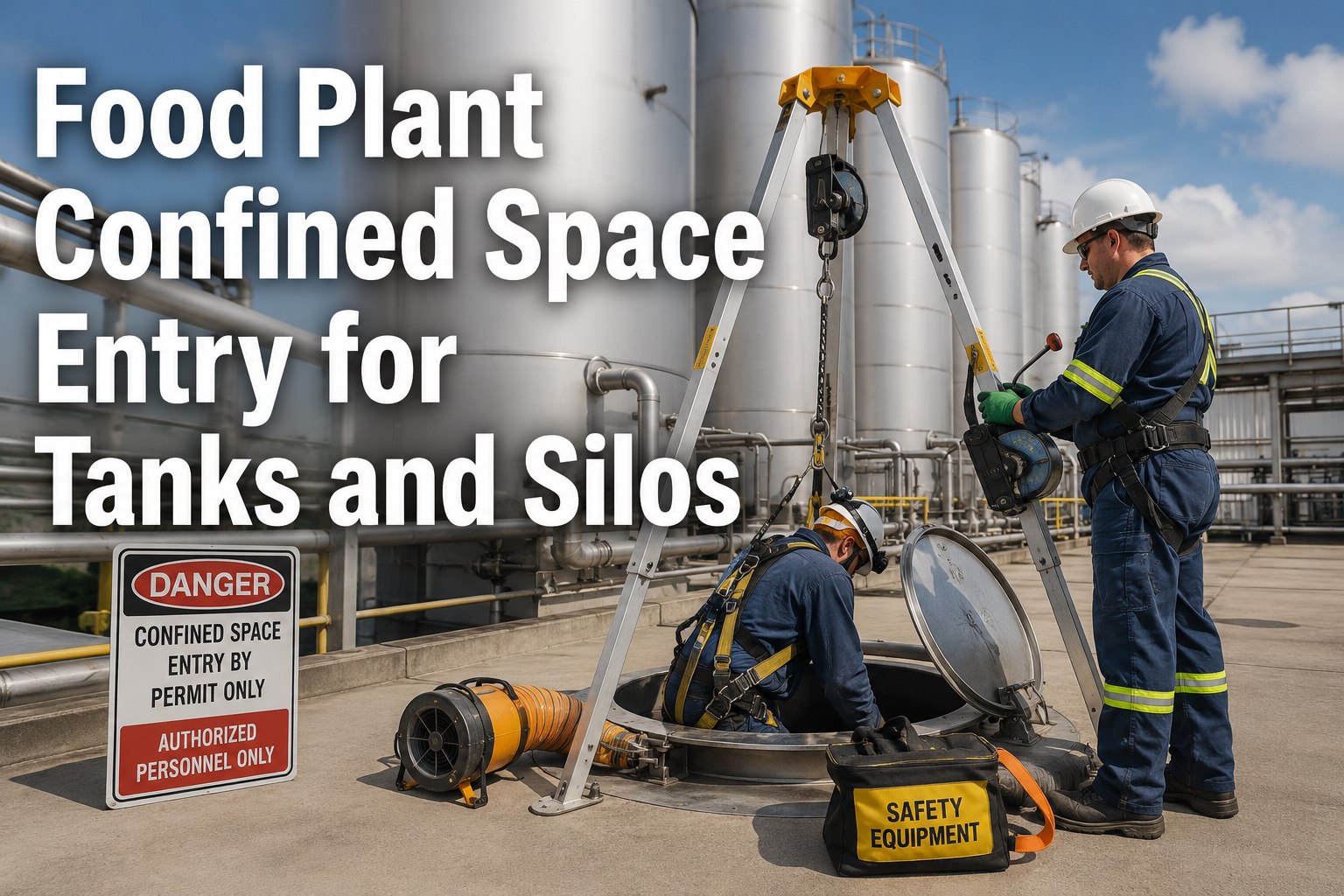
Butterfly valves, racking arms, pressure relief valves, temperature sensors, CIP spray balls, and cone gaskets. Weekly visual inspection plus quarterly full-service; OSHA confined space protocols required for internal entry.
03
Bright Tank and Carbonation
Carbonation stones, CO2 pressure regulators, rupture discs, level sight glasses, and sanitary valves. ASME and PED pressure vessel inspection certificates must remain current — expired certs create insurer and TTB compliance exposure.
04
Filtration and Clarification
DE filters, sheet filters, centrifuges, and crossflow membrane systems. Differential pressure trending identifies media saturation before throughput loss; micro-motion flow meters require periodic TTB-mandated calibration.
05
CIP Infrastructure
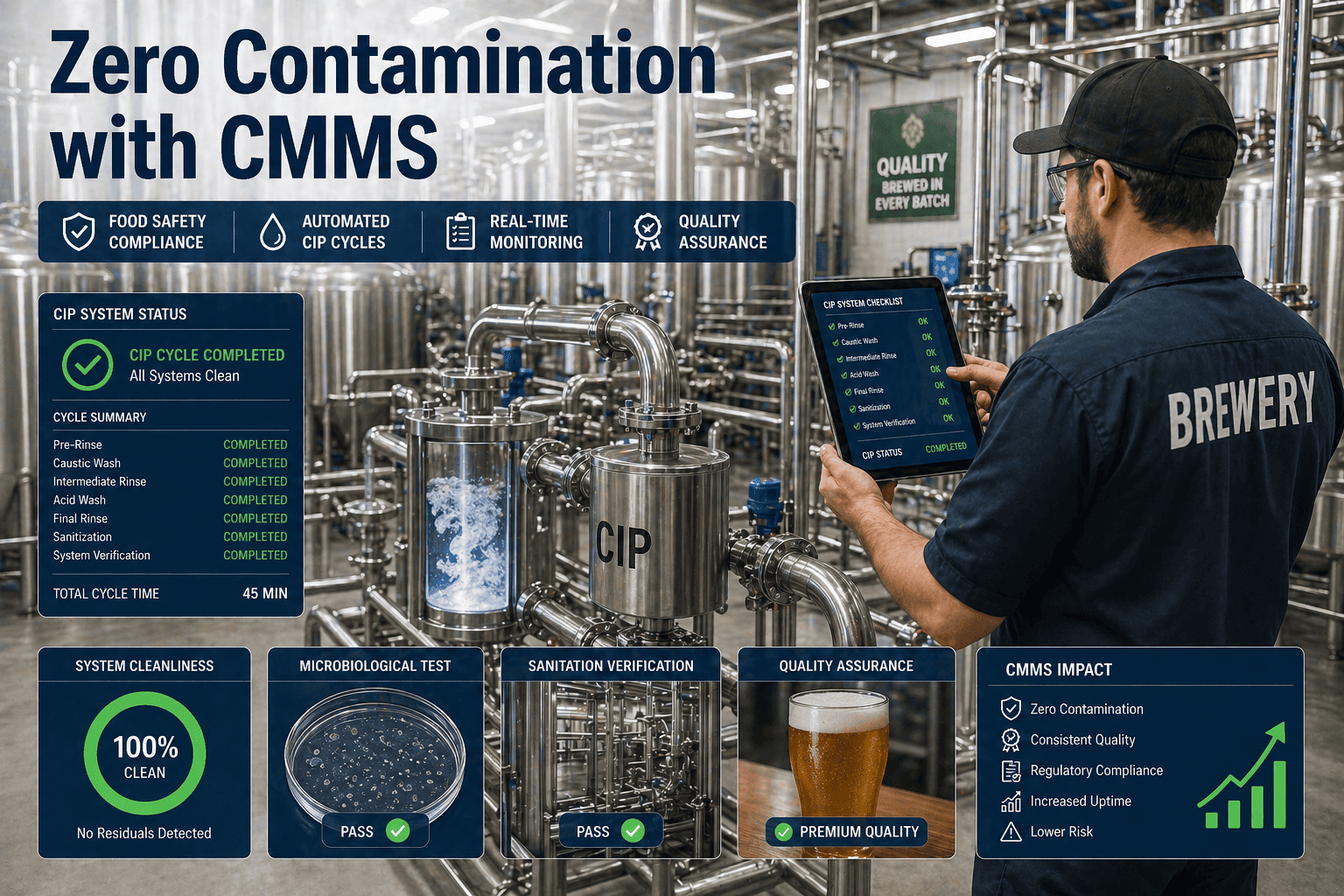
CIP spray balls, caustic and acid dosing pumps, heat exchangers, chemical concentration sensors, and return pumps. CIP cycle validation — temperature, concentration, and contact time — must be logged per FDA 21 CFR Part 110 cGMP requirements.
06
Utilities: Glycol, Boiler, Water, Air
Glycol chiller compressors, boiler tubes and safety valves, RO membrane replacement cycles, and compressed air dew point monitoring. These support systems enable every production process — their failure cascades instantly across the entire cellar.
Industry Pain Points: Where Brewery Maintenance Breaks Down
Contaminated Batches from Deferred Seal Replacement
Fermenter and bright tank butterfly valve seals have defined service intervals — typically 6 to 12 months. Without CMMS tracking, seals routinely exceed service life, creating micro-harboring points for Lactobacillus and wild yeast that generate off-flavours, trigger batch rejection, and require emergency deep-clean protocols costing thousands per incident.
Incomplete TTB and FDA Records During Inspection
TTB auditors cite missing or incomplete maintenance records as a leading inspection failure point. Under 27 CFR 25.42, flow meter and measuring device calibration records must be available on demand. Paper logs filed incorrectly or missing for prior audit cycles create regulatory exposure even when the maintenance work was actually performed.
CIP Spray Ball Degradation and Biofilm Formation
CIP spray ball inspections and cycle validations deferred under production pressure are the leading cause of biofilm formation in fermenters and bright tanks. Without CMMS-triggered PM tasks for spray ball pull-and-inspect cycles, CIP coverage holes develop undetected — producing microbial off-flavours that only surface at sensory panel review or customer complaints.
Glycol Chiller and Boiler Failures Cascading Across Cellar
Utility system failures have immediate, cascading impacts across the entire production operation. A glycol chiller compressor failure in summer results in rising fermenter temperatures, yeast stress, and compromised fermentation profiles across every active tank. Breweries managing utilities reactively face multi-day production losses during compressor repair windows — start a free trial to put every utility asset under scheduled PM coverage.
Breweries allocating 15% of operational budget to preventive maintenance see 20% fewer unscheduled repairs — and zero batch contamination incidents tied to deferred PM.
How Oxmaint Solves Brewery Maintenance Challenges
Asset Registry
Full Brewery Asset Hierarchy
Register every fermenter, bright tank, CIP pump, glycol chiller, and filtration unit with manufacturer specs, service intervals, and pressure vessel certificates. Hierarchy: Brewery > Cellar > Vessel > Component — giving you full visibility from portfolio to individual gasket.
PM Scheduling
Auto-Generated Brewery Work Orders
Define PM intervals by asset class — weekly fermenter checks, monthly CIP spray ball inspections, quarterly seal replacements, annual pressure vessel certifications. Oxmaint auto-generates and assigns work orders before intervals expire, eliminating the deferred-maintenance cycle.
Compliance Documentation
TTB and FDA Audit-Ready Records
Every CIP cycle validation, flow meter calibration, seal replacement, and pressure test is logged with timestamp, technician, chemical concentration, and result — creating a complete, searchable compliance record that survives TTB 27 CFR 25.42 and FDA 21 CFR Part 110 inspection requests.
Mobile Execution
Brewery Floor Work Orders on Mobile
Technicians complete work orders, capture photos of gasket condition, log CIP chemical concentrations, and close tasks from the cellar floor on mobile — no paper, no back-office data entry, no missing records. Real-time status visible to brewmaster and operations manager instantly.
Spare Parts
Gasket and Seal Inventory Tracking
Link minimum stock levels for high-turnover items — butterfly valve seals, CIP spray balls, pump impeller seals, heat exchanger gaskets — to PM schedules. Oxmaint triggers reorder alerts before critical spares run out, eliminating the emergency procurement premium that hits during unplanned failures.
Multi-Site
Portfolio View Across Brewing Locations
Brewing groups operating multiple taprooms, production sites, or contract brewing facilities manage all asset PM status, compliance records, and open work orders from a single operations dashboard — eliminating the $57K+ annual cost of equipment incompatibility and inconsistent maintenance standards across sites.
Reactive vs Planned: Brewery Maintenance Comparison
Maintenance Dimension
Reactive Model
Planned with Oxmaint
Fermenter seal replacement
Replaced after contamination event — batch already lost
Replaced on schedule — zero contamination risk
CIP spray ball inspection
Inspected when biofilm complaint surfaces — weeks late
Monthly pull-and-inspect work orders auto-generated
Flow meter calibration (TTB)
Calibrated only during TTB audit — citation risk
Quarterly calibration cycles with logged results
Glycol chiller compressor
Failed mid-summer — 3-day multi-tank production halt
What brewery equipment should be on a preventive maintenance schedule in Oxmaint?
All production-critical and compliance-sensitive assets should have PM schedules: fermenters (weekly visual inspection, quarterly full-service including seal and spray ball replacement), bright tanks (monthly valve and CIP check, annual pressure vessel recertification), brewhouse heat exchangers (quarterly gasket inspection), glycol chillers (semi-annual compressor and refrigerant service), boilers (annual statutory inspection), CIP dosing pumps (monthly concentration sensor calibration), and flow meters required for TTB measurement records. Oxmaint allows you to define PM intervals by asset class and auto-generate work orders so nothing falls through the cracks. Start a free trial to build your brewery PM register today.
How does Oxmaint help breweries pass TTB inspections and FDA audits?
Oxmaint logs every maintenance action — CIP cycle parameters, flow meter calibration results, seal replacements, pressure tests — with timestamp, technician, and outcome. Under TTB 27 CFR 25.42, brewers must maintain calibration records for all measuring devices including flow meters and site glass gauges. Under FDA 21 CFR Part 110, all food-contact equipment must show documented sanitary maintenance. Oxmaint generates one-click compliance reports covering any requested date range, eliminating the paper log scramble that occurs when an inspector arrives. Audit-ready documentation is a standard output of normal day-to-day CMMS use — not a separate administrative task.
Can Oxmaint track CIP cycle validation logs for fermenters and bright tanks?
Yes. CIP validation records — including caustic concentration (target 2–3% NaOH), acid rinse verification, cycle temperature at all points, contact time, and final rinse chemical residual — can be logged as structured fields in Oxmaint work orders. Technicians complete these on mobile during each CIP cycle. The records are stored against the specific vessel asset and are searchable by date, vessel, or parameter. This creates the documented CIP history required by FDA cGMP and provides the evidence base to investigate any biofilm or contamination event traced to a specific vessel.
Does Oxmaint work for multi-site brewing operations and contract breweries?
Yes. Oxmaint is built for multi-site portfolio management. Brewing groups operating multiple production facilities, taproom breweries, or contract brewing arrangements manage all assets, PM schedules, work order status, and compliance documentation from a single operations dashboard. Each site maintains its own asset hierarchy and compliance records while corporate operations leadership has a portfolio-level view of maintenance performance, open work orders, and overdue PM tasks across all locations. This eliminates the $57K+ annual cost of inconsistent maintenance standards and equipment incompatibility that affects multi-location brewing operations. Book a demo to see the multi-site brewery management view.
Brewery Maintenance Platform
Stop Losing Batches and Budget to Reactive Maintenance
Turn every fermenter, bright tank, and CIP system into a scheduled, documented, audit-ready asset. Oxmaint gives brewery operations teams the PM infrastructure to protect product quality, pass TTB and FDA inspections, and eliminate the 4.8x cost premium of reactive repair.
Full brewery asset registry with PM schedules and compliance documentation
Mobile work orders for cellar, brewhouse, filtration, and packaging teams
TTB and FDA audit-ready records generated from normal daily use
Used by food and beverage operations teams managing 10,000+ assets. Live in days, not months.