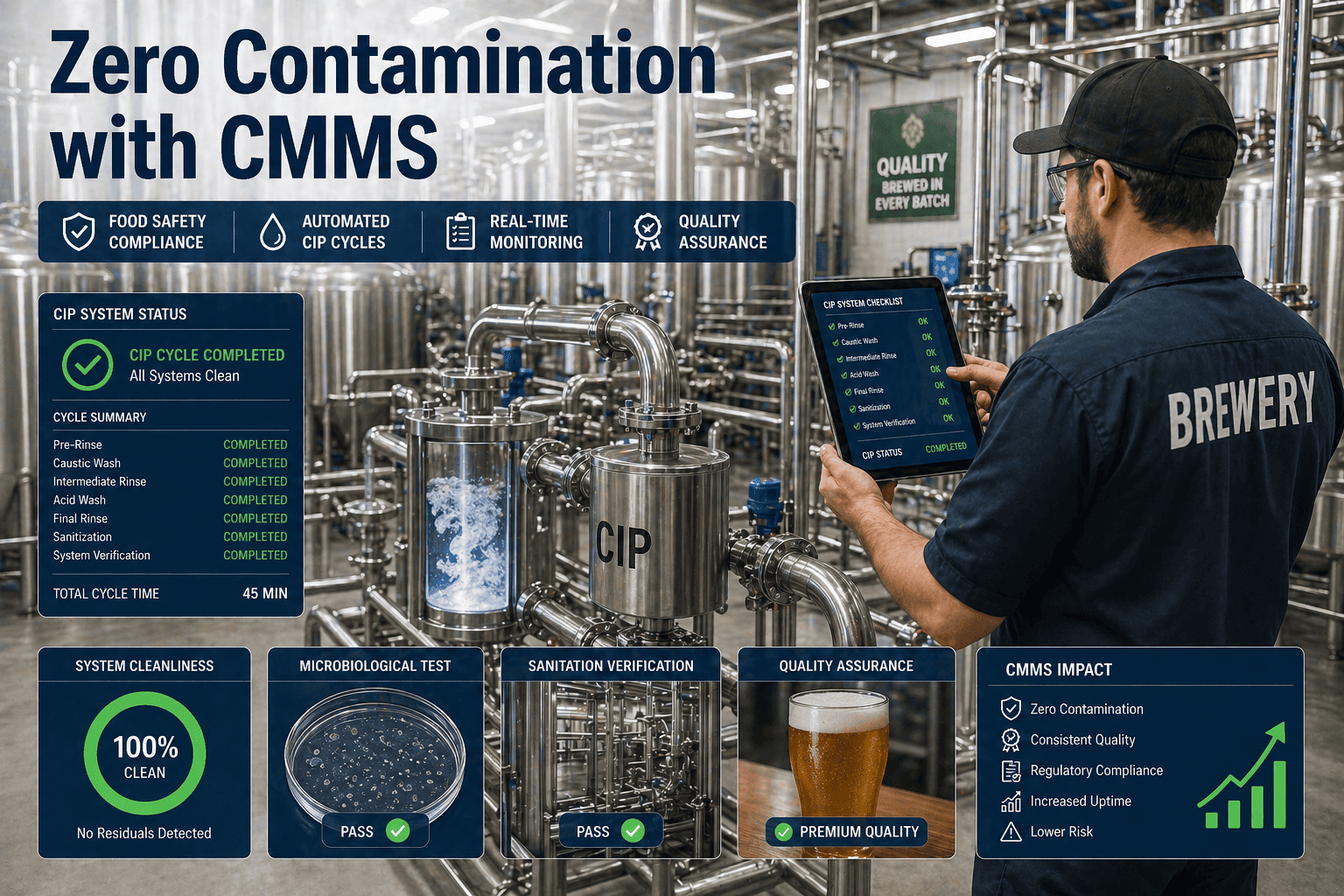
A single contamination event at a craft brewery can trigger a full product recall, FDA investigation, and permanent damage to a brand built over years of patient craft. In the craft beer industry, where trust is the product as much as the beer itself, contamination is not a maintenance problem — it is an existential one. Yet most craft breweries manage CIP (Clean-In-Place) schedules on whiteboards, track sanitation compliance in spreadsheets, and have no automated mechanism to flag when a critical step has been skipped or delayed. This case study documents how one craft brewery eliminated contamination events entirely — by replacing manual sanitation tracking with CMMS-driven CIP validation, automated sanitation scheduling, and real-time food safety compliance management. If you manage a brewery or food-grade beverage operation, start a free trial with Oxmaint or book a food safety compliance review before your next audit cycle.
Food Safety & Compliance Case Study
How a Craft Brewery Eliminated Contamination Events Using CMMS
By digitizing CIP validation, automating sanitation schedules, and building a full compliance audit trail, this craft brewery achieved zero contamination events across two full production years — and passed every food safety inspection without a critical finding.
Zero
Contamination events in 24 months post-deployment
100%
CIP validation compliance (logged and time-stamped)
98%
Sanitation schedule adherence across all production lines
0
Critical findings in 4 consecutive food safety audits
Is your brewery's CIP compliance documented and audit-ready? Oxmaint automates CIP validation, sanitation scheduling, and corrective action records — so you are always inspection-ready, not just inspection-surviving.
Craft breweries operate in a uniquely high-risk food safety environment. Unlike large industrial brewers, craft operations frequently run multiple SKUs on the same equipment — creating frequent changeovers, complex CIP cycles, and sanitation steps that must be executed correctly every single time.
Skipped or Shortened CIP Cycles
Under production pressure, CIP steps get shortened or skipped entirely — with no automated enforcement or alert system. Residue in tanks, lines, and heat exchangers creates a direct pathway to contamination.
No Chemical Concentration Validation
Manual CIP chemical mixing relies on operator judgment. Without automated concentration logging, diluted sanitizer solutions can pass undetected — rendering the entire CIP cycle ineffective against spoilage organisms.
Gasket and Seal Overrun
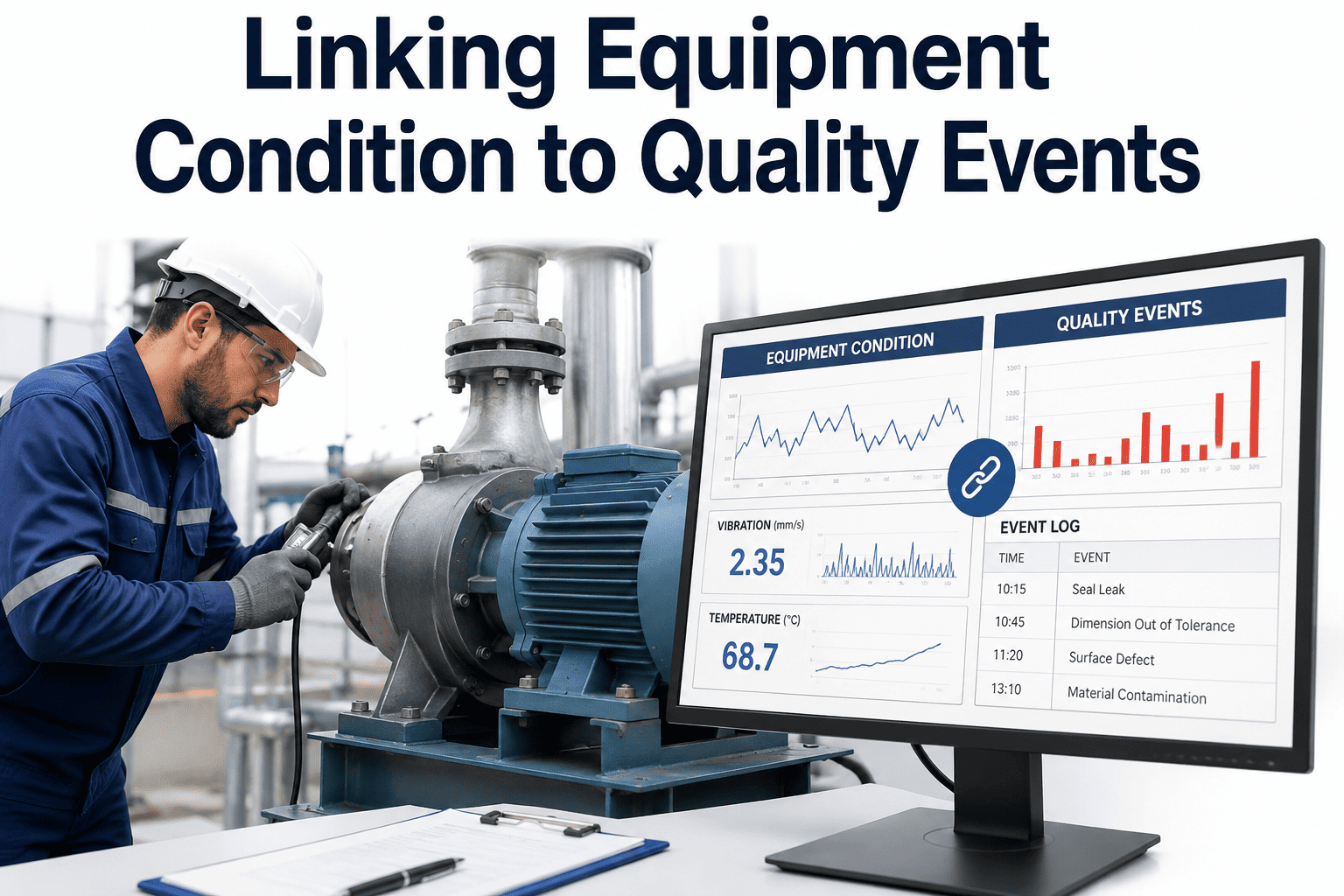
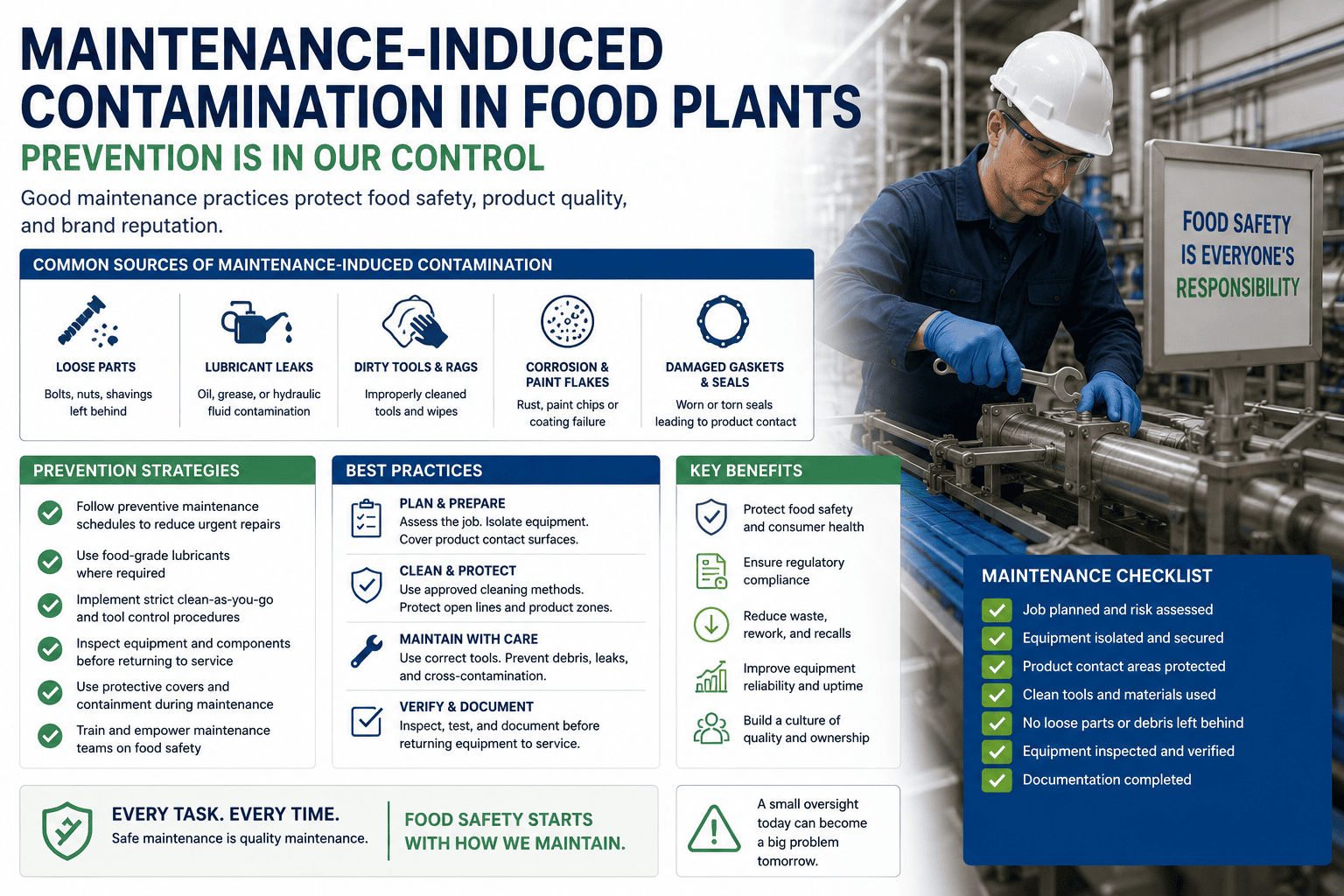
Brewery gaskets and seals on fermenters, bright tanks, and transfer lines have defined service intervals. Without CMMS-driven PM tracking, seals run past replacement dates — creating micro-harboring points for Lactobacillus and wild yeast.
No Audit Trail for Regulators
During FDA or TTB inspections, breweries with paper sanitation logs cannot demonstrate consistent compliance. Missing or illegible records — even for work that was actually done — can result in citations and remediation requirements.
The Brewery's Contamination History Before CMMS
Over 18 months before CMMS deployment, the brewery experienced a pattern of quality and safety incidents that eroded both team confidence and brand reputation.
6
Contamination events in 18 monthsThree involved detectable Lactobacillus in finished product; three were caught during in-process testing before packaging. Two batches were destroyed at a direct cost of $84,000.
4
Failed internal CIP auditsInternal audit revealed that CIP completion logs were missing for 4 of the last 6 audit cycles — not because CIP was skipped, but because paper records were incomplete or filed incorrectly.
$84K
Direct batch destruction costTwo contaminated batches totaling 800 BBL were destroyed. This figure excludes investigation labor, brand impact from affected accounts, and the cost of emergency deep-clean protocols.
38%
Gaskets and seals past service intervalAsset audit revealed 38% of fermenter and bright tank gaskets were operating beyond their documented replacement interval — none of which had triggered a maintenance work order.
How Oxmaint Eliminated Each Contamination Risk Factor
The implementation mapped every identified contamination risk to a specific Oxmaint capability. Food safety improvement was not a side effect of better maintenance — it was the primary design objective.
Automated CIP Scheduling
Oxmaint's PM scheduler automatically generated CIP work orders for every vessel and transfer line based on production triggers — not calendar intervals. Every CIP was assigned to a specific operator with a digital checklist including step-by-step chemical concentration targets, temperature verification, and rinse confirmation. No step could be marked complete without entry.
Digital CIP Validation Records
Every CIP completion was time-stamped, operator-attributed, and stored in Oxmaint's immutable audit log. Chemical concentration readings were entered against pre-defined acceptable ranges — any out-of-range entry automatically triggered a corrective action work order before the next production run could begin.
Gasket and Seal PM Automation
All fermenter, bright tank, and transfer line seals were added to Oxmaint's asset registry with manufacturer-specified replacement intervals. Replacement work orders were generated automatically — with the correct part pre-identified in inventory. The 38% overrun rate dropped to zero within 60 days of go-live.
Real-Time Sanitation Dashboard
The head brewer and QA manager could see the real-time sanitation status of every vessel and line at any moment — including time elapsed since last CIP, next scheduled CIP, and any open corrective actions. Production scheduling was linked to sanitation status, preventing scheduling a vessel that had not completed its CIP cycle.
One-Click Audit Reports
For every inspection — internal, FDA, or third-party food safety auditor — the brewery could generate a complete sanitation compliance report covering any date range within seconds. CIP logs, corrective actions, chemical records, and equipment PM history were presented in a format designed for food safety audit requirements.
Corrective Action Escalation
When any sanitation step was flagged out-of-spec, Oxmaint automatically escalated a corrective action work order to the QA manager with a defined response deadline. No out-of-spec result could be acknowledged and closed without a documented corrective action and re-test confirmation — building a closed-loop food safety system.
Before vs. After: Food Safety & Sanitation Performance
Scroll right to view full table
Metric
Before Oxmaint (18 months)
After Oxmaint (24 months)
Result
Contamination events
6
0
Eliminated
CIP completion compliance
71%
100%
+29 points
Sanitation schedule adherence
64%
98%
+34 points
Gaskets past service interval
38%
0%
Eliminated
Batch destruction cost
$84,000
$0
$84K saved
Audit prep time (per inspection)
2–3 weeks
2 hours
-97%
Critical audit findings
3 findings
0
Zero findings
Open corrective actions (avg)
14 outstanding
1.2 outstanding
-91%
The Financial and Brand Case for Zero-Contamination Operations
The direct ROI calculation understates the real value. In craft brewing, brand equity is inseparable from product consistency — and a single contamination event that reaches consumers can permanently restructure the business.
$84K
Batch destruction costs eliminated in first 24 months
$210K
Estimated brand impact value protected (draft account retention)
160hrs
Annual audit preparation time recovered
14x
ROI on Oxmaint investment within the first year
One avoided recall in the craft beer industry can save hundreds of thousands in direct costs — and preserve years of brand-building. Start a free trial today to see how Oxmaint builds an unbreakable food safety compliance system around your brewery operations.
Frequently Asked Questions
How does a CMMS prevent contamination in a craft brewery?
A CMMS prevents contamination by ensuring CIP cycles are completed correctly every time, gaskets and seals are replaced before they become harboring points, sanitation steps are digitally validated before vessels can be scheduled for production, and all corrective actions from out-of-spec results are tracked to closure. The result is a closed-loop system where no sanitation failure can go undetected or unresolved. Start a free trial to see Oxmaint's food safety module.
What food safety regulations apply to craft breweries in the US?
US craft breweries are subject to FDA oversight under the Food Safety Modernization Act (FSMA), specifically the Preventive Controls for Human Food rule (21 CFR Part 117). They must maintain Hazard Analysis and Risk-Based Preventive Controls (HARPC) plans, sanitation records, and equipment maintenance documentation. Oxmaint's audit reports are structured to meet 21 CFR Part 117 documentation requirements directly.
Can Oxmaint track CIP chemical concentration and temperature compliance?
Yes. CIP work order checklists in Oxmaint include numerical entry fields for chemical concentration (with acceptable range validation) and temperature readings. Out-of-range values automatically trigger a corrective action work order and prevent the vessel from being cleared for production until the issue is resolved and re-tested. Book a demo to see the CIP validation workflow in action.
How quickly can a craft brewery implement Oxmaint for food safety compliance?
Most craft breweries can go live with CIP scheduling, sanitation records, and basic asset PM tracking within 2–4 weeks. Oxmaint's brewery-specific templates cover standard CIP procedures, common vessel types, and typical gasket/seal intervals — significantly reducing setup time compared to a generic CMMS configuration. Full audit-readiness is typically achieved within 60–90 days of deployment.
Contamination Is Preventable. With CMMS, It Is Also Provable.
Every contamination event in brewing is traceable to a gap in sanitation management. Oxmaint closes every gap — automated CIP validation, seal replacement PM, real-time sanitation status, and audit-ready records — so your brewery operates at zero-contamination standard, every batch, every inspection, every year.