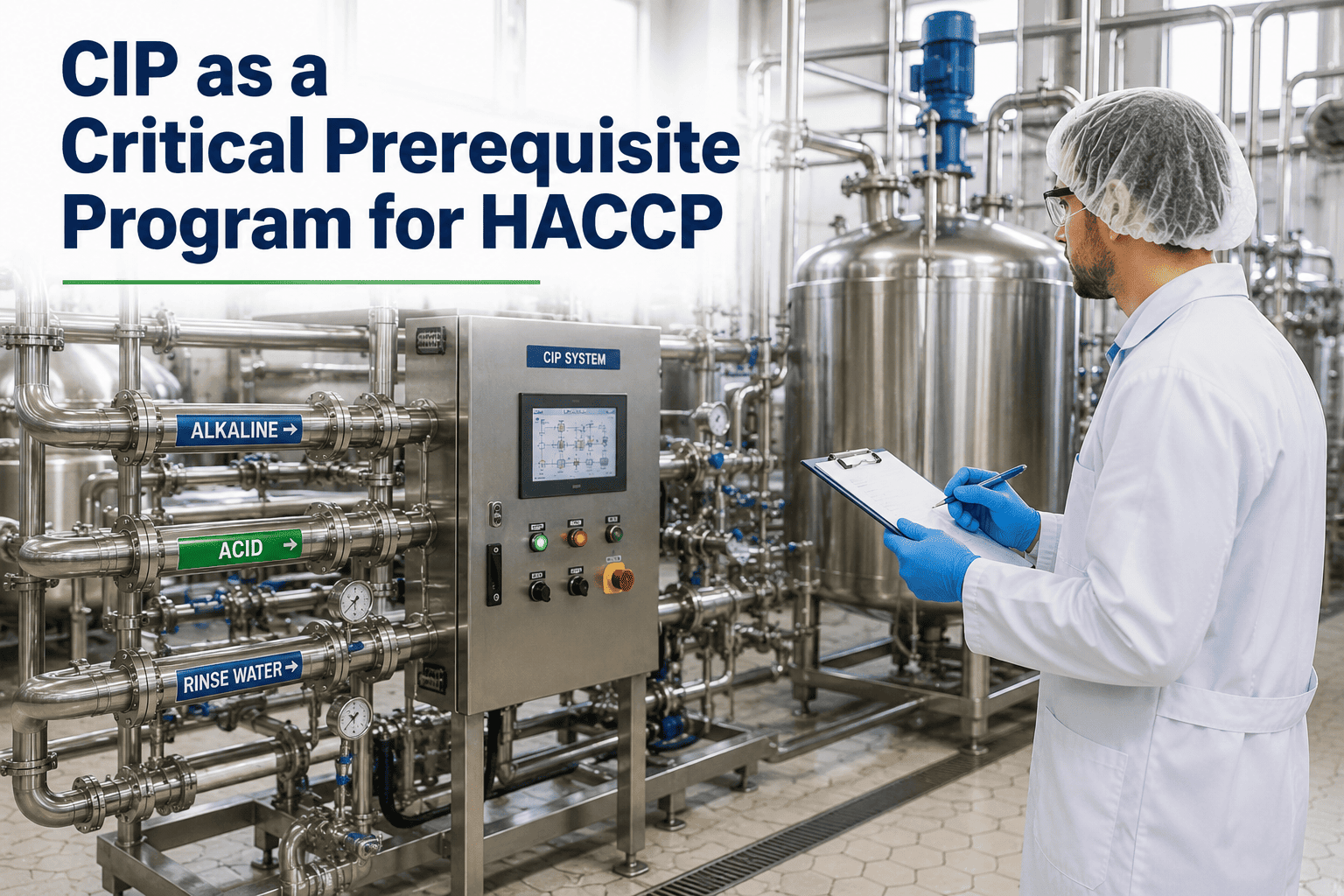
A Clean-in-Place system does not just wash your tanks and pipelines — it is one of the most heavily audited prerequisite programs inside your HACCP plan, and when a cycle runs short on temperature, chemical concentration, or contact time, that is not a housekeeping note, it is a documented Critical Control Point deviation. Studies of dairy and ready-to-eat recalls have linked inadequate CIP execution or verification to nearly 28% of Listeria contamination events, which is why FDA, BRC, SQF, and FSSC 22000 auditors treat CIP charts as primary food safety evidence rather than routine sanitation paperwork. For plant managers, QA leads, and maintenance teams running dairy, beverage, meat, and RTE lines across the USA, UK, Canada, Australia, and the EU, keeping CIP inside the CCP framework means proving every wash cycle met its validated setpoints, every single time, with a record an inspector can pull up in seconds. Start a free trial or book a demo to see how Oxmaint turns CIP into an audit-ready prerequisite program.
The Five-Stage CIP Cycle — and Where Each CCP Checkpoint Sits
Pre-Rinse
Potable water flushes loose product residue before any chemical enters the circuit. Rinse duration and water temperature form the first logged checkpoint of the cycle.
2–5 minAlkaline Wash
Detergent circulates to dissolve fats and proteins. Concentration and contact temperature are the two most commonly cited deviation points in audit findings.
60–85°CIntermediate Rinse
Flushes alkaline residue so it cannot neutralize the sanitizer in the next stage. Conductivity readings confirm the line is chemically clear before sanitizing.
3–6 minAcid / Sanitize
Delivers the microbial kill step of the cycle. Concentration, temperature, and dwell time here are treated as CCP-equivalent parameters by most GFSI schemes.
15–20 minFinal Rinse
Removes sanitizer before product contact resumes. Final rinse conductivity and ATP swab results are the record auditors request most often at inspection.
2–4 minTurn Every CIP Cycle Into an Audit-Ready Record
Oxmaint logs temperature, concentration, and cycle time against your validated recipe automatically, flags out-of-range runs as a CCP deviation, and keeps every chart retrievable the moment an inspector asks for it.
Why a Missed CIP Cycle Is Treated as a CCP Deviation, Not a Cleaning Note
Regulators classify CIP as either a prerequisite program or an operational prerequisite program depending on the scheme, but in practice a failed wash cycle is investigated with the same rigor as a failed kill step because the downstream risk is identical: a pathogen or allergen residue left on a product-contact surface. The four risk categories below are what auditors and quality teams actually check when a CIP chart shows an out-of-range reading.
Biofilm and Residue Survival
Short contact time or low sanitizer concentration lets biofilm persist in pipe joints and gaskets, giving Listeria and other pathogens a surface to colonize between cleaning cycles.
Sanitizer Carryover
An incomplete final rinse leaves detergent or sanitizer residue on product-contact surfaces, creating an allergen-adjacent chemical hazard that shows up in the next batch.
Unrecorded Deviations
A CIP skid that ran off-recipe but was never flagged is a documentation gap — and an undocumented deviation is treated by GFSI auditors as if the deviation itself never received corrective action.
Traceback Exposure
When a positive environmental swab is traced back to a line, the first document requested is the CIP history. A missing chart turns a contained event into a full production hold.
The Four CIP Parameters Every Auditor Verifies
| CIP Parameter | Typical Critical Limit | Monitoring Method | Consequence of Deviation |
|---|---|---|---|
| Wash Temperature | 60–85°C (alkaline stage) | Inline RTD sensor logged per cycle | Reduced detergent activity, incomplete soil removal |
| Chemical Concentration | Per validated recipe, ±5% | Conductivity or titration sample | Under-dosing leaves residue; over-dosing leaves chemical carryover |
| Contact / Cycle Time | 15–20 min sanitize stage | PLC timer tied to skid controller | Insufficient microbial kill on contact surfaces |
| Final Rinse Conductivity | Below site-defined threshold | Conductivity probe at outlet | Sanitizer residue carried into next production run |
From Sensor Drift to Recall: How One Missed Parameter Escalates
A dosing pump or temperature sensor drifts out of range
Small mechanical drift on a CIP skid rarely trips an alarm on its own — it shows up only as a slightly lower reading on that day's chart.
Residue or biofilm remains on the product-contact surface
The cycle completes and the line goes back into production, but the contact surface was never actually brought to validated cleanliness.
The gap goes undetected until a swab or scheduled audit
Without a system flagging the parameter automatically, the deviation surfaces days or weeks later — usually during routine environmental monitoring.
A documented CCP deviation and production hold follow
Quality must now investigate every batch run since the last confirmed good cycle, which can mean holding several days of finished product.
Catch the Drift Before It Becomes a Hold
Oxmaint alerts your team the moment a CIP reading trends toward its limit — not after the next audit finds it — so a sensor drift stays a maintenance ticket instead of a recall investigation.
How Global Food Safety Schemes Classify CIP
CIP sanitation is managed as a prerequisite or preventive control, with records required to demonstrate the cleaning step consistently met its validated parameters.
Hygiene rules require cleaning and disinfection procedures for equipment to be effective and verifiable, placing CIP validation squarely inside the plant's HACCP-based controls.
Sanitation of enclosed equipment is listed among the prerequisite programs that must be in place before a HACCP plan can be considered valid.
CIP is typically classified as an operational prerequisite program, requiring periodic revalidation and documented monitoring at the frequency defined in the food safety plan.
How Oxmaint Manages CIP as a Digital Prerequisite Program
Validated Setpoint Verification
Each CIP work order checks the cycle's actual temperature, concentration, and time against the validated recipe stored in the asset record.
Real-Time Deviation Flags
Readings trending outside the critical limit trigger an immediate corrective action task instead of waiting for the next manual review.
Concentration and Lot Tracking
Chemical lot numbers, dosing rates, and concentration checks are captured per cycle, giving traceability from supplier lot to specific production run.
ATP Swab Scheduling
Post-cycle ATP or micro swab tasks are scheduled automatically and linked back to the CIP run they are verifying.
Annual Revalidation Reminders
Oxmaint tracks the revalidation date for every CIP circuit and generates the task automatically before the interval lapses.
One-Click Compliance Export
Every CIP chart, swab result, and corrective action is exportable by date range or line, ready for an FDA, BRC, or SQF auditor on request.
Paper CIP Logs vs. an Oxmaint Digital Record
| CIP Task | Paper-Based Approach | Oxmaint Digital Approach |
|---|---|---|
| Recipe verification | Operator checks gauge readings against a printed sheet | Cycle data compared automatically against the stored recipe |
| Deviation response | Found only if someone reviews the chart before filing | Flagged the moment a reading crosses its critical limit |
| Chemical lot tracking | Handwritten in a separate logbook, if at all | Captured per cycle and linked to the batch record |
| Audit retrieval | Binder search across months of filed paperwork | Filtered export by date, line, or parameter in seconds |
| Revalidation tracking | Relies on someone remembering the anniversary date | Scheduled automatically ahead of the due date |
Frequently Asked Questions
Is CIP a Critical Control Point or a prerequisite program?
Most food safety plans classify CIP as a prerequisite or operational prerequisite program rather than a standalone CCP, but a deviation is still investigated with CCP-level rigor because it carries a direct pathogen or allergen risk. Start a free trial to see how CIP deviations are logged inside a CMMS.
What happens if a CIP cycle runs outside its validated parameters?
An out-of-range temperature, concentration, or time reading typically triggers a documented deviation investigation, a hold on affected product, and a corrective action record before the line can resume normal release.
How often should a CIP system be revalidated?
Most food safety schemes recommend annual revalidation at minimum, with an immediate revalidation required whenever equipment, chemistry, or the cleaning recipe changes in a way that could affect cleaning efficacy.
What is the difference between CIP and COP?
CIP cleans enclosed equipment like tanks and pipelines without disassembly, while COP requires removing parts such as fittings, clamps, or utensils for cleaning outside the system, each with separate validated procedures.
Can a CMMS actually reduce CIP-related audit findings?
Yes. Digitized maintenance and monitoring programs that document every calibration, chemical check, and cycle result have been linked to substantially fewer audit findings than paper-based CIP recordkeeping. Book a demo to see the audit export in action.
Your CIP Program Is Only as Strong as Its Weakest Logged Cycle
Oxmaint connects every CIP wash, swab result, and revalidation date to the CCP it protects — so your next audit is a five-minute export instead of a week of chasing paperwork.


-system-maintenance-best-practices-for-food-and-beverage.png)

