Cleaning a food plant is only half of sanitation. The other half is proving that the cleaning worked before production starts. A line that looks clean can still carry residue, biofilm or allergen traces, and a line that fails a swab may only need a second pass. Choosing the right verification method, setting clear pass and fail criteria and recording the result in a consistent way is what separates a sanitation program that works from one that only exists on paper. See also how maintenance management software can hold your verification routine together.
Cleaning verification methods: ATP testing and visual checks
Compare visual inspection, ATP swabs, allergen tests and microbiological testing, and set pass and fail criteria that show a line is truly ready for production.
Why verification is a separate step
Cleaning is a task, and verification is a test of the outcome. Merging the two lets the same person who cleaned the line decide it is clean, with nothing to back up the opinion.
Four verification methods and what each can tell you
No single method answers every question. Combine them according to the risk of the area and the product.
| Method | What it shows | Strengths | Limits |
|---|---|---|---|
| Visual inspection | Visible soil, residue, water, damage and missed areas | Immediate, no consumables, can cover the whole line | Cannot see thin films, biofilm or microbes, and depends on lighting and the inspector |
| ATP bioluminescence swab | Total organic residue, including food soil and microbial material, as a relative light reading | Fast result on the spot, quantitative, easy to trend | Does not identify organisms or allergens, and readings can be affected by some chemicals and surfaces |
| Allergen swab or rapid test | Presence of a specific allergen protein on a surface or in a rinse | Targeted for allergen changeovers, quick screening | Detects only the allergen it is designed for, and kits differ in sensitivity |
| Microbiological swab | Counts or presence of indicator organisms, or specific pathogens | Confirms microbial control and supports environmental monitoring | Results take time, so production may start before the answer is known |
Check the instructions of your test supplier for how to use, store and interpret each device and kit.
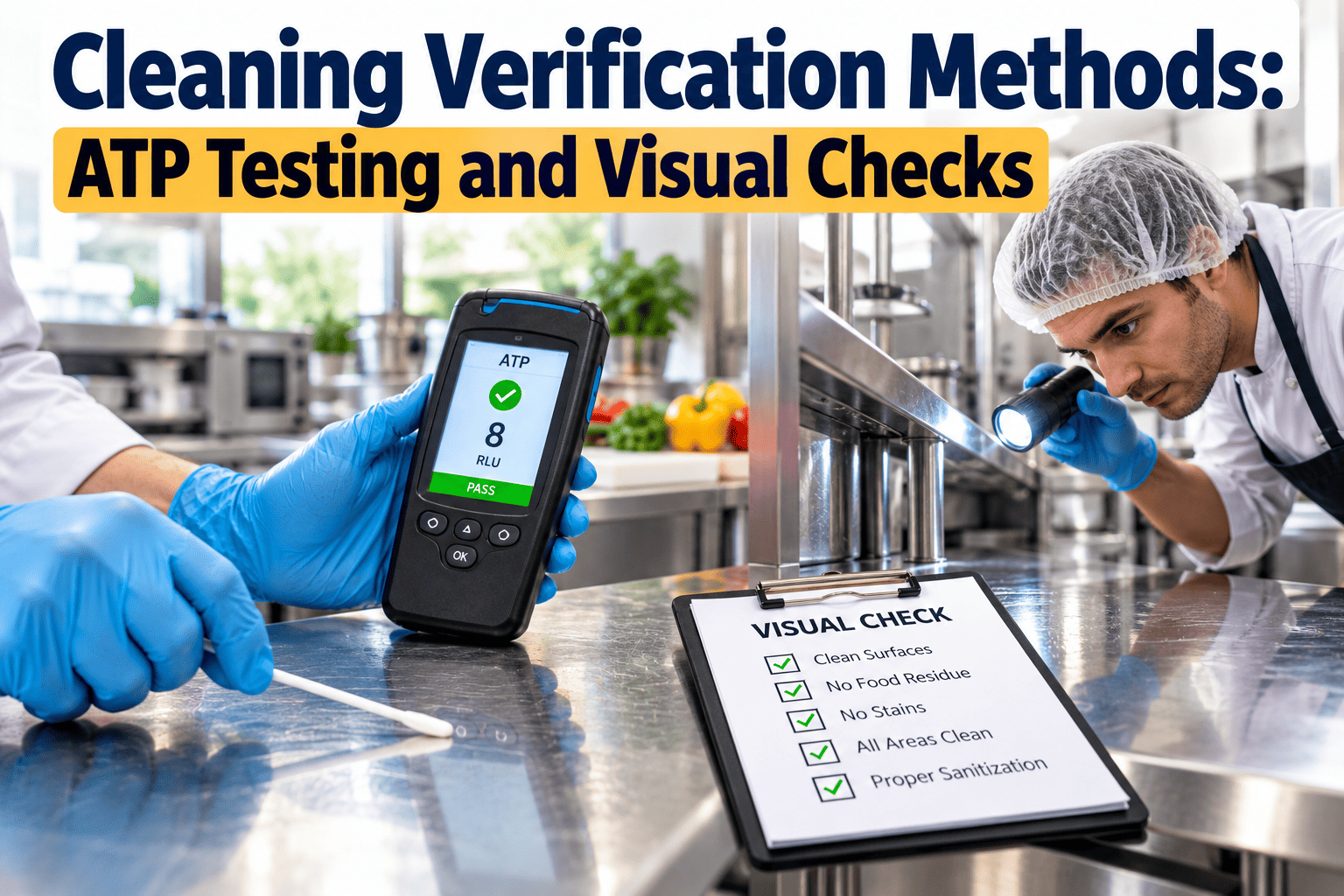
Make the visual inspection structured, not casual
A trained eye with good lighting catches many failures before any swab is needed. The difference between a useful visual check and a quick glance is a checklist and a defined standard.
- Define what acceptable looks like, with photo references where possible.
- Have someone other than the cleaner perform the check, or at least a second verification on critical equipment.
- Record the result, the area, the inspector and the time, even when everything passes.
How ATP swab testing works in practice
ATP is a molecule found in all living cells, including food residue and microorganisms. A swab collects any present from a surface, and a meter measures the light produced in a reaction, shown as relative light units, or RLU.
- RLU values depend on the brand of device and swab, so limits cannot be copied from another site or supplier.
- Strong sanitizers, some surface materials and residual moisture can affect readings. Follow supplier guidance and keep the method consistent.
- ATP shows how much organic residue is present, not whether a pathogen is there.
Record every verification where the team can see it
Schedule swab and inspection tasks, capture results on mobile devices and raise re-clean or repair work orders in Oxmaint.
Build a verification schedule for your plant
Set clear limits before you start testing
Criteria must be written down in advance and agreed by quality. Many plants use three bands so that operators know exactly what to do with each result.
Set the numeric limits for each device and each site by testing known clean surfaces over time, then reviewing the spread of results with your supplier.
- Use stricter limits for food contact surfaces than for other areas.
- Review limits when you change chemicals, devices, swabs or surfaces.
- Record what happens next, not only the number, including retest results.
Choose test sites by risk zone
Sampling every surface is impossible. A zone approach, widely used in environmental monitoring, focuses effort where contamination matters most.
- Include hard-to-clean spots such as welds, seals, gaskets, bearing housings and dead legs.
- Rotate secondary sites so that over time you cover the full area.
- Use the same fixed sites for trending, and add random sites to avoid cleaning only what is tested.
When ATP is not enough
ATP is a general indicator of cleanliness. Some risks require a test that is specific to the hazard.
What to do when a verification fails
A failed test is useful information. The response should be quick, documented and aimed at the cause.
Repeated failures at the same site usually point to equipment condition, such as scratches, cracks, loose parts or poor drainage, not just to cleaning effort.
Swabbing technique decides whether the result means anything
Two people swabbing the same surface can produce very different numbers. Standardize the method so that results are comparable across days, shifts and sites.
- Swab after cleaning and after any sanitizer has dried or been rinsed, according to your procedure and test instructions.
- Do not swab the same spot repeatedly in a way that damages the surface or removes residue that cleaning missed.
- Train and check new testers, and compare their results with an experienced person on the same surface.
Assign frequency and responsibility for each method
Write the verification plan in a simple table, so everyone knows what is tested, how often and who owns the result. Adapt the example below to your own risk assessment.
| Check | Example frequency | Typical owner | Record |
|---|---|---|---|
| Visual pre-operation inspection | Every cleaning cycle, before start-up | Sanitation supervisor, then production or quality | Checklist with sign-off and time |
| ATP swabs on food contact surfaces | Per plan, often each pre-operation on selected sites | Quality technician or trained sanitation staff | Site, result, limit and retest |
| Allergen swabs | After allergen changeovers and as scheduled | Quality | Product sequence, site and result |
| Microbiological swabs | As defined in the environmental monitoring program | Quality, with laboratory | Zone, site, organism and result |
| Review of trends | Weekly and monthly | Quality manager with sanitation and maintenance | Trend report and actions |
Common mistakes in cleaning verification
Most verification programs fail quietly. Look for these patterns in your own records.
- Testing only the easy, flat surfaces, so that hard-to-clean spots are never examined.
- Re-cleaning and retesting until the result passes, but recording only the final pass.
- Using limits copied from another plant or a different brand of device.
- Treating a low ATP reading as proof that allergens or pathogens are absent.
- Allowing the cleaner to choose the swab site, which lets the test follow the cleaning, not the risk.
- Collecting results but never trending them, so repeat failures are not linked to worn equipment.
Use results to improve the program, not only to release lines
Individual results tell you whether to start. Trends tell you what to improve.
| Trend to review | What it can indicate | Typical action |
|---|---|---|
| Repeated failures at one site | Hard-to-clean design, damaged surface or equipment fault | Inspect and repair the item, or update the cleaning instruction for that spot |
| Failures on one shift or crew | Training, time pressure or unclear instructions | Retrain, adjust schedules, review supervision |
| Gradual rise in readings | Chemical concentration, water temperature or equipment wear changing | Check dosing, temperatures, tools and rinsing |
| Failures after maintenance | Residue from lubricants, tools or poor reassembly cleaning | Add cleaning and verification to the maintenance close-out |
| Consistently very low readings | Limits that are too loose, or sampling that is too easy | Review limits and test sites with quality |
What auditors look for in verification records
Auditors want to see a system that detects problems and responds, not a record of perfect results. Strong files usually show the following.
- A written verification plan with sites, methods, frequencies, limits and responsible roles.
- Complete, signed and dated results, including failures and retests.
- Evidence that failures led to corrective action, and that the action was checked later.
- Calibration or verification records for meters and thermometers, and valid expiry dates for swabs and kits.
- Training records for the people who clean, swab and review results.
Supporting verification with maintenance workflows
Oxmaint is maintenance management software, not a laboratory system. It supports the scheduling, records and equipment follow-up around verification.
- Recurring tasks for pre-operation inspections, swab rounds and equipment readiness checks, with owners and due times.
- Mobile checklists so results and notes are captured at the equipment instead of later at a desk.
- Corrective work orders when a site keeps failing, linking the result to the repair of seals, surfaces, drains or guards.
- Asset history showing which equipment has repeated sanitation problems.
- Reports for overdue verifications and repeat failures by area, line or shift.
- Maintenance close-out checks so cleaning and verification are done before equipment returns to service.
Cleaning verification methods: common questions
Is ATP testing enough on its own?
No. It is a fast indicator of organic residue, but it does not identify organisms or allergens. Pair it with visual checks and with micro or allergen tests where the risk requires.
Who sets the ATP pass limit?
Your quality team sets it for your device and swab, using baseline data from known clean surfaces. Supplier guidance is a starting point, not a universal number.
How often should we verify cleaning?
Visually after every clean, and with swabs at a frequency based on risk, such as every pre-op for food contact surfaces. Document the plan and follow it. You can book a demo to see scheduling in action.
Can the cleaner verify their own work?
It is better to have an independent person verify, especially for critical areas. At minimum, add a supervisor or quality check to the sign-off.
What should we do first?
Pick your highest risk line, define sites, limits and responses, and run the routine for a few weeks. You can sign up and set the tasks up today.
Prove it is clean before production starts
Combine clear criteria, the right verification methods and reliable records, and give auditors and customers proof that sanitation works.
Start with one line and a simple routine