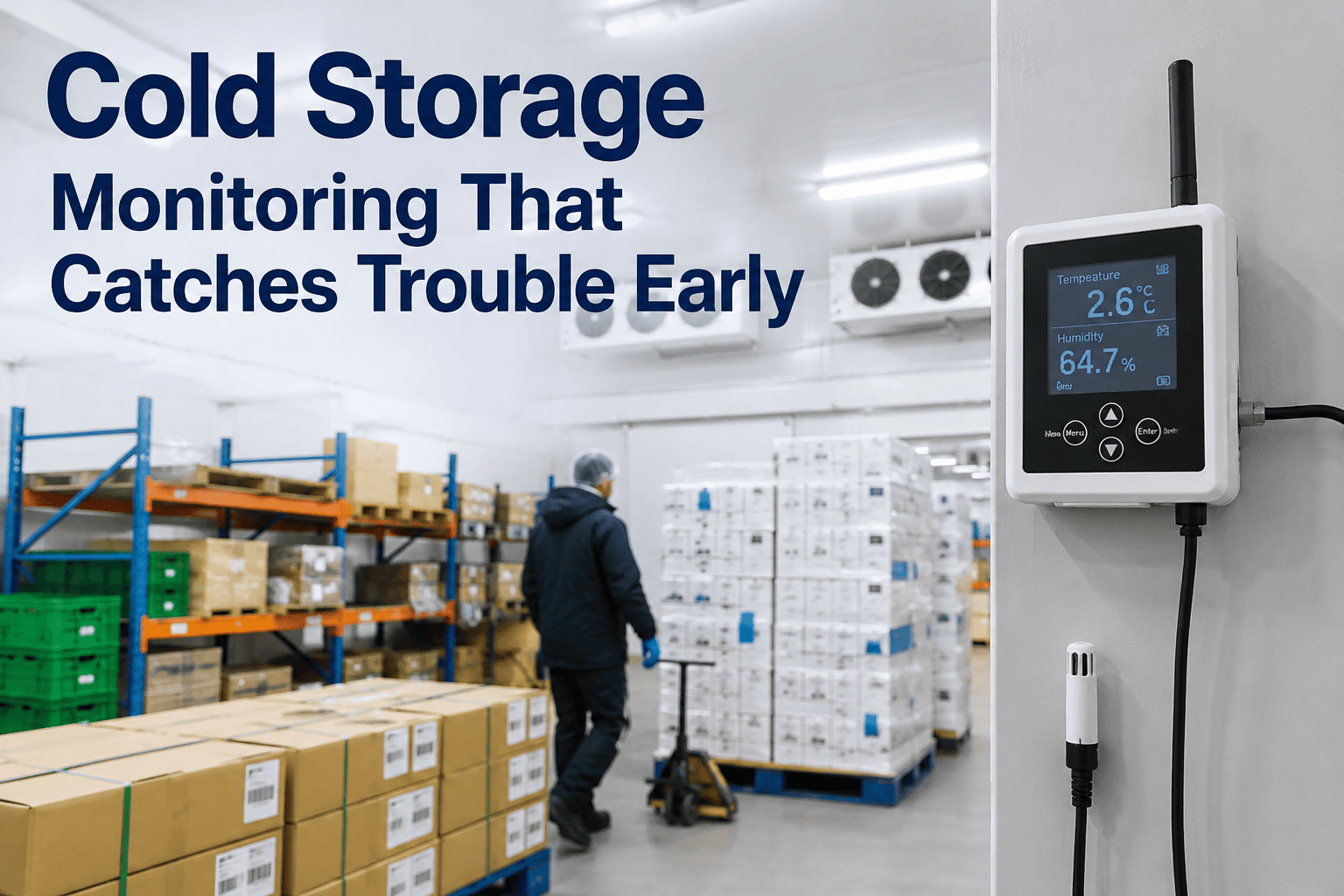
A single cracked or compressed gasket on a cold storage door can bleed thousands of dollars in wasted refrigeration energy per year — and the worst part is that the loss is silent. Temperature excursions triggered by compromised door seals remain one of the top three root causes of product loss in food distribution, often because inspection gets deferred in favor of more visible equipment issues. This guide walks through a CMMS-driven approach to door seal integrity, from gasket condition scoring to air infiltration measurement and preventive maintenance scheduling that closes the gap before it costs you a load. Ready to digitize the entire program? Start Free Trial and turn every inspection into tracked, defensible data.
COLD STORAGE MAINTENANCE GUIDE
How long has that gasket been leaking cold air — and how much is it costing you per week?
A 12-foot door seal with a 1/4-inch continuous gap along the jamb can allow up to 1,400 CFM of conditioned air to escape every minute the door is closed, driving compressor runtime up 18–24% and pushing product zones past their HACCP critical limits. Sealing the gap is cheap. Finding it on time is the hard part — and that is exactly what a CMMS-driven inspection program solves.
INSPECTION CADENCE BY DOOR TYPE
Tiered Door Seal Inspection Checklist
Not every door carries the same excursion risk. High-traffic dock doors cycle 80–120 times per day and demand weekly gasket checks, while low-traffic reach-in panels can tolerate a 90-day cadence. The checklist below maps inspection frequency and verification method to door class so technicians spend time where the risk lives.
Truck Dock & Blast Freezer Doors
- Visual scan of perimeter gasket for compression set, tears, and mold
- Flashlight test along full jamb closure in darkened bay
- Inspect impact damage from forklift blades and pallet corners
- Verify door sweep contact across full threshold width
- Confirm auto-closer torque and cycle speed to spec
- Log infrared spot temps at four corners of door frame
Walk-In Cooler & Hallway Doors
- Paper-dollar drag test at five points around the frame
- Check hinge alignment and door sag with a torpedo level
- Inspect magnetic strip pull-force with a 2-lb spring scale
- Clean gasket grooves of ice buildup and debris
- Verify defrost heater termination thermostat operation
Reach-In & Display Case Panels
- Dollar-bill drag test on all four gasket sides
- Inspect corner welds for separation and brittleness
- Measure door-to-frame gap with a feeler gauge (.020 max)
- Replace gaskets older than 36 months or with visible set
REPLACEMENT THRESHOLDS & SCORING
When a Gasket Crosses From "Monitor" to "Replace Now"
Subjective "looks fine" inspections are why seals fail. The scoring matrix below gives every gasket a defensible 1–4 condition rating tied to a CMMS trigger, so replacement work orders generate automatically the moment a threshold is breached — not after a weekend excursion event.
| Score | Gasket Condition | Air Infiltration (CFM @ 0.30 in. wg) | Excursion Risk | CMMS Action Triggered |
|---|---|---|---|---|
| 1 | Uniform compression, full contact, no tears | Under 25 CFM | Negligible | Schedule next routine inspection |
| 2 | Light compression set, minor edge wear, contact 90%+ | 25 – 80 CFM | Low – monitor zones | Create corrective work order, 30-day follow-up |
| 3 | Visible gaps, tears > 2", hardening, mold growth | 80 – 300 CFM | High – active energy bleed | Auto-generate replacement WO, priority High |
| 4 | Critical failure: missing sections, frame misalignment | Over 300 CFM | Critical – excursion imminent | Emergency WO, door tagged out-of-service |
QUANTIFYING THE LEAK
Air Infiltration Math Every Facility Manager Should Run
Once you can measure a leak, you can cost-justify the fix. The formula below converts gasket gap area into dollars of wasted refrigeration per month — the exact number that turns "we'll get to it next quarter" into "schedule the work order today."
MONTHLY ENERGY WASTE FROM DOOR SEAL LEAK
Waste ($) = Gap Area (ft²) × Air Velocity (FPM) × 60 min × Hours/Month × ΔH (BTU/ft³) × Electric Cost ($/kWh) ÷ COP
WORKED EXAMPLE — REGIONAL FOOD DISTRIBUTOR, 22 DOORS
A mid-Atlantic cold storage operator running 22 dock doors at –10°F spent $42,800 annually on unexplained energy overruns. A CMMS-structured gasket audit identified 9 doors scoring 3 or 4 — collectively leaking an estimated 4,100 CFM of conditioned air. Replacing all 9 gaskets and re-aligning 3 door frames cost $6,400 in parts and labor. The operator recovered full investment in 1.8 months and eliminated three recurring temperature excursion alerts within the first week of closure.
12-MONTH PM SCHEDULE
The Annual Door Seal Integrity Calendar
A CMMS doesn't just remind you to inspect — it sequences inspections to match seasonal load, defrost cycles, and audit windows. Below is the recurring 12-month rhythm that keeps every door in your facility within spec and audit-ready year-round.
Baseline Audit & Gasket Scoring
Every dock and walk-in door receives a full condition score (1–4), infrared spot survey, and dollar-drag test. All scores logged in CMMS as the year-over-year benchmark.
High-Traffic Door Focus
Weekly Tier 1 inspections hit full stride. Replace any gasket that dropped to Score 3 during spring volume ramp. Verify auto-closer torque after humid season begins.
Peak-Load Thermal Verification
Infrared thermal imaging of every door frame during peak afternoon load. Identify convection loops and cold bridges. Flag any door with a 6°F+ delta at corners for realignment.
Audit Prep & Budget Justification
Compile CMMS condition reports for HACCP and third-party audits. Pull cost-avoidance data from work orders to justify next year's gasket replacement capital line.
THE CMMS DIFFERENCE
Manual Inspection vs. CMMS-Driven Seal Program
The gap between a clipboard checklist and a connected CMMS program is not just convenience — it is the difference between catching a leak in week one and discovering it during a failed audit eight months later.
- Inspection cadence drifts 30–60 days during busy weeks
- No photos or scores attached to asset history
- Replacement decisions rely on memory, not data
- Energy waste invisible until utility bill arrives
- Audit prep takes 2–3 days of manual report building
- Auto-scheduled PMs escalate if missed by 48 hours
- Every gasket score, photo, and CFM reading lives on the asset record
- Work orders generate automatically when Score 3 threshold is crossed
- Energy cost-avoidance tracked per door, per quarter
- One-click audit report exports condition history for any date range
Stop deferring the inspection that protects your temperature and your margin.
Deploy a CMMS-driven door seal program in under a day. Every gasket scored, every leak quantified, every work order auto-generated before the excursion happens.
FREQUENTLY ASKED
Door Seal Integrity — What Teams Ask Before They Start
How often should cold storage door seals actually be inspected?
High-traffic dock and blast freezer doors should be visually inspected weekly with a full gasket scoring audit monthly. Walk-in cooler doors typically require monthly checks, while low-cycle reach-in panels can follow a 90-day cadence. The key is tying frequency to door cycles — a dock door opening 120 times daily degrades gaskets 6–8x faster than a hallway door opening twice.
What is the fastest way to test a door seal without special equipment?
The dollar-bill drag test remains the field standard: close the bill in the door at five points around the frame and pull. Uniform resistance means good contact; if the bill slides freely, the gasket has lost compression. For a more precise read, a smoke pencil or infrared camera will reveal convection paths invisible to the drag test. You can standardize both methods inside your CMMS checklist — Book a Demo to see the mobile inspection form in action.
How much energy does a single failed gasket actually waste?
A dock door gasket with a 1/4-inch continuous crack can waste $300–$500 per month in extra compressor runtime at typical commercial electric rates, depending on the temperature differential and door size. Across a facility with 8–10 compromised doors, that is $30K–$50K annually in pure waste — almost always exceeding the cost of a full gasket replacement program.
Can a CMMS automatically generate replacement work orders?
Yes. When a technician logs a gasket condition score of 3 or higher during a mobile inspection, the CMMS can auto-trigger a replacement work order with the correct part number, priority level, and assigned technician — no supervisor approval bottleneck. This is what closes the gap between "found the leak" and "fixed the leak" before the next audit cycle.
How long does it take to roll out a CMMS-driven seal program?
Most cold storage operators are live in 1–2 days: import door asset list, assign inspection checklists by tier, set the PM schedule, and dispatch the first round of mobile inspections. The scoring matrix and auto-trigger thresholds come pre-configured for food storage environments. Start a Start Free Trial to import your door inventory and schedule the first audit this week.
Every door sealed. Every excursion prevented. Every dollar tracked.
Join the cold storage operators using OxMaint to turn door seal inspections from a deferred chore into a defensible, data-driven program.
Free 14-day trial · No credit card