Energy costs represent one of the largest controllable expenses in food manufacturing — yet most facilities leave 20 to 35 percent of that spend on the table every year. The culprit is not outdated equipment alone; it is deferred maintenance, untracked utility consumption, and the absence of a systematic approach to energy management. For sustainability managers and facilities teams under pressure to cut carbon emissions while controlling operational budgets, the path forward is clear: maintenance-driven energy management is the most cost-effective and measurable lever available. Start your free trial and see how smarter maintenance transforms your plant's energy performance.
Why Energy Management Is a Maintenance Problem First
In food manufacturing, energy is the second-largest operating cost after raw materials — and it responds directly to how well equipment is maintained. A refrigeration compressor with fouled condenser coils draws 15 to 25 percent more electricity; a boiler with scaled heat exchangers compounds inefficiency month over month; HVAC systems with clogged filters quietly inflate kilowatt-hour consumption across every shift. These are not failure events — they are slow, preventable energy leaks. Facilities with proactive, PM-scheduled maintenance programs consistently achieve energy intensity 20 to 35 percent lower than reactive counterparts, because degraded mechanical efficiency always shows up in the utility bill before it shows up as a breakdown. Every percentage point of preventive maintenance compliance translates directly into utility savings, making CMMS-driven scheduling one of the most powerful energy management tools a food plant sustainability team can deploy.
HVAC Maintenance and Energy Efficiency in Food Processing Facilities
HVAC systems in food manufacturing plants carry a dual burden — maintaining strict hygiene-compliant air quality while running continuously across multi-shift schedules — making them one of the highest energy consumers on the plant floor and one of the highest-leverage targets for reduction. Scheduled HVAC maintenance encompassing filter replacement, coil cleaning, belt tension checks, damper calibration, and refrigerant charge verification typically cuts HVAC energy consumption by 10 to 20 percent versus reactive baselines. Pressure differential sensors enable filter replacement at the optimal efficiency point rather than a fixed calendar interval, VFDs allow airflow to track actual demand, and when integrated with a CMMS, maintenance histories can be correlated with consumption data to surface exactly which deficiencies are costing the most. Sign up free to connect HVAC maintenance schedules with real-time energy tracking.
Boiler Maintenance Strategies That Reduce Food Plant Utility Costs
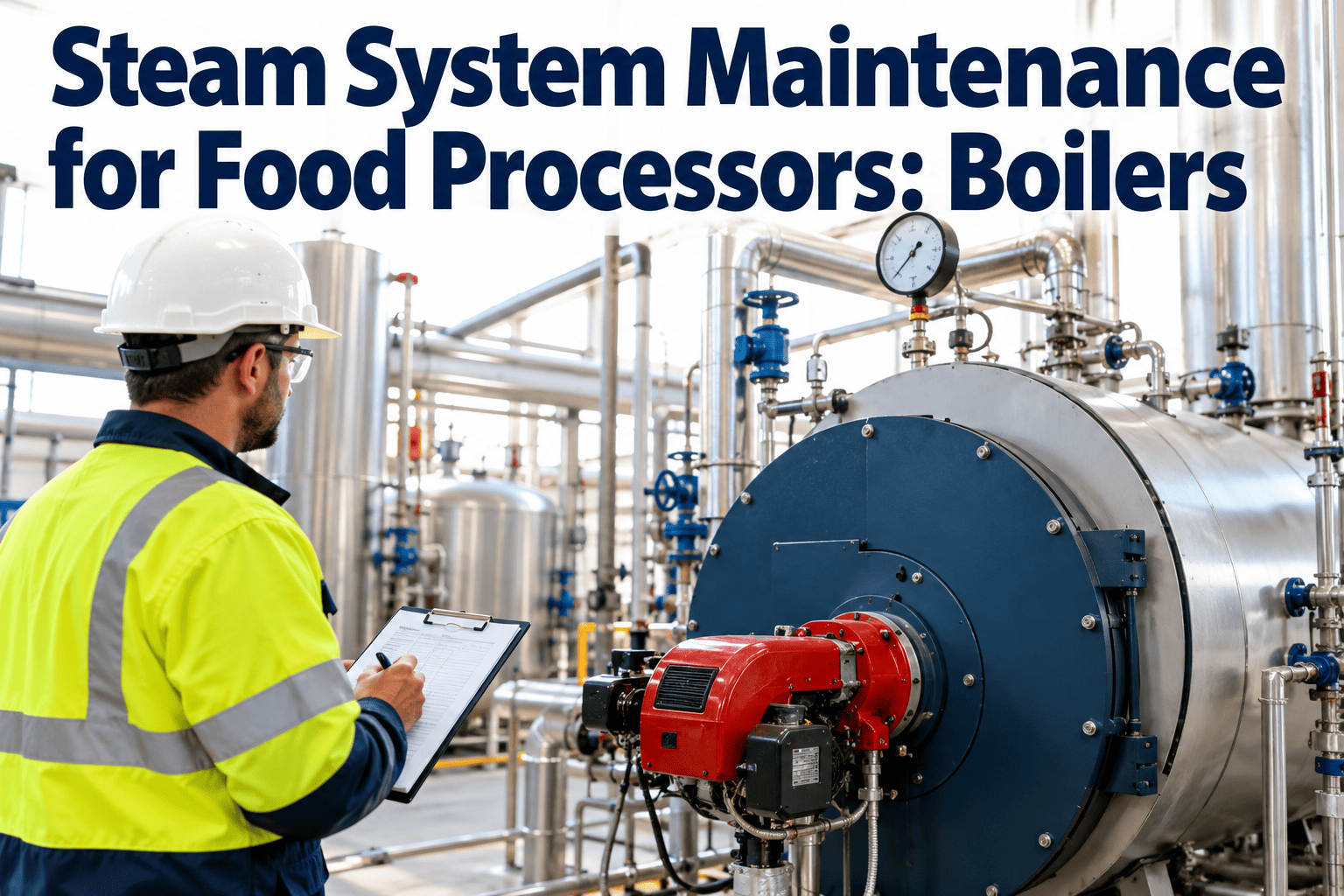
Boilers supply steam for cooking, sterilization, CIP systems, and process heating — and a unit running at 80 percent combustion efficiency instead of its 88 percent design spec is not a marginal issue; it is a continuous fuel drain compounding across thousands of annual operating hours. Effective boiler energy management centers on four disciplines: combustion tuning to verify optimal fuel-to-air ratios, regular descaling of heat transfer surfaces to eliminate the insulating barrier that forces the burner to fire longer, blowdown control calibration to minimize energy lost in discharged condensate, and insulation integrity checks. Applied systematically through a PM program, these measures typically deliver boiler efficiency gains of five to fifteen percentage points — directly reducing natural gas or fuel oil expenditure across the facility. Book a demo to see how boiler PM scheduling works inside the platform.
Refrigeration System Energy Optimization: The Largest Single Opportunity
Refrigeration energy in food manufacturing — encompassing process cooling, cold storage, blast freezing, and controlled atmosphere storage — commonly represents 30 to 50 percent of total facility electricity consumption. No other system category offers comparable energy reduction potential through maintenance optimization. The primary drivers of refrigeration energy waste are condenser fouling, evaporator ice accumulation, refrigerant charge deficiencies, and compressor valve wear — all of which are preventable through disciplined maintenance scheduling and condition monitoring.
Steam System Efficiency: Traps, Insulation, and Distribution Losses
Steam distribution systems are chronic sources of invisible energy waste — and failed steam traps, which pass live steam directly into condensate return lines, are the most common culprit. Industry surveys consistently find 15 to 25 percent of traps in unmanaged systems are failed at any given time, each one representing thousands of dollars in annual fuel loss. Correcting this requires annual trap surveys using ultrasonic testing or infrared thermography, insulation surveys of distribution piping to locate heat loss points, and condensate recovery maintenance to return high-energy condensate to the boiler feedwater system rather than discharging it. Together, these disciplines typically recover five to fifteen percent of total steam system energy output — a return that compounds year over year in facilities that embed them in their PM program. Start your free trial and activate steam trap tracking across your facility today.
CMMS Energy Tracking: Connecting Maintenance Data to Utility Performance
The gap between maintenance programs and energy management in most food plants is a data gap — work orders capture labor and downtime, utility bills capture total consumption, but neither connects the two. Bridging this requires integrating CMMS maintenance data with energy metering infrastructure so that maintenance events can be correlated with utility performance in near real time. Modern CMMS platforms assign consumption baselines to individual assets and automatically flag deviations indicating efficiency degradation — when a refrigeration compressor's energy index climbs above baseline before any alarm triggers, a predictive alert fires and enables intervention before the loss compounds into a significant cost event. This shifts energy management from a monthly billing review into an asset-level operational discipline. Explore the platform to see how CMMS energy tracking is implemented across food manufacturing facilities.
Sustainable Food Manufacturing: Building the Business Case for Energy Investment
Sustainability commitments in food manufacturing are no longer voluntary differentiators — they are increasingly embedded in customer supplier requirements, investor ESG frameworks, and regulatory reporting obligations across major markets. Energy performance is the most quantifiable dimension of operational sustainability, and maintenance-driven energy reduction offers the most defensible ROI case for capital allocation: the savings are measurable, the payback periods are short, and the environmental benefits are directly calculable in carbon equivalent terms. Book a demo to build your facility's energy ROI model with our team.
| System | Reactive Maintenance | Proactive Maintenance |
|---|---|---|
| Refrigeration | Fouled coils, undercharge — 15–25% excess energy draw | Scheduled cleaning, charge verification — design efficiency maintained |
| Boilers | Scale buildup, untuned combustion — 5–15% efficiency loss | Regular descaling, combustion tuning — peak efficiency sustained |
| HVAC | Clogged filters, worn belts — 10–20% higher fan energy | Condition-based filter replacement, VFD calibration — demand-matched airflow |
| Steam Systems | 15–25% of traps failed; significant distribution losses | Annual trap surveys, insulation integrity — 5–15% system energy recovered |
| Compressed Air | Undetected leaks — up to 30% of generation lost | Leak detection surveys, pressure optimization — near-zero uncontrolled loss |
| Compliance Reporting | Manual data assembly, estimated figures, audit exposure | CMMS-generated energy records per asset, audit-ready on demand |
For sustainability and facilities managers building the internal business case for proactive maintenance investment, the financial model is straightforward. A mid-scale food manufacturing facility with an annual energy spend of two million dollars that achieves a 25 percent reduction through maintenance optimization generates five hundred thousand dollars in annual savings — against a CMMS platform and program implementation cost that typically pays back within twelve to eighteen months. The carbon reduction associated with that energy saving is directly quantifiable for ESG reporting purposes, providing sustainability teams with defensible, auditable performance data that meets the disclosure requirements of major reporting frameworks.
Compressed Air: The Hidden Energy Drain in Food Processing Operations
Compressed air is among the most energy-intensive utilities in food manufacturing — and among the most poorly managed. Only 10 to 30 percent of the electrical energy input to a compressor converts into useful pneumatic work, and industry data consistently estimates that 20 to 30 percent of what is generated is lost to uncontrolled leaks before it ever reaches an end use. Ultrasonic leak detection surveys conducted quarterly identify repair points that each deliver a measurable drop in compressor run time; intake filter maintenance prevents units from working against elevated restriction; and system pressure audits identify opportunities to reduce distribution pressure to the minimum required level, cutting both generation cost and leak losses proportionally. These disciplines combined typically achieve energy reductions of 20 to 30 percent in facilities implementing them for the first time. Sign up free and start scheduling compressed air leak surveys through your CMMS today.