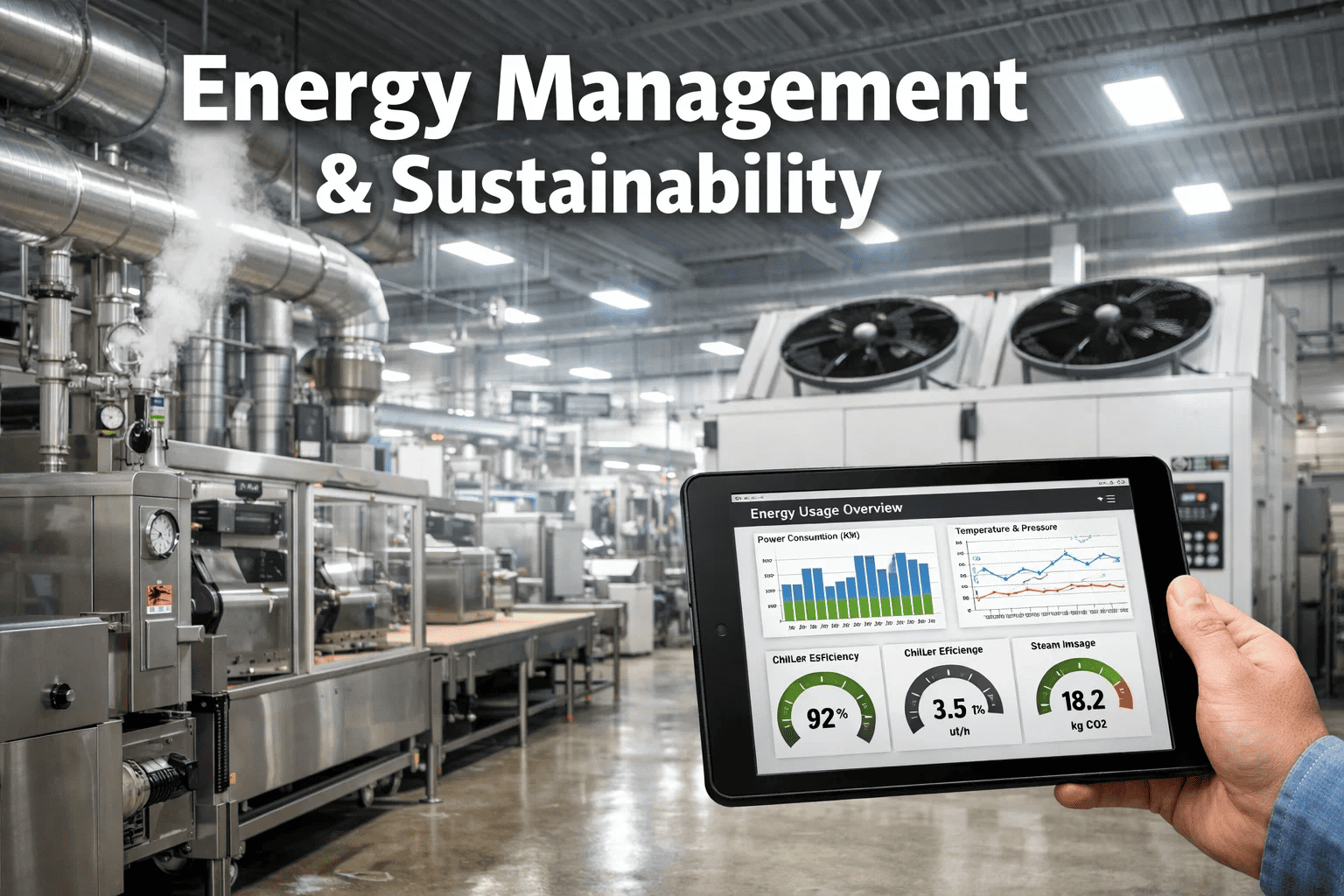
Your utility bill isn't lying — but it isn't telling you the whole truth either. The real story is buried in your maintenance logs: degraded seals, over-pressurized compressors, refrigeration units cycling longer than they should, and motors running at partial load while drawing near full power. See how Oxmaint detects hidden energy waste → This page breaks down exactly where those energy dollars are disappearing — and what it takes to stop the leak.
Cost Strategy · Energy & Sustainability
The Hidden Energy Leak
How Maintenance Inefficiencies Inflate Food Plant Utility Costs — Without Anyone Noticing
Energy is the second-largest operating cost in food manufacturing — after raw materials. But unlike raw materials, energy waste is invisible. It hides inside failing compressors, degrading motors, and refrigeration systems running harder than they need to. Your utility bill goes up. Nobody knows why.
The Core Problem
Why Energy Waste Stays Hidden in Most Food Plants
Most plant managers know energy costs are high. Very few know why — because the wasteful systems look like they're working fine from the outside.
The compressor runs all day
↓
But 25% of its output is leaking through joints, fittings, and seals that haven't been inspected in 18 months. The pressure drop gets misread as equipment failure — so leadership approves a new compressor purchase instead of a $400 seal replacement.
The refrigeration unit holds temperature
↓
But it's cycling 40% longer than it should because condenser coils are dirty and refrigerant charge is low. The temperature target is met — but electricity consumption has crept up 18% over six months. Nobody noticed because the product was fine.
The motor on line 3 runs every shift
↓
But it's a 75 HP motor operating at 35% load — drawing 90% of rated power because no VFD was installed and nobody benchmarked its real load profile. It's been running this way for years. Your energy team had no visibility to flag it.
Where the Energy Goes
The Food Plant Energy Leak Map
Every food facility has the same leak points. The difference between high-cost and low-cost operations is whether those leaks have been found and fixed.
Your Utility Bill
Where is the money going?
40–60%
Refrigeration Systems
Dirty coils, low refrigerant, inefficient cycling — the single biggest energy consumer in most food plants. Often running 15–25% harder than necessary.
20–30%
Compressed Air Systems
Air leaks waste 20–30% of compressor output. Compressed air costs 8x more per unit than electricity. The #1 overlooked energy drain in food manufacturing.
15–20%
Process Motors & Drives
Oversized motors at partial load, missing VFDs, and degrading bearings draw near full power while delivering partial output — invisible on a utility bill.
10–15%
HVAC & Facility Systems
Air handlers with degraded filters, steam traps that have failed open, and HVAC running during non-production hours add thousands to monthly bills quietly.
5–10%
Idle Equipment & Phantom Loads
Equipment left running during breaks, weekends, and shutdowns. Production lines in standby drawing significant power. Nobody's measuring it, so nobody stops it.
The Root Cause
Why This Is a Maintenance Problem, Not an Energy Problem
Every one of those energy leaks has a maintenance root cause. You don't fix your utility bill by calling your energy provider. You fix it by fixing your equipment.
Compressor runs constantly, high electricity bill
Air leaks at joints & fittings — no scheduled leak inspection program
$12,000–$80,000 per compressor system
Refrigeration electricity spend increasing month-over-month
Dirty condenser coils + low refrigerant charge — no PM tracking
18–25% reduction in refrigeration energy costs
Production line motors drawing excessive current
Degraded bearings + no load profiling — no asset performance baseline
10–20% motor energy reduction per line
HVAC costs elevated year-round
Failed steam traps + clogged filters — no predictive HVAC maintenance
$8,000–$30,000 annually for mid-size plants
High utility bills on non-production days
No equipment shutdown protocols — energy usage not monitored off-shift
Up to 14% of total energy spend recovered
Real-World Case · Iowa Meat Processing Plant
A meat processing facility in Iowa was spending $47,000 per month on electricity. After implementing energy monitoring integrated with their maintenance platform, they discovered $14,200 of that was disappearing every month — into equipment running during non-production hours, inefficient refrigeration cycling, and compressed air leaks that had never been quantified.
Total changes required: mostly operational adjustments, scheduled maintenance fixes, and shutdown protocols. No capital investment in new equipment.
$127K
Annual energy savings identified and recovered
30%
Of monthly electricity spend was waste
The Solution
How Oxmaint Surfaces Energy Waste Before Your Utility Bill Does
Oxmaint connects asset performance data with maintenance history to detect the equipment behaviors that quietly inflate energy consumption — and flag them before they become expensive patterns.
01
Asset Performance Baseline
Oxmaint establishes what "normal" looks like for every critical asset — compressors, refrigeration units, motors, and HVAC systems. Deviations from baseline are flagged automatically, so abnormal energy draw becomes visible before it becomes chronic.
02
Maintenance-to-Energy Correlation
The platform links PM completion data to energy trends. If a compressor's energy draw spikes in the same week a scheduled inspection was skipped, that correlation is surfaced automatically — so you see the true cost of deferred maintenance in real dollars.
03
Compressor & Refrigeration Monitoring
Real-time monitoring of load cycles, run time, pressure, and temperature gives maintenance teams the data to detect inefficient cycling, abnormal pressure drop (often caused by air leaks), and refrigeration systems working harder than their specs require.
04
Off-Shift & Idle Energy Alerts
Oxmaint tracks energy consumption patterns across shifts. When equipment draws significant power during non-production periods, alerts go to the maintenance team — identifying phantom loads that could represent 10–14% of your total energy spend.
05
Predictive Maintenance for Energy Efficiency
Bearing wear, belt degradation, and seal failure all increase energy consumption before they cause equipment failure. Oxmaint's predictive alerts catch these conditions early — so you schedule a $300 repair before it becomes a $4,000 emergency and months of elevated utility bills.
What Plants Recover When Maintenance Drives Energy Decisions
Compressed Air System Efficiency
Refrigeration Energy Consumption
After: ~75% (25% reduction)
Off-Shift Phantom Load Costs
Before: Untracked & uncontrolled
After: Reduced by up to 70%
Overall Plant Energy Spend
Before: Industry average baseline
After: Up to 45% reduction possible
Your utility bill is already telling you something's wrong. Oxmaint helps you find exactly what — and fix it.
Most food plants recover their Oxmaint investment from energy savings alone, without touching production volumes or staffing levels.
Questions & Answers
What Plant Managers Ask About Energy-Driven Maintenance
Common questions from facilities teams connecting maintenance performance to utility cost reduction for the first time.
How do I know if maintenance inefficiency is actually causing my high energy bills?
The clearest signal is a rising utility bill without a corresponding increase in production volume. If your output has stayed flat but energy costs have climbed 10–20% over 12–18 months, deferred or reactive maintenance is almost certainly a contributing cause. Degrading compressors, refrigeration systems working harder, and motors running inefficiently are the typical culprits — all of which are invisible on a utility bill but detectable through asset performance monitoring.
What's the fastest energy win most food plants can get?
Compressed air leak detection and repair. It's consistently the highest ROI, fastest-payback energy initiative in food manufacturing. A proper leak audit — combined with a scheduled inspection and repair program — can recover 20–30% of compressed air system energy costs, often within 30–60 days of implementation. For a mid-size food plant running multiple compressors, that frequently translates to $50,000–$150,000 in annual savings.
Does Oxmaint require new energy meters or IoT hardware to detect energy waste?
Not necessarily. Oxmaint works with your existing sensor data, CMMS records, and maintenance logs to identify patterns that correlate with energy inefficiency. For deeper energy monitoring, IoT sensors can be added to specific assets — particularly compressors and refrigeration systems — but the platform delivers significant value through maintenance correlation analysis even before any new hardware is installed.
How does predictive maintenance reduce energy consumption specifically?
Equipment in poor condition uses more energy to perform the same work. A compressor with worn seals runs longer to maintain pressure. A motor with degraded bearings draws more current to maintain speed. A refrigeration condenser with dirty coils runs more cycles to maintain temperature. Predictive maintenance catches these conditions at the early-degradation stage — when a $300 service visit restores normal efficiency — rather than at failure, when months of elevated energy consumption have already been billed.
How long before we see measurable reduction in energy costs?
Most plants see their first measurable energy wins within 60–90 days. Compressed air and refrigeration inefficiencies are typically the first to surface, since they are the largest consumption categories and the most affected by maintenance status. The deeper savings from predictive maintenance — eliminating chronic degradation patterns — typically compound over 6–12 months as the asset performance baselines mature and the AI models become more accurate.
Is this relevant if we already have a PM program in place?
Yes — and this is where most facilities find the most surprising gaps. A calendar-based PM program tells you that maintenance happened. It doesn't tell you whether the equipment is actually performing efficiently between PM events. Oxmaint adds the layer of continuous performance monitoring that calendar-based programs miss — identifying energy-impacting degradation that occurs between scheduled maintenance visits, which is where the majority of invisible energy waste actually happens.
Energy & Maintenance Intelligence for Food Plants
Stop Paying for Energy Waste You Can't See
Oxmaint connects asset performance monitoring with maintenance intelligence to find the hidden energy leaks inflating your utility bills — and give your team a clear action plan to fix them.
No equipment replacement needed
·
Works with existing assets
·
First energy insights within 30 days
·
ROI often recovered from energy savings alone