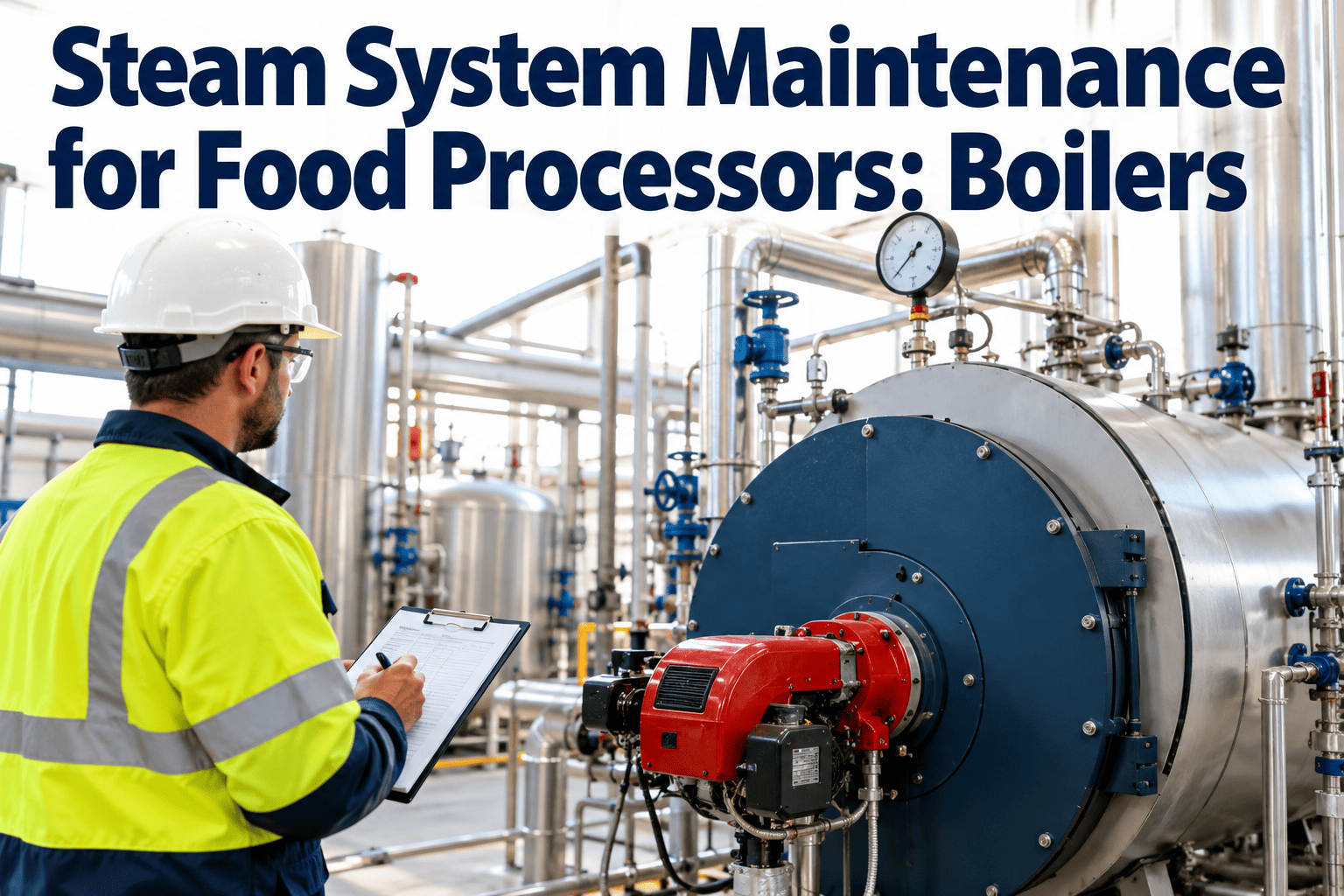
Boiler and steam system failures in food and beverage plants are not just maintenance problems — they are production emergencies. A single boiler outage can halt pasteurization, sterilization, and CIP operations simultaneously, exposing facilities to food safety violations, OSHA citations, and production losses that compound by the hour. Across food manufacturers in the USA, UK, Canada, Australia, UAE, and Germany, the plants achieving the highest uptime share one common practice: a disciplined, data-driven approach to boiler and steam system maintenance built on predictive monitoring, structured inspection cycles, and CMMS-driven scheduling that eliminates the reactive patterns that cost facilities four to five times more per repair. Want to build that program? start a free trial or book a demo to see how Oxmaint manages it end-to-end.
Stop Reacting to Boiler Failures. Start Preventing Them.
Oxmaint gives food plant maintenance teams automated boiler inspection workflows, steam trap tracking, water treatment logs, and audit-ready compliance documentation — all from one mobile-first CMMS platform.
What Is Boiler and Steam System Maintenance?
Boiler and steam system maintenance is the structured, multi-discipline program of inspections, water treatment, mechanical servicing, and compliance documentation that keeps industrial steam generation and distribution assets operating safely, efficiently, and within regulatory requirements. In food and beverage facilities, steam is a critical process utility — used for heating, pasteurization, sterilization, cooking, CIP systems, and jacketed vessel heating — making any gap in the maintenance program a direct threat to both production continuity and food safety certification. A well-run steam maintenance program covers the boiler itself, the distribution network including steam traps and pressure reducing valves, condensate return systems, and the chemical water treatment program that protects every component. start a free trial and set up your full boiler asset register in Oxmaint within the first session.
Core Components of a Food Plant Steam System
Fire-Tube and Water-Tube Boilers
The primary steam generation asset. Fire-tube boilers dominate small-to-mid food plant installations; water-tube designs serve high-pressure, high-capacity operations. Both require annual inspection, NDE testing, and ASME/PED certification across North American and European plants.
Steam Distribution Headers and Mains
Insulated piping networks distribute steam from the boiler house to process points. Corrosion, water hammer, and expansion joint fatigue are the primary failure mechanisms — each detectable through structured inspection programs and CMMS-triggered thickness monitoring records.
Steam Traps
Steam traps remove condensate while retaining live steam — and are the most failure-prone component in any distribution network. Industry data shows 15–25% of steam traps in typical plants are failed at any given time, wasting energy and reducing process temperature consistency.
Condensate Return Systems
Recovering condensate saves fuel, water, and chemical treatment costs. A well-maintained condensate return system recovers 80–90% of water heat value. Flash steam vessels, pumping traps, and return lines require regular inspection to prevent iron contamination and energy loss.
Pressure Reducing Valves (PRVs)
PRVs step down distribution pressure to process-specific requirements. Failed PRVs cause either under-pressure (reducing process effectiveness) or over-pressure (creating safety risk). Annual testing and rebuild schedules are standard across ASME B31.3 and EN 13480 frameworks.
Boiler Water Treatment Systems
Chemical dosing, softening, deaeration, and blowdown control maintain water quality within ABMA and BWT guidelines. Poor water treatment is the leading cause of tube scaling, corrosion, and premature boiler failure across all food plant types and operating pressures.
Critical Pain Points: What's Failing in Food Plant Steam Systems
Undetected Steam Trap Failures
Failed-open steam traps bleed live steam continuously. A single 1/2-inch trap failed open at 100 psi wastes over 60 lbs of steam per hour — translating to thousands of dollars annually per trap. Most plants with no trap survey program have 20%+ of their trap population failed.
Deferred Boiler Inspections
Statutory boiler inspections deferred under production pressure create regulatory exposure and insurance liability. In the US, ASME/NB inspection requirements are legally mandated; in the UK, PSSR 2000 requires written schemes of examination. Missing inspection windows creates both safety and compliance risk.
Inconsistent Water Treatment Logging
Manual water treatment logs are incomplete, illegible, or missing entirely in 60%+ of facilities. Without trend data, treatment upsets go undetected until scale formation, corrosion, or foam carryover affects steam quality and process performance.
Missing Pressure Vessel Certifications
Expired pressure vessel certificates are among the top non-conformances found in third-party food safety audits. Plants managing certificates in spreadsheets or paper files routinely miss renewal windows — a finding that triggers immediate regulatory and insurance escalation.
How Oxmaint Manages Boiler and Steam System Maintenance
Oxmaint's CMMS platform is purpose-built for the audit trail, scheduling, and condition tracking requirements that steam system maintenance demands — connecting every boiler asset, inspection history, water treatment log, and compliance certificate into one searchable system accessible from desktop or mobile. start a free trial and configure your boiler PM schedule in less than a day.
Full Boiler Asset Hierarchy
Register every boiler, trap, PRV, and heat exchanger with manufacturer data, install date, pressure rating, and inspection history. Parent-child asset links connect boilers to every downstream component.
Automated Inspection Workflows
Schedule annual statutory inspections, quarterly trap surveys, monthly blowdown verification, and daily water chemistry checks — each generating mobile work orders with built-in checklists and sign-off fields.
Certificate Expiry Alerts
Upload ASME/PED/PSSR certificates to asset records. Oxmaint alerts maintenance and compliance teams 60, 30, and 7 days before expiry — eliminating the spreadsheet-tracking failures that cause audit non-conformances.
Digital Water Log Management
Mobile-captured water chemistry readings create a continuous trend record — replacing paper logs with searchable, graphable data that flags treatment upsets and supports annual boiler inspection documentation.
Trap Survey and Loss Tracking
Log every steam trap with condition status, failure mode, and energy loss estimate. Oxmaint calculates trap population health and prioritizes replacements by energy cost — turning trap surveys into ROI decisions.
Audit-Ready Documentation
Every inspection, repair, and water test generates a date-stamped, technician-signed record retrievable in seconds. BRCGS, SQF, and FDA auditors receive complete boiler history reports in one export.
Reactive vs. Planned: The Real Cost Difference
ROI of Structured Boiler Maintenance
Frequently Asked Questions
How often should boilers be inspected in a food processing plant?
Statutory boiler inspections are required annually in most jurisdictions — ASME/NB in the USA, PSSR 2000 written scheme inspections in the UK, and TRD/BetrSichV requirements in Germany. Internal inspections during planned outages, water chemistry checks monthly, and blowdown verification weekly are standard best practice. CMMS scheduling ensures none of these windows are missed regardless of production schedule pressure.
What is the most common cause of boiler failure in food plants?
Poor water treatment is the leading cause of premature boiler failure globally — responsible for scale formation on heat transfer surfaces, oxygen pitting corrosion, and caustic embrittlement. A structured water treatment program with daily chemistry monitoring, consistent chemical dosing, and CMMS-logged blowdown records prevents the tube degradation that leads to unplanned failures and early boiler replacement.
How does steam trap maintenance affect food plant energy costs?
Failed steam traps are among the highest per-unit energy waste sources in food plant operations. A single failed-open trap at 150 psi can waste 100+ lbs of steam per hour — equivalent to thousands of dollars per year per trap. Plants conducting annual ultrasonic trap surveys and replacing failed traps typically recover 10–30% of total steam generation costs within 12 months of the program start.
Can Oxmaint manage multi-site boiler compliance across different regulatory frameworks?
Yes. Oxmaint supports multi-site asset management with site-specific compliance requirements configured per location. A food manufacturer operating facilities in the USA, UK, and Germany can manage ASME, PSSR, and BetrSichV inspection schedules within the same platform — with portfolio-level dashboards showing compliance status across all sites and individual site records maintaining jurisdiction-specific documentation requirements.
Your Boiler Program Deserves a Better System Than Spreadsheets
Oxmaint centralizes every inspection record, water log, steam trap survey, and compliance certificate in one platform — giving your team real-time visibility and giving your auditors instant confidence. Join food manufacturers across the USA, UK, Australia, and UAE who have eliminated reactive boiler failures with Oxmaint.