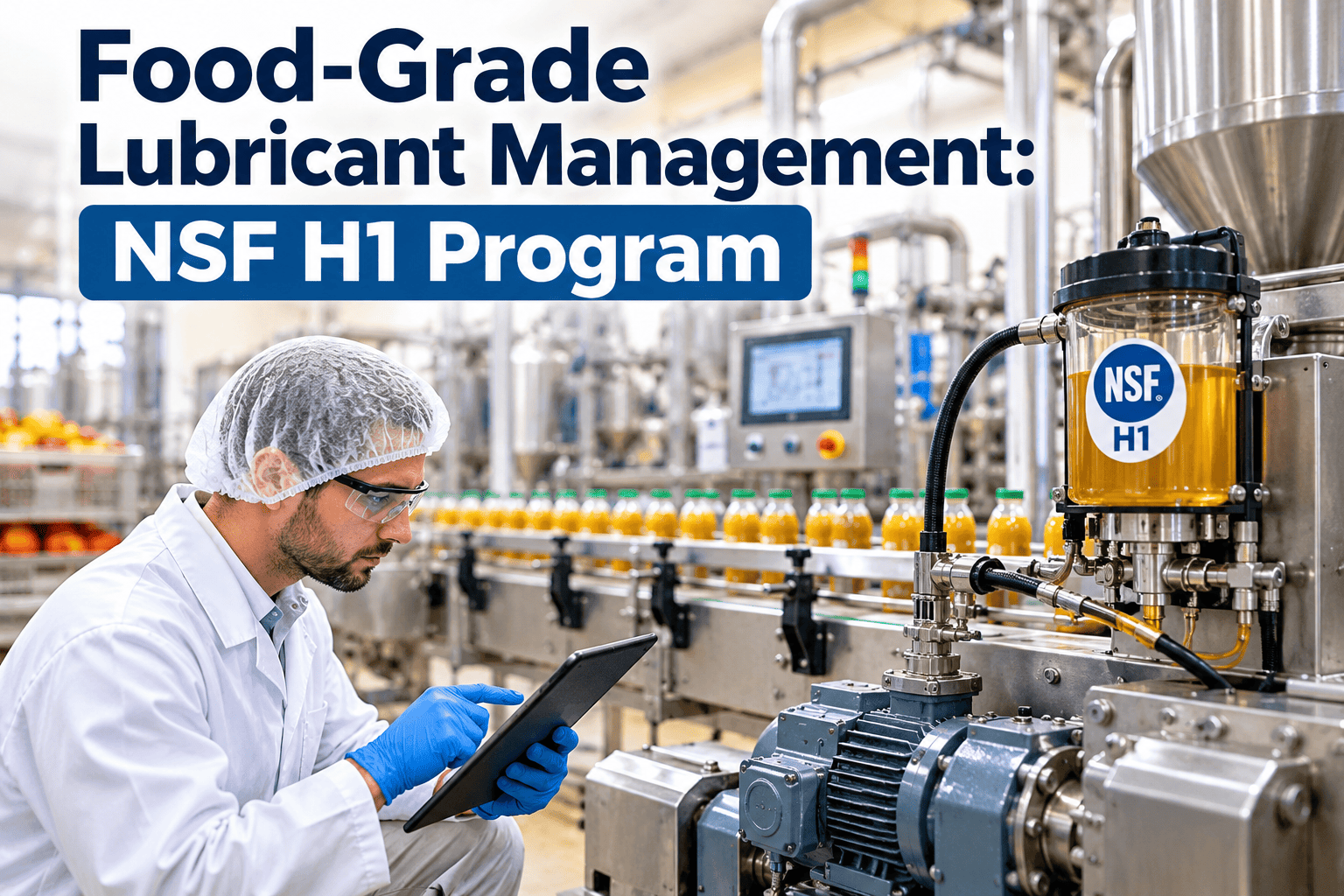
Food-grade lubrication is one of the most compliance-critical and most commonly mismanaged maintenance activities in food manufacturing. A single application of the wrong lubricant to a food-contact bearing — or an undocumented over-lubrication event that pushes grease onto a conveyor belt — can trigger a Class II recall, an FDA warning letter, and weeks of production shutdown. Yet most food plants still manage lubrication programs through handwritten lube sheets, unlabeled grease guns, and technician memory. NSF H1 lubricant compliance failures are among the top five causes of food safety auditor major nonconformances in manufacturing environments. The financial exposure is direct: the average food product recall costs $10 million in direct costs alone, before accounting for brand damage and lost contracts. Structured digital lubrication documentation eliminates this risk — start a free trial to digitize your food-grade lubrication program today, or book a demo and walk through your specific lubrication compliance requirements with our team.
Identify Hidden Lubrication Compliance Risks in 30 Minutes
See how much regulatory exposure you can eliminate from undocumented and incorrectly applied food-grade lubricants across your facility.
- Real-time lubrication point tracking across every food-contact and incidental-contact asset
- NSF H1 verification and contamination prevention documentation at every application
- Audit-ready lubrication records for FDA, FSMA, SQF, BRC, and FSSC 22000 inspections
Used by food manufacturing operations managing 10,000+ assets — live in days, not months
What Is a Food-Grade Lubricant Application and Documentation Checklist?
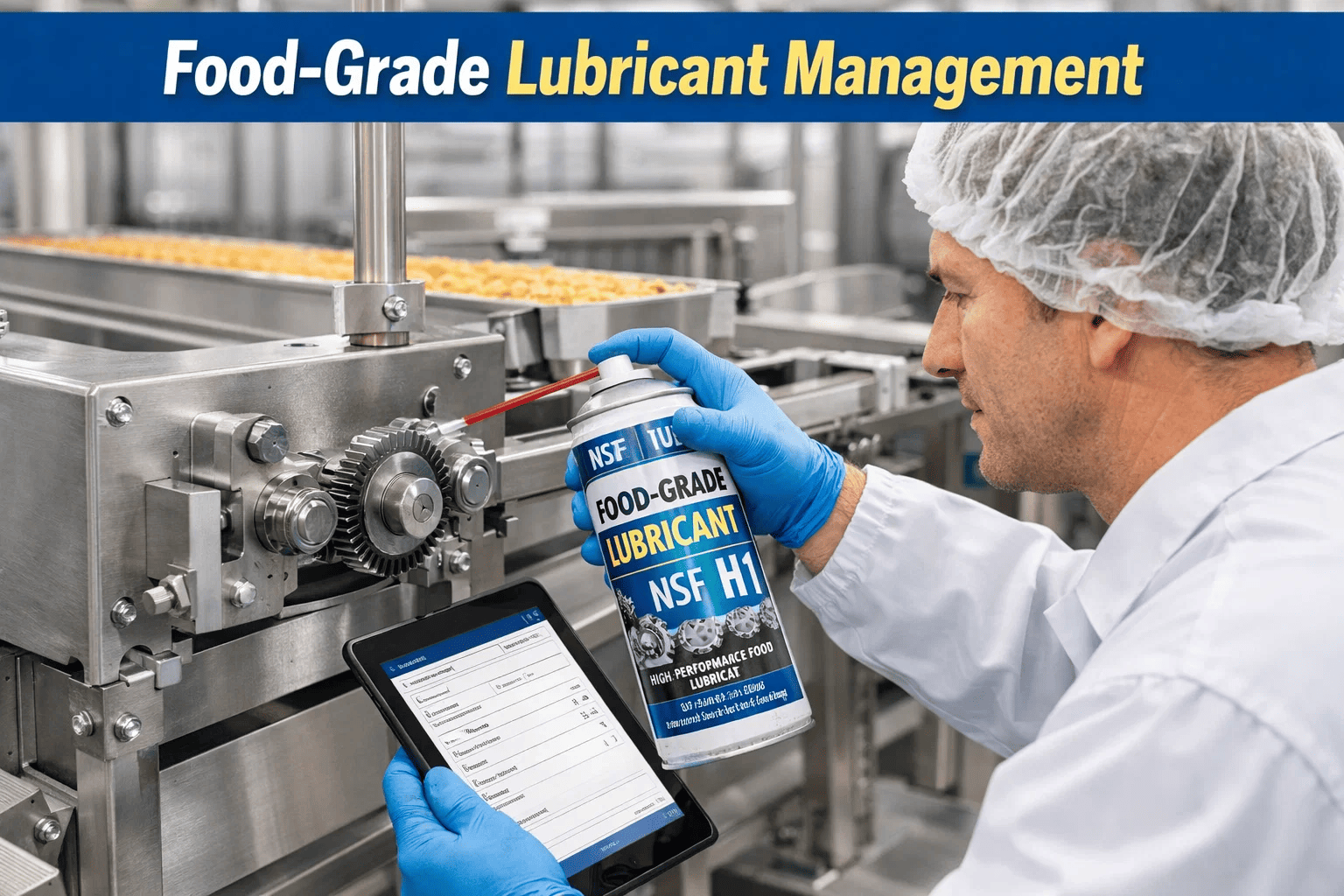
A food-grade lubricant application and documentation checklist is a structured verification workflow that guides maintenance technicians through every step of a compliant lubrication task in a food manufacturing environment — from confirming the correct NSF H1 or H2 lubricant for the specific application zone, through applying the verified quantity at the correct lubrication point, to completing the documentation that creates a traceable, audit-ready record of every lubricant application in the facility. It is not a generic maintenance log. It is a food safety control point.
The distinction between H1, H2, and H3 lubricant classifications is the foundation of food-grade lubrication compliance. NSF H1 lubricants are approved for incidental food contact — required for any lubrication point where lubricant could migrate into food. NSF H2 lubricants are for non-food-contact areas only. Misapplication — using an H2 lubricant on an H1-required point, or applying any lubricant in excess quantities near food contact surfaces — constitutes a food safety incident requiring FSMA Preventive Controls documentation and, depending on severity, customer and regulatory notification.
Digital lubrication checklists enforced through a CMMS eliminate misapplication risk by displaying the approved lubricant, approved quantity, and application method for each specific point — making the right action the only available action. Facilities that digitize lubrication programs report compliance nonconformance rates near zero and audit preparation time reduced by over 70% — start a free trial to see how Oxmaint enforces your food-grade lubrication program, or book a demo to review your current lubrication risk profile with our team.
Food-Grade Lubrication Compliance Framework: 8 Core Elements
Every lubrication point in the facility catalogued with its NSF classification requirement (H1, H2, or H3), approved lubricant product, application frequency, and quantity specification — linked to the parent asset in the CMMS hierarchy.
Technician confirms NSF H1 certification of selected lubricant before application at any food-contact or incidental-contact point. Product number and lot verification captured in the work order — not assumed from container label alone.
Approved quantity (grams of grease, ml of oil) specified per point. Over-lubrication — a leading cause of lubricant migration onto food contact surfaces — prevented by documented quantity limits that cannot be overridden without supervisor authorization.
Pre-application and post-application inspection steps confirm lubricant has not contacted food, packaging, or food-contact surfaces. Any visible contamination triggers an immediate hold protocol and corrective action work order.
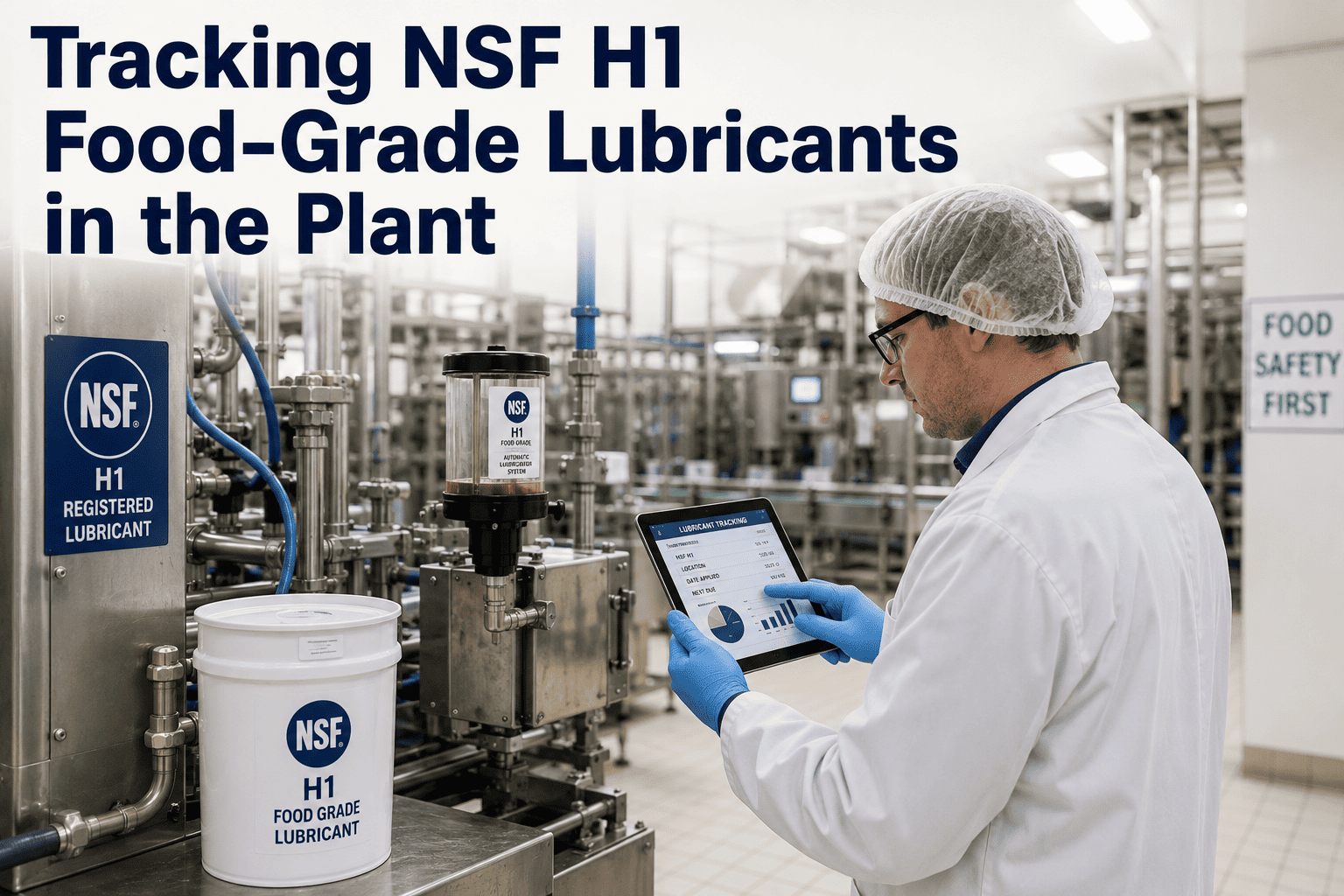
Every application documented with lubricant product name, NSF registration number, lot number, quantity applied, application method, technician ID, and timestamp — creating the complete traceability chain required by FSMA Preventive Controls Rule.
PM lubrication tasks scheduled automatically based on equipment operating hours, production cycles, or calendar intervals per manufacturer recommendations — with mobile alerts dispatched to technicians when lubrication is due.
Approved food-grade lubricant inventory managed within the CMMS — tracking stock levels, lot numbers, and expiry dates. Unapproved lubricants physically segregated and system-blocked from food-contact lubrication work orders.
Periodic lubrication audit workflow verifies approved lubricants are in use, application quantities match specifications, and documentation is complete. Audit findings generate automatic corrective action work orders with assigned owner and due date.
Lubrication Compliance Pain Points: Where Food Plants Fail Audits
Food-grade lubrication failures are almost never caused by intentional non-compliance. They are caused by systems that make it too easy to do the wrong thing — unlabeled grease guns, missing specification sheets, verbal instructions that get distorted, and documentation that happens after the fact if it happens at all. The result: facilities with excellent intentions and poor documentation receive major audit nonconformances for lubrication practices that their technicians believed were correct. Switching to a structured digital lubrication workflow removes this ambiguity entirely — start a free trial to lock down your food-grade lubrication compliance today.
Unlabeled grease guns and shared lubricant containers result in H2 or non-approved lubricants applied to food-contact bearing points. The error is invisible until an audit inspector asks for application records — or until a regulatory sample test detects the contamination in finished product.
Technicians applying grease by feel rather than specification routinely over-lubricate bearings adjacent to food contact surfaces. Excess lubricant purges onto conveyor belts, product chutes, and packaging equipment — creating contamination events that trigger product holds and customer complaints.
Paper lube sheets are completed inconsistently — filled in at end of shift from memory, missing lot numbers, or skipped entirely during production pressure. SQF and BRC auditors consistently identify incomplete lubrication records as a major nonconformance requiring immediate corrective action.
Non-NSF lubricants enter the facility through maintenance supply orders placed outside the approved vendor list, or from technicians bringing personal lubricant products. Physical segregation fails without system-enforced controls — creating recall exposure every time an unapproved product is used near a food line.
Critical lubrication intervals are missed when production schedules override maintenance access. Under-lubricated bearings fail prematurely — creating both the mechanical repair cost and the debris contamination risk if bearing failure scatters metal and lubricant into the production environment.
When a lubricant contamination event occurs — or when a customer complaint triggers an internal investigation — facilities with paper lubrication systems cannot reconstruct which lubricant was applied to which point on which date by which technician. Inability to demonstrate control is itself a regulatory violation under FSMA Preventive Controls.
How Oxmaint Solves Food-Grade Lubrication Compliance
Every lubrication point catalogued within the asset hierarchy — with approved NSF lubricant, classification zone, application method, and quantity specification locked per point. Technicians see exactly what to apply before they open a grease gun.
Work orders for food-contact lubrication points display only NSF H1-approved lubricants from the approved inventory. Non-approved lubricants cannot be selected for H1 application points — making the compliant choice the only available choice.
Every application captures lubricant name, NSF registration number, lot number, quantity applied, application method, pre and post contamination check results, technician ID, and timestamp — automatically compiled into a traceable record against the specific asset and work order.
Lubrication PM tasks scheduled automatically against equipment operating hours, production run counts, or calendar intervals — dispatched to technician mobile devices with asset location, approved lubricant, and required quantity pre-populated. No missed intervals.
Food-grade lubricant inventory managed with lot tracking, expiry monitoring, and segregation flags. Unapproved lubricants system-blocked from food-contact work orders. Stock alerts prevent lubrication delays caused by inventory stockouts on critical H1 products.
Complete lubrication history exportable by asset, date range, technician, or lubricant product — in the exact format required for FDA, FSMA, SQF, BRC, and FSSC 22000 audit documentation requests. Preparation time reduced from days to minutes.
Manual vs. Digital: Food-Grade Lubrication Program Comparison
| Program Element | Manual / Paper-Based | Digital CMMS with Oxmaint |
|---|---|---|
| Lubricant Selection | Technician chooses from memory or unlabeled grease gun — misapplication common | Approved NSF lubricant pre-specified per point — only compliant option available |
| Application Quantity | Applied by feel — over-lubrication causing product migration frequent | Exact quantity specified per point — deviation flagged and documented |
| Lot Traceability | Lot numbers rarely captured — incident investigation impossible | Lot number verified and linked to every application record automatically |
| Documentation Timing | Paper sheets completed after shift from memory — accuracy unreliable | Real-time mobile capture at point of application — cannot be completed after the fact |
| Audit Preparation | Days of manual record reconstruction — gaps frequently discovered during audit | Searchable digital records exported in minutes — always audit-ready |
| Schedule Compliance | 54% average — missed lubrication intervals cause premature bearing failures | 85–95% compliance — automated scheduling with mobile dispatch and escalation |
| Contamination Detection | No systematic post-application check — contamination discovered by quality or customer | Pre and post contamination check required in work order — deviations trigger immediate holds |
| Unapproved Lubricant Control | Physical segregation only — frequently fails in practice | System-enforced blocking — unapproved lubricants cannot be selected for food-contact points |
ROI from Digital Food-Grade Lubrication Management
The return on digital lubrication management is measured in three dimensions: avoided recall costs from contamination prevention, reduced audit nonconformance risk from complete documentation, and extended equipment life from consistent precision lubrication. Given that the average food recall costs $10 million in direct costs alone, preventing even a single lubrication-related contamination event delivers ROI that dwarfs the cost of any CMMS investment. Teams that implement structured digital lubrication management see results within the first 30 days — book a demo to see the Oxmaint ROI calculator applied to your specific lubrication risk profile.
Frequently Asked Questions
What is the difference between NSF H1, H2, and H3 lubricants in food manufacturing?
NSF H1 lubricants are registered for use in food processing environments where there is the possibility of incidental food contact — required for any bearing, chain, or mechanical component adjacent to food, packaging, or food-contact surfaces. NSF H2 lubricants are acceptable only in food plant locations where there is no possibility of lubricant contacting food — typically drive systems, motor housings, and equipment located in non-food areas. NSF H3 (soluble oils) are used for cleaning and preventing rust on hooks, trolleys, and similar equipment. Using an H2 lubricant on an H1-required application point — even once — constitutes a food safety incident under FSMA Preventive Controls requirements, potentially requiring customer notification and regulatory reporting. Oxmaint enforces H1 application zones by making only NSF H1 lubricants selectable for food-contact lubrication work orders. Start a free trial to configure your NSF classification zones.
What documentation do food-grade lubricant applications require for FSMA and SQF compliance?
FSMA Preventive Controls Rule (21 CFR Part 117) requires that facilities document their food safety preventive controls and demonstrate they are operating as intended. For lubrication, this means records must capture: the lubricant product name and NSF registration number, the specific application point (linked to the HACCP or food safety plan), the quantity applied, the date and time of application, and the identity of the technician performing the task. SQF Edition 9 and BRC Issue 9 both require a documented lubrication program with evidence that only approved lubricants are used in food-contact zones and that all applications are recorded. Oxmaint captures all of these fields automatically in every lubrication work order and compiles them into audit-ready reports on demand.
How does Oxmaint prevent over-lubrication that causes product contamination?
Over-lubrication is prevented through three mechanisms in Oxmaint. First, every lubrication point has an approved quantity (grams of grease, ml of oil) specified in the asset record — displayed to the technician in the work order before application begins. Second, the post-application contamination check step in the digital inspection form requires the technician to confirm no lubricant has contacted food, packaging, or food-contact surfaces before the work order can be closed. Third, any observed contamination triggers an immediate product hold workflow and corrective action work order — ensuring the event is documented, investigated, and resolved with full traceability. These three controls eliminate the over-lubrication contamination risk that paper programs cannot address. Book a demo to see the contamination prevention workflow in action.
How does Oxmaint handle lubrication programs across multiple food production lines or facilities?
Oxmaint manages lubrication programs across multiple lines and facilities through its five-level asset hierarchy: Portfolio, Property, System, Asset, and Component. Each lubrication point sits within this hierarchy — meaning technicians at each line or facility see only the lubrication tasks relevant to their location, while maintenance managers and quality directors see consolidated compliance status across all lines and sites in a single dashboard. Approved lubricant specifications can be standardized portfolio-wide or customized by facility where different regulatory environments or equipment types require it. Multi-site lubrication audit reports are generated in one export — eliminating the manual compilation process that currently consumes days of management time before each certification audit.
Stop Leaving $10 Million Recall Exposure on the Table
Turn every lubrication point into a documented, compliant, traceable control with Oxmaint — and give auditors exactly what they ask for in minutes, not days.
- NSF H1 classification enforcement at every food-contact lubrication point
- Complete application traceability for FDA, FSMA, SQF, BRC, and FSSC 22000
- Automated lubrication scheduling with 85–95% compliance vs. 54% on paper
No heavy implementation required | Works across multi-site food manufacturing portfolios | Live in days, not months



-procedure-checklist.png)