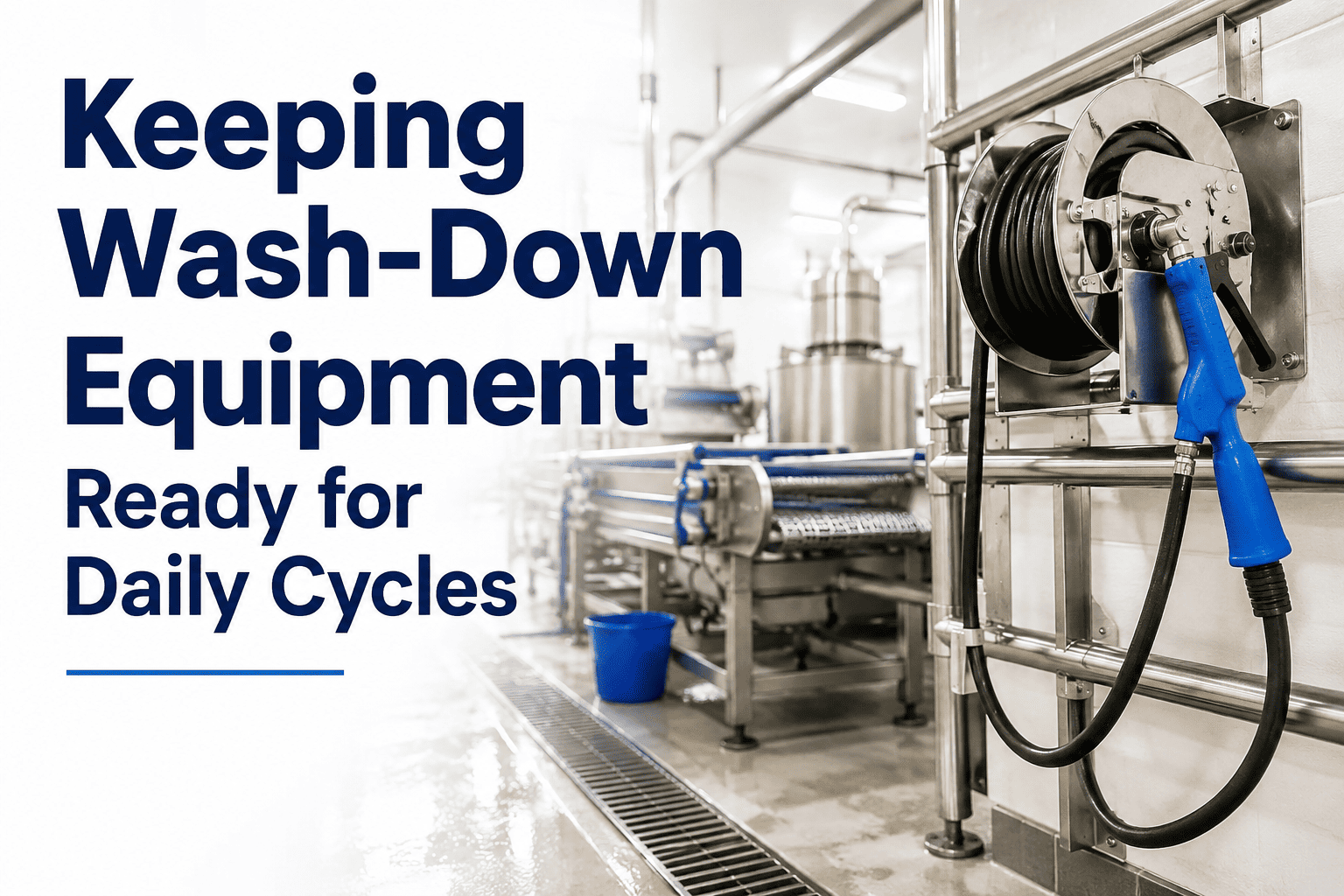
Daily sanitation cycles don't fail because crews cut corners — they fail because the equipment they depend on wasn't maintained before the shift started. In food plants running two or three production cycles a day, wash-down gear takes more abuse in a week than most facility assets see in a year: high-pressure pumps cycling thousands of times, foam heads exposed to chlorinated alkaline chemistry, and chemical injectors slowly calcifying between each use. The cost of one delayed sanitation window easily runs $4,000–$9,000 in lost production minutes, and that compounds across a 50-week year. This guide walks through the PM rituals, chemical-system service points, and CMMS-driven reliability habits that keep wash-down equipment ready for every cycle — and you can Start Free Trial to operationalize all of it inside one tracked system.
Can your wash-down fleet survive three sanitation cycles — every single day?
Most food plants lose 40+ minutes of production per day to undermaintained wash-down equipment. Failed pumps, clogged foamers, and miscalibrated injectors quietly extend every cleanup window. Here is the CMMS-backed system that flips that math.
A single delayed sanitation window costs more than a year of PM labor
Industry benchmark data from USDA-inspected protein and dairy plants shows that the average sanitation-overrun event lasts 47 minutes and costs $5,200 in lost line throughput, plus re-allocated labor. When that happens twice a week, the annual bleed passes $500,000 — and almost none of it shows up as a "maintenance" line item.
A 180-asset poultry processing plant in Arkansas was spending roughly $42K/year on reactive wash-down repairs — failed unloader valves, seized foam pumps, ruined injector quills. After moving all wash-down PM into a CMMS-tracked program with 7-day, 30-day, and 90-day task tiers, reactive spend dropped to $9.1K, sanitation overruns fell 61%, and the changeover window tightened by 22 minutes per day.
The 4-point PM that keeps high-pressure washers alive past 2,000 hours
High-pressure pumps are the workhorses of wash-down — and the first thing to fail when PM slips. A 4-point weekly check, paired with a 250-hour service interval, typically extends pump life from 1,400 hours to 2,300+ hours and cuts unplanned replacements by half.
Verify pressure relief cycles cleanly at 10% above operating pressure. A sticking unloader spikes pressure 200–400 PSI and ruptures seals within days.
Weekly · 5 minCheck oil level, color, and water intrusion. Milky oil = water past the seal. Replace oil at 250 hours; replace seals before 500 hours to prevent bearing failure.
Weekly · 8 minA worn 0.045" nozzle flows 18% more water at lower PSI, straining the pump. Replace nozzles when flow exceeds 110% of spec — typically every 90 days in daily-use plants.
30 days · 6 minClogged inlet filters starve the pump and cause cavitation — the #1 silent killer of high-pressure pumps. Inspect, flush, and log pressure drop across the filter.
7 days · 4 minFoamers and injectors: the two systems that drift fastest under daily chemistry
Foam cleaning systems and chemical injectors are precision metering devices treated like garden hoses. Chlorinated alkaline cleaners, acid descalers, and sanitizers calcify, scale, and erode internal components — and the drift is invisible until foam coverage drops below the 60-second cling time that sanitation SOPs require.
- Foam coverage drops to 35-second cling time before anyone notices
- Injector quills scale up, chemical ratio drifts ±40% from setpoint
- Sanitation crew compensates by over-using chemistry — $1,800/mo waste
- Audit findings surface only during quarterly third-party inspections
- Foam cling time logged per cycle; alert triggers below 55 seconds
- Injector ratio verified weekly; drift kept within ±5% of setpoint
- Chemical usage tied to actual square footage cleaned — 22% cost drop
- Every foam head, injector, and regulator has a QR-coded asset record
| Foam / Chemical PM Task | Frequency | CMMS Trigger | Failure It Prevents |
|---|---|---|---|
| Foam head disassembly & soak | 14 days | Auto-generated work order | Clogged orifice → uneven coverage |
| Injector quill descale | 30 days | Meter-based trigger | Ratio drift → under-dosed chemistry |
| Chemical line pressure test | 7 days | Scheduled round | Tube rupture → chemical exposure |
| Foam cling-time verification | Each shift | Operator checklist (mobile) | Coverage failure → sanitation rework |
| Concentrate drum level log | Daily | IoT sensor + manual confirm | Run-dry injector → pump damage |
The 3-tier PM schedule that ties wash-down reliability to CMMS-tracked KPIs
Without a CMMS, wash-down PM is a clipboard exercise — and clipboards don't generate alerts when a 30-day task is 9 days overdue. A tiered CMMS program structures every task around a frequency, an owner, and a measurable outcome, then rolls those into reliability KPIs that sanitation and maintenance leadership can both see.
Operator-Owned Pre-Cycle Checks
Visual inspection of hoses, guns, nozzles, and foam heads before the first sanitation cycle. Mobile checklist submitted via CMMS app — 8 items, under 4 minutes. If cling time, pressure, or foam pattern fails spec, a work order auto-opens before the cycle starts, not after it ends.
Maintenance Technician PM
Weekly: inlet filter flush, oil level check, unloader test, line pressure log. Monthly: injector descale, nozzle orifice measurement, foam head soak, chemical ratio verification. Each task has a QR-coded asset tag, a digital sign-off, and a photo attachment requirement for compliance traceability.
Reliability Engineering Review
Pump seal replacement, unloader rebuild, hose assembly swap, and a full calibration of chemical dosing. The CMMS pulls 90 days of pressure logs, cling-time data, and chemical usage to flag systemic drift — not just component failure — and feeds it into an MTBF review for every wash-down asset.
Target: ≥ 96% availability across all wash-down assets. Plants below 90% typically lose 30+ minutes of production per sanitation window — the threshold where overruns start compounding across the week.
The 5 metrics that tell you wash-down health before a cycle fails
CMMS value isn't in logging work orders — it's in turning logs into leading indicators. These five metrics, tracked weekly inside the CMMS dashboard, predict wash-down failure 7–14 days before it impacts a sanitation cycle.
Share of scheduled sanitation hours where equipment is operational, not in PM or repair.
Percentage of tier-1 and tier-2 tasks completed on time, within the CMMS-scheduled window.
Minimum acceptable dwell time for foam on vertical surfaces — the sanitation coverage proxy.
Acceptable variance between set dosing ratio and actual injector output, verified weekly.
Mean time between failure for high-pressure pumps under a tiered CMMS program. Baseline without PM: 1,400h.
The ultimate lagging indicator. Anything above 2/week signals a systemic wash-down reliability gap.
Stop losing production minutes to wash-down failures you can predict
Move your foam, chemical, and high-pressure PM into a CMMS that alerts before a cycle breaks — not after.
Wash-down equipment maintenance, answered
How often should high-pressure wash-down pumps be serviced in a food plant?
Daily visual checks (oil level, leaks, inlet filter), weekly functional PM (unloader test, pressure log, nozzle wear), and a 250-hour oil change with seal inspection. In a plant running 3 sanitation cycles daily, that 250-hour interval lands roughly every 8–10 weeks. A full 90-day deep service — seal swap, unloader rebuild, hose replacement — extends pump life past 2,000 hours and is the single highest-ROI PM task on the wash-down list.
What does a CMMS actually do for wash-down reliability that a clipboard doesn't?
A CMMS auto-generates work orders on a meter- or time-based trigger, assigns them to a technician with a QR-scanned asset, and forces a digital sign-off with photo evidence. More importantly, it aggregates 90 days of pressure logs, foam cling-time data, and chemical usage into a dashboard that flags drift 7–14 days before a failure. You can Book a Demo to see exactly how that workflow looks in a real plant environment.
Why do foam cleaning systems drift even when nothing looks broken?
Foam heads and injectors meter chemistry through tiny orifices that slowly calcify from chlorinated alkaline and acid cleaners. A 10% reduction in orifice diameter drops foam cling time from 60 seconds to under 40 — well below the coverage threshold for validated sanitation SOPs. Weekly foam-head soak, monthly injector descale, and per-shift cling-time verification are the three tasks that catch drift before it becomes an audit finding.
How much can a food plant save by moving wash-down PM into a CMMS?
Plants that implement a tiered CMMS wash-down program typically cut reactive repair spend 60–75%, reduce sanitation overruns 50–65%, and tighten the daily changeover window by 15–25 minutes. For a mid-size protein line running 2 overruns per week at $5.2K each, that's $250K–$340K in recovered production time annually — before counting reduced chemistry waste and audit-finding remediation costs.
What's the fastest way to get a wash-down CMMS program running?
Start with an asset register: tag every pump, foamer, injector, and hose assembly with a QR code. Then load tier-1 daily checks into the mobile app, layer in tier-2 weekly and monthly PM, and set the tier-3 90-day review as a reliability-engineering task. You can Start Free Trial and have the full tiered schedule built inside a single afternoon — no migration, no spreadsheets required.
Your next sanitation cycle shouldn't depend on luck
Deploy a CMMS-tracked wash-down reliability program in an afternoon. Tiered PM, mobile checklists, KPI dashboards, and audit-ready records — built for daily-cycle food plants.
Free 14-day trial · No credit card