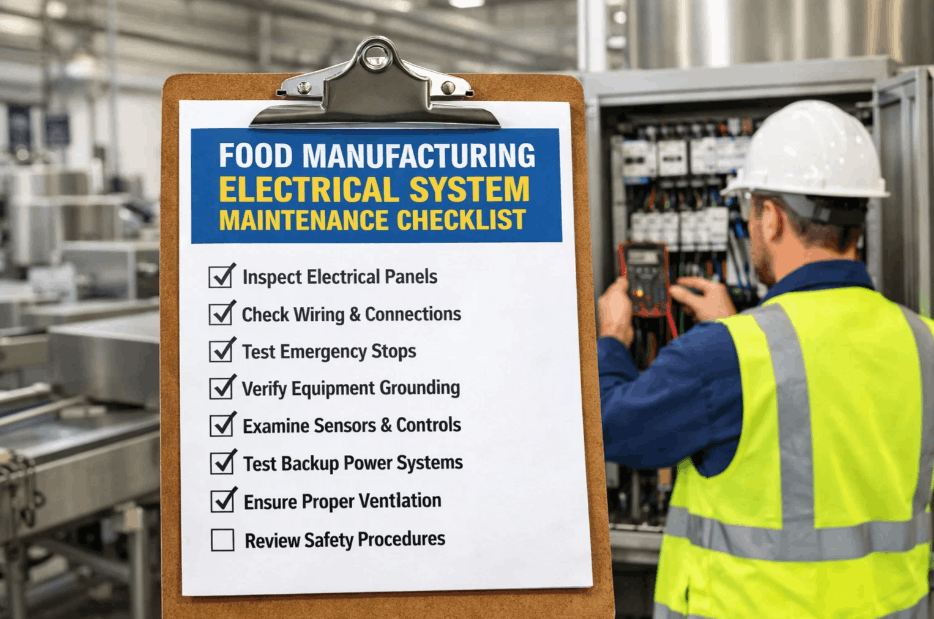
Food plant electrical failures are not maintenance inconveniences — they are food safety events. A single arc flash in a wet processing area, a tripped GFCI that halts a production line mid-cycle, or an IP69K-rated motor failure in a washdown zone does not just create downtime. It creates contamination risk, OSHA exposure, insurance liability, and in FSMA-regulated environments, documented production holds that require full traceability investigation before restart. For electrical maintenance managers, plant engineers, and operations leads in food manufacturing facilities across the USA, UK, Canada, Australia, UAE, and Germany, electrical system maintenance is inseparable from food safety management — and the facilities achieving both production excellence and regulatory compliance run structured, CMMS-managed electrical PM programs built for the unique demands of food manufacturing environments. start a free trial or book a demo to see how Oxmaint structures food plant electrical maintenance.
Electrical Maintenance That Keeps Your Plant Safe and Producing
Oxmaint gives food plant electrical teams automated PM scheduling for panels, motors, VFDs, and GFCI systems — with arc flash compliance documentation, thermal imaging trend tracking, and audit-ready records built into every work order.
Why Food Plant Electrical Maintenance Is Different from Standard Industrial Electrical Work
Standard industrial electrical maintenance manages one primary risk: equipment failure and production loss. Food plant electrical maintenance manages three simultaneous risks: equipment failure, worker safety (arc flash and electrocution), and food safety (contamination from electrical events). The combination of high-humidity washdown environments, product-contact proximity, continuous multi-shift operation, and stringent hygiene requirements creates an electrical maintenance challenge that standard industrial programs are not designed to address. start a free trial and configure your food plant electrical asset register in Oxmaint today.
Arc Flash Hazard in Wet Environments
Food plant switchgear and MCCs in areas subject to steam, humidity, and cleaning aerosols face accelerated insulation degradation that increases arc flash incident energy potential. NFPA 70E (USA), CSA Z462 (Canada), and BS 7671 (UK) require documented arc flash hazard analysis before any energized work — and CMMS-enforced work permits make compliance systematic.
Electrical Events as Contamination Sources
Arc flash events generate copper oxide particulates. Electrical fire suppression introduces contaminants. Motor bearing failures in food-contact zones cause mechanical contamination. In FSMA-regulated facilities, any electrical failure in or above a food-contact zone requires a documented contamination assessment — making maintenance records a food safety requirement, not just an operational one.
IP Rating Degradation in Washdown Zones
IP69K-rated equipment installed in high-pressure washdown zones loses its ingress protection rating when gaskets degrade, cable glands loosen, or enclosure seals deteriorate — typically within 2–4 years without scheduled inspection and maintenance. An IP rating that no longer represents actual equipment condition is a silent failure that washdown water exploits during every cleaning event.
GFCI and RCD Testing Gaps
Ground fault circuit interrupters (USA/Canada) and residual current devices (UK/EU/Australia) in food plant wet areas require quarterly or monthly testing to verify trip function — but these tests are among the most commonly deferred electrical maintenance tasks in facility inspection records. An untested GFCI that has lost trip function creates both worker electrocution risk and OSHA exposure.
The 8 Electrical Asset Classes Requiring Structured PM in Food Plants
Main Switchgear and Distribution Boards
Thermal imaging quarterly, torque verification annually, insulation resistance testing per NEC/BS 7671 schedule. Switchgear in humid processing areas requires moisture-resistant enclosure integrity checks at each inspection.
Motor Control Centers (MCCs)
Quarterly thermal scanning of all MCC sections under load. Annual bus bar torque verification. Contactor contact gap measurement and replacement per OEM wear limits. Drawer unit seal and IP rating verification in washdown zones.
Three-Phase Process Motors
Monthly vibration readings and insulation resistance testing annually per IEEE 43. NSF H1-rated bearing lubrication at OEM intervals. Food-grade motor seals in direct product contact zones require quarterly inspection and replacement on condition.
Variable Frequency Drives (VFDs)
Quarterly cooling fan and heat sink cleaning. Annual capacitor health check via drive diagnostics. Control board contamination inspection for food plant aerosol ingress. Parameter backup after every configuration change — critical for same-day restart after drive failure.
GFCI and RCD Protection Devices
Monthly functional test — press test button, verify trip and reset. Annual calibration test with certified test equipment. Maintain test records per device location for OSHA inspection and electrical maintenance audit. Replace any device failing trip test immediately.
IP69K Enclosures and Junction Boxes
Quarterly gasket, cable gland, and door latch inspection in washdown zones. Replace degraded gaskets immediately — IP69K integrity is binary. Annual IP rating verification against original installation specification. Replace enclosures that can no longer meet original IP rating requirements.
Earthing and Bonding Systems
Annual earth resistance testing per BS 7430 (UK), NEC Article 250 (USA), and equivalent frameworks. Bond continuity testing for all stainless steel processing vessels and conveyors — static discharge in powder and particulate processing areas is an ignition risk requiring documented earth program maintenance.
Emergency Lighting and Safety Systems
Monthly lamp and battery function test. Annual full-duration discharge test per BS 5266 (UK) or NFPA 101 (USA). Emergency lighting failures during a plant evacuation event are immediately actionable under OSHA and Building Regulations — making documented test records essential for compliance.
Arc Flash Safety Compliance Across Markets
Arc flash hazard analysis required for all electrical equipment where energized work may occur. PPE selection based on incident energy calculations. Energized work permit mandatory inside restricted approach boundary. Annual review of arc flash labels required.
All electrical systems must be safe and maintained so as to prevent danger. Periodic inspection and testing (EICR) required at defined intervals. Duty holders must demonstrate that maintenance programs include documented inspection and test records for all electrical systems.
Electrical installations must comply with wiring rules and be maintained to prevent hazard. Test and inspection requirements for switchboards, RCDs, and earth systems in commercial and industrial environments. High labor costs in Australia make preventive electrical maintenance ROI particularly compelling.
DGUV Regulation 3 mandates regular testing of electrical equipment at risk-based intervals — typically annually for portable equipment and every four years for fixed installations. Documentation of test results per equipment item is mandatory and subject to regulatory inspection.
How Oxmaint Manages Food Plant Electrical Maintenance
Oxmaint registers every electrical asset — from individual motors and GFCI outlets to switchgear sections and VFD arrays — and connects them to automated PM schedules, compliance documentation workflows, and condition-based alerting via IoT sensor integration. book a demo to see the electrical maintenance platform in detail.
Arc Flash Work Permit Workflows
Energized electrical work orders in Oxmaint include mandatory arc flash boundary confirmation, PPE selection documentation, and supervisor authorization fields — making NFPA 70E compliance procedurally automatic for every energized task.
Quarterly Panel Inspection Scheduling
Thermal imaging inspection work orders schedule quarterly panel scans — with photo attachment fields for hotspot documentation, severity classification, and trend comparison against previous scans captured in the panel asset record.
Monthly Test Work Orders Per Device
Every GFCI outlet and RCD is registered as an asset in Oxmaint with monthly functional test work orders. Failed test results automatically generate corrective action tasks with immediate priority — creating the documented response that OSHA inspectors require.
Vibration and Insulation PM
Monthly vibration work orders and annual insulation resistance testing scheduled per motor asset — with IEEE 43 baseline values stored in the record and automatic alerts when vibration or insulation readings trend beyond acceptable thresholds.
Washdown Zone Enclosure Inspection
Quarterly enclosure inspection work orders for all IP69K assets in washdown zones — with gasket condition, cable gland torque, and door seal check fields. Degraded gaskets trigger replacement work orders before washdown moisture ingress causes electrical failure.
Multi-Standard Documentation Management
Configure electrical maintenance documentation requirements per site — NFPA 70E for USA, Electricity at Work for UK, DGUV Reg 3 for Germany — within the same Oxmaint platform, with site-specific compliance requirements and audit export formats.
Reactive vs. Structured: Electrical Maintenance in Food Plants
Electrical Maintenance ROI for Food Plants
Frequently Asked Questions
What arc flash documentation does NFPA 70E require in food manufacturing?
NFPA 70E requires facilities to perform an arc flash hazard analysis for all electrical equipment where employees may perform work while energized — documenting incident energy levels, arc flash boundaries, and required PPE for each equipment location. This analysis must be reviewed every five years or whenever a major modification occurs. Energized Electrical Work Permits must be completed before any work inside the restricted approach boundary — documenting the justification for energized work, the PPE to be used, and supervisor authorization. CMMS platforms can embed the permit fields directly into electrical work orders, making NFPA 70E compliance procedurally mandatory for every energized task.
What IP rating is required for electrical equipment in food plant washdown zones?
IP69K is the minimum rating recommended for electrical equipment in high-pressure, high-temperature washdown zones — such as those found in meat processing, dairy, and ready-meal facilities. IP69K certification means the enclosure withstands 80°C water at 80–100 bar pressure from any direction when tested per DIN 40050 Part 9. However, IP ratings are initial installation ratings — gasket degradation, cable gland wear, and hinge seal deterioration can reduce effective protection long before the enclosure visibly fails. Scheduled quarterly inspection of all food plant electrical enclosures in washdown zones is industry best practice, with replacement of degraded sealing components before integrity is compromised.
How often should GFCI outlets be tested in a food manufacturing facility?
OSHA and NFPA recommendations, along with most food plant electrical safety programs, call for monthly functional testing of all GFCI outlets in wet process areas — pressing the test button to verify trip function and the reset button to verify restoration. Annual calibration testing with certified test equipment verifies trip current thresholds. All test results must be recorded at the device level, with the date, tester identity, and result captured in a system retrievable for OSHA inspection. A CMMS that generates monthly GFCI test work orders per device and records results in the asset record is the most reliable mechanism for maintaining both the testing discipline and the documentation trail that OSHA requires.
Can Oxmaint manage electrical maintenance compliance across different global regulatory frameworks?
Yes. Oxmaint allows site-specific configuration of electrical maintenance standards — so a food manufacturer operating plants in the USA, UK, and Germany can configure NFPA 70E permit workflows for the US facility, Electricity at Work Regulations inspection schedules for the UK plant, and DGUV Regulation 3 test interval requirements for the German operation — all within the same platform. Each facility's electrical maintenance records are maintained independently with the appropriate regulatory documentation fields, while portfolio-level reporting provides management oversight of compliance status across all sites simultaneously.
Electrical Safety and Production Uptime Are Not Trade-Offs. Oxmaint Delivers Both.
Food plant electrical teams across the USA, UK, Germany, Australia, and UAE use Oxmaint to maintain arc flash compliance, thermal imaging programs, GFCI documentation, and motor PM schedules — all from one mobile-first platform that makes every electrical maintenance task traceable, scheduled, and audit-ready.