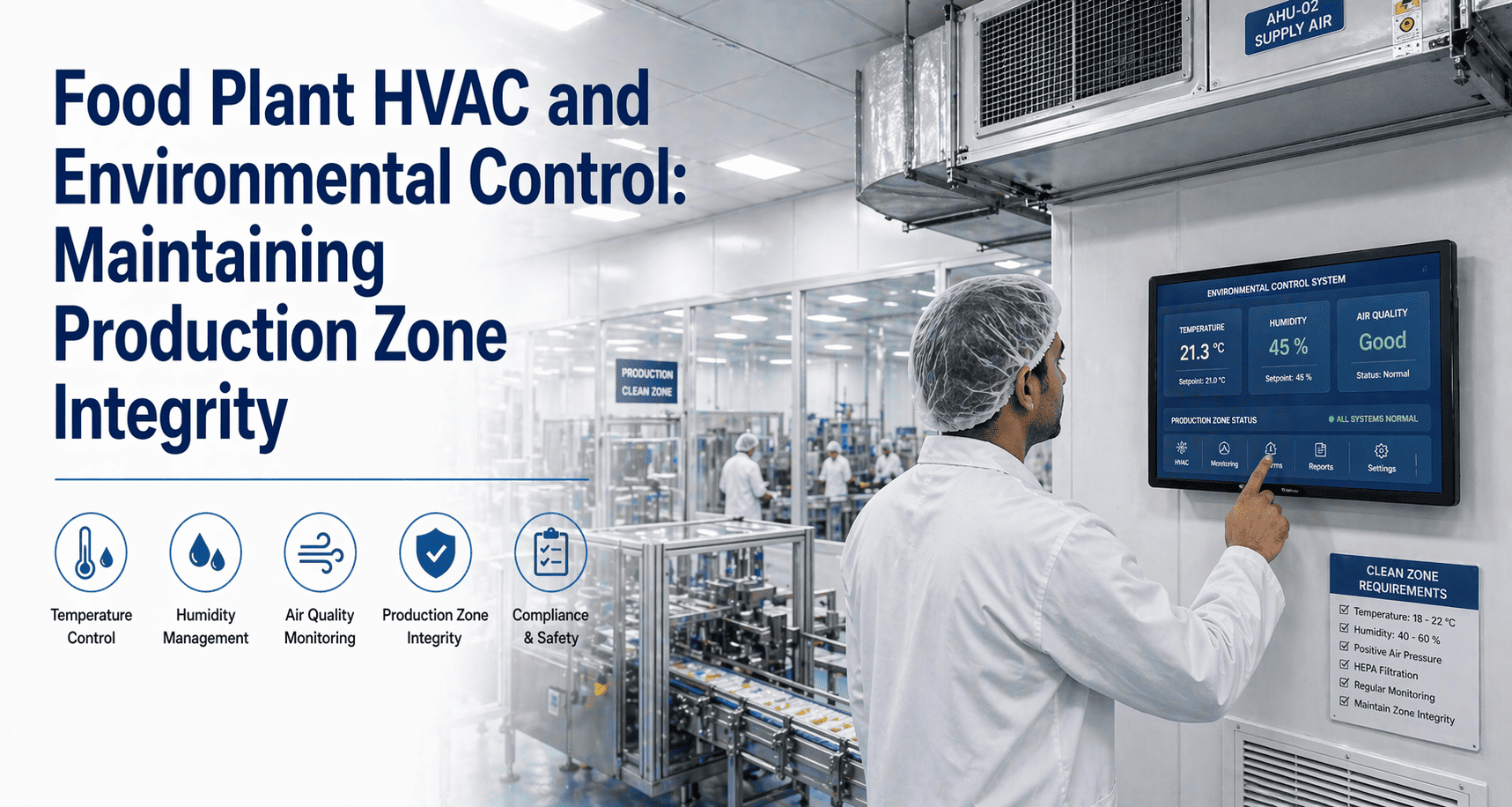
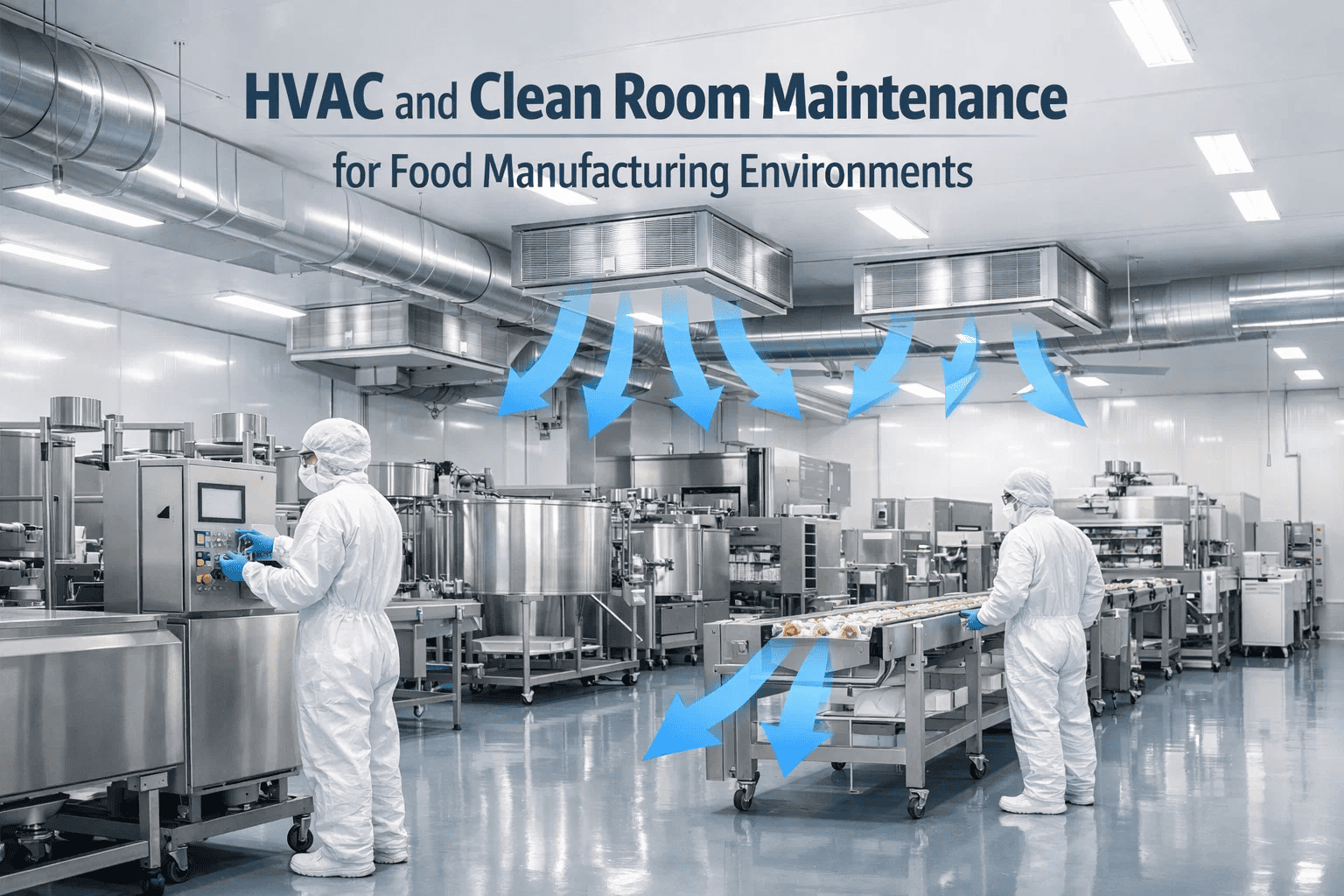
Food plant HVAC maintenance is one of the most overlooked — and highest-risk — operational disciplines in food manufacturing. A poorly maintained air handling system is not just an energy drain; it is a direct threat to product safety, regulatory compliance, and production continuity. Facilities engineers across the US, UK, Canada, Germany, and the UAE are under mounting pressure to keep HVAC systems performing at specification while managing tighter maintenance budgets and increasingly complex certification requirements. Sign Up Free to see how OxMaint helps food plants take full control of HVAC maintenance scheduling and compliance tracking.
Centralize Your Food Plant HVAC Maintenance — From Air Handling to Dust Collection
OxMaint's CMMS platform automates HVAC PM schedules, tracks filter replacements, monitors positive pressure differentials, and stores audit-ready documentation across every zone in your food facility.
What Is Food Plant HVAC Maintenance — and Why Does It Matter?
HVAC maintenance in food manufacturing encompasses the scheduled upkeep, inspection, and repair of air handling units (AHUs), duct networks, filtration systems, dust collectors, exhaust systems, and building pressurization controls. Unlike commercial HVAC, food plant air systems directly affect product integrity, allergen segregation, microbial risk, and regulatory audit outcomes.
Regulators under FSMA, BRC Global Standard, IFS Food, and SQF treat HVAC maintenance as a food safety control — not a facilities function. Facilities engineers who treat air handling as a background utility rather than a critical control point routinely encounter non-conformances, product contamination events, and costly corrective action programs that could have been prevented with disciplined preventive maintenance.
Why HVAC Failures Carry Disproportionate Risk in Food Manufacturing
The consequences of HVAC neglect in food plants are not gradual — they are sudden and severe. A failed positive pressure differential allows unfiltered external air to infiltrate processing zones. A saturated HEPA filter in a ready-to-eat area becomes a microbial reservoir. A clogged dust collector in a flour or spice handling area creates an explosive concentration risk.
For facilities engineers managing multi-zone plants in Canada and the UAE — where climate extremes compound humidity and temperature control challenges — HVAC system reliability is foundational to every other production control. A structured maintenance program backed by a CMMS platform is the only reliable way to keep these systems performing between audits, not just during them.
Air Handling Unit (AHU) Maintenance: The Core of Food Plant Air Quality
Air handling units are the primary mechanism for delivering conditioned, filtered air to food processing zones. In high-care and high-risk areas, AHUs must maintain precise temperature bands, humidity levels, and particulate filtration standards simultaneously. Any degradation in AHU performance cascades directly into product zone conditions.
Filter Bank Inspection and Replacement
Pre-filters, intermediate filters, and final HEPA or ULPA stages must be inspected on defined cycles — not simply changed on calendar intervals regardless of actual loading. Differential pressure gauges across each filter stage should be logged at every PM visit. Pressure drop thresholds must be set in your CMMS to trigger replacement work orders automatically before filters become barriers to airflow or microbial growth sites.
Coil Cleaning and Inspection
Cooling and heating coils accumulate bio-film, scale, and particulate buildup that reduces heat transfer efficiency and creates microbial colonization risk. In food plants, coil cleaning must use food-safe, certification-compliant chemicals — not general commercial HVAC degreasers. Cleaning records must document chemical identity, concentration, contact time, and rinse verification for FSMA and BRC audit readiness.
Fan and Motor Servicing
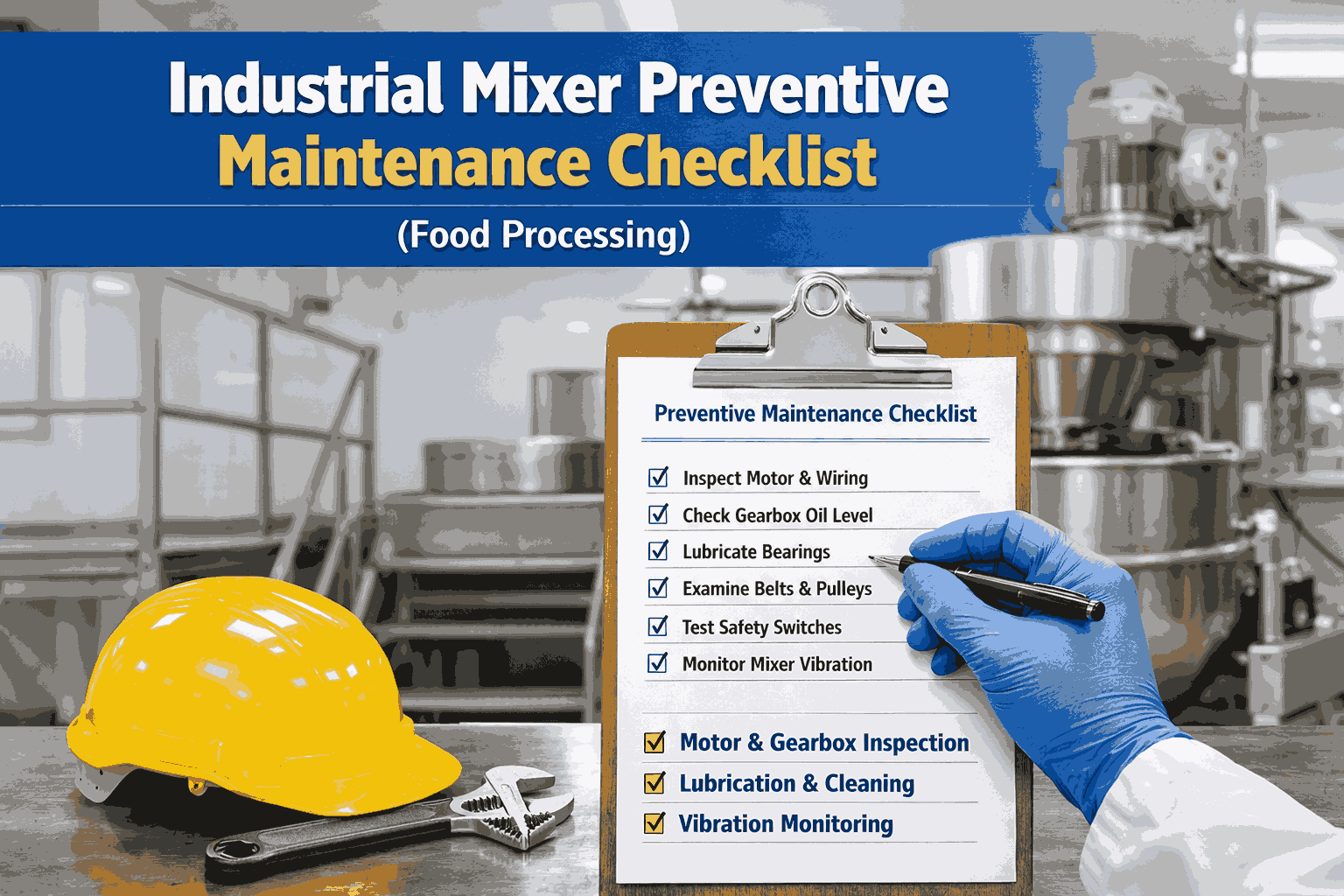
Supply and return fan assemblies require bearing lubrication, belt tension checks, vibration analysis, and drive alignment on scheduled intervals. Fan imbalance is a leading cause of premature motor failure and is detectable well before catastrophic breakdown through vibration trending — a condition monitoring practice that pairs directly with predictive maintenance tools in a CMMS environment.
Damper and Actuator Verification
Modulating dampers controlling zone airflow, outside air intake, and recirculation ratios must be functionally tested to confirm full travel, calibrated position feedback, and actuator torque sufficiency. Failed dampers that hold fixed positions — common in aging plants — create uncontrolled airflow imbalances that undermine positive pressure schemes and allergen segregation strategies.
Positive Pressure Management: The Invisible Contamination Barrier
Positive pressure differential — maintaining higher air pressure inside controlled processing zones than in adjacent areas — is the primary engineering control that prevents unfiltered external air, pests, and airborne contaminants from migrating into product contact environments. It is also one of the most frequently misconfigured and poorly maintained controls in food plants.
Facilities engineers in Germany and UK food plants operating under IFS or BRC certification are required to demonstrate that positive pressure differentials are actively monitored and maintained within specification — not simply assumed to be functioning because the HVAC system is running. Book a Demo to see how OxMaint automates differential pressure logging and triggers corrective work orders in real time.
Define Pressure Differential Specifications by Zone
High-care zones require minimum 10–15 Pa positive differential relative to adjacent lower-care areas. High-risk ready-to-eat zones may require 15–25 Pa depending on product and certification standard. These specifications must be documented in equipment records — not held in institutional memory — and linked to CMMS alarm thresholds for automated monitoring response.
Continuous Monitoring vs. Periodic Verification
Best practice in Canadian and UAE facilities with high ambient temperature and humidity variability is continuous electronic differential pressure monitoring with data logging — not manual checks once per shift. Continuous monitoring catches pressure losses from door seal failures, filter loading, and fan performance degradation before product exposure windows open. Logged data also satisfies audit requirements without additional manual record-keeping burden.
Door and Penetration Seal Integrity
Positive pressure schemes fail at perimeter penetrations — door seals, duct penetrations, cable entries, and equipment pass-throughs. Seal inspection must be a formal PM task in CMMS, not an informal walkdown. Replacing a $40 door sweep on schedule prevents the pressure failures that generate $40,000 audit corrective action programs — a straightforward ROI calculation that justifies proactive seal inspection programs.
Air Balance Verification Intervals
Full air balance testing — measuring supply, return, and exhaust airflow volumes to verify zone pressure relationships — should be conducted annually at minimum, and after any significant HVAC modification, building renovation, or production layout change. Air balance reports must be retained in the maintenance record system and linked to the relevant equipment assets in CMMS for audit retrieval.
Dust Collection System Maintenance in Food Processing
Dust collection is a life-safety and food safety system simultaneously. In flour milling, sugar handling, spice processing, and dry ingredient manufacturing, accumulated dust creates explosive concentrations at very low threshold levels. ATEX and NFPA 652/654 compliance — mandatory in EU and US facilities respectively — depends entirely on dust collection systems that are maintained to specification.
Temperature and Humidity Control: Maintaining Product Integrity Across Zones
Food processing plants require precise, zone-differentiated temperature and humidity control — not simply general comfort cooling. Chilled ready-to-eat zones, ambient dry ingredient areas, chocolate tempering environments, and bakery proofing rooms each have fundamentally different HVAC requirements that must be maintained independently and verified continuously.
Facilities teams in UAE and Canada face particular challenges from extreme ambient conditions — desert heat and humidity in the Gulf, extreme cold and humidity swings across Canadian seasons — that place significantly higher demand on HVAC system components than temperate European or US climates. CMMS-driven maintenance programs that adjust PM frequency seasonally are demonstrably more effective in these markets than fixed annual schedules.
| Processing Zone Type | Typical Temperature Range | Humidity Requirement | Key HVAC Maintenance Focus | Regulatory Reference |
|---|---|---|---|---|
| High-Care Ready-to-Eat | 2–8°C | <70% RH | HEPA filter integrity, positive pressure verification, coil bio-film control | BRC Global Standard, SQF |
| Ambient Dry Ingredient | 15–21°C | <55% RH | Dust collector PM, humidity sensor calibration, damper verification | FSMA, IFS Food |
| Thermal Processing | Zone-dependent | Process-specific | Exhaust capacity, make-up air balance, ventilation rate verification | OSHA, local building codes |
| Bakery / Proofing | 27–35°C | 75–85% RH | Humidity control valve PM, condensate drainage, AHU coil inspection | SQF, BRCGS |
| Cold Store / Freezer | -25°C to 4°C | Controlled | Defrost cycle verification, evaporator coil cleaning, door seal inspection | FSMA, EU Reg 852/2004 |
| Packaging and Dispatch | 15–22°C | <65% RH | Filter replacement, airflow balance, dust control verification | BRC, IFS, FSMA |
Allergen Segregation Through HVAC Design and Maintenance
Airborne allergen transfer is a documented and legally consequential food safety risk. Facilities processing nuts, gluten-containing grains, dairy, or shellfish in proximity to free-from or allergen-controlled production areas must demonstrate that HVAC systems do not create cross-contamination pathways through shared air handling or duct systems.
Allergen risk assessment for HVAC must be a documented procedure — not an informal assumption. In UK and German facilities where consumer allergen legislation is stringently enforced, demonstrating that allergen-containing dusts cannot migrate via air handling into free-from zones requires air balance data, filter efficiency evidence, and pressure differential records. Get Started Free to build an allergen-aware HVAC maintenance program in OxMaint with zone-level documentation and compliance tracking.
How AI Vision Enhances Food Plant HVAC Maintenance
AI Vision — the application of computer vision and machine learning to inspection data — is transforming how facilities engineers monitor HVAC system condition between scheduled maintenance visits. For food plants managing large, distributed air handling infrastructure, AI Vision provides a continuous, objective condition assessment layer that traditional scheduled inspection alone cannot deliver.
CMMS Integration for HVAC Maintenance Governance
A Computerized Maintenance Management System is the operational backbone of any food plant HVAC maintenance program that must be both consistently executed and audit-ready. Without CMMS-managed scheduling, documentation, and cost tracking, HVAC maintenance reverts to reactive patterns — filters changed when someone notices airflow problems, coils cleaned when an audit is imminent, records assembled from memory under auditor pressure.
A purpose-built CMMS maintenance management tool gives facilities engineers structured control over every HVAC maintenance task across every system in their facility — with automatic PM scheduling, work order generation, documentation capture, and compliance reporting built into the workflow.
Automated PM Schedule Generation
CMMS generates HVAC PM work orders automatically based on calendar frequency, run hours, or condition triggers — ensuring filter changes, coil cleaning, fan servicing, and pressure verification tasks are never missed through production pressure or staffing gaps. Schedule adherence is tracked and reportable for audit purposes.
Zone-Level Equipment Hierarchy
CMMS links every AHU, dust collector, exhaust fan, and damper assembly to the processing zone it serves — enabling zone-based maintenance history retrieval during audits. When a BRC auditor asks for the maintenance records for the high-care area AHU, CMMS delivers them in seconds rather than hours of manual filing search.
Contractor and Vendor Work Order Management
Specialist HVAC contractors, air balance engineers, and dust collector service providers can be assigned work orders directly within CMMS — with SLA tracking, documentation requirements, and invoice matching built into the workflow. This eliminates the disconnect between vendor-completed work and internal maintenance records that creates audit exposure.
Parts and Consumables Inventory Tracking
CMMS tracks HVAC filter stock, belt inventory, lubricant supplies, and sensor spares against minimum reorder levels — preventing the scenario where a PM-triggered filter change cannot proceed because filter stock has run out. For Canadian facilities managing long supply chains for specialist HEPA media, inventory automation is operationally critical.
Benefits and ROI of a Structured Food Plant HVAC Maintenance Program
The business case for investing in structured HVAC maintenance management — supported by CMMS automation and AI Vision monitoring — is measurable across food safety performance, energy efficiency, equipment longevity, and regulatory audit outcomes. Facilities engineers who can quantify these returns are far better positioned to secure maintenance budget approvals from operations and finance leadership.
Common HVAC Maintenance Challenges in Food Plants — and How to Solve Them
HVAC Access During Live Production
Mechanical rooms and AHU access points are frequently inaccessible during production runs due to proximity to food zones, GMP access controls, and hygiene transition requirements. Solution: integrate HVAC PM scheduling into CMMS production planning visibility — scheduling maintenance tasks automatically into sanitation stops, planned downtime, and line changeover windows rather than requiring manual coordination between maintenance and production teams.
Inconsistent Filter Change Records
Filter replacement records are among the most commonly missing or inconsistent maintenance documents found during food safety audits. Solution: make work order closure — with photo evidence and part lot number recording — a mandatory step before the CMMS marks a PM complete. CMMS-enforced documentation standards eliminate the ad-hoc paper records that fail under audit scrutiny.
Dust Collector Performance Degradation Between PMs
Fixed-interval dust collector PM schedules do not account for throughput variation — a collector serviced on the correct calendar interval may have processed three times its expected dust load due to a production surge. Solution: implement run-hours-based and differential pressure-triggered PM scheduling in CMMS, so maintenance frequency scales with actual system demand rather than calendar time alone.
Specialist Contractor Dependency Without Oversight
Many food plants rely on specialist HVAC contractors for air balance testing, duct cleaning, and filter installation — but have no governance structure to verify that contracted work was performed to the required standard. Solution: require all contractor work orders to be completed and documented within CMMS before invoices are approved, with photo evidence and signed-off work reports retained in the equipment maintenance record.
Best Practices for Food Plant HVAC Maintenance Programs
Build a Zone-Based HVAC Asset Register
Every HVAC component — AHU, duct section, dust collector, exhaust fan, damper, sensor — should be registered in CMMS with its parent zone, criticality classification, PM requirements, and spare parts list. A structured asset hierarchy is the foundation of every effective HVAC maintenance program and the prerequisite for meaningful audit documentation.
Classify HVAC Assets by Food Safety Criticality
Not all HVAC equipment carries equal food safety risk. High-care zone AHUs and allergen boundary air handling systems warrant more frequent PM and more rigorous documentation than general ventilation systems. Criticality classification drives PM frequency allocation, spare parts stocking levels, and escalation response times when failures occur.
Implement Seasonal PM Frequency Adjustments
Food plants in Canada and the UAE should adjust HVAC PM frequencies seasonally — increasing filter change intervals during high-ambient dust periods, increasing dehumidification maintenance during peak humidity months, and prioritizing freeze protection PM tasks ahead of winter shutdowns. CMMS seasonal task templates enable this without manual planning overhead.
Conduct Annual Air Balance Verification
Annual third-party air balance testing verifies that zone pressure relationships, airflow volumes, and filtration efficiency are performing to design specification. Air balance reports must be stored in CMMS linked to the affected zone assets — creating a longitudinal record that demonstrates HVAC performance trend over time, not just at a single point-in-time audit snapshot.
The Strategic Case for Investing in Food Plant HVAC Maintenance Infrastructure
Facilities engineers who treat HVAC maintenance as a structured, data-driven discipline — rather than a reactive facilities function — build plants that perform better on audits, produce safer products, run at lower energy cost, and avoid the catastrophic consequences of air quality-related contamination events. The investment is in governance infrastructure: CMMS scheduling, AI Vision monitoring, structured documentation, and contractor oversight — not simply in more frequent maintenance visits.
Food plants across the US, UK, Canada, Germany, and UAE that build this infrastructure outperform peers on certification outcomes, energy benchmarks, and product safety records — because their HVAC systems are maintained by evidence and data, not by assumption and memory. Book a Demo to explore how OxMaint's CMMS tools work for food plant HVAC environments.
Ready to Build an Audit-Ready HVAC Maintenance Program for Your Food Plant?
OxMaint gives facilities engineers the CMMS infrastructure to manage AHU schedules, dust collector PMs, positive pressure monitoring, allergen segregation documentation, and contractor oversight — from a single platform, always audit-ready.
Frequently Asked Questions
How often should air handling units be serviced in food processing facilities?
AHU service frequency depends on zone criticality and throughput. High-care zone AHUs typically require quarterly inspections including filter differential pressure checks, coil inspection, fan belt verification, and damper function testing. Annual full service including coil chemical cleaning, air balance verification, and motor condition assessment is standard. CMMS-driven scheduling adjusts these intervals based on run hours and condition data rather than calendar time alone.
What positive pressure differential is required in food processing high-care areas?
Most BRC and SQF certification standards recommend a minimum 10 Pa positive differential between high-care zones and adjacent lower-care or ambient areas. High-risk ready-to-eat areas may require 15–25 Pa depending on the specific certification standard and risk assessment. Differentials must be continuously monitored with calibrated sensors and documented — not simply verified periodically by manual gauge reading.
How does dust collection maintenance relate to food safety compliance?
Dust collection systems serve dual functions in food plants — controlling airborne particulate that affects product quality and allergen segregation, and managing combustible dust concentrations that create explosion risk under NFPA 652/654 and ATEX regulations. Both functions require documented maintenance programs with inspection records, bag integrity verification, and explosion protection system testing retained in the facility maintenance record system.
Can a CMMS platform manage HVAC maintenance compliance documentation for food safety audits?
Yes — a purpose-built CMMS platform centralizes all HVAC maintenance records, links them to specific equipment assets and processing zones, and makes them instantly retrievable during audits. For BRC, SQF, IFS, and FSMA compliance programs, CMMS-managed HVAC records provide the complete, time-stamped maintenance history that auditors require — without the manual assembly process that creates documentation gaps and audit risk.
How does AI Vision improve HVAC maintenance outcomes in food manufacturing?
AI Vision provides continuous, objective condition assessment between scheduled HVAC maintenance visits — analyzing inspection photos to detect filter degradation, coil fouling, duct accumulation, and seal failures before they create food safety risk or equipment failure. It also verifies that PM tasks were physically completed by reviewing technician-submitted photo evidence, closing the gap between reported and verified maintenance execution.
What HVAC maintenance records are required for BRC and SQF food safety certification?
BRC and SQF auditors typically require evidence of: scheduled PM completion records for all HVAC equipment, filter change records with part identification and lot numbers, air balance test reports, positive pressure monitoring logs, coil cleaning records with chemical identity documentation, and contractor qualification records for any external HVAC service providers. All records must be linked to the specific equipment and accessible during unannounced audits.