A machine guard fails, a technician gets caught, and the line stops for the day. What happens in the next 48 hours decides whether that failure comes back in six months or gets shut down for good. Sign up to link every incident report, root cause, and corrective action directly to the asset and work order history behind it.
What This Guide Covers
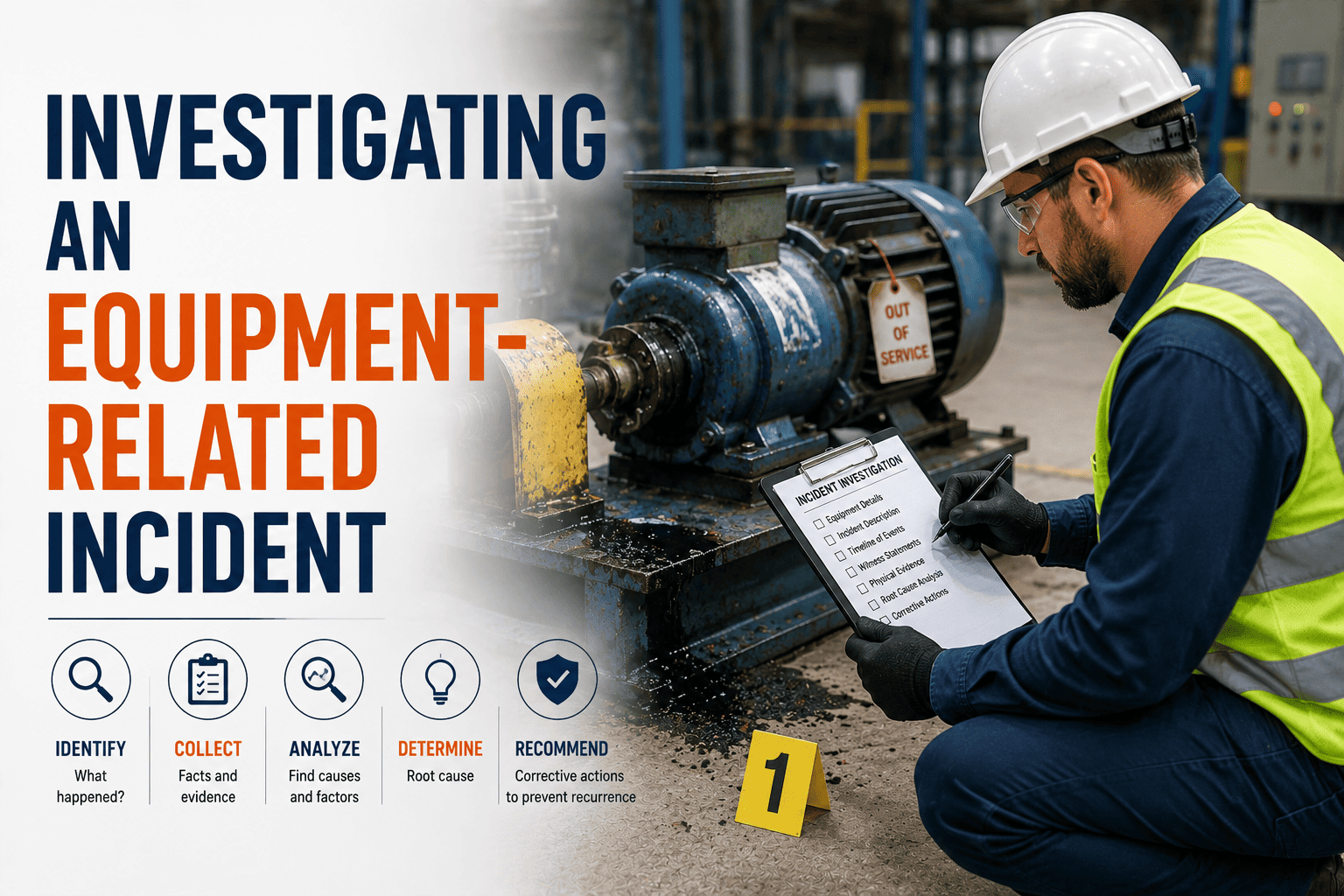
Investigating an equipment-related incident means preserving evidence before it disappears, running a root cause analysis that goes past "equipment failure," assigning corrective actions with real owners and deadlines, and keeping every one of those records tied to the asset in your CMMS.
The Two Directions An Investigation Can Take
| If The Investigation Stops Short |
If It Goes To Root Cause |
| "Equipment failure" gets written down and the work order is closed |
The failure mode is traced back to a missed PM, a worn part, or a training gap |
| Photos and statements are collected days later, after memory and evidence fade |
Evidence is locked in while the scene is still fresh, before the line restarts |
| A corrective action is noted but never assigned to anyone with a deadline |
Every corrective action has an owner, a due date, and a verification step |
| Same failure, same machine, six months later — no one remembers the first one |
The asset history shows the pattern before it becomes a third repeat incident |
Running The Investigation In 5 Steps
1
Secure The Scene And Preserve Evidence
Photograph the equipment, tag the failed part, and pull sensor or fault data before the line is reset or the part is replaced
2
Collect Statements While Memory Is Fresh
Talk to the operator and anyone nearby the same shift, separately, before accounts start blending together
3
Push Past "Equipment Failure" With RCA
Use 5 Whys or a fishbone breakdown to separate the failure mode from the real root cause — a part, a process, or a person
4
Assign The Corrective Action, Not Just Note It
Every fix gets a named owner and a due date, tied to the work order that triggered it
5
Verify The Fix Actually Held
Close the loop with a follow-up check instead of assuming the corrective action worked because the work order says "complete"
Investigation Records That Hold Up Later
OxMaint links every incident, RCA, and corrective action to the exact asset and work order behind it, so nothing gets lost to turnover or production pressure. Sign up for a free trial to start logging investigations against real asset history, or book a demo to see the full incident workflow.
What CMMS-Linked Investigation Adds
Evidence Attached To The Asset
Photos, statements, and sensor logs sit directly on the equipment record, not scattered across email
RCA That Won't Get Skipped
A built-in root cause step means the investigation can't close as just "equipment failure"
Corrective Actions With Owners
Every action item is assigned, dated, and tracked until it's verified closed
Recurring Failure Alerts
Asset history flags a repeat failure mode before it becomes a third incident
Why Turnover Is The Real Threat To Discipline
A thorough investigation process on paper means nothing if it depends on one experienced supervisor remembering the steps. When that person moves on, or the line is down and production is pushing to restart, investigation discipline is the first thing to slip — unless the process itself, not a person's memory, is what's holding it together.
Frequently Asked Questions
Q
How fast should an equipment incident investigation start?
As close to immediately as safety allows. Evidence like fault codes, part condition, and eyewitness memory all degrade fast, and the first hours after an incident are when the most accurate information is still available.
Q
Is "equipment failure" an acceptable root cause?
No. It describes what happened, not why. A real root cause traces the failure back to a specific missed PM, a worn component past its service interval, an unclear procedure, or a training gap.
Q
Who should own the corrective action once it's identified?
A named individual, not a department. Corrective actions assigned to "maintenance" in general tend to sit open indefinitely, while actions tied to one owner and one deadline get verified and closed.
Make Every Investigation Count
OxMaint keeps incident evidence, root cause analysis, and corrective action tracking tied directly to the asset, so nothing depends on one person's memory. Sign up for a free trial to start building a defensible investigation record today, or book a demo to see it mapped to your equipment.