The receiving dock is where food safety is won or lost before a single ingredient touches your production line. Every rejected delivery accepted, every temperature deviation overlooked, and every dock door left unsealed is a preventable contamination event, a regulatory violation, or a HACCP critical limit breach that your facility will have to account for — to an FDA inspector, a GFSI auditor, or a plaintiff's attorney. Yet receiving docks remain among the most documentation-deficient areas in food manufacturing: surveys of GFSI-certified facilities consistently find that incoming product temperature verification, supplier compliance documentation, and dock equipment PM records are among the top five audit deficiencies, appearing in 34% of major non-conformances identified during annual surveillance audits. The cost of a single mis-accepted incoming load that reaches production is not the cost of one recall — it is the cost of the recall plus three months of customer confidence erosion plus the regulatory scrutiny that follows every FDA Form 483 observation in your facility's history. Structured, digital receiving dock inspection is not paperwork — it is your first and most cost-effective food safety control — start a free trial to deploy Oxmaint's receiving dock inspection workflow at your facility today, or book a demo and we will build your incoming inspection checklist together.
Identify your receiving dock compliance gaps and close them before your next GFSI surveillance audit or FDA inspection.
- Real-time incoming product temperature verification with auto-escalation on deviations
- Supplier verification and vehicle cleanliness inspection with digital sign-off
- Dock equipment PM scheduling for levellers, doors, and refrigerated staging areas
What Is a Food Plant Receiving Dock Inspection?
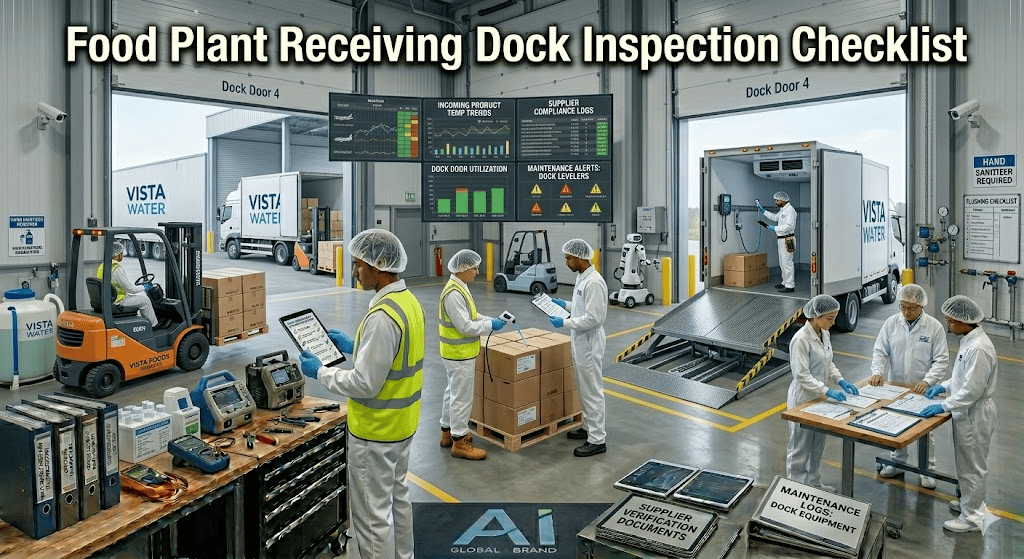
A food plant receiving dock inspection is the structured, documented process of verifying incoming products, delivery vehicles, supplier documentation, and dock infrastructure at the point of receipt — before any incoming material enters the facility or is approved for use in production. It is both a food safety control and a preventive maintenance activity: a food safety control because incoming temperature verification, vehicle cleanliness, and supplier certificate review are HACCP prerequisite programme requirements under FSMA, CODEX, and all GFSI schemes; and a maintenance activity because dock doors, dock levellers, refrigerated staging areas, and receiving equipment require scheduled inspection and servicing to remain functional.
Under FDA FSMA 21 CFR Part 117 Subpart G, food manufacturers must establish supplier verification activities for each raw material and ingredient that is a significant hazard identified in the facility's hazard analysis. Incoming temperature verification is specifically listed as an acceptable verification activity for temperature-controlled ingredients. GFSI-recognised standards (SQF Code 2.4, BRC Issue 9 clause 3.5, IFS Food Version 7 section 4.5) require documented receiving procedures covering temperature checks, label verification, vehicle condition assessment, and supplier documentation review — start a free trial to implement FSMA and GFSI-aligned receiving procedures in Oxmaint with zero paper.
The receiving dock is also one of the highest physical-risk zones in a food manufacturing facility from a maintenance perspective. Dock levellers take the full impact load of loaded forklifts (15,000–30,000 lb) hundreds of times per day. Dock seals and shelters protect temperature-controlled products from ambient air infiltration during loading and unloading. Dock doors and dock lights operate in harsh conditions — temperature cycling, vehicle impact, moisture, and high-cycle frequency. Without scheduled PM, these assets fail in ways that directly compromise food safety: a failed dock seal allows ambient air (and pests) into the temperature-controlled receiving area; a stuck dock leveller causes manual handling injuries; a failed dock door lock creates a facility security breach.
Receiving Dock Inspection and Compliance Framework
Product temperature checked at point of receipt with calibrated probe thermometer. Results logged against category-specific limits. Deviations trigger hold and notification before acceptance decision.
Vehicle interior condition, odour, pest evidence, temperature recorder download, and cross-contamination risk from previous loads assessed and documented for every refrigerated and frozen delivery.
Certificate of Analysis, Certificate of Conformance, country of origin, allergen declaration, and GFSI certification currency verified against approved supplier specifications on every delivery.
Dock door seal integrity, weather strip condition, door panel damage, lock function, and pest exclusion effectiveness inspected on daily and weekly PM schedules to prevent air infiltration and pest ingress.
Hydraulic leveller lip extension, safety leg function, dock board condition, and working load limit compliance verified on scheduled PM intervals. Safety leg failures cause the leading category of dock worker injury.
Dock area cleaning verification, pest station inspection, drain condition, and bird and rodent exclusion measures audited daily. Receiving docks are the highest-risk pest entry point in most food facilities.
Temperature of refrigerated receiving staging areas logged every 2 hours; door cycle frequency tracked; staging time limits enforced to prevent cold chain breaks between truck unloading and cold store transfer.
Formal hold tags and electronic records for any delivery placed on hold for temperature deviation, documentation failure, or vehicle condition concerns — with disposition (accept, reject, rework) documented by an authorised person.
Receiving Dock Compliance Pain Points
When receiving is busy and a temperature check is skipped, the easiest response is a blank space in the log or a best-estimate entry written after the delivery truck has left. Both are audit findings: a blank is an undocumented control, and an entry without a matching timestamp is evidence of record falsification — one of the few violations that triggers FDA enforcement action beyond a 483 observation.
Dock levellers, dock doors, and refrigerated staging areas don't fail on a convenient schedule. They fail at 6 AM on a Monday when the first three refrigerated trucks of the week are queued outside. A dock leveller failure that stops unloading for 4 hours costs $2,400 in driver wait time, $800 in emergency repair, and $3,200 in production schedule disruption — all of which a quarterly PM inspection costing $180 would have prevented.
Approved Supplier Lists maintained in spreadsheets, Certificate of Analysis files stored in email inboxes, and allergen declarations logged in paper binders create verification backlogs where receiving staff accept deliveries without confirming current GFSI certification or allergen status. GFSI auditors review supplier documentation compliance as a scored element — facilities with more than 10% of incoming deliveries lacking verified supplier status face major non-conformances. Book a demo to see how Oxmaint integrates supplier verification into every receiving work order.
When a customer complaint triggers a forward-trace investigation, you need to know which incoming lot of ingredient X was used in production batch Y within 4 hours. Without a digital receiving record linked to production documentation, that trace takes days — during which finished product that may be implicated stays on retail shelves and in consumer homes.
How Oxmaint Solves Food Plant Receiving Dock Compliance
Deploy mobile receiving checklists that require a timestamped temperature reading, vehicle condition rating, and supplier document verification before any delivery can be accepted or rejected in the system. No skipped checks, no backdated entries, no paper gaps.
When an incoming reading exceeds the category limit, Oxmaint immediately places the delivery on automated hold, notifies the QA manager, and creates a disposition work order — preventing automatic acceptance of out-of-spec product while the hold review is completed.
Schedule quarterly dock leveller hydraulic checks, monthly door seal and weather strip inspections, and daily pest exclusion audits. Work orders auto-generate and assign to the right technician — dock equipment PM compliance reaches 94% vs. 42% on manual systems.
Link each incoming inspection to your Approved Supplier List in Oxmaint. Expired GFSI certifications, missing CoAs, or allergen declaration mismatches automatically flag on the receiving work order — stopping the acceptance of non-compliant deliveries before they enter the facility.
Every incoming inspection creates a traceable lot record linking supplier, vehicle, delivery date, temperature at receipt, document status, and acceptance decision — available for forward or backward trace within seconds of a quality event or customer complaint.
Generate complete GFSI or FDA receiving records — covering every incoming inspection, temperature log, hold and release decision, and supplier verification for any date range — in under 10 minutes. Start a free trial to see how fast Oxmaint generates your receiving audit documentation pack.
Reactive vs. Planned: Food Plant Receiving Dock Comparison
| Receiving Dock Area | Reactive Approach | Planned Oxmaint Approach |
|---|---|---|
| Temperature Verification | Paper log; checks skipped when busy; backdated entries common; temperature deviations accepted without formal hold | Digital timestamped entry mandatory before acceptance; deviations auto-create hold and escalate to QA before product moves |
| Supplier Documentation | CoAs stored in email; GFSI certifications not verified against expiry; allergen status checked informally | Supplier verification integrated into receiving workflow; expired documents auto-flag; allergen declarations compared against specs |
| Dock Leveller PM | Serviced only after failure; safety leg failure causes workplace injury; hydraulic failure stops receiving for 4+ hours | Quarterly hydraulic PM; safety leg function test every 90 days; failures predicted and scheduled before they affect operations |
| Dock Door and Seal | Damaged seals unnoticed until pest ingress or temperature complaint; door damage creates facility security gap | Monthly seal and weather strip inspection; damage creates immediate corrective work order before pest or temperature compromise |
| Pest Exclusion Audit | Pest station checked only during pest control contractor visit; dock area hygiene audited at annual GFSI audit only | Daily dock hygiene and pest station check with timestamped mobile sign-off; evidence available for every day of the year |
| Traceability Records | Paper receiving logs stored in binders; forward trace takes days; recall investigation compromised by incomplete records | Digital lot records link supplier, date, temperature, and disposition; forward or backward trace completed within minutes |
ROI and Compliance Results from Digital Receiving Dock Management
Receiving Dock Inspection: Frequently Asked Questions
What temperature limits apply to incoming refrigerated and frozen food products?
What supplier documentation should be verified at the receiving dock?
How often should dock levellers and dock doors receive preventive maintenance?
What makes a food plant receiving dock inspection record legally defensible?
Stop Letting Receiving Dock Documentation Gaps Become Recall Investigations
Turn every incoming temperature check, supplier verification, and dock equipment inspection into a timestamped, GFSI-ready record with Oxmaint — and eliminate the documentation vulnerabilities that convert temperature deviations into regulatory events.
- Real-time temperature verification with automatic hold and escalation on deviations
- Supplier documentation verification integrated into every receiving workflow
- Dock equipment PM scheduling with condition-based triggers and compliance tracking