When your production line stops, the clock starts ticking — and most food plants are losing far more time than they realize before a technician even touches the machine. The breakdown itself is rarely the biggest problem. It is everything that happens between the moment a machine fails and the moment someone starts fixing it: the missed alert, the unreachable technician, the missing work order, the wrong spare part. That gap is where your production schedule dies. Sign up for Oxmaint to see exactly how AI-driven workflow automation compresses every phase of your MTTR — and starts recovering lost production hours in the first 30 days.
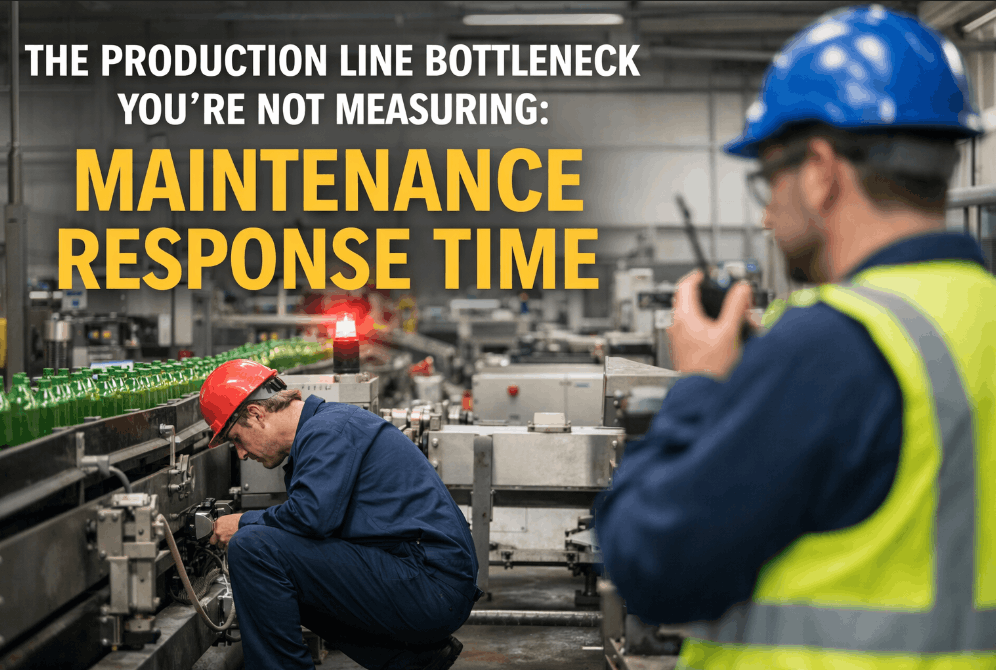
The Production Line Bottleneck You Are Not Measuring
Maintenance Response Time is costing your food plant more than any single equipment failure — and almost nobody tracks it.
Every food plant tracks downtime. Very few track what happens before the wrench turns: the missed alert, the unreachable technician, the missing work order, the wrong spare part. That gap — between failure and fix — is where your production schedule dies every single shift.
What Slow Response Time Actually Costs Per Shift
These are not hypothetical numbers. They are what food manufacturing operations report when they actually measure the full response cycle from failure moment to line restart.
The 5 Hidden Phases That Inflate Your MTTR
MTTR is not one problem — it is five separate delays stacked on top of each other. Most plants only address the last one. The first four are where the real money is lost, shift after shift, year after year.
The machine fails. An operator notices and shouts across the floor. Someone walks to find a supervisor. There is no automated alert, no digital notification, no timestamped record of when the failure actually occurred. By the time anyone acknowledges the problem, 10 to 15 minutes have already vanished — and that lost time compounds everything that follows in the response chain.
The supervisor has to physically locate an available technician — calling, radio-ing, walking the floor. There is no visibility into who is available, who is closest, or who has the relevant skill set for the specific failure type. Without automated dispatch, this phase alone adds 15 to 25 minutes to every single failure event, 24 hours a day, seven days a week.
The technician arrives at the machine with no asset history, no previous failure record, no maintenance log. They start diagnosing from scratch — even if the exact same machine failed for the exact same reason three months ago and someone wrote it in a notebook that no one can find. This context gap is the most expensive hidden delay in food plant maintenance operations.
The diagnosed repair requires a spare part that may or may not be in stock — the technician has to physically check the storeroom. The repair may require supervisor sign-off through a manual paper process. Each approval step and parts retrieval trip adds delay that has absolutely nothing to do with the mechanical repair itself. In some facilities, this phase extends beyond 45 minutes for parts that were out of stock.
Once the machine is running again, the technician is expected to complete paperwork. In reactive environments, this rarely happens accurately or completely. Without a precise repair record, the next failure event starts the same cycle from zero — with no institutional knowledge carried forward, no pattern recognition possible, and no way to prevent the same failure from recurring on the same equipment next month.
How Does Your MTTR Compare to Top-Performing Food Plants?
Top-quartile food manufacturers achieve MTTR that is 60% lower than the industry average — translating directly into 200 or more additional production hours per asset per year. The gap between world-class and below-average operations is not equipment or budget. It is the response workflow.
How AI-Driven Workflow Automation Attacks Every Phase That Inflates MTTR
Oxmaint does not just track MTTR — it systematically eliminates every delay phase that inflates it, from the moment a failure occurs to the moment the production line restarts. Each fix maps directly to one of the five hidden phases identified above. Sign up for Oxmaint to activate all five response accelerators in your food plant.
Instant Automated Failure Detection
IoT sensors and equipment monitoring trigger automatic alerts the moment a machine deviates from normal operating parameters. The failure is logged, timestamped, and escalated digitally — before a human even notices. Detection delay drops from 12 minutes to under 60 seconds, immediately stopping the clock on the most preventable phase of every failure event.
Intelligent Technician Dispatch
Oxmaint automatically identifies the nearest available technician with the correct skill set for the specific failure type and routes a prioritized mobile work order directly to their device. No supervisor phone calls, no radio chatter, no walking the floor to find someone. Dispatch completes in seconds rather than the 15 to 25 minutes manual routing typically consumes.
Asset History at the Point of Repair
Every technician arrives at a failure with the machine's complete history on their mobile device — previous failures, repair notes, sensor readings, parts used, and service records. They diagnose with full context instead of starting from scratch. Average diagnosis time drops by 40 to 60%, and repeat failures are identified immediately because the pattern is visible in the asset record rather than buried in a paper notebook.
Integrated Parts and Digital Approvals
Spare parts inventory is linked directly to work orders — technicians see parts availability on their mobile device before they leave the equipment location. Digital approval workflows replace paper sign-off processes. Work orders are pre-authorized for common failure types, eliminating the most frequent approval delays entirely. Parts trips to the storeroom with correct information rather than guesses.
Mobile-First Repair Documentation
Technicians complete repair records on their phones at the exact point of fix — not hours later from incomplete memory. Repair notes, photos, parts used, and resolution details are captured in structured digital format every single time. The institutional knowledge base grows with every repair event, making every future response faster and every recurring failure pattern visible before it becomes a production crisis.
86 Minutes Recovered Per Failure Event
The combined time savings across all five automated phases average 86 minutes per failure event — representing 80% of the 108-minute preventable delay that typical food plants lose without an optimized response workflow. At $260 per minute, that is more than $22,000 recovered per significant failure event compared to manual response processes.
From 4-Hour MTTR to Under 90 Minutes
Before implementing Oxmaint, this facility's maintenance team operated entirely reactively. When a filler or capper failed, the supervisor would walk the floor to find an available technician, who would then arrive at the machine with no prior knowledge of its failure history or previous repair context. Average MTTR across the three lines was 4.2 hours per significant failure event.
After 90 days on Oxmaint — with automated failure alerts, mobile technician dispatch, digital asset history at the point of repair, and integrated parts availability — their MTTR dropped to 87 minutes. The same technicians. The same equipment. The difference was entirely in the response workflow, not the repair skill.
The facility calculated that the MTTR reduction alone recovered more than $340,000 in production value during the first year — driven by reduced per-event losses across all three lines combined. Oxmaint's annual platform cost was recovered within the first two significant failures prevented.
Beyond MTTR: What Response Time Optimization Changes Across Your Entire Operation
Reducing maintenance response time does not just recover production hours. It creates a cascade of operational improvements that compound across every shift, every line, and every facility in your network.
Faster, documented repairs mean every corrective action is captured and traceable. FDA FSMA, SQF, and BRC auditors expect to see that equipment failures were detected, addressed, and documented promptly. An optimized MTTR workflow automatically generates the compliance documentation trail that manual systems consistently fail to produce.
Technicians who receive automated, contextual work orders rather than frantic radio calls feel more professional and effective. They arrive with information instead of confusion, complete repairs faster, and spend less time on administrative tasks. Food manufacturers using CMMS-driven dispatch consistently report higher maintenance team satisfaction scores and lower voluntary turnover within the first year.
The repair documentation captured by each Oxmaint work order builds the asset intelligence base that makes predictive maintenance possible. Once six to twelve months of structured repair data accumulates, AI models can identify failure patterns before they become production stops — transforming the same workflow that reduces MTTR today into the infrastructure that prevents failures entirely tomorrow.
When every repair is timestamped and documented with photos, parts used, and technician notes, warranty claims become straightforward. Equipment vendors cannot dispute failure timelines when the digital record is complete and precise. Food manufacturers using Oxmaint recover significantly more warranty value because documentation is available on demand at the moment a claim needs to be filed.
Common Questions About MTTR and Maintenance Response Time Optimization
Practical answers for plant managers and operations directors evaluating maintenance response optimization for the first time. For questions specific to your facility, book a demo and speak directly with an Oxmaint implementation specialist.
AI-Driven Maintenance Response Optimization for Food Manufacturing
Oxmaint gives food plant maintenance teams automated failure detection, intelligent technician dispatch, mobile asset intelligence, and integrated parts management — compressing every phase of your MTTR into a fraction of what it costs your operation today. The repair takes 25 minutes. Everything before it takes 95. Oxmaint fixes the 95.