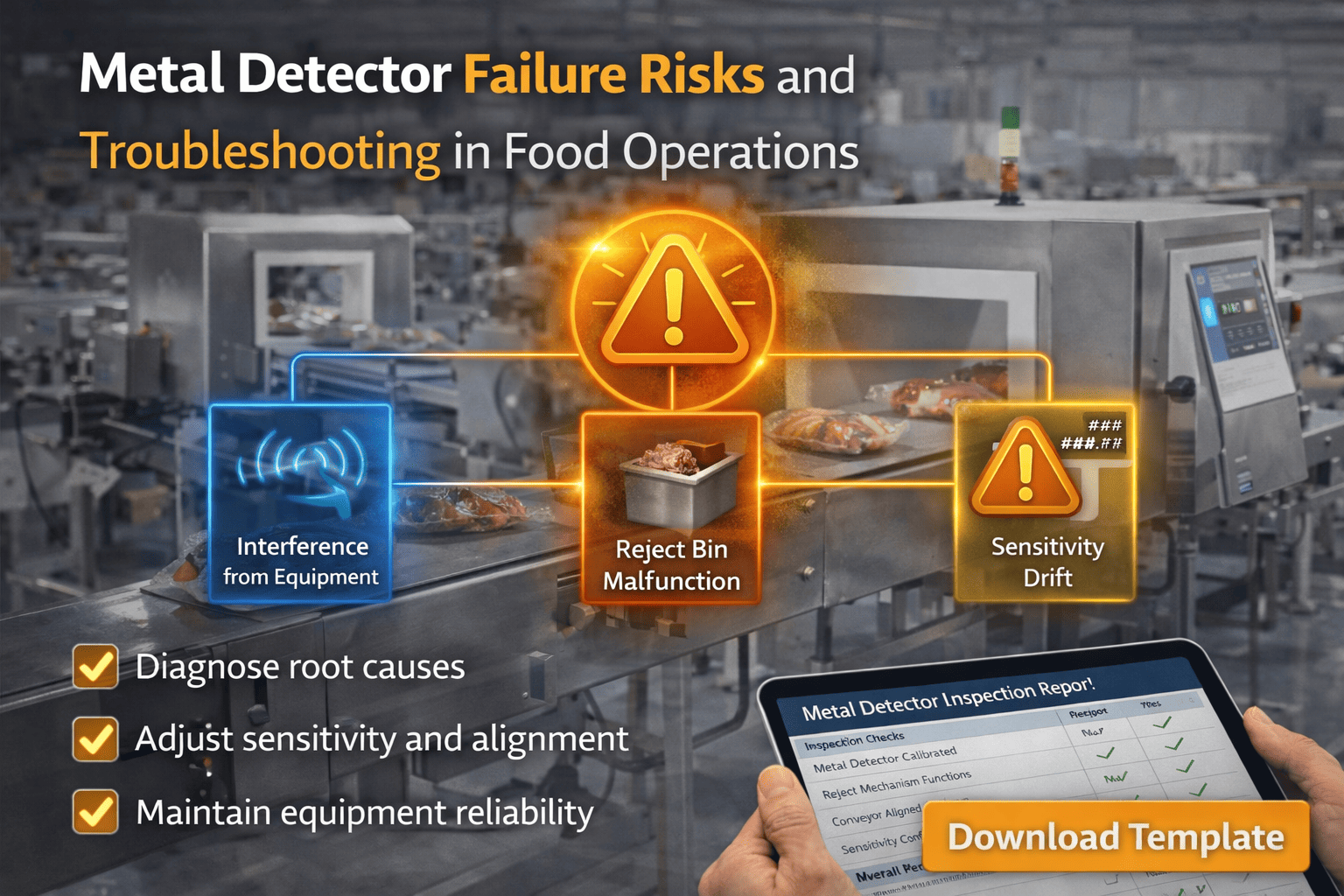
Metal Detector Failure Risks and Troubleshooting in Food Operations

By John Snow on January 26, 2026

metal-detector-common-failures-and-troubleshooting

At 6:23 AM on a Wednesday in February, a frozen pizza manufacturer in Ohio discovered their primary production line metal detector had been passing product without actually scanning for contamination. The failure went undetected for nearly four hours because operators saw the green indicator light and assumed the system was functioning normally. Investigation revealed a loose coaxial cable connection that had degraded over weeks of vibration, finally failing completely during the overnight shift. The result: 47,000 pounds of potentially contaminated product requiring disposition, a voluntary recall of distributed product, customer notification obligations, and an FDA inspection that uncovered systemic gaps in metal detector common failures prevention and response protocols. Total cost exceeded $890,000, yet the underlying cable connection issue would have cost less than $200 to address during routine maintenance.

Metal detectors represent one of the most critical control points in food manufacturing, yet they fail in ways that often go unnoticed until contaminated product reaches customers or regulators arrive asking questions. Unlike dramatic equipment breakdowns that stop production immediately, metal detector failures frequently manifest as silent degradation, reduced sensitivity, or intermittent faults that allow contamination to pass while the system appears operational. Understanding the failure modes specific to food industry metal detection equipment enables proactive intervention that prevents both food safety incidents and the regulatory consequences that follow.

Sign up to track metal detector maintenance and prevent failures or book a demo to see how systematic monitoring catches problems before they compromise food safety.

Failure Analysis

Metal Detector Failure Risks and Troubleshooting in Food Operations

Identify failure patterns, implement root cause analysis, and prevent the detection gaps that create food safety incidents.

78%
Of Failures Are Preventable with Proper Maintenance
43%
Of Failures Involve Sensitivity Drift or Calibration
67%
Reduction in Failures with Structured PM Programs
$127K
average
Cost of Metal Detection Failure Incident

Understanding Metal Detector Failure Impact in Food Manufacturing

Metal detection failures in food operations carry consequences that extend far beyond equipment repair costs. When a metal detector fails to detect contamination, the resulting incident can trigger product recalls affecting millions of units, regulatory enforcement actions including warning letters and consent decrees, customer relationship damage that takes years to repair, and in worst cases, consumer injuries that create liability exposure and brand damage that may prove permanent.

The challenge with metal detector failures is their often invisible nature. Unlike a conveyor motor that stops running or a filling machine that produces obvious defects, metal detectors can fail in ways that allow contaminated product to flow through while all indicators suggest normal operation. Sensitivity drift, environmental interference, and software faults may reduce detection capability by 50% or more while the system continues running and operators see no obvious malfunction.

78%
of metal detector failures in food manufacturing are preventable through proper maintenance, environmental control, and systematic verification programs. The remaining 22% involve component failures that, while not preventable, can be detected quickly through proper monitoring before significant product exposure occurs.

Root cause analysis of metal detector incidents consistently reveals patterns that repeat across facilities and industries. The same failure modes appear whether the detector monitors cereal, frozen meals, or pet food. Understanding these patterns enables maintenance teams to focus attention on the specific areas that drive the majority of failures, rather than spreading resources across theoretical risks that rarely materialize.

Sign up for Oxmaint to implement failure tracking that identifies patterns and prevents recurring incidents.

Primary Metal Detector Failure Modes in Food Operations

Metal detector failures fall into distinct categories, each with characteristic causes, warning signs, and prevention strategies. Understanding these failure modes enables targeted maintenance that addresses actual risks rather than theoretical concerns.

01
27%
Sensitivity Drift and Calibration Loss
Gradual change in detection sensitivity over time due to component aging, temperature cycling, or electromagnetic environment changes. The detector continues operating but with reduced ability to detect small contaminants.
Increasing difficulty passing test wand verification at edges of aperture. Gradual increase in sensitivity readings needed to pass tests. Intermittent failures on smallest test wand size.
Track sensitivity readings over time rather than just pass/fail results. Establish drift thresholds that trigger recalibration before detection capability is compromised. Schedule calibration verification quarterly at minimum.
$45,000-180,000 including product hold, re-inspection, potential recall, and investigation costs depending on exposure duration.
02
21%
Reject System Malfunction
The detector identifies contamination correctly but the reject mechanism fails to remove the product from the line. Causes include pneumatic system failures, timing errors, mechanical wear, and electrical faults in the reject actuator.
Slow or weak reject action. Inconsistent reject timing. Air pressure fluctuations. Unusual sounds during reject activation. Products not fully clearing the belt during rejection.
Verify reject function at every test wand check, not just detection. Monitor pneumatic system pressure continuously. Include reject mechanism in daily maintenance inspection. Test reject at full production speed.
$75,000-250,000 as contaminated product confirmed detected but not removed creates higher liability exposure and more extensive recall requirements.
03
18%
Environmental Interference
External electromagnetic fields, vibration, or temperature extremes interfere with detection capability. Sources include nearby motors, variable frequency drives, welding equipment, and HVAC systems that create intermittent interference patterns.
Intermittent false rejects with no apparent cause. Detection performance varying by time of day or production line activity. Sensitivity changes correlating with nearby equipment operation.
Survey electromagnetic environment during installation and after any nearby equipment changes. Maintain minimum clearances from interference sources. Install appropriate shielding. Document environmental baseline conditions.
$30,000-120,000 depending on whether interference caused missed detections or only false rejects. Investigation costs often significant.
04
14%
Product Effect Compensation Errors
Conductive or magnetic products create signals that the detector must compensate for. When product characteristics change due to formulation variations, moisture content, temperature, or packaging changes, the compensation settings may no longer be appropriate.
Increased false reject rate after recipe or packaging changes. Difficulty achieving target sensitivity with certain products. Seasonal variation in detector performance correlating with ingredient changes.
Revalidate detector settings after any product formulation or packaging changes. Monitor product effect signal levels and establish acceptable ranges. Communicate between R&D, quality, and maintenance when product changes occur.
$25,000-90,000 primarily from production disruption and re-inspection of product made during periods of inadequate compensation.
05
11%
Electrical and Connection Failures
Cable connections loosen due to vibration, corrosion develops in connectors, power supply issues cause intermittent operation, or ground faults develop. These failures often cause intermittent or partial loss of function.
Intermittent display issues or communication errors. Sensitivity readings that vary without apparent cause. System resets or error codes. Detection performance that changes when cables are moved.
Include connection inspection in routine maintenance. Use appropriate strain relief and cable management. Protect connections from moisture and cleaning chemicals. Verify ground continuity regularly.
$15,000-100,000 depending on failure duration and whether intermittent faults allowed contaminated product to pass undetected.
06
9%
Software and Firmware Faults
Software bugs, memory corruption, or firmware issues cause unexpected behavior. May manifest as incorrect parameter application, failure to log data, communication errors with reject systems, or complete system lockup.
Unexpected system behavior or display errors. Settings that do not match what was entered. Missing or corrupted log data. Communication failures with plant systems. Unusual response to operator inputs.
Keep firmware updated to manufacturer recommendations. Maintain parameter backups. Verify settings after any software updates or power interruptions. Document known software issues and workarounds.
$20,000-150,000 depending on nature of software fault and whether it affected detection, logging, or both.

Track Failures. Find Patterns. Prevent Recurrence.

Oxmaint captures every metal detector issue, links failures to root causes, and identifies the maintenance gaps that allow problems to develop. Stop reacting to failures and start preventing them.

Troubleshooting Guide: Systematic Diagnosis of Metal Detector Problems

When metal detector issues arise, systematic troubleshooting quickly identifies root causes and guides appropriate corrective action. This diagnostic framework addresses the symptoms maintenance teams most commonly encounter.

Symptom: Failed Test Wand Verification
If test fails at aperture edges only
Check sensitivity settings and recalibrate. Edge sensitivity decreases first as calibration drifts.
If stainless steel fails but ferrous passes
Phase angle may need adjustment. Check for environmental interference affecting specific frequency ranges.
If all metals fail simultaneously
Check power supply, coil connections, and main electronics. Complete loss of detection indicates major system fault.
If failures are intermittent
Suspect loose connections, environmental interference, or power quality issues. Log time of failures and correlate with other facility events.
Symptom: Excessive False Rejects
If false rejects correlate with specific products
Product effect compensation needs adjustment for that product. Check moisture content, temperature, and formulation against validation parameters.
If false rejects vary by time of day
Environmental interference from equipment operating on schedules. Survey electromagnetic environment during high-reject periods.
If false rejects started after equipment changes nearby
New interference source introduced. Check for VFDs, motors, or other electromagnetic sources within recommended clearance distances.
If false rejects occur randomly
Check for vibration issues, loose conveyor components, or intermittent electrical noise. May indicate developing equipment fault.
Symptom: Reject System Not Operating
If reject never activates
Check reject enable setting, signal wiring between detector and reject, and reject controller power. Verify reject is not disabled in software.
If reject activates but product not removed
Check pneumatic pressure, cylinder stroke, and timing delay settings. Pusher may not have enough force or travel to clear product.
If reject timing is inconsistent
Check encoder or speed sensing for conveyor. Timing calculated from line speed; if speed sensing fails, timing becomes erratic.
If reject activates slowly
Check air supply pressure and flow capacity. Inspect solenoid valve for wear. Check for restrictions in pneumatic lines.
Symptom: Display or Communication Errors
If display is blank or flickering
Check power supply voltage and connections. Display failures often indicate power supply issues affecting entire system.
If communication with plant systems fails
Check network cables and termination. Verify IP settings if Ethernet connected. Check serial cable and baud rate settings if serial.
If settings do not save after power cycle
Battery backup for memory may be depleted. Some systems require parameter backup to non-volatile storage manually.
If system shows error codes
Document exact error code and consult manufacturer documentation. Error codes provide specific diagnostic information for trained technicians.

Root Cause Analysis Framework for Metal Detector Failures

Effective root cause analysis goes beyond fixing the immediate symptom to identify why the failure occurred and what systemic changes prevent recurrence. This framework guides investigation of metal detector incidents.

1
Define the Problem Precisely
Document exactly what failed, when it was discovered, how long it may have persisted, and what product was affected. Avoid vague descriptions like "metal detector not working" in favor of specific observations like "stainless steel test wand at 2.5mm not detected at left edge of aperture during 10:00 AM verification."
2
Collect Relevant Data
Gather all available information including verification logs, maintenance records, environmental conditions, production data, and recent changes to equipment or products. Interview operators about any observations or unusual events. Download detector logs if available.
3
Apply 5-Why Analysis
Ask "why" repeatedly to trace from symptom to root cause. Example: Why did detection fail? Sensitivity drifted below threshold. Why did sensitivity drift? Calibration interval too long. Why was interval too long? Based on manufacturer recommendation without considering facility conditions. Why were facility conditions not considered? No formal process to evaluate environmental factors.
4
Identify Contributing Factors
Root causes often involve multiple contributing factors across categories: Equipment (age, condition, design), Process (procedures, training, verification), People (awareness, skills, workload), and Environment (temperature, vibration, interference). Address all significant contributors.
5
Develop Corrective Actions
Create specific, measurable actions that address root causes, not just symptoms. Include immediate corrections, systemic changes to prevent recurrence, and verification steps to confirm effectiveness. Assign owners and deadlines for each action.
6
Verify Effectiveness
After implementing corrective actions, monitor for recurrence and verify the changes achieved intended results. Track similar failures across all metal detectors to ensure systemic issues are fully addressed.

Example: 5-Why Analysis for Sensitivity Drift Failure

Why 1:
Why did contaminated product pass through the detector?
Sensitivity had drifted below the level needed to detect 2.5mm stainless steel.
Why 2:
Why had sensitivity drifted?
Temperature cycling over several weeks caused gradual component parameter shift.
Why 3:
Why was drift not detected during verification?
Daily verification only recorded pass/fail, not actual sensitivity readings that would show trending.
Why 4:
Why did verification not include sensitivity trending?
Procedure was designed for minimum compliance rather than optimal detection performance.
Why 5:
Why was the procedure not optimized?
No formal review process to improve procedures based on industry best practices and failure experience.
Root Cause: Lack of continuous improvement process for metal detector procedures led to verification program that met minimum requirements but did not detect developing problems.
Corrective Actions: (1) Revise verification procedure to record actual sensitivity readings, (2) Establish trending thresholds that trigger recalibration, (3) Implement quarterly procedure review incorporating lessons learned, (4) Train operators on importance of trending data.

Document Every Failure. Eliminate Repeat Problems.

Oxmaint captures failure data, guides root cause analysis, tracks corrective actions to completion, and identifies patterns across your metal detection fleet. Build the knowledge base that prevents recurring incidents.

Preventive Maintenance Strategies to Reduce Failure Risk

Systematic preventive maintenance addresses the underlying conditions that lead to metal detector failures. These strategies target the failure modes that account for the majority of incidents.

01
Sensitivity Trending Program
Record actual sensitivity readings at each verification rather than just pass/fail results. Establish baseline values and track changes over time. Set thresholds that trigger investigation or recalibration before sensitivity degrades to failure levels. Review trends weekly to catch gradual drift.
02
Environmental Monitoring
Document baseline electromagnetic environment during installation. Re-survey after any changes to nearby equipment. Monitor ambient temperature and humidity. Maintain minimum clearance distances from interference sources. Install shielding where environmental control is not practical.
03
Connection Integrity Program
Include all electrical connections in routine inspection. Check for looseness, corrosion, and damage from vibration. Verify ground continuity quarterly. Protect connections from moisture and cleaning chemicals. Re-terminate connections showing any signs of degradation.
04
Reject System Maintenance
Test reject function at every verification, not just detection. Monitor pneumatic system pressure continuously. Inspect pusher, cylinder, and diverter components weekly. Replace wear components on schedule rather than waiting for failure. Verify timing at production speed.
05
Product Effect Management
Revalidate detector settings after any product formulation changes. Monitor product effect signal levels and establish acceptable ranges. Communicate between R&D, quality, and maintenance when product changes occur. Document seasonal variation in product characteristics.
06
Software and Firmware Management
Maintain current firmware versions per manufacturer recommendations. Backup all parameters and product codes regularly. Verify settings after any software updates or power interruptions. Document known software issues and workarounds. Test thoroughly after any software changes.

Failure Documentation Requirements for Regulatory Compliance

When metal detector failures occur, proper documentation is essential for regulatory compliance and demonstrates the facility's commitment to food safety. Inadequate failure documentation often draws greater regulatory scrutiny than the failure itself.

Immediate Documentation

Record within minutes of failure discovery: Date and time of discovery, nature of the failure, who discovered it, immediate actions taken, and estimated duration the failure may have existed.

Product Impact Assessment

Document: Products that passed through the detector during failure period, quantities involved, current location of affected product, distribution status, and hold/segregation actions taken.

Investigation Records

Maintain: Root cause analysis documentation, evidence collected, personnel interviewed, data reviewed, and conclusions reached. Include technical details supporting the investigation findings.

Corrective Action Records

Document: Immediate corrections made, systemic changes implemented, responsible persons, completion dates, and verification that actions were effective. Track all actions to completion.

Product Disposition Records

Maintain: Decision on affected product disposition, rationale for decision, re-inspection results if applicable, destruction records if applicable, and customer notifications if product was distributed.

Verification of Resolution

Document: Testing confirming detector returned to proper function, verification that corrective actions prevented recurrence, and ongoing monitoring results showing sustained performance.

Book a demo to see how Oxmaint guides failure documentation and ensures complete records that satisfy regulatory expectations.

Frequently Asked Questions: Metal Detector Failures

How quickly should we respond when a metal detector fails verification?
Stop production immediately upon discovering a failed verification. Segregate all product that passed through the detector since the last successful verification. Begin troubleshooting to identify the cause while simultaneously documenting the incident. Do not resume production through that detector until verification passes consistently. The speed of response directly affects the volume of potentially affected product.
What is the difference between a false reject and a detection failure?
A false reject occurs when the detector rejects product that does not contain metal contamination, typically due to product effect issues or environmental interference. A detection failure occurs when the detector fails to identify actual metal contamination, allowing it to pass through. While false rejects are disruptive and costly, detection failures create food safety risk and potential regulatory issues. Both require investigation but detection failures demand more urgent response.
How do we determine how long a metal detector failure may have existed?
Review verification records to identify the last successful test. All product processed since that successful verification must be considered potentially affected. This is why frequent verification is critical: more frequent testing reduces the exposure window when failures occur. Some failures may have developed gradually, so also review trending data for signs of degradation that preceded the complete failure. Sign up for Oxmaint to implement verification tracking that minimizes exposure windows and supports rapid incident assessment.
Should we notify customers or regulators about metal detector failures?
Customer notification depends on whether potentially affected product was shipped and the specific requirements in customer contracts. Regulatory notification (FDA reportable food registry) applies when there is reasonable probability that contaminated food was distributed and could cause serious health consequences. Consult your food safety team and legal counsel to assess notification requirements based on the specific circumstances of each incident.
How often should metal detectors be calibrated to prevent failures?
Manufacturer recommendations typically specify annual calibration, but many food operations require quarterly or more frequent calibration based on environmental conditions and historical drift rates. The appropriate interval depends on your specific equipment, environment, and how quickly you have observed sensitivity drift. Trending data from daily verifications helps establish the right calibration frequency for your operation.

Prevent Failures Before They Compromise Food Safety

Oxmaint provides the maintenance tracking, failure documentation, and root cause analysis tools that transform reactive troubleshooting into proactive prevention. Protect your products, your customers, and your brand with systematic metal detector management.


Share This Story, Choose Your Platform!