A sanitizer bucket can look identical at 0 ppm, at 200 ppm and at 600 ppm. Only a test, taken at the right place and time and written down, tells you whether food-contact surfaces were actually treated with an effective solution. Inspectors and auditors increasingly ask for that proof, and plants that cannot show it often struggle to defend their cleaning program. This guide explains how to build a sanitizer concentration verification log, what to record, and how to connect it to sanitation management software so failures trigger action.
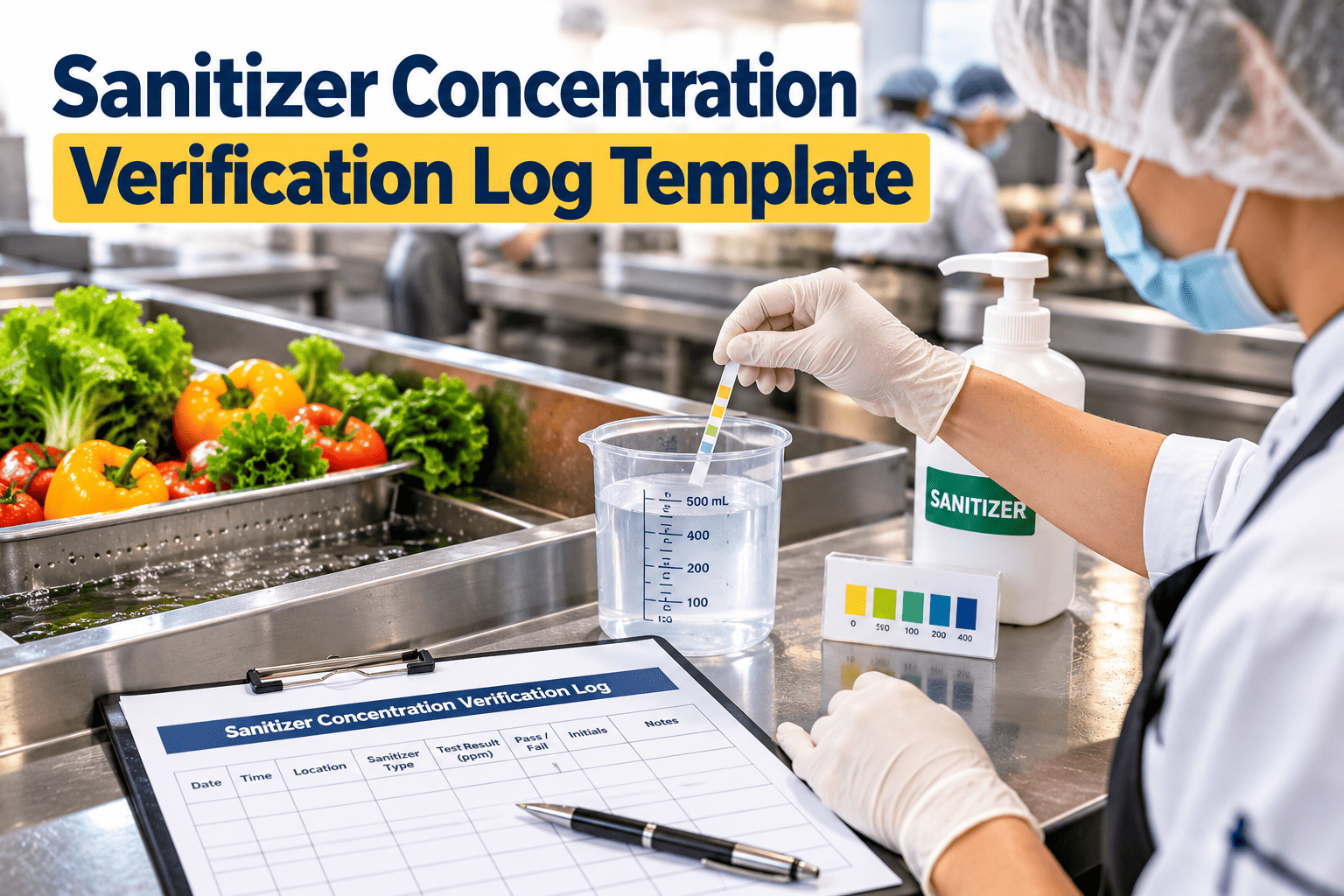
Sanitizer Concentration Verification Log Template
Record test strip or meter results, chemical, location and corrective action for every concentration check, so a reading outside the label range is never just a number on a sheet.
Six reasons the number on the bucket is wrong
Incorrect concentration is rarely a mixing mistake alone. It usually traces back to equipment, water or habits that a log can expose when readings are reviewed over time.
Dispenser or proportioner drift
Worn pumps, blocked metering tips, kinked tubing and low chemical drums quietly change the dilution ratio.
Hardness and temperature
Quaternary ammonium products can be affected by hard water, and cold water can slow dissolving or reduce effectiveness.
Solution that has been used up
A bucket that began in range loses strength after greasy cloths and food particles pass through it.
Wrong strip or poor technique
A chlorine strip dipped in quat, an expired strip, or a late read can produce a confident but false result.
Mixing by eye
Pouring a splash of concentrate into a bucket is common on busy shifts, especially where dispensers are broken.
Entries without action
A failed reading with no corrective action, retest or sign-off is a documentation gap and a food safety gap.
Common sanitizer types and typical concentration ranges
Always follow the EPA-registered product label and your local regulator. The table reflects commonly cited ranges in the FDA Food Code used as teaching references.
| Sanitizer | Typical concentration | Typical contact time | What to watch |
|---|---|---|---|
| Chlorine | 50 to 100 ppm | Per label, often about 7 to 30 seconds depending on conditions | Strength falls as organic soil rises; pH and temperature matter |
| Quaternary ammonium (quat) | Per label, commonly 200 to 400 ppm, not above the label limit | About 30 seconds | Water hardness, minimum solution temperature, residue if too strong |
| Iodine | 12.5 to 25 ppm | About 30 seconds | Temperature and pH limits, staining |
| Peracetic acid blends | Per label and product-specific test method | Per label | Use the specified strip or kit, since generic strips may not apply |
Match the strip to the chemical
Test strips are built for a specific chemistry and range. Use the strip named on the product label and write its range on the log header.
Fields every concentration entry should capture
A good entry answers who, what, where, when, how much, and what happened next. Use this layout for a paper sheet, spreadsheet or mobile form.
| Field | Example entry | Why it matters |
|---|---|---|
| Date and time | Start of shift, 05:45 | Proves the check occurred before use |
| Location or equipment | Line 3 dispenser, wash station B | Ties readings to a specific source |
| Chemical and product name | Quat sanitizer, product and lot | Allows traceback if the product is the issue |
| Test method and device | Strip range 0 to 500 ppm, strip lot | Shows the method suits the chemistry |
| Required range | Label range for this use | Defines pass or fail without debate |
| Measured result | Actual ppm value | Supports trend review |
| Pass or fail | Pass / Fail | Triggers next step |
| Corrective action | Remixed, retested, 220 ppm | Shows the failure was closed |
| Tested by and verified by | Initials, supervisor initials | Provides accountability and review |
Test strips, titration kits and digital meters compared
No single method fits every sanitizer or every site. Pick the simplest method that gives reliable results for the chemistry you use.
Test strips
- Fast and low cost for routine checks.
- Read within the time stated on the vial, since late reads can be too high.
- Store sealed and discard after expiry.
- Limited resolution between color steps.
Titration kits
- Better resolution for audits and chemical verification.
- Slower and needs trained users.
- Useful to validate strips or dispenser calibration.
- Reagent shelf life must be tracked.
Digital meters
- Reduce color-matching judgment.
- Need calibration and battery checks.
- Suit high-volume plants and central dosing systems.
- Calibration records belong in the asset history.
A shift timeline for concentration checks
Frequency should reflect risk and policy. The timeline shows a common pattern, and your food safety plan decides the final intervals.
Dispensers and fresh solutions
Test each dispenser output and every freshly filled bucket, spray bottle and foot-foam station.
Periodic checks
Retest in-use buckets on a set schedule, commonly every two to four hours, and whenever the solution looks cloudy or soiled.
New batch, new test
Every change of solution or drum gets a fresh reading before use.
Verification before release
Record final sanitizer checks as part of the pre-operational release record.
Review and calibrate
Review trends and verify dispenser output against a reference method.
Water, temperature and contact time
Concentration is only one part of effective sanitizing. Three conditions decide whether the correct ppm reading actually delivers a kill step.
Water quality
Hard water can reduce the performance of some quaternary ammonium products. If a plant draws from variable sources, record the water source on the log and ask your chemical supplier for the maximum hardness the product tolerates.
Solution temperature
Labels often state a minimum temperature for dilution and use. A cold-water fill that reads in range on a strip may still perform below label expectations, so list the minimum temperature in the header of the sheet.
Contact time
A surface must stay wet for the full label time. Concentration records do not prove that, so pair the log with a visual verification step on the pre-operational checklist.
A five-step routine for taking a reliable reading
Most testing errors come from technique rather than equipment. Teach one routine and post it at every test location.
Confirm the strip
Check chemistry, range and expiry date before opening the vial.
Sample correctly
Dip into the solution at the point of use with clean, dry hands.
Time the read
Compare to the color chart within the seconds stated on the label.
Decide and act
Pass, adjust or stop, using the written corrective actions.
Record immediately
Write the value, time and initials while standing at the station.
Reading patterns and what they usually mean
Trends are more useful than single results. These patterns appear often in sanitation records and point to different fixes.
| Pattern in the log | Likely cause | Suggested response |
|---|---|---|
| Low at the dispenser every Monday | Air in lines or empty drum after a weekend | Prime the line, check drum levels at shutdown, add to Friday checklist |
| Buckets drift low by mid-shift | Soil load consuming the active chemical | Shorten bucket change interval and retest on schedule |
| Some stations high, others low | Hand mixing at stations without dispensers | Move to metered dispensing and retrain staff |
| Readings jump between operators | Different reading times or strip lots | Standardize the read time and retire old lots |
| Gradual decline over several weeks | Pump wear or tubing scale | Open a preventive maintenance task and replace wear parts |
From a printed sheet to a working verification workflow
Plants can move the log into software in stages, keeping the field layout the same so operators barely notice the change.
Build the foundation
- Add dispensers, sinks and foam stations as assets with location.
- Create inspection forms with required range, pass or fail and corrective action fields.
- Assign recurring checks by shift, line or area.
- Store label sheets and supplier instructions on each asset record.
Close the loop
- Route failed results to a supervisor and open a work order automatically where needed.
- Schedule preventive maintenance for pumps, tubing and calibration.
- Track strips, tips and fittings as inventory.
- Review reports by location, chemical and shift in monthly sanitation meetings.
Who owns each part of the concentration program
Records fail most often at handoffs. Naming an owner for each step prevents a check from belonging to everyone and therefore no one.
| Role | Responsibility | Evidence in the record |
|---|---|---|
| Sanitation operator | Tests solutions, takes first corrective action, records every reading | Initials, time, value and retest |
| Sanitation supervisor | Reviews failures each shift and confirms retests were completed | Verification signature and notes |
| Maintenance technician | Calibrates and repairs dispensers, pumps and tubing | Work order, parts used and verification result |
| Quality assurance | Reviews trends, validates methods and approves procedure changes | Monthly review, training and method records |
| Chemical supplier | Provides labels, safety data and dispenser support as needed | Service reports and product documentation |
Keep the record honest
Never back-fill readings. If a check was missed, record that it was missed, what was done to verify the surfaces afterward and who approved the next step.
Recording mistakes that weaken an otherwise good program
Auditors tend to look for patterns of weak documentation before they question the chemistry itself.
Identical readings all week
A column of the same value suggests values were copied, not measured. Strip color steps make some repetition normal, but variation should appear over time.
Missing location or time
Without them, a reading cannot be matched to the surfaces cleaned, and a later review cannot tell which station failed.
Failure without a retest
Writing remixed beside a low reading is incomplete until a passing retest appears with its own time and initials.
No supervisor review
Records that are never reviewed stop being corrections and become paperwork, and repeated problems keep coming back.
Give every failed reading a next step
Capture concentration checks on mobile, flag out-of-range results instantly and open a work order for the dispenser behind them.
What happens when a reading fails
Corrective action should be defined before it is needed, so any operator reacts the same way.
Reading taken
Compare to the required range for that chemical and use.
Too low
- Stop using the solution on food-contact surfaces.
- Check the dispenser, drum level and water source.
- Remix or re-dose and retest.
Too high
- Dilute with potable water and retest.
- Rinse surfaces if the label requires.
- Check for over-dosing at the source.
Close and record
- Log the retest result and initials.
- Assess product exposure and escalate to QA if needed.
- Open a work order for repeat failures.
Treat dispensers as assets, not accessories
When the same dispenser fails repeatedly, the answer is maintenance, not more testing. These tasks keep the source accurate.
Output check
Verify each dispenser against a reference test on a fixed interval.
Tubing and tips
Inspect for kinks, scale and blockage, and replace on schedule.
Pump and valves
Service pumps, check valves and backflow devices according to the supplier.
Spare parts
Keep tips, tubing and fittings in inventory so repairs happen the same day.
How Oxmaint supports the concentration program
The log stays the same, but it gains scheduling, alerts and history once it runs inside a maintenance platform.
| Need | Paper or spreadsheet | In Oxmaint |
|---|---|---|
| Scheduled checks | Relies on memory | Recurring inspections assigned by location or shift |
| Out-of-range result | Noted, maybe ignored | Failed item can open a corrective work order |
| Dispenser upkeep | Fixed when it breaks | Preventive maintenance tasks on the dispenser asset |
| Parts | Hunted for during failure | Inventory tracked with reorder levels |
| Audit retrieval | Binder search | Searchable records and exportable reports |
| Trend review | Rarely done | Dashboards by location, chemical and shift |
Checklist for a defensible concentration record
Before the next audit, confirm that the program can answer every question below without searching.
- Required ranges are written for every chemical and use.
- Test method and strip range match each product.
- Test frequency is defined and followed on all shifts.
- Strips and reagents are in date and stored correctly.
- Every failure has a corrective action and retest.
- Supervisors verify and sign records on a schedule.
- Repeat failures link to maintenance work orders.
- Training records show who is authorized to test.
Sanitizer concentration log FAQs
What concentration should I record as the target?
Use the range on the EPA-registered product label for the surface and application. Quat labels often fall between 200 and 400 ppm, but confirm yours.
How often should concentration be tested?
At startup, after each refill and at regular intervals during use, commonly every two to four hours. Your plan and local rules set the final frequency.
Do I need to log a retest after a failure?
Yes. The original reading, the correction and the passing retest should all appear, with initials, so the failure is clearly closed.
Can this log be kept digitally?
Yes, mobile forms in Oxmaint capture readings, time stamps and sign-off, and link failures to work orders.
What if one dispenser keeps failing?
Treat it as an equipment problem. Register it as an asset and schedule calibration, or see a demo of how repeat failures are tracked.
Prove every sanitizer check was done and acted on
Bring concentration logs, corrective actions and dispenser maintenance into one audit-ready system.