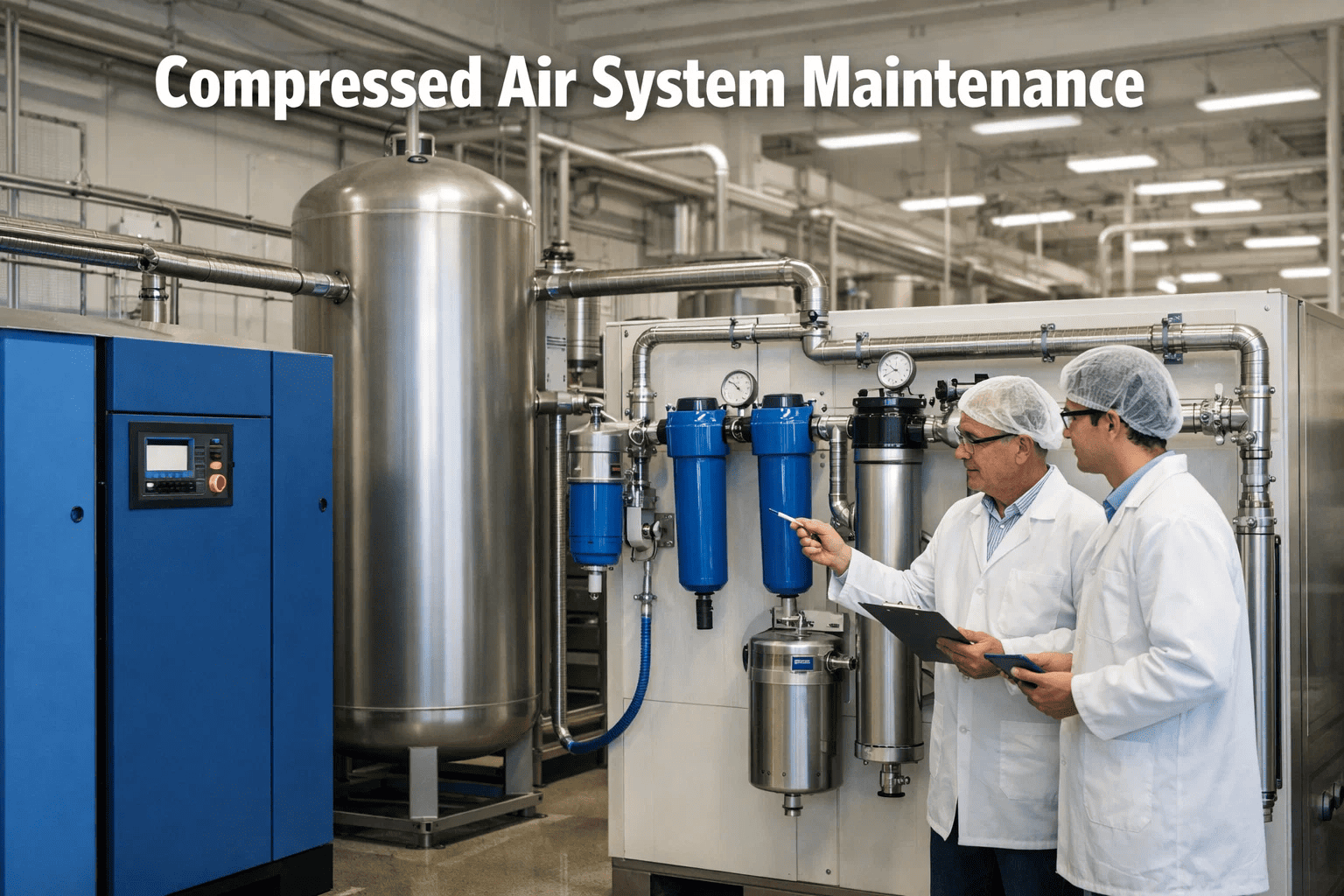
Snack food manufacturing equipment maintenance is the operational backbone of every profitable snack plant. From continuous fryers and oil filtration systems to seasoning tumblers and VFFS packaging machines, every line in a snack production facility depends on precision, cleanliness, and disciplined preventive maintenance schedules. When fryer temperatures drift, seasoning drums clog, or multi-head weighers lose calibration, yield drops and food safety compliance becomes a liability — not a guarantee.
Automate Your Snack Plant PM Schedules
Schedule fryer cleandowns, oil filtration cycles, and packaging line PM work orders — all from one CMMS built for food manufacturing.
Why Snack Equipment Maintenance Is Different
Snack food production environments are uniquely demanding. High-temperature oil, hygroscopic seasoning powders, and high-speed packaging film combine into a maintenance environment unlike any other in food manufacturing. Equipment runs continuously — often 20 hours a day — and every unplanned downtime event has an immediate, quantifiable cost in lost product, missed customer orders, and emergency contractor fees.
Snack plant engineers in the US, UK, Canada, Germany, and the UAE are increasingly moving from reactive breakdown response to structured preventive maintenance programmes anchored in CMMS platforms with food-grade inspection templates and automated work order generation. The shift is not optional for plants seeking SQF, BRC, or FSSC 22000 certification — sign up free to get your PM programme running today.
Fryer Maintenance: Continuous and Batch Systems
The fryer is the highest-value, highest-risk piece of equipment in most snack lines. Continuous fryers running potato chips, tortilla chips, or extruded snacks operate at 170–190°C and require daily, weekly, and monthly maintenance routines across multiple subsystems. Batch fryers used in lower-volume operations have different failure modes but are equally sensitive to neglect. Book a demo to see how OxMaint structures fryer PM schedules for your line.
Oil Temperature and Zone Control
Verify setpoint versus actual temperature in each fryer zone at start-up. Temperature sensors and RTDs drift over time and must be calibrated against certified reference thermometers quarterly. Uneven zone temperatures produce inconsistent cook — darker leading edge, undercooked trailing edge — and accelerate oil degradation.
Conveyor Belt and Drive System
Continuous fryer conveyor belts accumulate carbonised product deposits and fat oxidation residue that increase drive motor load and cause belt misalignment. Inspect belt tension, splice integrity, and drive sprocket wear weekly. Track drive motor amperage as a leading indicator — rising amp draw precedes belt failure by days, not hours.
Exhaust and Vapour Extraction
Fryer canopy exhaust systems accumulate grease in ductwork at rates that create fire risk and OSHA/HSE compliance exposure. Clean fryer exhaust ductwork to NFPA 96 or equivalent UK/German standards. Grease filters must be cleaned or replaced on a documented cycle — minimum weekly in high-volume continuous operations.
Heat Exchanger and Burner Maintenance
Direct-fired and indirect heat exchangers accumulate scale, carbon deposits, and combustion residue that reduce thermal efficiency and raise fuel consumption. Annual heat exchanger inspection and burner tune-up typically recovers 8–15% in energy costs — the single highest-ROI maintenance activity available on a gas-fired fryer system.
Oil Filtration System Maintenance
Oil quality is product quality. Frying oil degrades through oxidation, hydrolysis, and polymerisation — a process accelerated by heat, water, and food particle contamination. A disciplined oil filtration maintenance programme extends oil life by 40–60%, reduces acrylamide formation, and keeps total polar compound (TPC) levels within regulatory limits accepted in the EU, UK, Canada, and UAE.
Filter Media Inspection and Replacement
Continuous filtration systems use diatomaceous earth, paper filter sheets, or cartridge media. Monitor differential pressure across the filter housing — rising pressure indicates media exhaustion. Replace or regenerate media before breakthrough occurs, which passes fine carbon fines back into the oil bath and accelerates degradation.
Oil Turnover Rate Monitoring
Track the ratio of fresh oil addition to total system volume daily. Insufficient turnover allows TPC levels to accumulate beyond regulatory thresholds (25% TPC in the EU, 27% in Canada). Log oil additions against production volume and use turnover data to predict oil exchange timing — not guesswork or colour judgement.
Pump, Valve, and Piping Inspection
Hot oil pump seals, check valves, and filter housing gaskets are high-wear components operating under thermal stress. Inspect pump seal faces for weeping monthly. Valve actuator function and seat integrity deteriorates under continuous thermal cycling — add to quarterly PM scope and track replacement history against operating hours in the maintenance platform.
Cleandown Procedure Compliance
Full fryer cleandowns — draining, flushing, and mechanical scrubbing — must occur on a documented frequency appropriate to production volume and oil type. Cleandown procedures require sign-off verification, photographic documentation of residue-free heat transfer surfaces, and re-commissioning checks before oil refill. A CMMS platform with digital checklist enforcement prevents shortcuts.
Seasoning System Maintenance: Tumblers, Applicators, and Conveyors
Seasoning application is the step that defines product flavour consistency — and it is one of the most maintenance-neglected subsystems in snack production. Seasoning tumblers, drum coaters, slurry applicators, and electrostatic seasoning systems all have distinct failure modes that directly affect finished product quality, yield, and food safety compliance. Sign up free to build a seasoning system PM schedule in minutes.
Drum Tumbler and Coating Drum Maintenance
Seasoning tumblers accumulate compacted powder in drum seams, lifter bars, and discharge ends. Compacted seasoning absorbs moisture, forms lumps, and introduces contamination risk. Clean tumbler interiors to bare metal on every production changeover. Inspect drum drive rollers, trunnion bearings, and sealing interfaces weekly — bearing failures in this environment are accelerated by abrasive dust ingress.
Seasoning Pump and Applicator Systems
Slurry and liquid seasoning applicators use peristaltic or gear pumps that require tube or seal replacement on a scheduled basis. Track pump tube hours against manufacturer replacement intervals. Nozzle orifices clog progressively — inspect and clean spray nozzles before every production run. Electrostatic seasoning systems require electrode cleaning and high-voltage power supply verification on a weekly maintenance cycle.
Seasoning Zone Transfer Conveyors
Transfer conveyors between fryer discharge and seasoning tumbler carry hot product coated with residual oil — conditions that accumulate flavour cross-contamination between SKUs and present allergen risk. Flush and sanitise transfer belt surfaces between allergen-containing and non-allergen product runs. Inspect belt tracking, return roller condition, and scrapers weekly to prevent product accumulation under the belt.
How AI Vision Enhances Snack Food Equipment Maintenance
Artificial intelligence — specifically computer vision — is reshaping how snack plant engineers monitor, inspect, and predict equipment behaviour across fryers, seasoning systems, and packaging lines. What was previously a manual, shift-dependent process can now be automated with machine-level consistency and real-time alerting.
Real-Time Product Colour and Cook Monitoring
AI vision cameras positioned at fryer discharge continuously analyse product colour against golden-standard reference values. When colour drift indicates temperature deviation or oil quality change, the system alerts operators before out-of-spec product reaches packaging — eliminating manual colour card comparisons and reducing rework rates. Deployed across high-volume chip lines in the UK and Canada.
Fryer Zone and Heat Exchanger Anomaly Detection
AI-powered thermal cameras inspect fryer heat exchanger surfaces and oil zones for temperature non-uniformity, burner flame distribution problems, and scaling — all invisible to routine visual inspection. Plants in Germany and the UAE use thermal AI monitoring to schedule heat exchanger cleaning at the optimal interval rather than fixed calendar schedules, reducing unnecessary downtime.
Seasoning Uniformity and Coverage Analysis
Machine learning vision systems analyse seasoning distribution across product surfaces at line speed — detecting over-seasoning, bare patches, and clumping without stopping the line. This replaces labour-intensive manual seasoning checks and provides statistically valid coverage data for QA records. Particularly valuable for multi-SKU lines where seasoning changeovers are high-risk moments.
Packaging Machine Fault Prediction
When AI vision data — seal integrity images, jaw temperature profiles, film tracking variance — integrates with a CMMS snack food platform, the system identifies degradation trajectories in VFFS jaw assemblies, film drives, and cut-seal cycles. Work orders are generated automatically before failure, converting reactive seal jaw replacement into a planned maintenance event.
Packaging Line Maintenance: Multi-Head Weighers and VFFS Machines
Packaging line reliability determines whether finished product ships on time or accumulates at the end of the line. Multi-head combination weighers and vertical form-fill-seal machines are the two most failure-prone systems in snack packaging — and both require discipline-driven preventive maintenance schedules to maintain throughput and seal quality. Sign up free to automate your packaging PM calendar.
Multi-Head Weigher PM Programme
Multi-head weighers accumulate seasoning oil and fine particles in radial feeder troughs, pool hoppers, and timing gates. Build weigh head performance degrades silently — individual head drift goes undetected until weight compliance fails. Calibrate all weigh heads against certified reference weights at the start of each shift. Clean radial feeders and timing gates at every product changeover to prevent cross-contamination and compaction-related inaccuracy.
VFFS Machine Seal Jaw and Temperature Maintenance
Seal jaw temperature uniformity is the primary determinant of seal integrity in vertical form-fill-seal machines. Jaw heater element resistance should be verified monthly against baseline values — resistance drift precedes element failure. Jaw surface condition — serration depth, PTFE coating integrity — directly affects seal peel strength. Inspect and resurface jaws on a documented hour-based replacement cycle, not based on visual judgement alone.
Film Tracking and Drive System Maintenance
Film tracking problems cause misaligned seals, registration errors, and film waste. Inspect film drive rollers for glazing and debris build-up weekly — a glazed pull roller loses grip and causes film slip, producing seal misalignment that is difficult to detect without running a statistical seal audit. Verify dancer arm tension and brake assembly function at the start of each roll change.
Gas Flush System Verification
Modified atmosphere packaging (MAP) in snack lines depends on accurate nitrogen flush rates to achieve target residual oxygen levels. Verify gas flush flow rates and residual O₂ values against specification at the start of each production run using a calibrated headspace analyser. Flow regulator drift and nozzle wear are common failure modes — schedule regulator calibration quarterly and nozzle replacement annually.
CMMS and Maintenance Software for Snack Food Plants
Selecting the right CMMS platform for snack food manufacturing requires evaluating food-grade inspection template libraries, mobile work order execution, equipment-specific PM scheduling, and audit trail capability for food safety certification. The table below compares the primary system categories available to snack plant engineers and maintenance managers.
| System Type | Key Capabilities | Best Fit | Limitation | OxMaint Advantage |
|---|---|---|---|---|
| Spreadsheet PM Tracking | Manual work order logs, shift handover notes | Single-line owner-operators | No automation, version control failures, audit gaps | Automated fryer and packaging PM scheduling eliminates manual tracking |
| Generic CMMS | Asset registers, multi-trade work orders | Multi-site facilities teams | No food-grade inspection templates or snack equipment-specific workflows | Built-in snack line PM templates for fryers, weighers, and VFFS machines |
| ERP-Integrated Maintenance | Production-linked work orders, parts inventory | Large multi-national snack manufacturers | High implementation cost, long configuration lead time | Operational from day one — no ERP integration required as prerequisite |
| AI-Powered Maintenance Platform | Predictive scheduling, condition trending, mobile inspection, automated alerts | Plant engineers, maintenance managers, contract FM teams | Requires structured data input for full predictive capability | OxMaint combines preventive scheduling with AI-powered condition tracking in one snack-focused system |
| Vision Inspection Software | Automated defect imaging, product quality scoring | High-speed chip and extruded snack lines | Inspection data siloed from maintenance workflow | OxMaint integrates vision inspection alerts directly into PM work order generation |
Key Benefits of a Structured Snack Equipment PM Programme
The business case for preventive maintenance in snack food production is measurable and direct — reduced downtime, lower oil costs, better seal quality, and faster food safety audit readiness. Book a demo and walk through the ROI numbers for your specific line configuration.
Higher Line Availability
Structured PM reduces unplanned downtime events on fryers and packaging lines — the two highest-frequency failure sources in snack production. Plants implementing formal PM programmes report 20–35% improvement in OEE within the first year.
Reduced Oil Consumption
Consistent filtration maintenance and heat exchanger PM reduce oil degradation rates, extending bath life and cutting total oil spend by 25–40%. At industrial oil prices, this represents a material annual saving on high-volume continuous fryer operations.
Audit-Ready Compliance
SQF, BRC, and FSSC 22000 schemes require documented evidence of equipment maintenance. A CMMS with time-stamped work order history, photo evidence, and technician sign-off satisfies auditor requirements without last-minute record reconstruction.
Consistent Finished Product
Calibrated weighers, maintained seal jaws, and clean seasoning tumblers deliver consistent weight compliance, seal integrity, and flavour distribution across every production run — reducing consumer complaints and retail rejection rates.
Lower Energy Costs
Scaled heat exchangers, misaligned conveyor belts, and degraded drive components all increase energy consumption invisibly. PM programmes that include energy metrics as maintenance KPIs recover 8–15% in gas and electricity spend on fryer systems alone.
Predictable Capital Expenditure
Condition-tracked equipment allows finance teams to forecast major component replacements — fryer belts, heat exchangers, VFFS jaw assemblies — as planned capital line items rather than emergency budget surprises that disrupt operating cost targets.
Common Challenges in Snack Plant Maintenance — and How to Solve Them
Most snack line failures are predictable, repeat events that go uncorrected due to shift-to-shift handover gaps, inconsistent contractor standards, and the absence of a centralised maintenance system. Sign up free to centralise your snack plant maintenance records and stop recurring failures before they cost you.
Shift Handover Maintenance Gaps
Fryer cleandown tasks and weigher calibrations completed on day shift are not verified on night shift — defects accumulate undetected across multiple production runs before they cause line stoppage or a quality failure.
Use a CMMS with mandatory digital sign-off on PM tasks — no shift handover completed until all required tasks are verified and photographed in the system.
Oil Quality Managed by Eye
Operators judge oil quality by colour and smell rather than TPC measurement — resulting in oil changes that are either too early (waste) or too late (food safety risk and accelerated product quality decline).
Log TPC measurements against batch number in the maintenance platform. Set automated alerts when TPC approaches regulatory threshold — not after it crosses it.
Packaging Seal Failures at Scale
VFFS seal jaw maintenance is deferred until seal failure rates spike — by then thousands of packs have shipped with sub-specification seals, creating consumer complaint and retail recall exposure.
Replace jaw assemblies on a tracked hour-based cycle. Log jaw hours against replacement records in a central maintenance platform so renewal is scheduled in advance.
No Maintenance History at Audit Time
BRC and SQF auditors request fryer PM records and calibration certificates — maintenance teams search inboxes and paper binders for documentation that may not exist or cannot be located under audit conditions.
Store all work orders, calibration records, and inspection photos in a searchable, time-stamped CMMS. Audit retrieval takes seconds, not hours.
Best Practices for Long-Term Snack Production Equipment Performance
High-performing snack plants — from crisps manufacturers in the UK to extruded snack lines in Germany and the UAE — share a set of maintenance disciplines that consistently outperform reactive competitors. Book a demo and build these practices into an automated PM programme from day one.
Build Fryer Maintenance Around Oil Chemistry Data, Not Schedules Alone
Fixed-interval fryer cleandowns and oil changes are a starting point, not an endpoint. Supplement schedule-based PM with oil chemistry data — TPC, free fatty acid content, smoke point trend — to understand actual oil degradation rates under your specific production conditions. Adjust cleandown frequency seasonally and when SKU mix changes significantly shift oil loading rates.
Treat Allergen Changeovers as Maintenance Events
Seasoning system allergen changeovers require the same rigour as any scheduled PM task — documented procedure, verified completion, photographic evidence of cleaned surfaces, and sign-off by a qualified technician. Embedding allergen changeovers into the CMMS workflow (not a separate paper form) ensures consistent execution and creates the audit trail required by FSSC 22000 and BRC Food.
Use Packaging Machine Data Streams as Maintenance Leading Indicators
Modern VFFS machines and multi-head weighers generate operational data — seal temperature logs, reject counts, weight distribution statistics — that serve as leading maintenance indicators when trended over time. Integrate machine data exports into your maintenance platform to automatically generate PM work orders when performance metrics drift from baseline rather than waiting for a physical failure event.
Schedule Lubrication on Operating Hours, Not Calendar Days
Conveyor bearings, drive gearboxes, and seasoning tumbler trunnions in snack plants are often lubricated on fixed weekly intervals regardless of actual production hours. Plants running 5-day versus 7-day schedules have fundamentally different lubrication requirements. Configure your CMMS to trigger lubrication work orders based on runtime hours logged from PLC or motor monitoring data — not calendar reminders.
Build Spare Parts Criticality into the Maintenance Platform
Fryer belt sections, VFFS seal jaw inserts, weigher load cells, and filter media are critical spare parts with lead times that can stretch to 4–8 weeks from specialist suppliers in Canada, Germany, and the UAE. Link minimum stock levels for these items to PM work order completion in the CMMS — when a seal jaw is replaced, an automatic reorder is triggered before the backup stock reaches zero.
Frequently Asked Questions
How often should a continuous fryer be cleaned in a snack plant?
Full continuous fryer cleandowns should occur at minimum every 7–10 production days in high-volume operations, with daily partial cleandowns of accessible surfaces, belt inspection, and oil skimming. High-starch products — potato crisps, tortilla chips — generate more particulate contamination and may require more frequent cleandown cycles. Track cleandown frequency against oil quality data to optimise the schedule for your specific product mix.
What is the most common cause of VFFS seal failure in snack packaging?
Seal jaw temperature non-uniformity is the primary cause of VFFS seal failure in snack packaging lines. Heater element resistance drift, jaw surface wear, and PTFE coating degradation all reduce seal jaw performance gradually — often undetected until seal peel strength tests fail. A proactive jaw replacement programme based on tracked operating hours consistently outperforms reactive replacement triggered by visible seal quality problems.
What TPC limit applies to frying oil in the UK and EU?
The EU and UK generally apply a 25% total polar compound (TPC) limit for frying oils used in commercial food production, in line with guidance from the Codex Alimentarius Commission. Germany and several other EU member states enforce this limit actively at inspection. Canada applies a 27% TPC threshold under CFIA guidance. OxMaint's CMMS allows you to log TPC measurements against batch records and set automated alerts before thresholds are approached.
How do multi-head weighers lose calibration accuracy over time?
Individual weigh head load cells drift due to temperature cycling, mechanical shock from hard product impact, and contamination from seasoning oil and powder ingress into the load cell housing. Drift in individual heads skews the combination calculation, producing systematic weight bias that may not be detected until a retail weight audit. Calibrate all heads at shift start against certified reference weights and track individual head performance trends in the CMMS to identify drift before compliance failure.
Can AI tools be used to monitor snack production equipment?
Yes. AI vision systems deployed at fryer discharge, seasoning tumbler exit, and packaging line output can automatically monitor product colour, seasoning coverage, seal integrity, and weight distribution at line speed — without manual sampling. When integrated with a CMMS platform, these systems generate automated maintenance alerts when quality indicators suggest equipment degradation, converting reactive fault response into planned preventive intervention. Plants in the UK, Canada, Germany, and the UAE are actively deploying these systems on high-volume snack lines.
Put Your Snack Line PM on Autopilot
OxMaint's CMMS automates fryer cleandown schedules, oil filtration PM cycles, seasoning system inspection, and packaging line work orders — with the food safety audit trail your BRC and SQF auditors require.