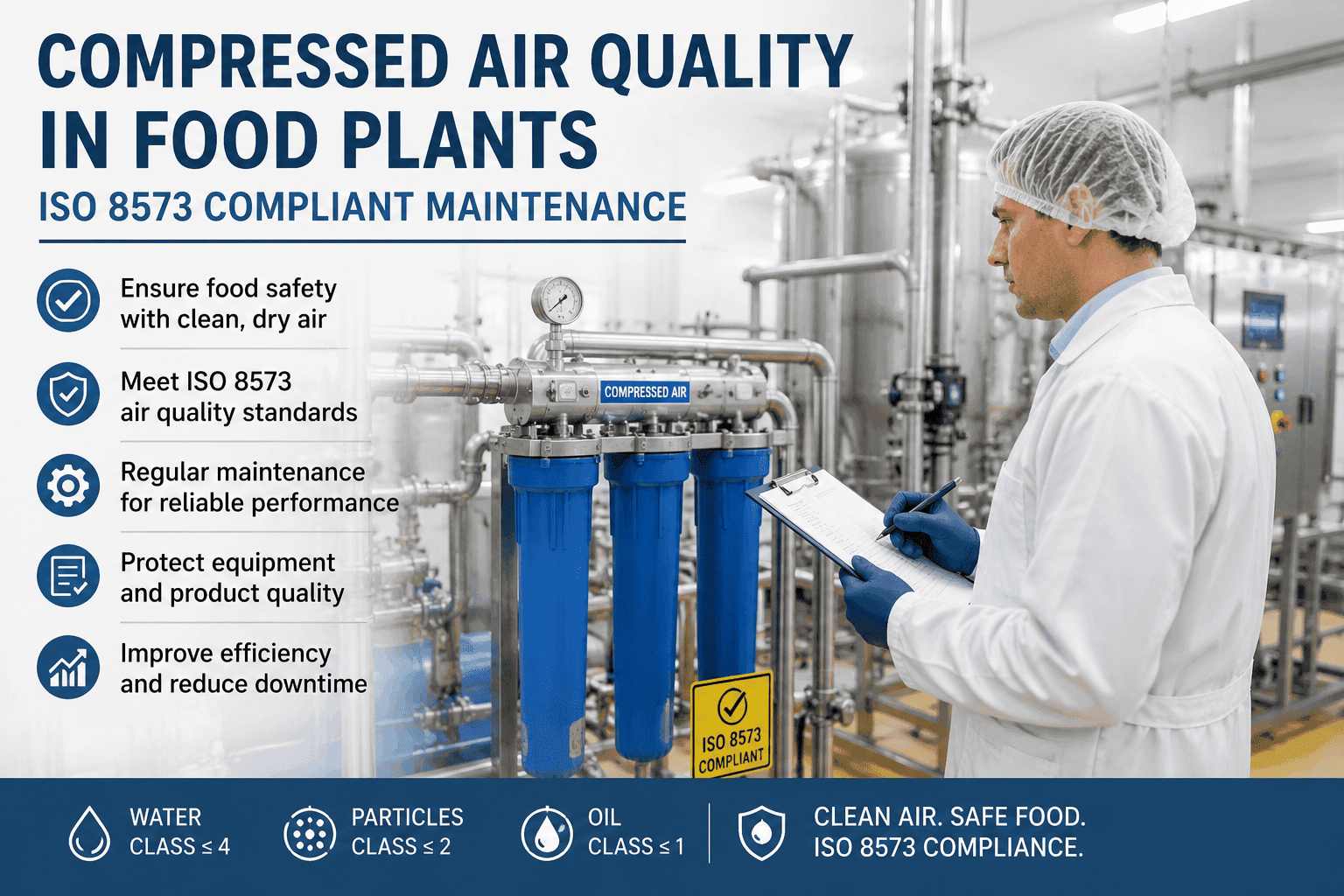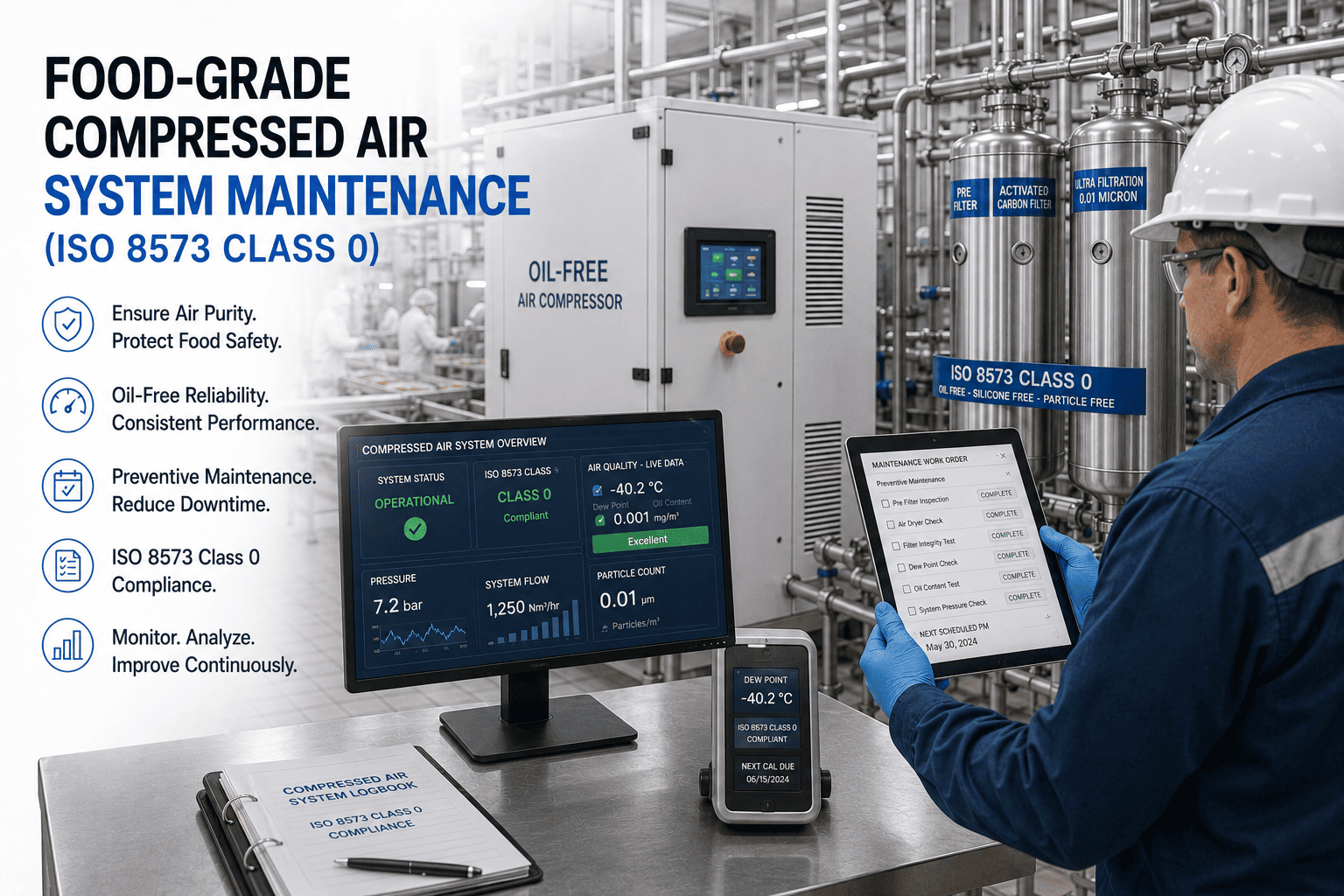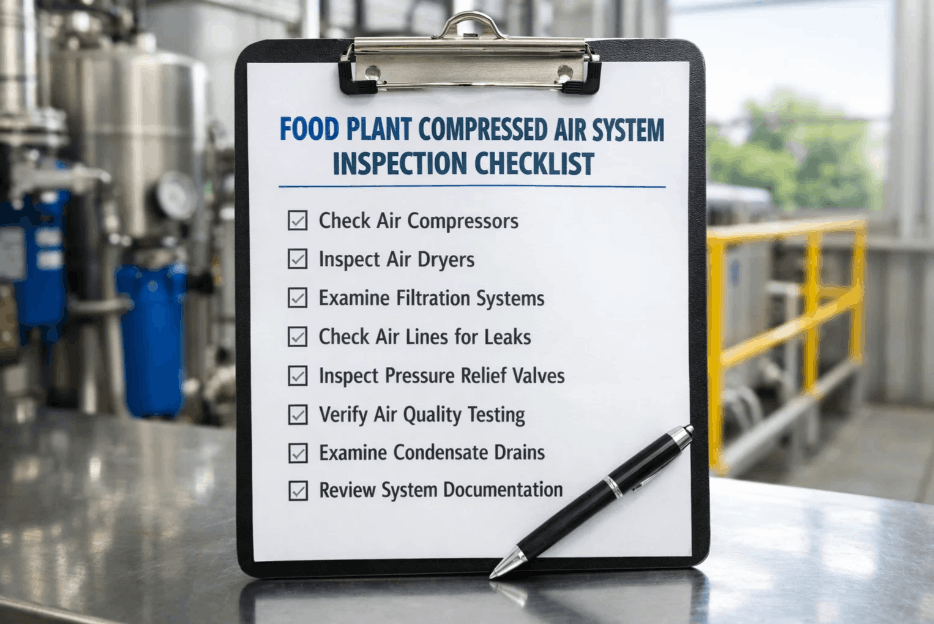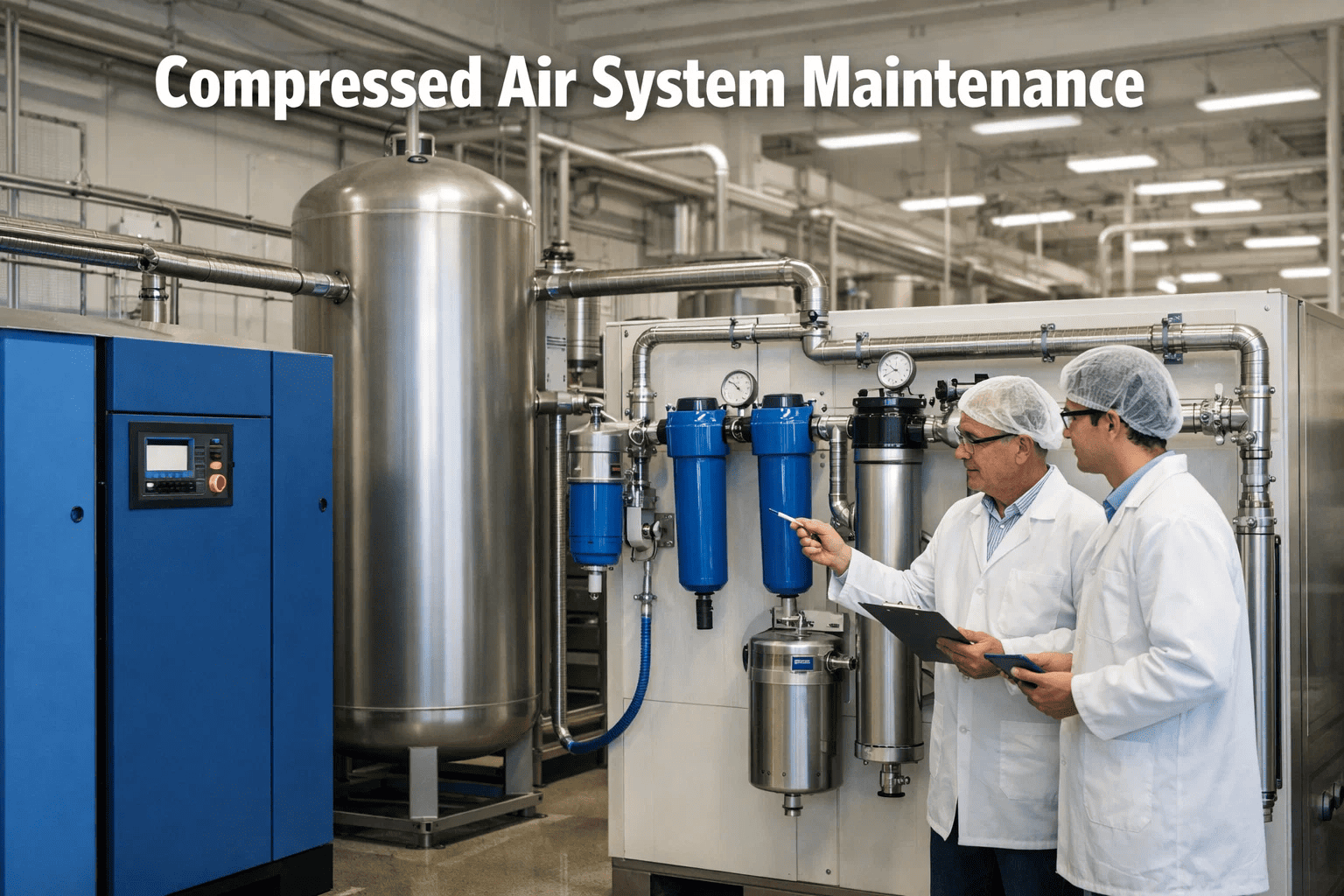
Compressed air is the fourth utility in food manufacturing — after electricity, water, and gas — and it is the one most frequently mismanaged from a safety, contamination, and maintenance perspective. In bakeries, beverage plants, dairy facilities, and meat processing sites across the USA, UK, Australia, Canada, UAE, and Germany, compressed air contacts packaging materials, actuates food-contact pneumatic cylinders, purges filling heads, and conveys powdered ingredients directly into product streams. When that air contains oil aerosols, microbial contamination, water vapor, or particulates, the food safety consequences are immediate and severe. A structured, ISO 8573-compliant compressed air maintenance program is not optional for certified food manufacturers — it is a prerequisite for every major food safety standard including BRCGS, SQF, FSSC 22000, and HACCP. Getting that program right starts with start a free trial or book a demo to see how Oxmaint structures compressed air maintenance for food manufacturers.
Make Your Compressed Air System Audit-Ready and Contamination-Free
Oxmaint schedules filter change intervals, dew point verification, leak detection programs, and air quality test logging — all tied to your compressed air assets, automatically, with full audit trail documentation built in from day one.
What ISO 8573 Means for Food Plant Compressed Air
ISO 8573 defines compressed air quality in three dimensions: particulate content (Class 1–9), moisture/water content (Class 1–9), and total oil content (Class 0–4). For compressed air in direct or indirect food contact — filling heads, conveying systems, pneumatic actuators touching packaging — most food safety standards require Class 1 or 2 air quality across all three parameters. This is not achievable from a standard industrial compressor without appropriate filtration, drying, and a verified maintenance program. start a free trial and configure Oxmaint's compressed air PM workflow for your facility in minutes.
The 6 Critical Components of a Food-Grade Compressed Air System
Air Compressor — Oil-Free or Oil-Injected
Oil-free compressors are the safest choice for direct food contact air — eliminating oil carry-over risk entirely. Oil-injected compressors require downstream activated carbon filtration to achieve acceptable oil content. Both types need quarterly filter inspection, annual valve servicing, and belt/seal replacement per OEM schedule.
Refrigerated Air Dryers
Refrigerated dryers remove bulk moisture, achieving pressure dew points of +3°C to +7°C — adequate for many indirect contact applications. Heat exchanger fouling, refrigerant level degradation, and condensate drain fouling are the primary failure modes. Monthly drain verification and quarterly heat exchanger inspection are standard.
Desiccant Dryers
Desiccant dryers achieve Class 1 and 2 moisture levels (-40°C to -70°C dew point) required for direct food contact and sensitive pneumatic instruments. Desiccant bed saturation and purge valve failure are the key maintenance items — requiring quarterly dew point verification and annual desiccant replacement cycles.
Coalescing and Activated Carbon Filters
Multi-stage filtration — pre-filter, coalescing filter, and activated carbon — removes particulates, aerosols, and residual oil vapor. Filter element differential pressure is the primary performance indicator: elements blocked beyond manufacturer limits pass contaminated air downstream regardless of installed filter rating.
Air Receivers and Distribution Lines
Receiver tanks accumulate condensate that introduces moisture and microbial risk downstream. Stainless steel or epoxy-lined receivers are required for food-grade systems. Weekly drain verification, annual internal inspection, and pressure vessel certification maintenance are the core tasks.
Point-of-Use Regulators and Pneumatic Tools
Point-of-use fittings, pneumatic cylinders, and handheld tools introduce contamination risk through worn seals and internal corrosion. Food-grade lubricants (NSF H1) must be used in all pneumatic systems with food contact potential. Quarterly seal inspection and lubrication verification are standard PM items.
Where Compressed Air Programs Fail Food Plant Audits
Overdue Filter Element Replacements
Filter elements past their service interval allow oil, particulates, and moisture to bypass the filtration stage — delivering non-compliant air to food contact points. Most failures occur not from filter malfunction but from deferred replacement due to missing PM schedules.
No Air Quality Test Records
BRCGS and SQF require documented air quality test results at defined intervals. Facilities relying on installation certificates from 3 years ago — without periodic retesting records — receive immediate non-conformances. Annual third-party air quality testing must be documented in the CMMS with certificates attached.
Undetected System Leaks
The average food plant loses 20–30% of compressed air output through system leaks — adding 25–35% to compressor energy costs. Without an annual ultrasonic leak detection survey, this loss accumulates invisibly across fittings, hose connections, and regulator bodies throughout the distribution network.
Expired Pressure Vessel Certificates
Air receivers are pressure vessels requiring statutory inspection under ASME, PSSR 2000 (UK), and equivalent frameworks globally. Expired certificates create immediate regulatory exposure, insurance liability, and audit non-conformances — particularly visible in multi-site portfolios managed without centralized certificate tracking.
How Oxmaint Structures Compressed Air Maintenance
Oxmaint centralizes compressed air system maintenance — connecting every compressor, dryer, filter, receiver, and distribution component into one asset hierarchy with scheduled PM, compliance tracking, and condition-based alerting. book a demo and see the compressed air maintenance workflow Oxmaint uses in certified food manufacturing facilities.
Complete Compressed Air Asset Hierarchy
Register every compressor, dryer, filter bank, receiver, and point-of-use regulator with model data, install date, service intervals, and certification status — creating the digital record that makes compliance tracking automatic.
Automated Filter Replacement Schedules
Configure filter element change intervals by hours, differential pressure, or calendar — whichever comes first. Oxmaint generates work orders before filters reach end-of-life, with element part numbers and technician instructions embedded in the task.
Air Quality Test Log Management
Upload annual ISO 8573 air quality test certificates to the relevant assets in Oxmaint. Expiry alerts notify compliance teams 60 and 30 days before retesting is required — eliminating the manual tracking failures that produce audit gaps.
Annual Leak Survey Work Orders
Schedule annual ultrasonic leak detection surveys as structured work orders with location-by-location checklists. Log leak locations, estimated flow rates, and repair actions — creating a year-over-year record of leak population and energy savings from repairs.
Pressure Vessel Certificate Tracking
Store ASME/PSSR inspection certificates for every air receiver in the asset record. Oxmaint triggers renewal alerts before statutory inspection windows close — protecting against the certificate lapses that generate immediate regulatory notifications during audits.
Dew Point and Pressure Trending
Connect dew point transmitters and pressure sensors to Oxmaint via IoT integration. Dew point drift above specification automatically generates a work order to inspect the dryer — catching desiccant saturation or refrigerant issues before air quality degrades downstream.
Reactive vs. Structured: Compressed Air Maintenance Comparison
Compressed Air Maintenance ROI for Food Manufacturers
Compressed Air Maintenance Frequency Guide
| Component | Task | Interval | Key Risk if Deferred | Compliance Standard |
|---|---|---|---|---|
| Coalescing Filter | Element replacement | Quarterly or 2,000 hrs | Oil and moisture bypass | ISO 8573 / BRCGS 4.9 |
| Activated Carbon Filter | Element replacement | Every 6 months | Oil vapor in food contact air | ISO 8573 / SQF |
| Refrigerated Dryer | Heat exchanger cleaning + condensate drain test | Monthly | Elevated dew point — moisture contamination | OEM / ISO 8573 |
| Desiccant Dryer | Desiccant bed replacement | Annual or per dew point trend | Moisture breakthrough — Class 2 loss | ISO 8573 Class 1/2 |
| Air Compressor | Oil, filter, valve, belt service | Per OEM (typically 2,000–4,000 hrs) | Compressor failure — full system loss | OEM Schedule |
| Air Receiver | Condensate drain verification | Weekly | Water accumulation — microbial growth | ASME / PSSR 2000 |
| Air Receiver | Statutory pressure vessel inspection | Annual (jurisdiction specific) | Certificate lapse — regulatory exposure | ASME / PSSR / TRD |
| Entire System | ISO 8573 air quality testing (third party) | Annual minimum | Undocumented contamination — audit failure | BRCGS / SQF / FSSC 22000 |
Frequently Asked Questions
Does all compressed air in a food plant need to meet ISO 8573 Class 1?
No — compressed air quality requirements are tiered by application. Air that directly contacts food or food-contact surfaces must meet the highest quality levels (Class 1 or 2 for particulates, moisture, and oil; Class A for microbiological). Air used for non-contact applications — equipment actuation in sealed systems, general-purpose tools in non-food areas — can comply with less stringent classes. Most BRCGS and SQF auditors require facilities to have a documented air quality risk assessment that maps each air use point to its required quality class and verifies that the installed filtration system can achieve that class.
How often should air quality testing be conducted in a certified food facility?
Annual third-party ISO 8573 air quality testing is the minimum requirement under BRCGS Issue 9 and SQF Edition 9 for all air contact applications. Facilities with higher contamination risk — direct product contact air, aseptic packaging lines, or applications where air contamination could reach vulnerable consumers — should consider semi-annual testing. Test results and certificates must be retained in the asset record and available for auditor review at any time. Facilities undergoing capital changes to their compressed air system should retest after any major modification.
What is the most common compressed air system failure in food plants?
The most common failures in food plant compressed air systems are: condensate drain malfunction (the most frequent cause of moisture breakthrough and downstream contamination), filter element overservice beyond rated capacity (the most common cause of oil and particulate contamination events), and refrigerated dryer heat exchanger fouling (the most common cause of dew point elevation). All three are entirely preventable through scheduled PM with Oxmaint-automated work orders — and all three typically go undetected in facilities without structured compressed air maintenance programs.
Can Oxmaint manage compressed air PM across multiple food plant sites?
Yes. Oxmaint's multi-site CMMS allows maintenance teams to manage compressed air asset records, PM schedules, air quality test certificates, and pressure vessel certifications across all facilities from one centralized platform. Regional compliance managers can view certificate expiry status across multiple sites simultaneously, and site-level maintenance teams receive automated work order prompts for their specific tasks. This is particularly valuable for food manufacturers operating in multiple regulatory jurisdictions — where ASME, PSSR, and ISO 8573 requirements apply to different facilities within the same portfolio.
Your Compressed Air System Is a Food Safety Asset — Manage It Like One
Oxmaint gives food plant teams the filter scheduling, air quality certificate tracking, leak survey management, and pressure vessel compliance tools that turn a liability into a documented, audit-ready asset. Facilities across the USA, UK, Germany, UAE, and Australia use Oxmaint to maintain food-grade compressed air programs without the administrative burden of manual tracking.