In 2026, AI-powered maintenance is no longer a pilot program — it is the operational baseline for government agencies that refuse to keep paying 3–5× the cost of planned repairs in emergency response spend. Machine learning models trained on public asset failure histories now predict HVAC failures 60 days out, autonomous work orders dispatch technicians before citizens notice a fault, and smart building analytics identify $200K–$400K in annual energy waste that manual HVAC schedules leave on the table. Schedule a demo to see how Oxmaint's AI Predictive Engine delivers this for your government facility portfolio.
AI-powered government facility maintenance in 2026 uses machine learning models trained on public asset condition data, sensor streams, and maintenance histories to predict failures before they occur, auto-generate work orders, optimize energy consumption, and produce the capital planning evidence government budget cycles require. Oxmaint's AI Predictive Engine, Autonomous Work Order system, and Smart Building Analytics deliver these capabilities to government agencies without requiring data science staff or lengthy implementation projects.
What AI Actually Does in Government Facility Maintenance
AI in government maintenance is not a chatbot. It is a pattern recognition engine applied to the data streams that government facilities already generate — asset condition records, sensor readings, work order histories, and energy meter data — to identify failure precursors weeks or months before any single threshold alert would fire. Book a demo to see Oxmaint's AI Predictive Engine analyzing your asset data.
Machine learning models assign a failure probability score to each asset — updated continuously as sensor data, maintenance records, and condition readings change. Scores above threshold auto-queue assets for inspection or proactive replacement before failure occurs.
When AI identifies a high-probability failure event, it generates, assigns, and schedules a corrective work order — routing the right technician to the right asset with pre-populated diagnostic steps, without requiring a dispatcher or supervisor intervention.
AI analyzes occupancy patterns, weather data, and HVAC performance against energy meter readings — identifying setback opportunities, equipment inefficiencies, and load optimization adjustments that reduce energy spend 20–30% without comfort trade-offs.
AI aggregates failure probability scores, RUL projections, and condition trends across an entire building portfolio — producing ranked replacement priority lists and 10-year capital schedules that update automatically as new data enters the system.
Oxmaint AI Predictive Engine — Live in Your Portfolio
Failure probability scoring, autonomous work order generation, and smart building analytics — built for government operations without requiring data science staff or a separate AI platform.
AI Capabilities by Government Asset Category
AI delivers different value across different public infrastructure categories. Here is what the predictive engine targets in each major government asset class — and what the intervention prevents.
AI models bearing temperature trends, refrigerant pressure curves, and filter differential pressure against failure event history — predicting compressor failures 45–60 days in advance. Average intervention cost: $12K. Average avoided emergency cost: $85K–$140K.
Vibration, flow rate, and motor current data modeled against pump failure curves — identifying bearing degradation and seal failure 30–90 days before breakdown. Unplanned pump failure costs $45K–$180K per event including emergency contractor premiums.
Infrared thermal scan data and load monitoring trends detect insulation degradation and loose connections before arc flash or transformer failure. AI flags panels approaching critical thermal thresholds weeks before an electrician would notice on a scheduled inspection.
Moisture sensor trends, thermal imaging data, and precipitation event logs modeled against membrane condition scores — identifying active leak zones before interior damage occurs. Early detection saves $180K–$600K per roof replacement cycle.
Door cycle counts, motor load curves, and hydraulic pressure data predict elevator failures that would trigger ADA compliance violations and emergency repair costs of $18K–$65K per event plus service interruption penalties.
Engine telemetry, fuel consumption trends, and PM compliance data modeled to predict drivetrain and hydraulic failures — keeping emergency vehicles and public works equipment at 92%+ availability without reactive repair cycles.
How Oxmaint Delivers AI-Powered Government Maintenance
Oxmaint's AI Predictive Engine analyzes multi-variable data streams per asset — sensor readings, maintenance history, work order frequency, condition scores, and environmental factors — assigning a failure probability score that updates continuously. Assets crossing configurable thresholds automatically enter the predictive intervention queue. No data scientist required. No separate AI platform. Book a demo to see failure probability scoring on your asset inventory.
When the predictive engine identifies a high-probability failure event, Oxmaint's Autonomous Work Order system generates the corrective work order — pre-populated with asset ID, failure type, diagnostic steps, required parts, and technician assignment — without requiring human dispatcher intervention. Every autonomous work order is timestamped, GPS-located, and linked to the originating prediction event for full audit trail documentation.
Oxmaint's Smart Building Analytics module ingests BMS data, occupancy sensor feeds, and energy meter readings — applying pattern recognition to identify HVAC setback opportunities, lighting schedule inefficiencies, and demand response optimization windows. Typical government building portfolios identify $200K–$400K in annual energy waste within 90 days of data collection. Schedule a demo to see energy analytics configured for your building portfolio.
Failure probability scores and condition trend data feed directly into Oxmaint's FCI scoring and CIP forecasting engines — producing AI-generated capital replacement priorities ranked by failure probability, consequence of failure, and cost-per-unit-time replacement economics. Rolling 10-year capital schedules update automatically as new asset data enters the system — eliminating the 4–8 week manual CIP compilation cycle per annual budget submission.
AI Adoption Stages for Government Agencies
Most government agencies do not start with a fully deployed AI predictive engine. They progress through three stages — each delivering measurable ROI before moving to the next. Understanding where your agency sits determines the right deployment strategy.
Asset registry with condition scores, automated PM scheduling, and mobile work order completion. This is the data infrastructure AI requires — without clean, structured asset data, predictive models have nothing to learn from.
IoT and BMS data connected to the asset management platform. Real-time sensor feeds create the continuous data stream that AI models need to identify failure precursors — going beyond scheduled inspection data alone.
Machine learning models trained on 6–12 months of operational data begin producing failure probability scores per asset — identifying failure events 30–90 days in advance with defensible confidence levels for capital planning purposes.
Oxmaint AI Capabilities — What We Deliver
Multi-variable ML model scores per asset — updated continuously from sensor data, work order history, and condition readings. Configurable alert thresholds trigger autonomous intervention queues.
AI-triggered work orders auto-generated, assigned, and scheduled without dispatcher intervention — pre-populated with asset context, diagnostic steps, and required parts. Full audit trail linked to originating prediction event.
BMS and occupancy data analyzed for energy optimization — HVAC setback schedules, lighting efficiency, and demand response windows identified automatically. Typical saving: $200K–$400K annually per 20-building portfolio.
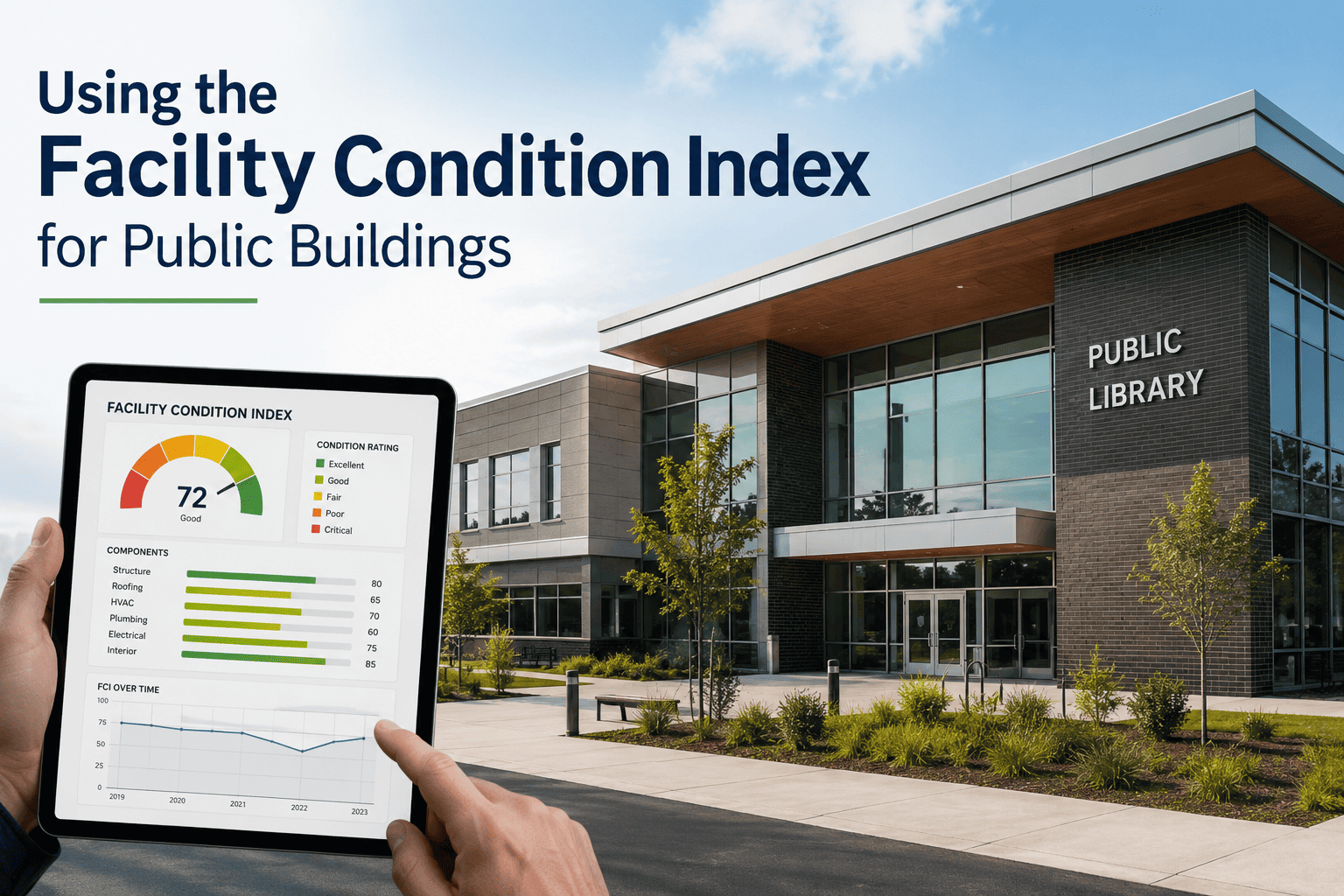
Facility Condition Index updated continuously by AI as sensor data and work order outcomes change condition trajectories — producing real-time capital planning evidence without manual engineering assessment cycles.
AI-aggregated infrastructure health scores across every department and building — giving city managers and elected officials a real-time view of risk concentration without manual compilation.
AI failure probability scores feed directly into rolling 10-year CIP schedules — ranked by failure probability, consequence weight, and cost economics. Auto-updated as new data changes risk profiles across the portfolio.
AI Performance Benchmarks — Oxmaint-Deployed Government Agencies
AI vs Traditional Maintenance — The Government Operations Comparison
Frequently Asked Questions
Continue Reading
Deploy AI Predictive Maintenance Across Your Government Facility Portfolio
Oxmaint's AI Predictive Engine, Autonomous Work Orders, and Smart Building Analytics deliver failure prediction, energy optimization, and AI-backed capital planning — live in government facilities without data science staff or lengthy implementation.