Public facilities directors defend capital budgets using age estimates and anecdotal break histories — while the same buildings hold $130B+ in deferred maintenance growing at 7% annually. Digital twin technology closes this gap: a virtual model of each facility updated from live sensor and work order data, running failure simulations before they happen in the real building. Schedule a demo to see how Oxmaint's digital twin integration delivers this for government facility portfolios.
A government facility digital twin is a live virtual model of a public building — updated continuously from IoT sensors, work order data, and inspection records — that allows facilities directors to simulate maintenance scenarios, predict component failures, and generate asset condition evidence required for capital budget approval and federal grant applications.
What Is a Government Facility Digital Twin?
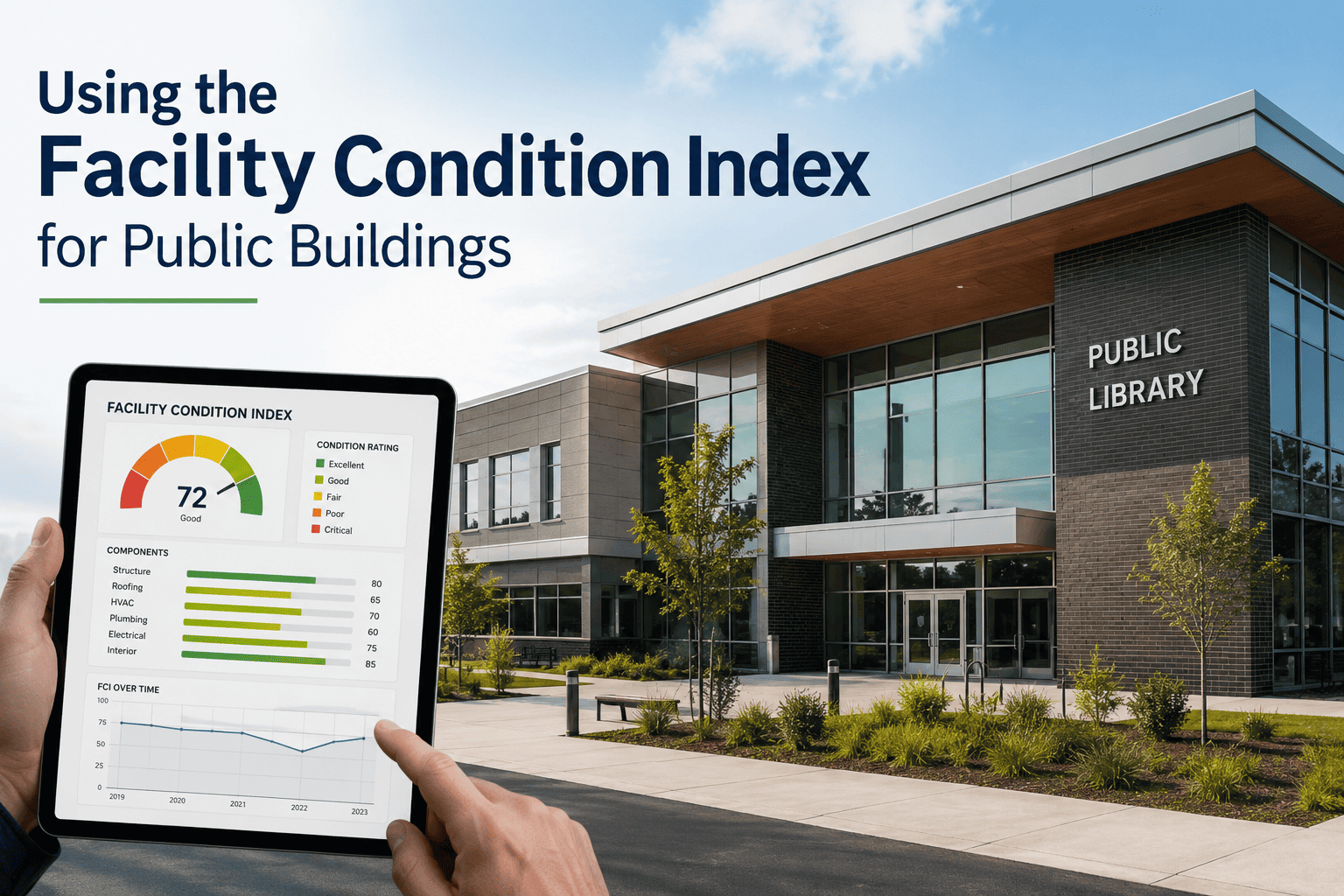
A digital twin is more than a 3D building model. It is a data-synchronized virtual replica reflecting the current condition of every system in a facility — HVAC, electrical panels, plumbing, roofing, and structural elements — updated in real time from sensors, inspections, and work order completions. For government facilities, the most valuable output is the FCI score, RUL projection, and capital forecast the twin generates automatically as field data flows in.
Every physical asset mapped to a digital record — specs, installation date, replacement value, and maintenance history linked to the virtual model geometry.
IoT sensors stream temperature, pressure, vibration, and energy data into the twin — triggering alerts and work orders when readings deviate from baseline thresholds.
Run what-if scenarios against the virtual model — simulate failure consequences, test replacement timing, and compare intervention costs before committing capital.
FCI scores, RUL projections, and 10-year replacement schedules generated automatically — formatted for council submission and federal grant applications.
See Oxmaint's Digital Twin Integration Live
Oxmaint connects your asset registry, IoT sensor feeds, and work order data into a live condition model — no BIM specialist or separate platform required.
How Government Facilities Use Digital Twins Today
Early government digital twin adoption has concentrated in three areas where the data-to-decision gap is most costly: capital budget justification, energy optimization, and emergency response preparedness. Book a demo to see how Oxmaint delivers each capability for your facility portfolio.
FCI-scored asset condition maps give council members visual evidence of infrastructure degradation — replacing age-estimate spreadsheets. Approval rates rise from 47% to 88%.
Twins simulate occupancy patterns against HVAC load data — identifying setback schedules that reduce energy spend 20–25% without additional hardware.
Virtual building models pre-loaded with utility shutoff points, fire suppression zones, and access route data — instantly accessible to first responders during incidents.
Sensor trend analysis identifies equipment approaching failure 30–90 days in advance — converting $85K emergency replacements into $22K planned interventions.
Model proposed renovations against existing infrastructure before committing to design — identifying conflicts and reducing construction change orders by up to 30%.
Aggregate FCI scores across a 20-building portfolio into a single dashboard — giving directors and elected officials real-time visibility without manual compilation.
What Oxmaint Delivers for Government Digital Twin Programs
Most government facilities don't need a bespoke BIM platform. They need existing asset data, work order history, and IoT feeds connected into a live condition model that produces capital planning outputs for their budget cycles. That is what Oxmaint delivers.
Oxmaint's asset registry — every building, system, and component with condition scores and maintenance history — serves as the data layer for digital twin functionality. No separate BIM import required. Records update automatically as work orders close. Book a demo to see the asset registry configured for your portfolio.
Oxmaint connects to HVAC sensors, electrical meters, leak detectors, and BMS systems via API and IoT protocols — streaming live condition data into asset records. Threshold breaches automatically generate work orders with equipment ID, reading value, and timestamp pre-populated. This is the sensor layer that makes a digital twin live rather than static.
Oxmaint's 3D visualization module maps asset condition scores onto building floor plans — giving directors a spatial view of where FCI thresholds are breached and which zones approach capital intervention. Scenario planning tools model intervention timing, cost, and consequence of deferral. Schedule a demo to see scenario planning for your CIP cycle.
RUL projections from the digital twin auto-trigger CIP entries when assets approach critical FCI thresholds. Rolling 10-year capital schedules formatted for council submission are generated without manual engineering staff compilation — replacing 4–8 weeks of annual effort with automated outputs that update continuously.
Digital Twin Implementation — Key Considerations for Government
Accurate asset records with condition scores deliver 80% of digital twin value before any visualization layer is added. Prioritize data quality over model complexity during initial deployment.
Most government buildings already have BMS, HVAC controls, and utility meters generating unused data. Connect existing sources before investing in new sensor hardware.
Deploy digital twin capital planning outputs 90 days before CIP submission deadlines — giving directors time to validate projections and format outputs for council presentation.
Begin with highest-FCI buildings where capital decisions are most urgent. Expand to the full portfolio once the data pipeline is validated — typically 3–6 months per phase.
Digital Twin ROI for Government Facility Portfolios
Oxmaint Solutions for Government Digital Twin Programs
Oxmaint is purpose-built for the constraints of government operations — fixed budgets, political cycles, and public records requirements. Digital twin capabilities are embedded in the platform, not bolted on as a separate product.
Auto-updated FCI scores per asset and building — the condition evidence that transforms capital budget submissions from estimates into data-backed requests councils approve.
Remaining Useful Life projections per asset class — automatically triggering CIP planning entries when assets approach replacement thresholds within the budget cycle horizon.
Rolling 5 and 10-year capital schedules formatted for council submission — generated automatically from twin condition data, updated continuously as field data changes.
Sensor anomalies auto-generate corrective work orders — closing the loop between the digital twin condition model and the field maintenance program in real time.
Asset condition scores mapped onto building floor plans — giving directors and elected officials a spatial view of infrastructure health without requiring GIS expertise.
Model intervention timing, cost of deferral, and multi-year capital scenarios — producing the what-if analysis that supports evidence-based infrastructure investment decisions.
Frequently Asked Questions
Continue Reading
Connect Your Facility Data Into a Live Capital Planning Model
Oxmaint's digital twin integration turns your asset registry, IoT feeds, and work order history into council-ready FCI reports and 10-year CIP forecasts — no BIM specialist required, live in 3–5 weeks.