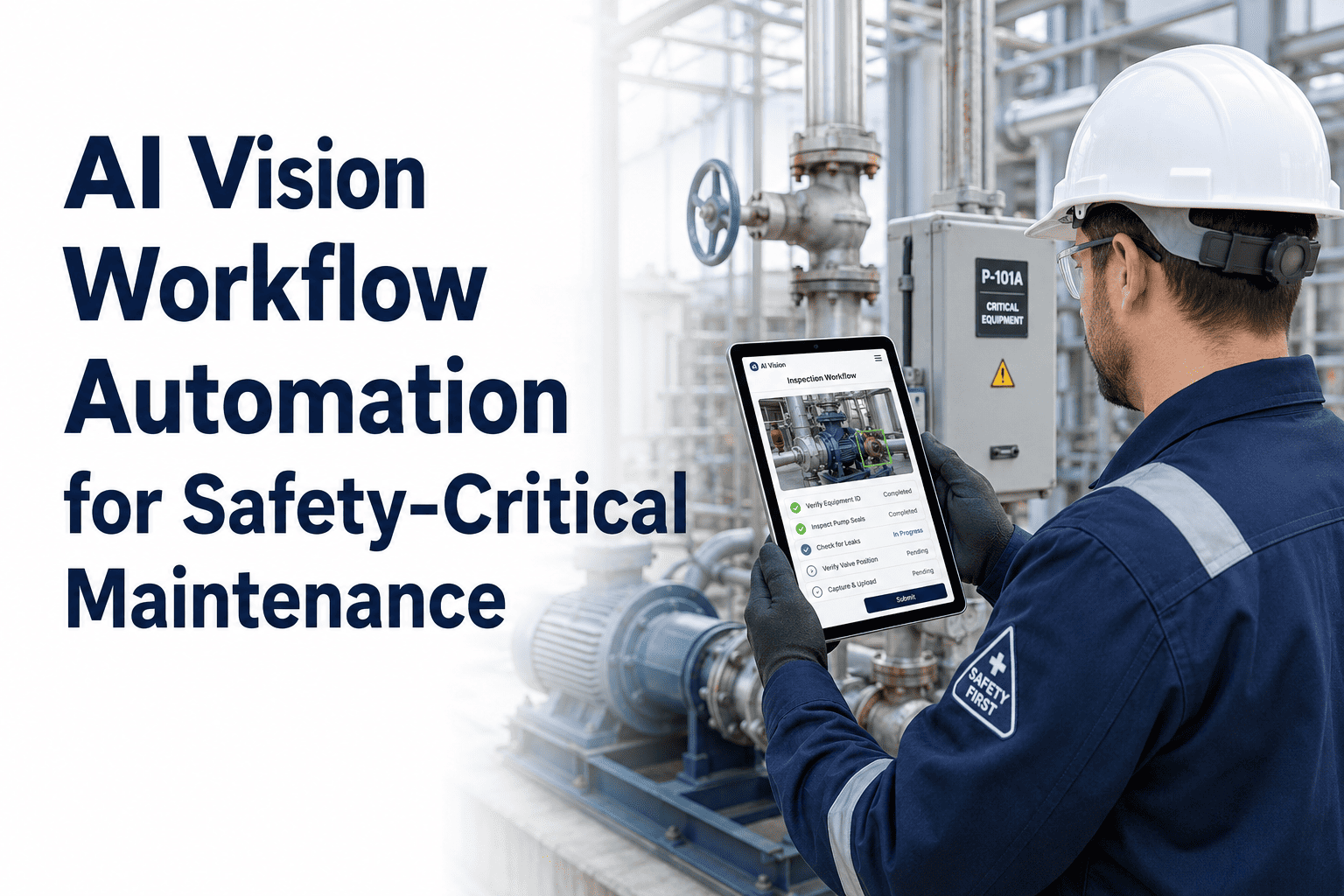
AI Vision Workflow Automation for Safety-Critical Maintenance

By James Smith on June 19, 2026

ai-vision-workflow-automation-for-safety-critical-maintenance

Safety-critical maintenance failures in government infrastructure — a missed electrical fault at a water treatment plant, a structural crack overlooked on a highway overpass, a generator anomaly at an emergency operations center — do not happen because inspectors are careless. They happen because the workflow between detection and response is too slow, too manual, and too dependent on individuals remembering to escalate. OxMaint AI Vision Workflow Automation eliminates that dependency by making the escalation automatic — the moment a camera detects a safety-relevant condition, OxMaint triggers the right response pathway without waiting for a human to decide whether to act. For government maintenance teams operating critical infrastructure, that difference between minutes and hours can determine whether a minor defect becomes a major incident. Start a free trial and configure your first safety-critical asset zone today.

AI Vision · Safety-Critical Maintenance · Government Infrastructure

Automated Response for Every Safety Risk — Before It Becomes an Incident

OxMaint AI Vision detects safety-critical conditions on public infrastructure, triggers the correct escalation pathway automatically, and creates a complete audit record — without waiting for manual intervention between detection and response.

Risk Coverage

Safety-Critical Asset Classes Monitored by OxMaint AI Vision

Critical
Electrical Infrastructure
Arc flash indicators
Heat signatures on panels
Moisture ingress on switchgear
Immediate shutdown alert + WO + Supervisor notification
High
Structural Assets
Crack propagation on bridges
Concrete spalling at joints
Corrosion on load-bearing steel
Priority WO + Structural engineer escalation
Medium-High
Water / Fluid Systems
Active leak near electrical
Pump housing staining
Valve seal failure indicators
Containment WO + Operations team alert
Monitor
Mechanical Systems
HVAC belt slippage
Generator fuel level low
Filter clogging — visual
Scheduled PM WO — next available window
Automation Logic

How the Safety-Critical Workflow Automation Fires

AI Detection Event Severity Tier Automated Action Response Time
Arc flash indicator on electrical panel Critical WO created + Supervisor + Safety officer notified + Shutdown flag < 60 sec
New crack propagation on bridge deck High Structural WO created + Engineer on-call alerted + Asset flagged for re-inspection < 2 min
Active fluid leak near electrical room High Containment WO + Facilities + Safety notification < 2 min
Generator fuel level at 15% Medium Scheduled refueling WO created + Ops team notified < 5 min
HVAC belt visual slippage detected Low PM WO added to next scheduled window — no immediate alert Next PM batch
OxMaint · AI Vision · Safety-Critical Government Assets

See the Automation Logic Run on Your Asset Types

A 30-minute demo covers how OxMaint AI Vision sets up safety-critical thresholds, configures escalation pathways by asset class, and generates the compliance records your department needs.

Measurable Outcomes

Safety and Compliance Results from AI Vision Automation

Mean Time to Respond — Safety Alerts
Manual Process

4.2 hrs
OxMaint AI

< 2 min
Safety Escalations Reaching Right Contact
Manual Process

54%
OxMaint AI

97%
Critical Defects with Complete Audit Record
Manual Process

41%
OxMaint AI

100%

"

In safety-critical government maintenance, the question is never whether to respond — it is whether the right person received the right information fast enough to respond correctly. Manual escalation chains fail because they depend on every link in that chain working simultaneously. AI vision workflow automation removes the human chain entirely from the detection-to-alert step, which is where most safety-critical failures actually occur. The right person receives the right information in under two minutes regardless of who else is available, on shift, or paying attention.

Anita Subramaniam
Safety and Maintenance Systems Consultant · 18 years in government infrastructure · NEBOSH Certified · Former PWD Safety Auditor
Frequently Asked Questions

AI Vision Safety Workflow Automation — Questions from Government Teams

How does OxMaint prevent false alarms from triggering unnecessary safety escalations?
OxMaint uses asset-class-specific detection thresholds that are calibrated during setup to distinguish true safety conditions from normal operational variation. Confidence scoring filters are applied per camera zone — a detection must exceed a set confidence level before triggering a Critical escalation. Planners can also review and tune thresholds over the first 30 days to reduce false positives without losing sensitivity to real conditions. Ask about threshold configuration in your demo session.
Can government teams configure different escalation contacts for different assets or shifts?
Yes. OxMaint supports escalation routing by asset type, site, shift schedule, and severity tier. A critical electrical panel alert at a water treatment plant can route to a different contact than the same severity alert at a road maintenance depot — and night-shift escalations can go to a different on-call contact than day-shift events. All routing rules are set in the OxMaint admin panel without any code configuration. Start a free trial and test the escalation routing configuration.
What compliance records does OxMaint generate for safety-critical incidents detected by AI vision?
Every AI-detected safety event generates a timestamped record containing the detection frame (image), asset ID, severity classification, notification log showing who was alerted and when, work order reference, and resolution confirmation. These records are exportable and are formatted to meet common government infrastructure safety audit requirements, including documentation for departmental review, incident reporting, and insurance purposes.
Does OxMaint AI Vision work with existing CCTV cameras already deployed at government facilities?
OxMaint integrates with most standard IP camera streams including existing CCTV infrastructure at government facilities, water plants, pump stations, and maintenance depots. A technical assessment confirms compatibility during onboarding. Book a demo and bring your current camera specifications — our team will confirm compatibility before you start a trial.
OxMaint · AI Vision · Safety-Critical · Free to Start

Safety-Critical Conditions Should Never Wait for Manual Escalation

OxMaint AI Vision detects, classifies, and escalates every safety condition on your public infrastructure automatically — before the window to respond closes. Government maintenance teams use it to stop incidents before they start.


Share This Story, Choose Your Platform!