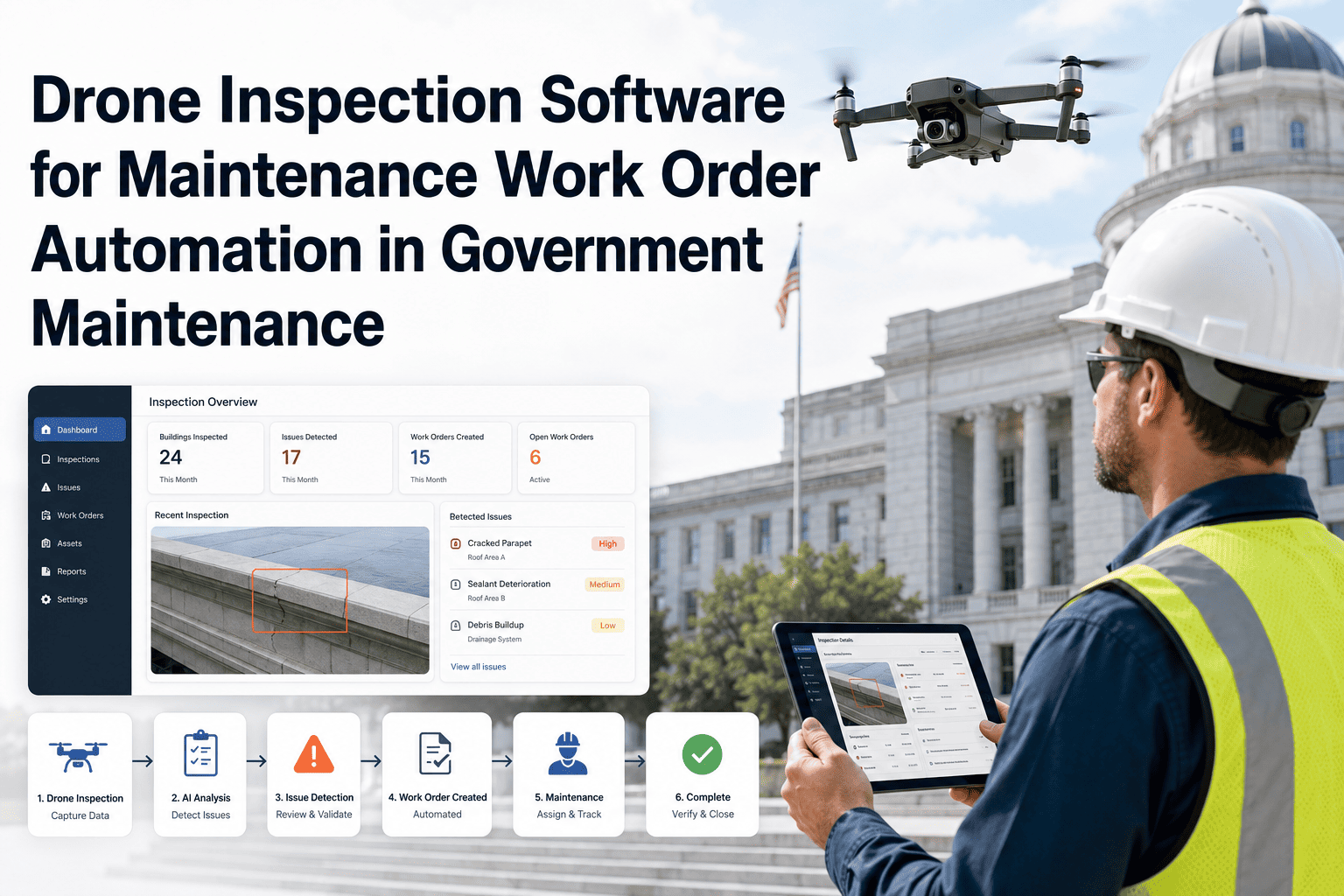
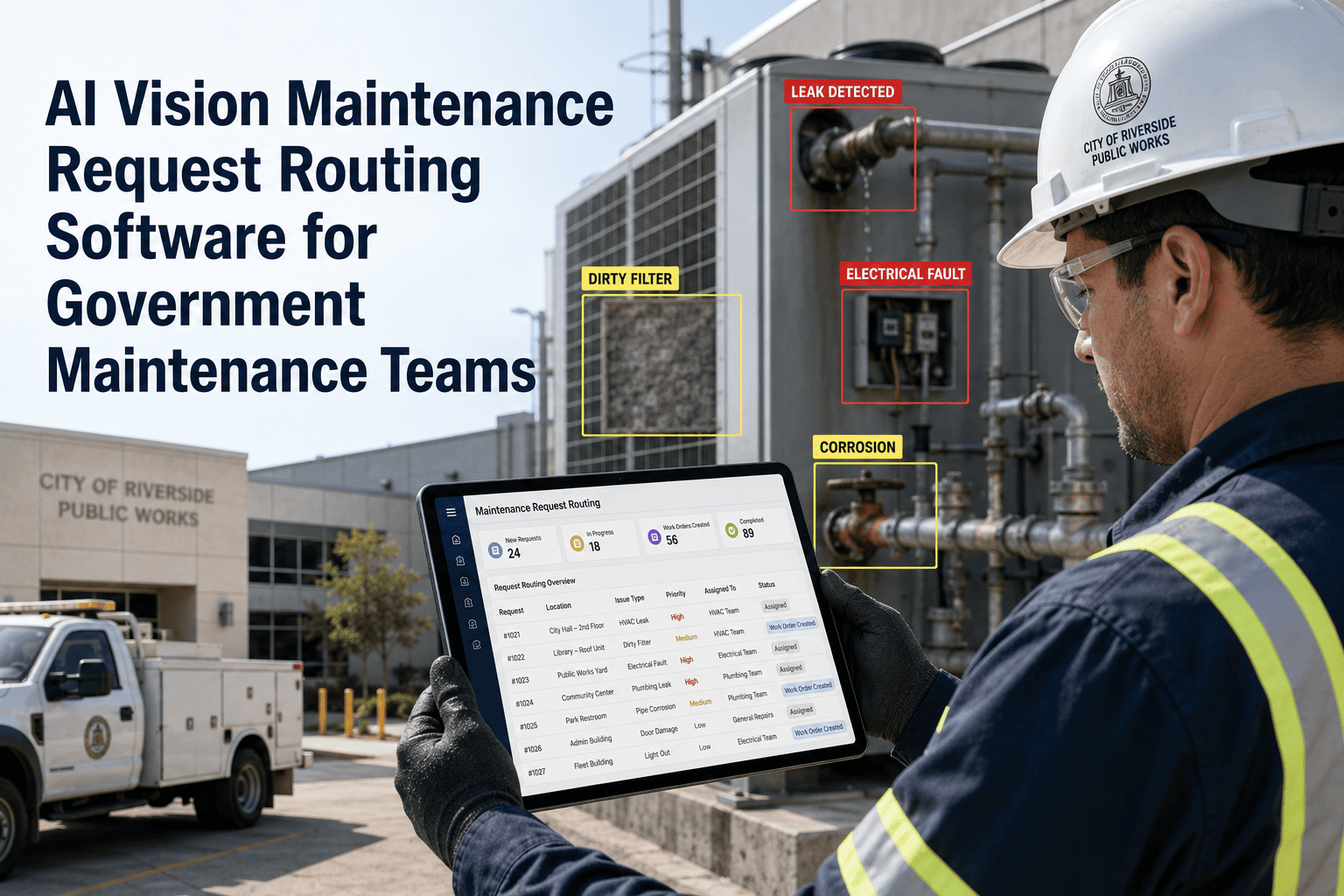
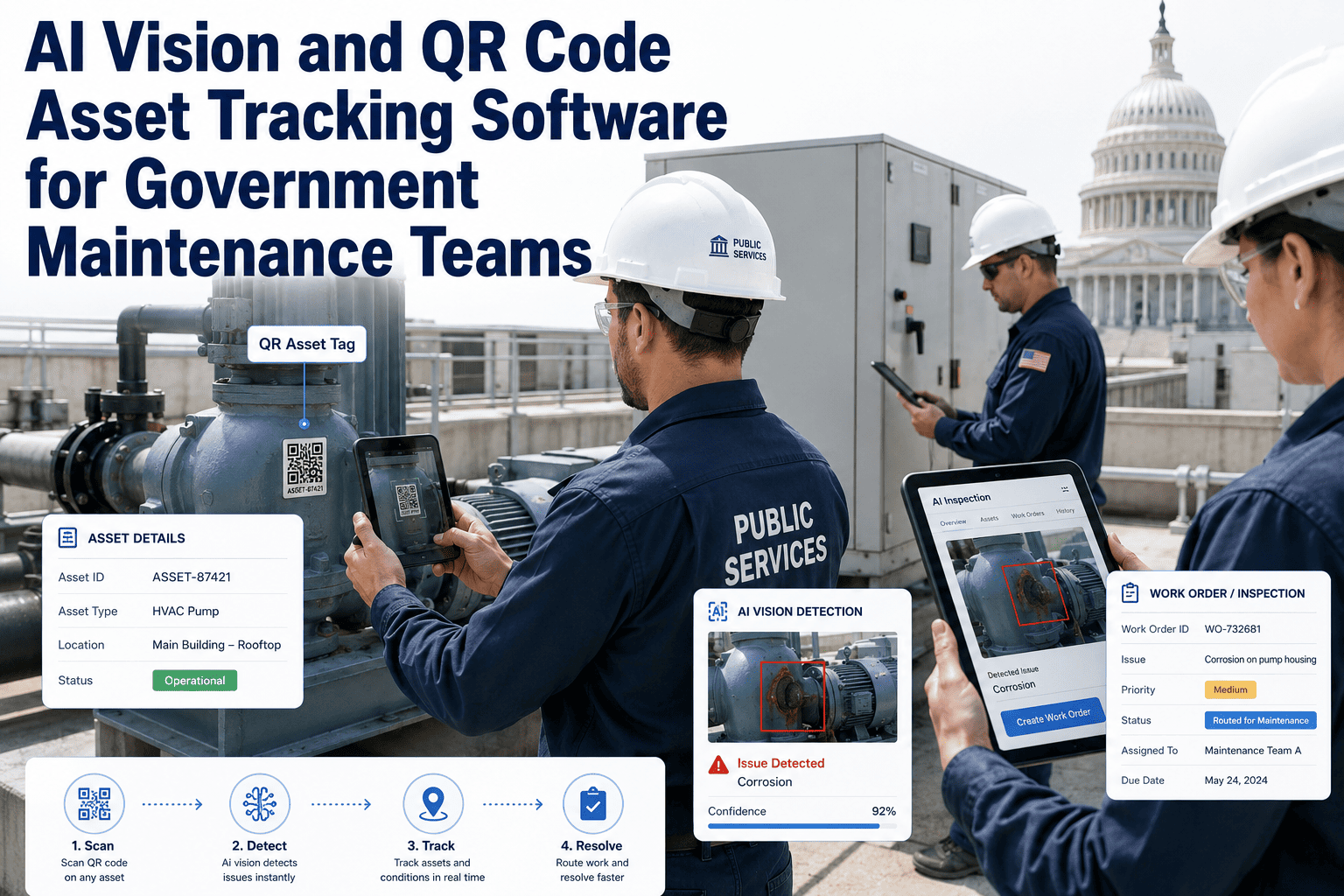
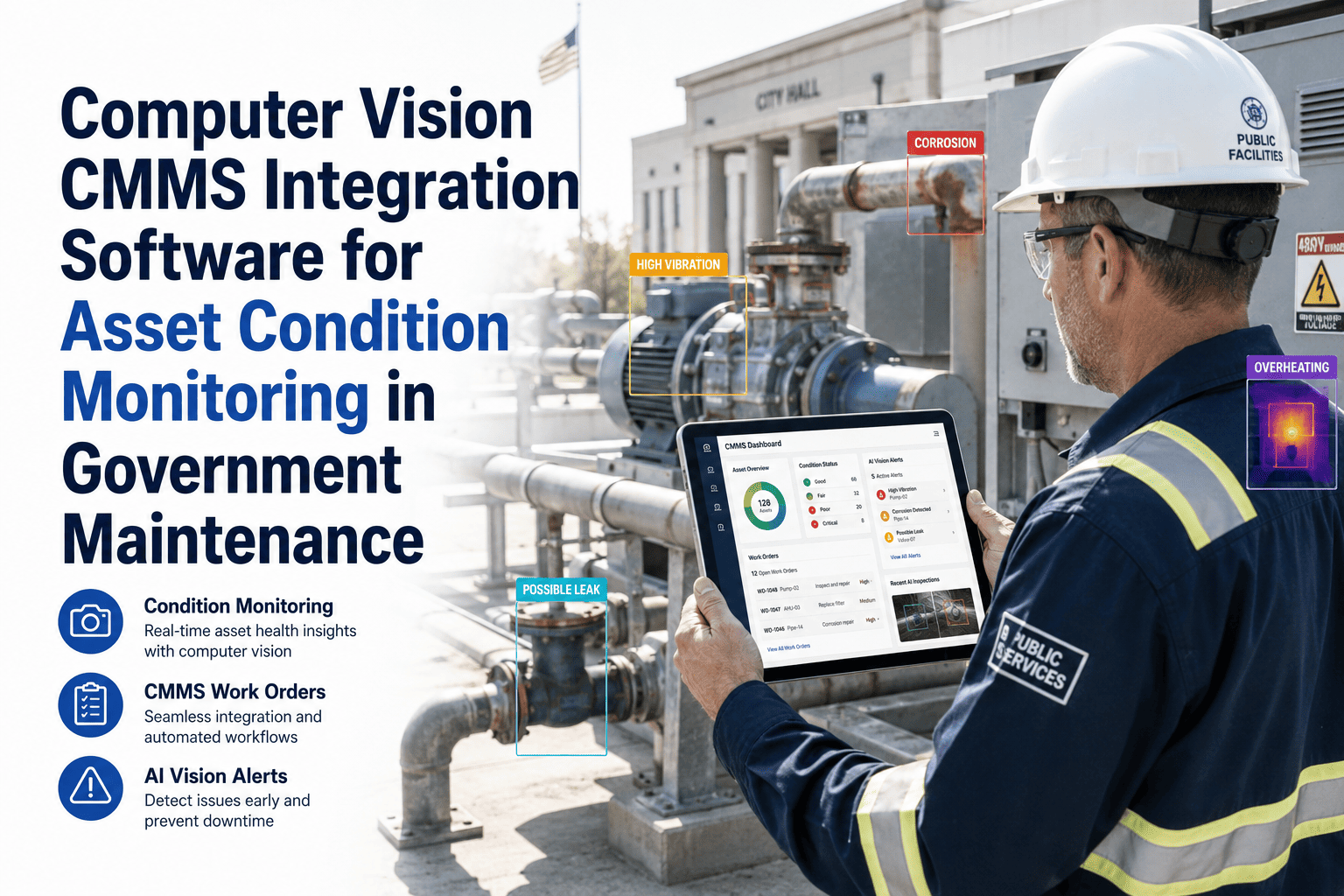
Preventive maintenance in government and public works has always depended on scheduled inspection rounds — a technician, a checklist, and a clipboard. But scheduled rounds only catch what happens to be visible on the day of inspection. Vision inspection integration gives preventive maintenance teams a continuous layer of asset monitoring that calendar-based PM programs cannot provide: cameras watch every asset every hour, AI flags degradation as it develops, and OxMaint automatically generates preventive work orders timed to intercept failures before they escalate. This guide explains how vision inspection integration works inside a preventive maintenance program, what government teams are measuring, and why asset condition data — not inspection schedules — is the better trigger for PM tasks. If your agency is ready to see this in practice, book a demo with OxMaint using your actual asset inventory.
Vision Inspection · Preventive Maintenance · Government Teams
Vision Inspection Integration for Preventive Government Maintenance
Scheduled PMs miss what happens between rounds. Vision inspection gives your preventive maintenance program the continuous condition data it was always missing — and turns every camera into an early-warning system.
Preventive Maintenance Has a Visibility Problem
A PM schedule tells technicians when to inspect. It does not tell them what changed between inspections. Asset degradation does not respect calendar intervals — and that gap is where infrastructure failures are born.
Defect develops in Week 2. PM inspection doesn't catch it until Week 8 — 6 weeks later, when repair cost has tripled.
Vision AI
Continuous 24/7 monitoring
Detected Week 2 — WO auto-created
How Vision Inspection Strengthens Your PM Program
01
Condition-Triggered PMs
Vision AI detects early-stage degradation — corrosion onset, surface cracking, seal deterioration — and triggers PM tasks before they progress to repair-level defects. Your PM schedule becomes a floor, not a ceiling.
02
Visual Evidence in Every PM Record
Every PM inspection round is automatically documented with camera-captured asset state — before and after comparison, with AI-annotated images stored in the work order history for each asset.
03
PM Interval Optimization
Condition data from ongoing vision monitoring shows which assets degrade faster than scheduled intervals predict. OxMaint uses this data to recommend PM interval adjustments — cutting unnecessary rounds and adding frequency where it matters.
04
Multi-Site Coverage Without More Staff
Government maintenance teams covering dozens of sites cannot scale manual inspection rounds to match the asset inventory. Vision inspection extends monitoring coverage without additional inspection headcount — cameras cover what people cannot.
PM Program Performance: Scheduled Only vs. Vision-Integrated
| Performance Metric |
Scheduled PM Only |
Vision-Integrated PM |
| Asset inspection frequency |
Weekly or monthly rounds |
Continuous — every hour |
| Defect detection lead time |
Days to weeks after appearance |
Hours after first detection signal |
| PM evidence documentation |
Technician text notes |
Annotated image + AI severity score |
| False alarm rate |
N/A (manual judgment) |
Under 5% with purpose-built AI |
| Work order creation speed |
15–60 min after detection |
Under 2 seconds, automatic |
| PM interval accuracy |
Fixed calendar — ignores condition |
Adjusted by real asset condition data |
| Unplanned downtime reduction |
Moderate (PMs help) |
Up to 41% further reduction |
See vision inspection integrated with your PM program — live, with your asset types.
OxMaint's team will walk through a live demo using government and public works asset scenarios specific to your maintenance environment.
What Government PM Teams Monitor with Vision AI
Bridges and Structures
Surface crack progression, joint degradation, coating failure, drainage blockage
Water and Sewer Systems
Visible leaks, corrosion spread, manhole condition, sediment buildup
Public Buildings
Facade cracks, roof wear, HVAC exterior condition, entry/exit surface wear
Roads and Pavements
Pothole formation, lane marking degradation, drainage grate condition
Government Fleet
Pre-shift condition scan, body damage, fluid leak detection, light systems
Electrical Infrastructure
Cabinet seal integrity, connector corrosion, weathering damage
Expert Perspective
Vision inspection integration does not replace a preventive maintenance program — it gives it the condition data it was always missing. Government maintenance teams running scheduled PM rounds are doing the right work at the wrong intervals. When you add continuous vision monitoring, PM tasks are triggered by what is actually happening to the asset — not by a calendar that cannot see degradation. The result is fewer emergency repairs, better budget predictability, and an audit trail that satisfies even the most thorough oversight review.
Senior Maintenance Strategy Consultant — Government Infrastructure Programs
Frequently Asked Questions
Will vision inspection replace our current PM inspection schedules?
No — it enhances them. Vision inspection provides continuous monitoring between scheduled rounds, so your team's PM work orders are now supplemented by condition-triggered work orders generated automatically when AI detects early-stage degradation. Many government agencies find that vision integration allows them to extend intervals for stable assets while increasing attention on those showing actual degradation signals.
Book a demo to see how OxMaint layers vision monitoring on top of your existing PM schedule.
How does OxMaint know which defects are PM-relevant versus urgent repairs?
OxMaint AI classifies each detected defect by type and severity on a 1–5 scale. Severity 1–2 findings generate preventive work orders — scheduled for the next available crew. Severity 3–4 generates priority PM work orders with shorter response windows. Severity 5 triggers immediate dispatch as an urgent repair work order. Government teams configure these thresholds during onboarding and can adjust them by asset category and zone.
Start a free trial to configure your thresholds.
Can vision-generated PM records satisfy government audit and compliance requirements?
Yes. Every vision-triggered PM work order includes timestamped annotated images, AI defect classification, asset ID, severity score, and the complete resolution history. These records are stored as immutable logs and are exportable for state, federal, and local compliance audits. They also satisfy documentation requirements for infrastructure grant reporting and government asset management frameworks such as GASB 34.
What if our agency has limited camera coverage — can we still benefit?
Yes. OxMaint supports hybrid operation — vision inspection covering camera-equipped zones, and traditional PM inspection rounds for areas without camera coverage. The same CMMS platform manages both, giving supervisors a unified work order queue regardless of how the defect was detected. OxMaint's onboarding team helps identify coverage gaps and recommends low-cost camera additions for highest-priority zones.
Book a demo for a coverage gap review with your specific site layout.
Your PM schedule is working. Now give it the eyes it needs.
Vision inspection integration turns continuous monitoring into scheduled PM triggers — before defects become emergency repairs.