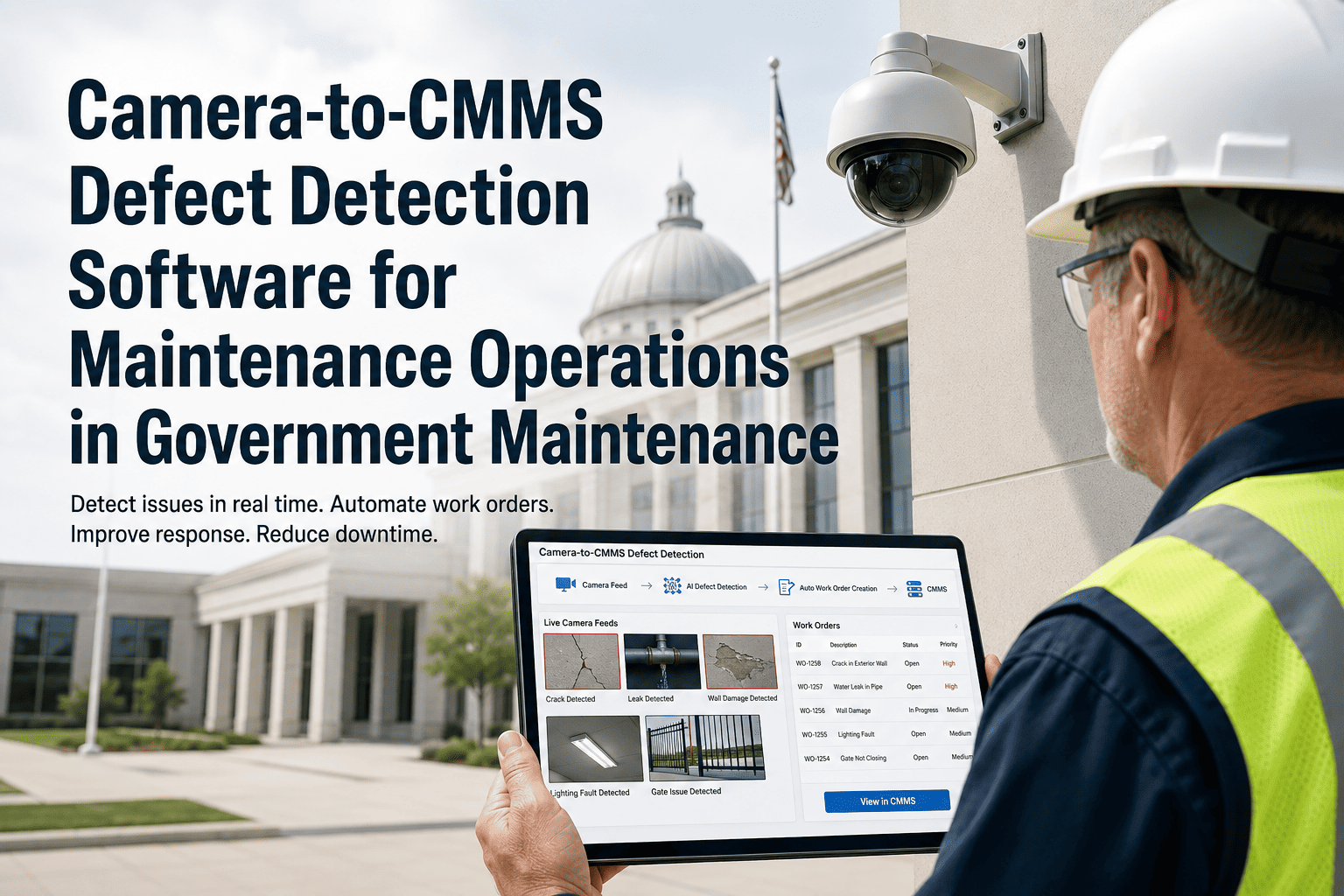
Visual inspection of public infrastructure has always depended on human eyes — but at scale, human review of hundreds of drone images per inspection cycle introduces inconsistency, missed defects, and delays that push critical repairs past safe thresholds. AI-powered drone image defect detection software integrated with government CMMS workflows removes that bottleneck by identifying and classifying structural anomalies in inspection imagery automatically — routing confirmed defects to work orders before a technician has opened the first folder. Public agencies using this approach complete defect triage in under 6 minutes per site versus an industry average of 47 minutes for manual review. The result is faster response, fewer missed findings, and a compliance record that documents not just what was repaired, but what was detected, when, and by which method. Book a demo with Oxmaint to see how AI defect detection connects to your existing maintenance scheduling system without requiring new infrastructure or retraining your inspection team.
AI Vision · Government Maintenance · 2026
Drone Image Defect Detection Software for CMMS Workflows in Government Maintenance
AI-powered defect detection on drone imagery — with automatic work order creation, severity classification, and full compliance documentation built for public sector inspection teams.
6 min
average defect triage time with AI vs 47 min manual review
94%
defect detection accuracy rate in pilot programs across infrastructure agencies
3x
more defects identified per inspection compared to manual visual review
Detection Capability
What AI Detects in Government Infrastructure Imagery
Modern defect detection models trained on government infrastructure datasets identify damage types across concrete, metal, asphalt, and composite materials — consistently, at scale, with no inspector fatigue.
B-01
Concrete Cracking
Bridges, retaining walls, tunnels
92% detection accuracy
R-02
Pavement Deterioration
Roads, parking surfaces, runways
89% detection accuracy
M-03
Corrosion and Rust
Steel bridges, utility poles, fencing
87% detection accuracy
W-04
Leak and Seepage Patterns
Water mains, dam faces, reservoirs
85% detection accuracy
S-05
Settlement and Displacement
Embankments, foundations, levees
83% detection accuracy
V-06
Vegetation Encroachment
Utility corridors, drainage channels
96% detection accuracy
CMMS Integration
From Image Upload to Work Order in Four Steps
01
Image Ingested
Drone imagery uploaded via mobile app or desktop — tagged to asset ID, location, and inspection date. Supports JPG, TIF, and orthomap formats.
02
AI Scans for Defects
Detection model identifies anomalies, classifies defect type, and assigns a severity rating — critical, moderate, or monitor — within seconds of upload.
03
Work Order Generated
CMMS auto-creates a work order with the annotated image, defect class, asset link, and recommended repair action — routed to the correct maintenance queue.
04
Compliance Record Stored
Detection log, work order, and repair outcome are stored as a linked compliance record — retrievable for regulatory review, insurance claims, or internal audit.
See AI defect detection connected to your CMMS workflow
Oxmaint routes every AI-flagged defect to the right team, at the right priority, with the right evidence attached — automatically.
Performance Comparison
Manual Review vs. AI Defect Detection: By the Numbers
| Metric |
Manual Image Review |
AI Defect Detection |
Improvement |
| Triage time per site |
47 minutes |
6 minutes |
87% faster |
| Defects identified per inspection |
Avg 4.2 findings |
Avg 12.7 findings |
3x more findings |
| Work order creation delay |
1.5 to 3 days |
Under 10 minutes |
Near real-time |
| Inspector fatigue errors |
Increases after image 50 |
Consistent across all images |
Zero fatigue effect |
| Compliance documentation |
Manual assembly required |
Auto-generated per finding |
Fully automated |
Severity Classification
How Oxmaint Prioritizes Detected Defects
Critical
Immediate work order — assigned within 2 hours of detection
Examples: active cracking in load-bearing concrete, corrosion through structural steel, active water intrusion in dam face
Moderate
Work order scheduled within current maintenance cycle — 7 to 14 days
Examples: surface spalling without rebar exposure, early-stage pavement cracking, minor corrosion on secondary members
Monitor
Logged for tracking — re-inspected at next scheduled drone cycle
Examples: hairline surface cracks, minor discoloration, early vegetation encroachment in non-critical zones
Expert Review
AI-assisted defect detection in government infrastructure programs consistently outperforms manual review on both recall rate and response speed. The decisive advantage is not just finding more defects — it is finding them faster and routing them to repair workflows without the latency of human handoff. Agencies that integrate AI detection with CMMS work order systems reduce their average defect-to-repair cycle by 60 to 70 percent compared to manual inspection pipelines.
Civil Infrastructure AI Review, 2025 — Based on analysis of 38 government infrastructure inspection programs across North America and Europe
Frequently Asked Questions
How accurate is AI defect detection on drone imagery for government infrastructure?
Detection accuracy varies by defect type, but pilot programs across government infrastructure agencies report overall accuracy rates between 83 and 96 percent depending on material type and image resolution. Concrete cracking, vegetation encroachment, and pavement deterioration consistently achieve the highest accuracy. Oxmaint's
AI detection pipeline is calibrated for infrastructure-specific defect classes — not generic object recognition — which significantly outperforms general-purpose computer vision on inspection datasets.
Does the AI detection system integrate with existing government CMMS platforms?
Yes. Oxmaint is designed to function as both a standalone CMMS and as a detection-to-work-order layer on top of existing maintenance systems. Defect findings from AI image analysis are output as structured work order data that can be routed into the agency's current asset management workflow.
Book a demo to discuss how Oxmaint connects to your agency's specific infrastructure management setup — including GIS asset registries and federal reporting frameworks.
Can government teams use this software without dedicated AI or data science staff?
Yes. Oxmaint's AI detection is fully managed — inspection teams upload drone imagery through the standard interface and the detection model processes it automatically in the background. No configuration, model training, or data science expertise is required from the agency side. Results appear as classified defect findings with annotated images, ready for supervisor review and work order approval within minutes of image upload.
How does the software handle compliance documentation for federally funded infrastructure?
Every defect detection event in Oxmaint generates a time-stamped finding record linked to the asset, inspection date, detection method, severity classification, and assigned work order. When the work order closes, the system creates a complete compliance record connecting detection to repair — meeting documentation requirements for
FHWA bridge programs, EPA utility inspections, and state DOT reporting frameworks. All records are stored digitally and exportable for federal and state submission.
Stop Missing Defects. Start Closing Repairs Faster.
Oxmaint brings AI defect detection directly into your government maintenance workflow — from drone image to work order to compliance record, without manual steps or disconnected systems.