Most public agencies do not fail at asset management because they lack data — they fail because that data never becomes a documented plan. An asset management plan (AMP) is the strategic document that connects everything an agency owns to what it costs to keep those assets at an acceptable level of service over a 10- to 20-year horizon. Public works directors, city engineers, and finance officers increasingly need an AMP not as a nice-to-have but as the evidence base behind GASB 34 reporting, capital budget requests, and grant applications that now require condition data as a funding prerequisite. Agencies without one tend to make reactive, politically driven capital decisions that concentrate risk in exactly the assets most likely to fail first. This guide walks through the six components every public-agency AMP needs, with a reference structure built inside Oxmaint.
Building an Asset Management Plan for Public Agencies — From First Draft to Funded Program
A working AMP defines what you own, how it should perform, what it will cost to keep it that way, and where the money is short. Here is the six-part structure that turns a spreadsheet of assets into a plan your council, auditors, and grant reviewers will actually trust.
An AMP Is Both a Compliance Document and a Funding Strategy
GASB 34 asks agencies to report what infrastructure is worth. ISO 55000 and the IIMM ask a harder question — what does it take to keep that infrastructure delivering an acceptable level of service, and where does the current budget fall short. An AMP answers both at once, and reviewers on grant panels increasingly ask for one by name before they release funding.
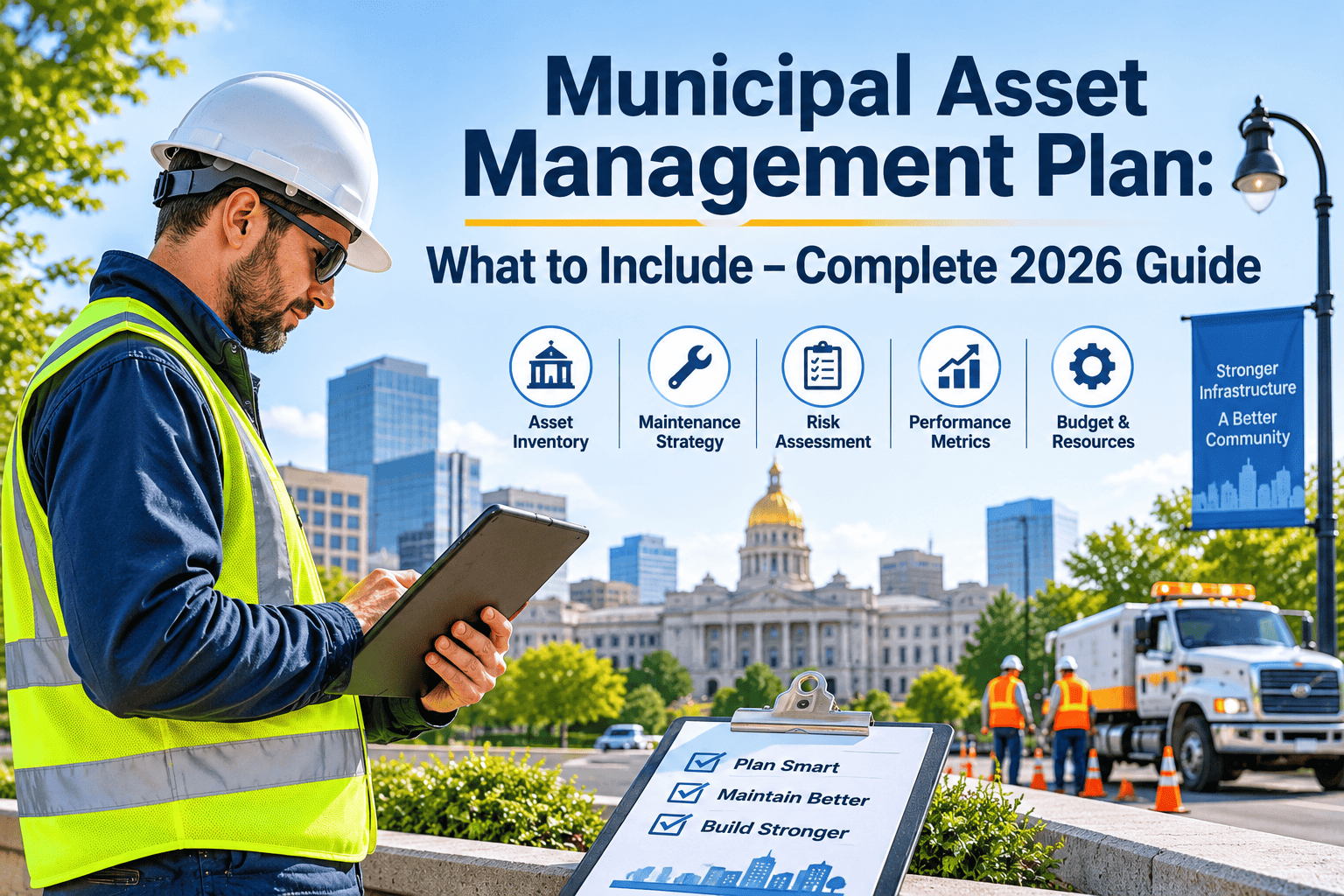
The Six Components Every Public Agency AMP Needs
Each component builds on the one before it — you cannot set a target level of service before you know your current asset condition, and you cannot forecast a funding gap before you know what the lifecycle strategy actually costs. Most agencies with 500 to 5,000 assets can move through a first working draft in 90 to 120 days.
Asset Inventory and Condition Assessment
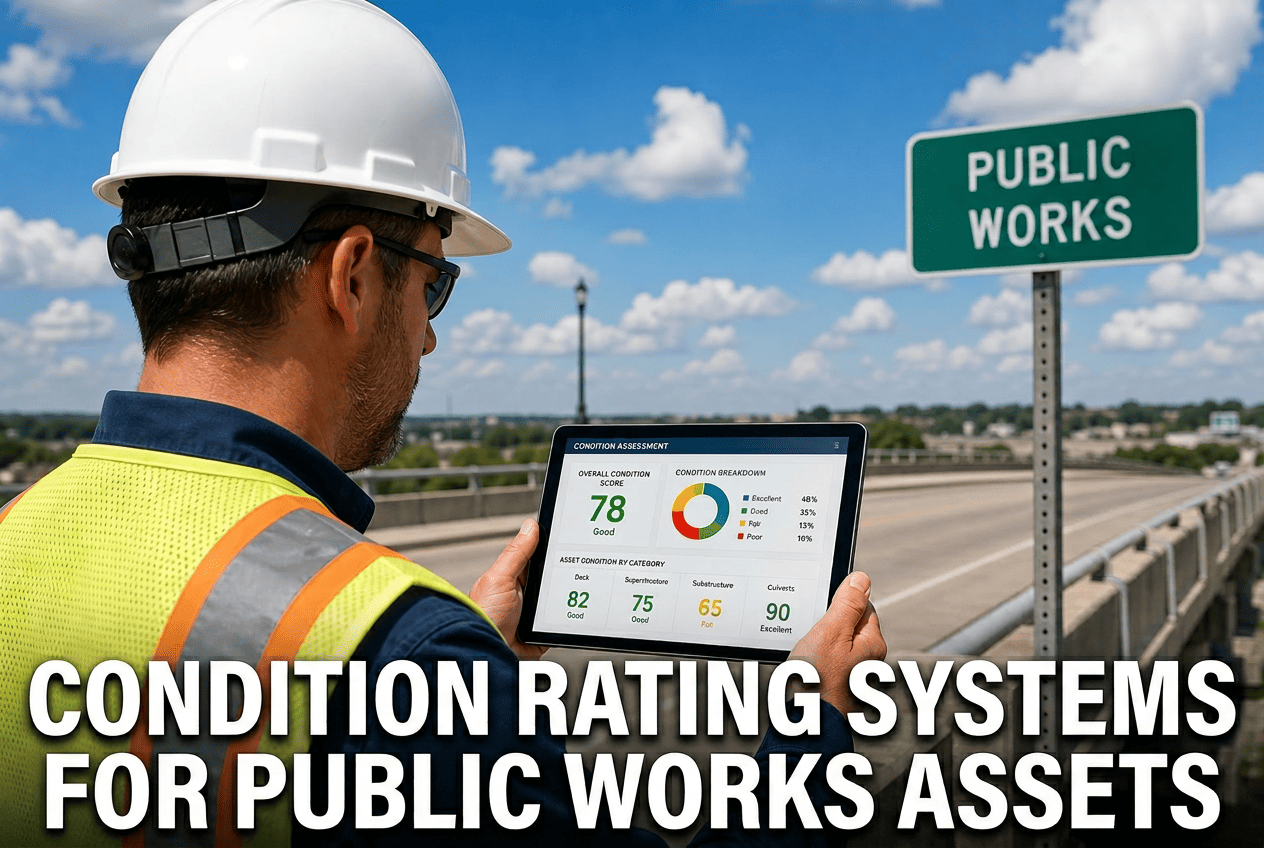
Every asset the plan covers — roads, water mains, buildings, fleet, parks equipment — needs a unique identifier, installation date, replacement value, and a current condition score. A Facility Condition Index or equivalent rating gives every asset a comparable number, which is what makes prioritization possible later. This step also closes the ghost-asset problem auditors flag most often: assets on the books that no longer physically exist, and assets in the field that were never recorded.
Levels of Service Definition
Levels of service describe how an asset should perform in terms residents and council members understand — pavement smoothness, water pressure reliability, response time to a pothole report — alongside the technical measure engineers use internally. Document both a current level of service and a target level, because the gap between the two is what justifies the capital request that follows.
Lifecycle Management Strategy
For each asset class, define the operations, maintenance, renewal, and disposal actions that keep the asset at its target level of service across its full useful life, not just until the next election cycle. This is where preventive maintenance schedules, rehabilitation triggers, and replacement timelines get tied to the condition data captured in step one instead of to a generic age assumption.
Risk Assessment and Criticality Ranking
Not every asset carries the same consequence of failure. Rank assets by the combination of probability of failure and impact — a lift station serving a hospital carries more risk than an identical unit serving a park restroom. Criticality ranking is what lets a constrained budget go to the assets where failure would be most costly or most dangerous, rather than the ones that are simply loudest in a council meeting.
Financial Forecast and Funding Gap Analysis
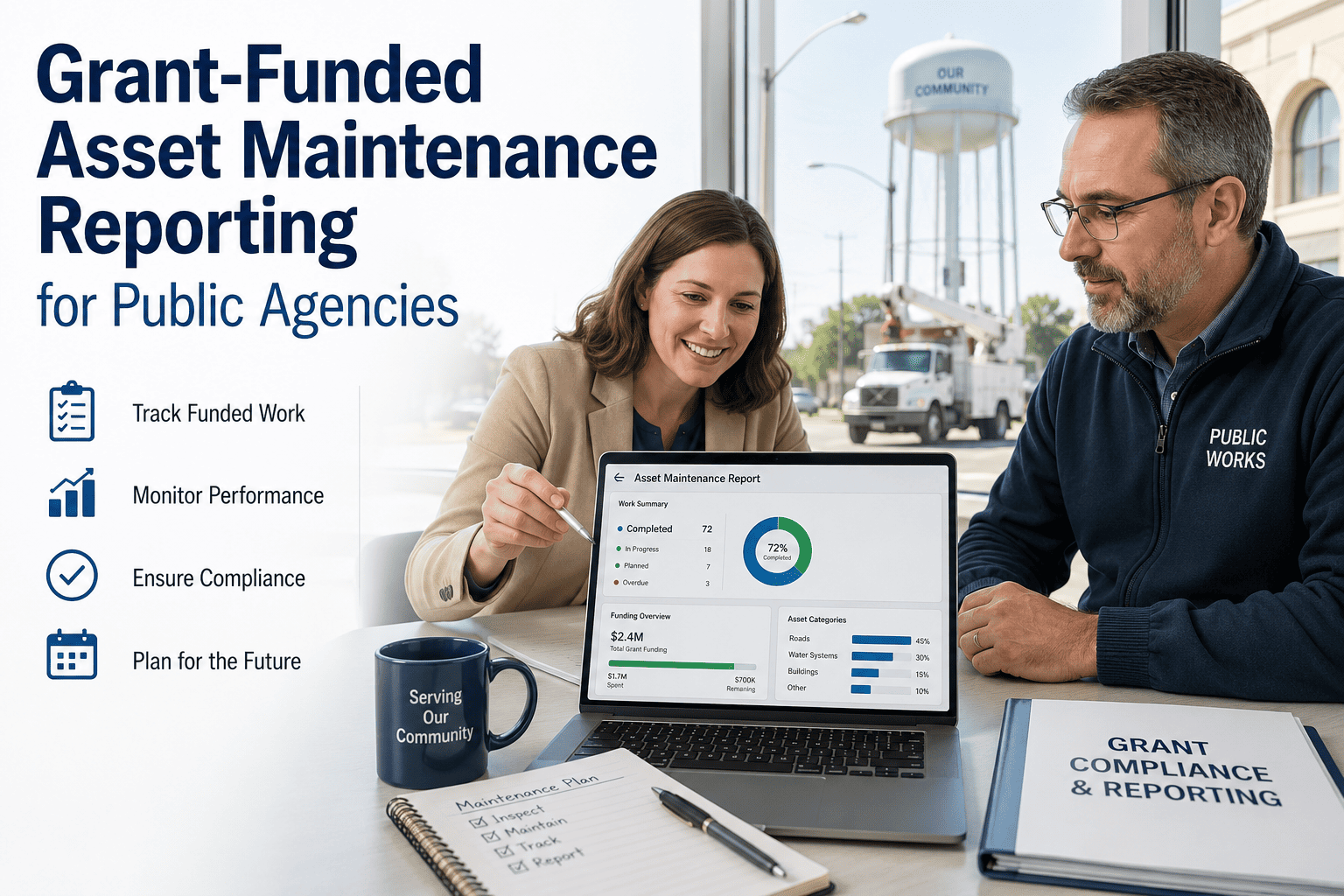
Translate the lifecycle strategy into a multi-year dollar figure, then compare it against realistic projected revenue — taxes, rates, grants, bonds. The difference is the funding gap, and stating it explicitly is what separates an AMP from a wish list. This section is also the one grant reviewers and bond rating agencies read first.
Improvement Plan and KPI Tracking
An AMP that is filed once and never updated drifts out of date within a budget cycle. Define the KPIs that will be tracked going forward — PM compliance, condition score trend, funding gap trend — and set a review cadence, typically annual for the financial forecast and every three to five years for a full plan refresh.
GASB 34 vs. ISO 55000 / IIMM — What Each Framework Actually Requires
Agencies often treat these as separate obligations. In practice, the asset register and condition data collected for one satisfies most of what the other requires — the difference is what each framework does with that data.
| Requirement | GASB 34 | ISO 55000 / IIMM |
|---|---|---|
| Primary purpose | Financial reporting and audit compliance | Operational strategy and value optimization |
| Core requirement | Capitalize and depreciate infrastructure assets | Strategic Asset Management Plan (SAMP) tied to organizational goals |
| Condition data | Required only if using the modified approach | Required as the basis for every lifecycle decision |
| Reporting audience | Auditors, bondholders, oversight agencies | Council, residents, grant reviewers, agency leadership |
| Update frequency | Condition reassessment at least every 3 years | Annual KPI review, full plan refresh every 3–5 years |
How Oxmaint Supports Each Part of the Plan
Oxmaint is built to carry the operational side of an AMP — the asset register, condition data, PM schedules, and KPI reporting — so the planning document reflects what is actually happening in the field, not a static snapshot from last year's budget cycle.
Import the full inventory by CSV, tag each asset with class, install date, and replacement value, and attach GPS location for field crews.
Field technicians log condition scores from mobile, so the register reflects current field state instead of a one-time baseline survey.
Set renewal and preventive work to trigger from whichever condition or age threshold the lifecycle strategy defines per asset class.
Assets are ranked automatically as condition and criticality inputs change, keeping the priority list current without a manual re-rank.
Forecasted lifecycle cost is compared against budgeted revenue automatically, producing the gap figure finance officers need for budget season.
PM compliance rate, average condition score, and funding gap trend update automatically and export in council-ready format.
Agencies Without an AMP vs. Agencies With One
Frequently Asked Questions
What is the difference between an AMP and a capital improvement plan?+
Does GASB 34 legally require a formal asset management plan?+
How often should a public agency update its AMP?+
What data do we need before we can define levels of service?
How long does it take to build a first AMP from scratch?
Your First AMP Draft Can Start This Budget Cycle
Every year without a documented plan is a year of capital decisions made on memory instead of evidence, and a year closer to a grant application rejected for missing condition data. Oxmaint gives you the asset register, condition tracking, and funding gap view an AMP is built on.