A municipal asset management plan turns scattered records, aging infrastructure, and competing budget requests into one documented strategy for what a city owns, what condition it is in, and what it will cost to keep it in service. Councils, auditors, and some funding programs increasingly expect a plan, and crews benefit just as much from clear priorities. This guide covers what to include, from inventory and condition scoring to levels of service, lifecycle costs, and an improvement plan. It also shows how Oxmaint asset management software keeps the plan alive after it is written.
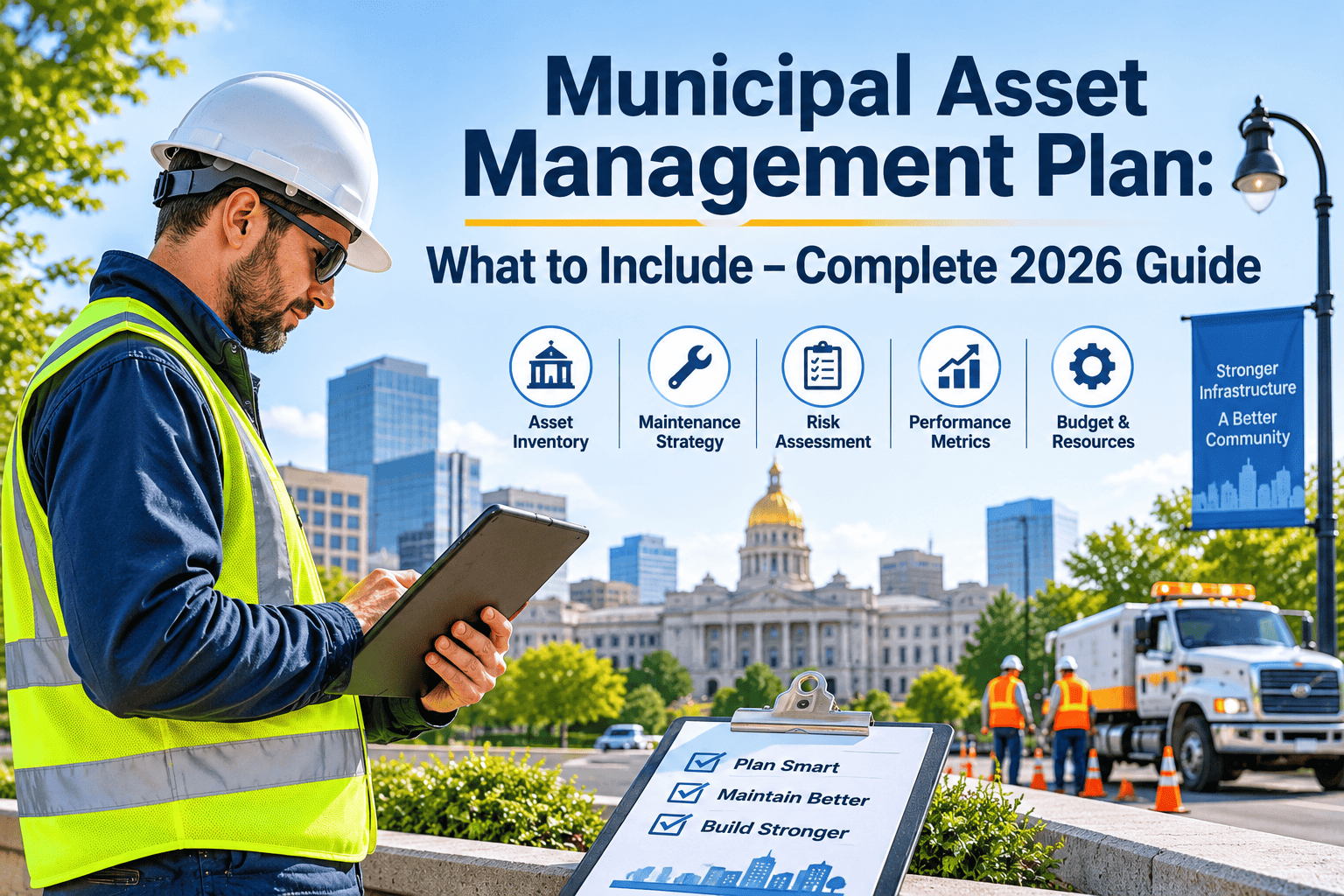
Municipal Asset Management Plan: What to Include – Complete 2026 Guide
A plan is only useful if it answers four questions: what do we own, what shape is it in, what service must it deliver, and what will it cost. Build each answer from real asset data.
- State of the assetsInventory, age, condition, replacement value
- Levels of serviceWhat residents expect and what you can measure
- Risk and criticalityWhere failure would hurt most
- Lifecycle strategiesMaintain, rehabilitate, renew, or dispose
- Financial planRequired spending against available funding
- Improvement planData, process, and capacity gaps to close
Why asset plans stall: fragmented records
Most cities hold asset information, but in five different places. A plan cannot be more accurate than the records beneath it.
Plan, register, and capital program: how they differ
Teams often confuse these documents. Each has a different job, and the plan should connect them.
| Document | Purpose | Typical horizon | Typical owner |
|---|---|---|---|
| Asset register | Single list of assets with attributes and history | Continuously updated | Asset management and operations |
| Asset management plan | Strategy for service levels, risk, lifecycle activities, and funding | Many years, reviewed regularly | Asset management lead with department heads |
| Capital improvement program | Funded list of major projects | Often five years or more | Finance and engineering |
| Maintenance plan | Scheduled inspections and repairs for in-service assets | Annual, with recurring tasks | Public works and utilities |
What to include in a municipal asset management plan
Use these eight chapters as a working outline. Adjust depth to the size and maturity of your organization.
-
Scope, goals, and context
State which asset classes are covered, which policies and council goals the plan supports, and who is accountable.- Asset classes and departments in scope
- Link to strategic and climate or resilience goals
- Roles for data, review, and approval
-
Asset inventory
List every asset you are responsible for, with enough attributes to plan work and value it.- Unique ID, type, location, and owner
- Install year, material, and expected life
- Replacement cost basis and data confidence
-
Condition and performance
Report current condition using a consistent scale and note how it was assessed, whether by inspection, testing, or estimate.- Condition distribution by asset class
- Inspection method and date
- Known failures and performance issues
-
Levels of service
Define the service residents receive and the technical measures that show whether you deliver it.- Customer-facing and technical measures
- Current performance and target
- Regulatory requirements that set a floor
-
Risk and criticality
Score consequence and likelihood of failure so scarce funds go to the assets that matter most.- Scoring method and weights
- Ranked high-risk assets
- Mitigation actions and owners
-
Lifecycle strategies
Describe how each asset class is operated, maintained, rehabilitated, and renewed, and when each option makes sense.- Preventive and inspection programs
- Repair versus replace triggers
- Demand growth and disposal plans
-
Financial strategy
Translate lifecycle needs into annual funding requirements, compare them to available budgets, and show the gap openly.- Forecast spending by lifecycle activity
- Funding sources and assumptions
- Options to close or manage the gap
-
Improvement plan and review
List the actions that will make the next version better, with owners and dates, and set a review cycle.- Data and process gaps
- Training and staffing needs
- Review and update schedule
Use one condition scale across every asset class
A five-point scale is common because it is simple to apply and easy to explain to elected officials. Whatever you choose, define each grade in writing.
Give your plan a living asset register
Keep inventory, inspections, work orders, and cost history in one place so each plan update starts from current data, not another data hunt.
Define levels of service you can measure
Levels of service connect assets to what residents actually experience. Each one needs a measure and a data source.
| Service | Customer-facing measure | Technical measure |
|---|---|---|
| Drinking water | Reliable supply and acceptable quality | Main breaks per length of pipe, pressure complaints, hydrant availability |
| Wastewater | No backups or overflows | Blockages, overflow events, lift station availability |
| Roads | Smooth, safe travel | Pavement condition index, pothole response time |
| Stormwater | Limited flooding | Inlet cleaning completion, flooding reports after storms |
| Facilities | Open, safe, comfortable buildings | Unplanned closures, backlog of safety-related work orders |
| Parks | Safe, usable recreation space | Playground inspection compliance, equipment out of service |
Plan the lifecycle decision at every stage
Costs are committed early and paid late. Each stage needs an explicit decision, not a default.
- PlanConfirm the need and compare options
- AcquireRecord specifications, warranties, and as-builts
- OperateTrack usage, energy, and performance
- MaintainSchedule inspections, PM, and repairs
- RenewRehabilitate or replace at the right time
- DisposeRetire, repurpose, or decommission safely
Show the funding gap plainly
Boards decide better when the gap is visible. Hiding it only delays the conversation.
- Required investment comes from lifecycle strategies, replacement costs, and remaining life, not from last year's budget.
- Present the gap by asset class so decision makers see where it concentrates.
- Offer options, such as phased renewal, service level changes, or added revenue, rather than only a total.
- State assumptions about inflation, condition data quality, and growth so reviewers can challenge them.
Asset register data checklist
Start with the fields that drive decisions. Add detail where it changes the plan.
- Unique asset ID and parent-child hierarchy
- Asset type, make, model, and material
- Location and GIS reference
- Install date and expected useful life
- Condition grade, date, and assessment method
- Criticality score and rationale
- Replacement cost and cost basis year
- Maintenance history and open work orders
- Warranty, manuals, and drawings
- Responsible department and contact
A three-year improvement timeline
The first plan will not be perfect. Show how it will improve, and then deliver on it.
Establish the baseline
Consolidate registers, adopt one condition scale, and score criticality for the highest-consequence asset classes.Connect plan to work
Link inspections and preventive schedules to the register, and start tracking cost by asset.Optimize and report
Use history to refine intervals, test repair-or-replace triggers, and publish progress against service targets.Standards and requirements to check
Requirements differ by country, state, province, and funding program. Confirm what applies to you before finalizing the plan.
Where Oxmaint supports each plan section
Oxmaint is maintenance management software. It supplies the operational data the plan depends on and records what happens after approval.
| Plan section | Oxmaint capability |
|---|---|
| Inventory | Asset records with hierarchy, location, documents, and history |
| Condition | Mobile inspections with readings, notes, and photos |
| Lifecycle strategies | Preventive maintenance schedules and corrective work orders |
| Financial plan | Labor, parts, and cost history tied to each asset |
| Compliance | Auditable inspection and maintenance records |
| Monitoring | Dashboards and reports on backlog, compliance, and repeat failures |
| Parts | Inventory tracking for critical spares |
Measures to track once the plan is adopted
A plan on a shelf does nothing. Review a short set of measures each quarter.
- Register completeness: assets with full required fields ÷ total assets.
- Condition coverage: assets with a recent condition grade ÷ total assets.
- Preventive compliance: scheduled tasks done on time ÷ tasks due.
- Backlog age: average days open for non-emergency work orders.
- Funding ratio: available annual funding ÷ required annual investment.
Municipal asset management plan FAQs
How long should a municipal asset management plan be?
Length matters less than clarity. Cover the eight chapters at a depth your data supports, and expand over time.
Do we need perfect data before starting?
No. Record data confidence, start with critical assets, and list data gaps in the improvement plan.
How often should the plan be updated?
Review it annually and refresh fully on a longer cycle set by your policy or regulator.
Can software write the plan for us?
Software supplies data and reports, but people set service levels and priorities. Book a demo to see the data side.
Where should a small city begin?
Begin with one high-consequence asset class and a simple register. Create an account to try it.
Roles and governance: who owns the plan
Plans fail when ownership is vague. Name a person, not a committee, for each responsibility.
- Council or board: approves service levels, funding direction, and the review cycle, and asks for progress reports.
- Executive sponsor: usually the city manager or a department head who removes obstacles and keeps the plan on the agenda.
- Asset management lead: coordinates the register, scoring method, and plan updates across departments.
- Department asset owners: maintain data quality for their asset classes and provide technical input on lifecycle strategies.
- Finance: supplies replacement values, depreciation data, and funding assumptions, and reconciles the plan to the budget.
- GIS and IT: keep spatial data and systems aligned so the register does not fork into competing versions.
- Field crews: collect condition observations and close the loop by recording work against the right asset.
Handling data gaps honestly
Every city starts with imperfect data. State the gaps, estimate carefully, and plan to close them.
Communicating the plan to council and residents
A plan that nobody reads cannot shape decisions. Translate it into plain language.
- Lead with a one-page summary showing the number of assets, total replacement value, condition mix, and the funding gap.
- Use the same condition scale and colors in every chart so patterns are recognizable from one report to the next.
- Connect service levels to experiences residents recognize, such as water pressure, road smoothness, and park safety.
- Show two or three funding scenarios with the service consequences of each, instead of presenting a single ask.
- Report progress on the improvement plan every year, including what was delayed and why.
- Publish a short public version, since transparency builds support for maintenance spending that is otherwise invisible.
Common mistakes when writing the plan
Avoiding these saves months of rework.
- Writing it as a one-off report. Treat it as a living document with scheduled reviews and clear owners.
- Separating the plan from daily maintenance. If crews never see it, it will not change their work.
- Covering every asset equally. Start with the classes where failure carries the greatest consequence.
- Ignoring growth and demand. Plans should include new assets, since each one adds long-term cost.
- Using only age to judge condition. Age is a starting point, but inspections reveal real remaining life.
- Leaving the funding gap out. A plan that avoids the gap loses credibility with auditors and councils.
A review calendar that keeps the plan current
Set the rhythm now. Align it with your budget cycle and any regulatory deadlines that apply to you.
Track the improvement plan
Review progress on data, process, and capacity actions, and report overdue items to the executive sponsor.Refresh the numbers
Update inventory, condition grades, replacement costs, and the funding gap before the budget is set.Revisit strategy
Reassess levels of service, risk methods, and lifecycle strategies on the schedule your policy or regulator sets.Questions council should ask about the plan
Good questions keep staff accountable and make the plan better. Offer these to your board.
- What share of our assets are in poor or very poor condition, and how has that changed since the last review?
- Which failures would hurt residents most, and what are we doing about each of them?
- What is the gap between required and available funding, and what options exist to close it?
- How confident are we in the data, and which gaps matter most for decisions?
- Are preventive maintenance tasks being completed, and how do we know?
- What happens to service levels if we hold funding flat for the next five years?
Build a plan your crews can actually follow
Connect the plan to daily maintenance, so condition data, costs, and priorities stay current between reviews.