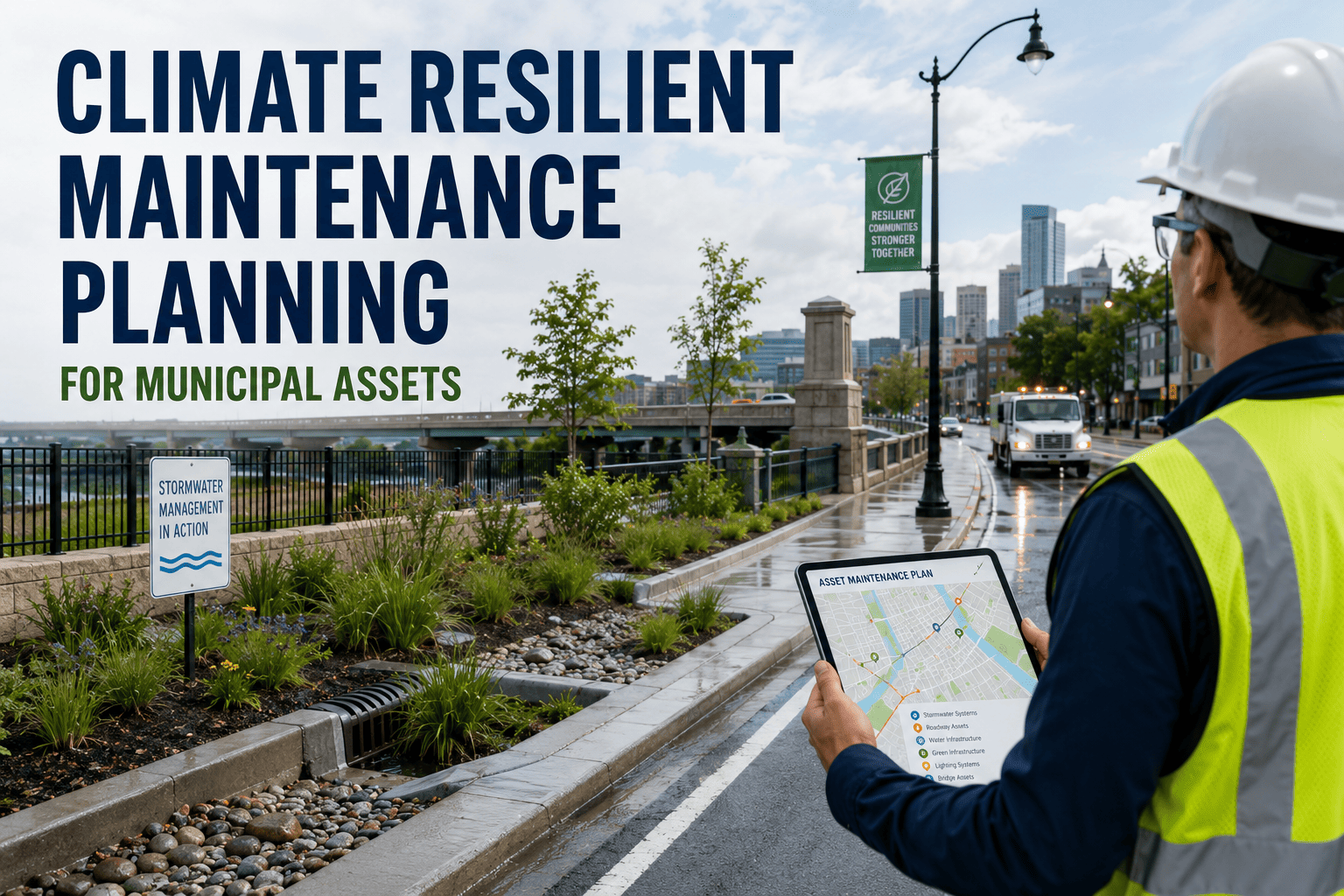
Public agencies managing roads, water systems, HVAC units, and critical facilities are now facing a new reality: climate events are not edge cases anymore — they are part of the operating calendar. OxMaint is a predictive maintenance and CMMS platform purpose-built for government and public-sector asset teams who need to move from reactive emergency repairs to a climate-ready maintenance posture before the next weather event hits.
Public Agency Maintenance
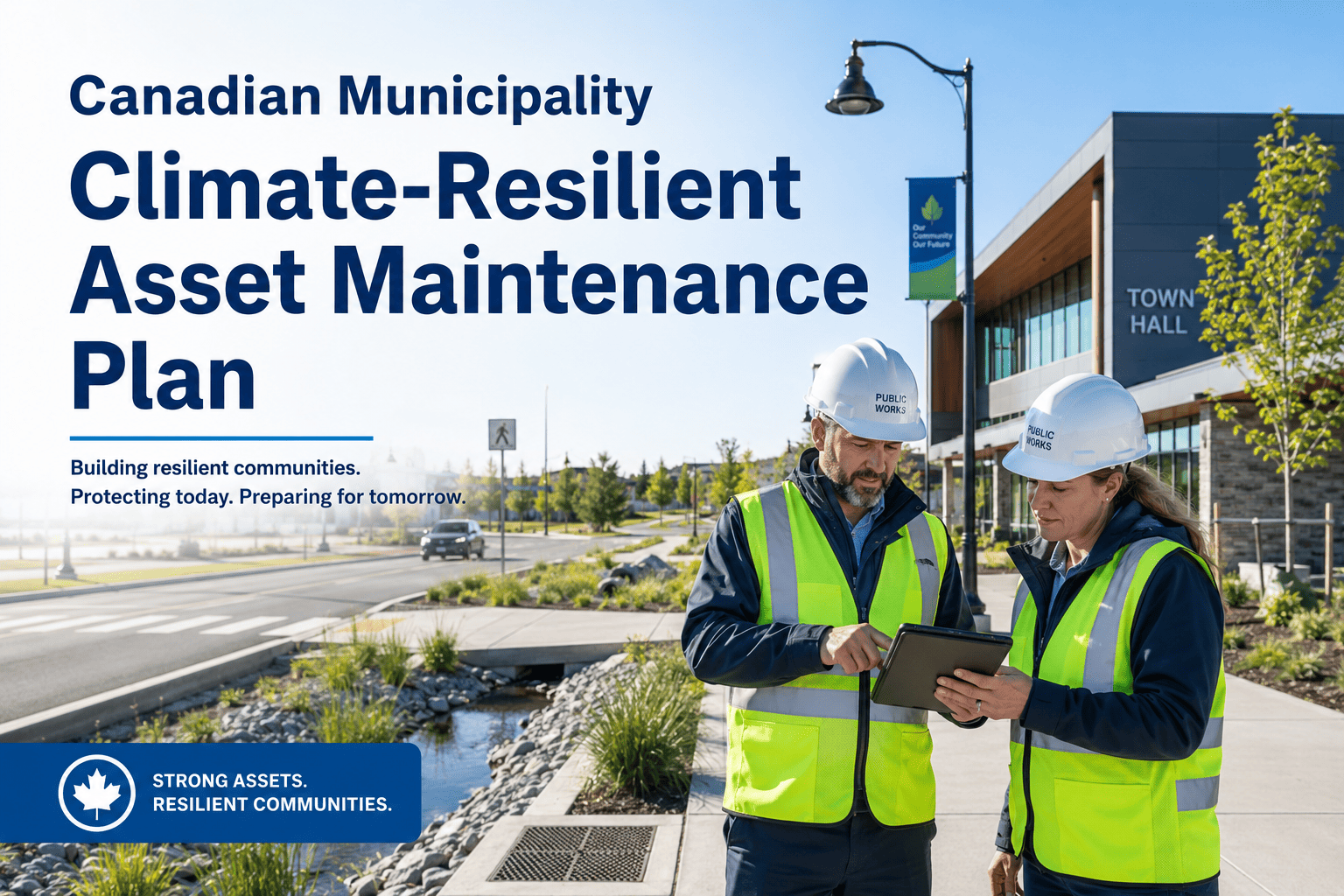
Climate-Resilient Asset Maintenance Plan for Public Agencies
In 2024, the US recorded 27 weather disasters each exceeding $1 billion in damage — totaling $182.7 billion. Most of that damage was preventable with proactive asset maintenance. This guide shows public agencies exactly how to build a climate-resilient maintenance plan.
$182.7B
Climate disaster damages in the US in 2024 alone
4:1
Benefit-cost ratio of investing in climate-resilient infrastructure
$463B
In damage that climate adaptation investment could prevent by 2100
3–5×
Higher cost of reactive emergency repairs vs. preventive maintenance
Why Existing Maintenance Plans Are Failing
Most public agency maintenance programs were designed for mid-20th-century climate conditions. Bridges, water mains, HVAC systems, and drainage infrastructure are routinely serviced on fixed calendar cycles — not based on condition, weather risk, or real-time asset health. When a heat dome or flood event hits, deferred maintenance turns into emergency contractor fees, service disruptions, and prolonged federal reimbursement battles due to poor documentation.
Calendar-Based Scheduling
Assets serviced by date, not condition — missing weather-triggered stress that causes failures between scheduled PMs.
Paper or Spreadsheet Records
No timestamped, auditable trail for FEMA claims or federal reimbursement. Records are backdated, lost, or incomplete.
No Asset Risk Scoring
Teams cannot prioritize which assets to inspect or harden before a storm — every asset gets equal (insufficient) attention.
Reactive-Only Culture
Maintenance budgets are consumed by emergency repairs, leaving no resource for condition-based prevention programs.
The 5-Layer Climate-Resilient Maintenance Framework
A modern climate-ready maintenance plan is not one tool — it is a layered system. Each layer builds on the previous to create a program that can anticipate failures, respond faster, and document everything for compliance and funding.
Layer 1
Asset Register and Criticality Scoring
Every pump station, HVAC unit, retaining wall, culvert, and generator is catalogued with location, age, condition, and climate exposure rating. High-criticality assets get shorter PM intervals and pre-event inspection triggers.
Layer 2
Condition-Based PM Scheduling
Preventive maintenance work orders are generated based on sensor readings, operating hours, and seasonal risk windows — not just fixed calendar dates. Assets near flood zones or heat corridors receive additional PM cycles in advance of high-risk months.
Layer 3
IoT Sensor Integration and Alert Routing
Temperature probes, vibration sensors, and pressure monitors feed real-time data into the CMMS. When a threshold is breached — a pump running hot ahead of a heatwave, a sump motor drawing excessive current before a storm — a work order is auto-generated before failure occurs.
Layer 4
Mobile Field Execution with Photo Evidence
Technicians receive work orders on mobile devices, complete digital checklists with GPS-stamped photos, and close jobs in the field. No paperwork. No backdating. Every inspection is tied to a specific asset, technician, timestamp, and location.
Layer 5
Audit-Ready Compliance Records and FEMA Documentation
Every maintenance action is stored in a searchable, exportable audit trail. When climate events occur, agencies can immediately produce maintenance histories, inspection logs, and repair records needed for FEMA public assistance claims and insurance reimbursement.
Asset Categories and Climate Risk Mapping
Each public asset category carries a different climate failure profile. Use this matrix to understand what fails, when it fails, and what maintenance actions prevent it.
| Asset Category |
Primary Climate Risk |
Failure Mode |
Prevention Action in OxMaint |
Documentation Value |
| HVAC Systems |
Extreme heat events |
Compressor overload, coil fouling, refrigerant loss |
Pre-summer coil cleaning PM, amperage trend monitoring |
Cooling continuity records for public buildings |
| Stormwater Pumps |
Heavy rainfall, flash floods |
Impeller wear, motor burnout, debris blockage |
Pre-storm inspection trigger, wet-well sensor alerts |
Flood event response log for FEMA PA claims |
| Road Culverts |
Rainfall intensity increase |
Sediment blockage, structural erosion, scour failure |
Seasonal inspection checklist, GPS photo records |
Infrastructure condition history for grant applications |
| Backup Generators |
Grid outages from weather |
Fuel contamination, battery failure, coolant leak |
Monthly load test PM, fuel quality sampling log |
Emergency readiness certification records |
| Water Distribution |
Freeze-thaw cycles |
Pipe fracture, joint failure, pressure loss |
Pre-winter insulation inspection, pressure monitoring |
Asset age and condition data for capital planning |
| Bridge Structures |
Flooding, thermal stress |
Bearing seat erosion, expansion joint failure |
Post-event inspection WO, MTBF trending per structure |
Inspection history for federal bridge safety reporting |
How Predictive Maintenance Changes the Outcome
Reactive Approach
Asset fails during a heat event or flood
Emergency contractor called at 2–3× standard rates
No maintenance records = FEMA claim denied or delayed
Service disruption reported in local media
Budget consumed by one event, deferring other PMs
Predictive Approach with OxMaint
Sensor alert triggers inspection 48 hrs before failure
Planned repair completed at standard labor rates
Full maintenance log supports FEMA PA documentation
Service continuity maintained — zero public disruption
Budget protected; PM ROI documented for next cycle
Start Your Climate Maintenance Plan
OxMaint is used by facilities and public works teams to move from spreadsheet-based scheduling to a condition-aware, audit-ready maintenance program.
Implementation Roadmap: 90 Days to a Climate-Ready Program
Days 1–14
Asset Inventory and Risk Scoring
Import your complete asset register into OxMaint using the bulk upload template. Assign climate risk categories — flood exposure, heat stress, freeze-thaw, wildfire smoke — to each asset class. Set criticality tiers that determine PM frequency and pre-event inspection priorities.
Days 15–30
PM Schedule Build-Out
Configure recurring work orders for each asset category using OxMaint's pre-built public-sector PM libraries. Add seasonal trigger rules so high-risk assets receive additional inspection cycles before summer heat peaks and winter freeze windows.
Days 31–60
Field Team Deployment and Mobile Rollout
Onboard field technicians and inspectors to the OxMaint mobile app. Configure work order routing by zone, crew, and asset type. Establish photo-evidence and GPS-stamp requirements for all inspections so every field action is audit-documented from day one.
Days 61–90
Dashboard Review and Compliance Reporting
Run your first compliance review using OxMaint's reporting dashboard. Review PM completion rates, overdue tasks by asset class, and MTBF trends for high-risk assets. Generate your first climate-readiness documentation package — ready for leadership review or federal grant reporting.
Expert Review
Public works directors often underestimate the documentation gap until a FEMA claim is denied. Agencies that maintain timestamped, technician-certified maintenance records consistently recover reimbursement faster — and at higher rates — than those relying on reconstructed paper logs. A CMMS that auto-generates your compliance trail while your team runs their daily PMs is not a luxury for government facilities. It is now a fiscal necessity.
Infrastructure Maintenance Consultant — Municipal Public Works Advisory
Frequently Asked Questions
How does OxMaint help public agencies qualify for FEMA Public Assistance after a climate event?
OxMaint maintains a complete, timestamped maintenance history for every asset in your register. When a climate event damages infrastructure, agencies can export inspection records, repair logs, and pre-event maintenance documentation directly from the platform. FEMA Public Assistance applicants are required to demonstrate that assets were maintained in good condition — OxMaint provides exactly that audit trail. Start building your documentation record today at
app.oxmaint.ai.
Can OxMaint integrate with IoT sensors already deployed on public infrastructure?
Yes. OxMaint's predictive maintenance module can receive condition data from temperature sensors, vibration monitors, pressure transmitters, and flow meters deployed across your infrastructure. When a sensor threshold is exceeded — a pump drawing abnormal current, an HVAC unit reaching critical discharge temperature — OxMaint automatically generates a work order and routes it to the responsible technician, closing the loop between sensor alert and field response without manual intervention.
How does the platform handle multi-department or multi-site public agency structures?
OxMaint supports multi-site asset registers with department-level access controls. Public works, facilities management, utilities, and parks departments can each manage their own asset queues and work orders while senior administrators and compliance officers retain cross-department visibility. Regional dashboards show PM compliance rates and overdue inspections across all sites and departments in a single view, making it practical for county or district-level agencies managing dozens of locations.
Book a demo to see the multi-site configuration live.
What is the typical implementation timeline for a public agency moving from spreadsheets to OxMaint?
Most public agencies complete asset import, PM schedule configuration, and field team onboarding within 10–15 working days. OxMaint provides a bulk asset import template that accepts data directly from spreadsheets, eliminating manual re-entry. Pre-built PM task libraries for common government asset types — HVAC, pumps, generators, fleet vehicles, and buildings — significantly reduce setup time compared to building a maintenance program from scratch.
Ready to Build a Climate-Resilient Maintenance Program?
Agencies that invest in predictive maintenance today protect both their infrastructure and their federal reimbursement eligibility tomorrow.
OxMaint gives public agency maintenance teams the asset register, PM scheduling, mobile field execution, and compliance documentation they need — all in one platform built for government operations.