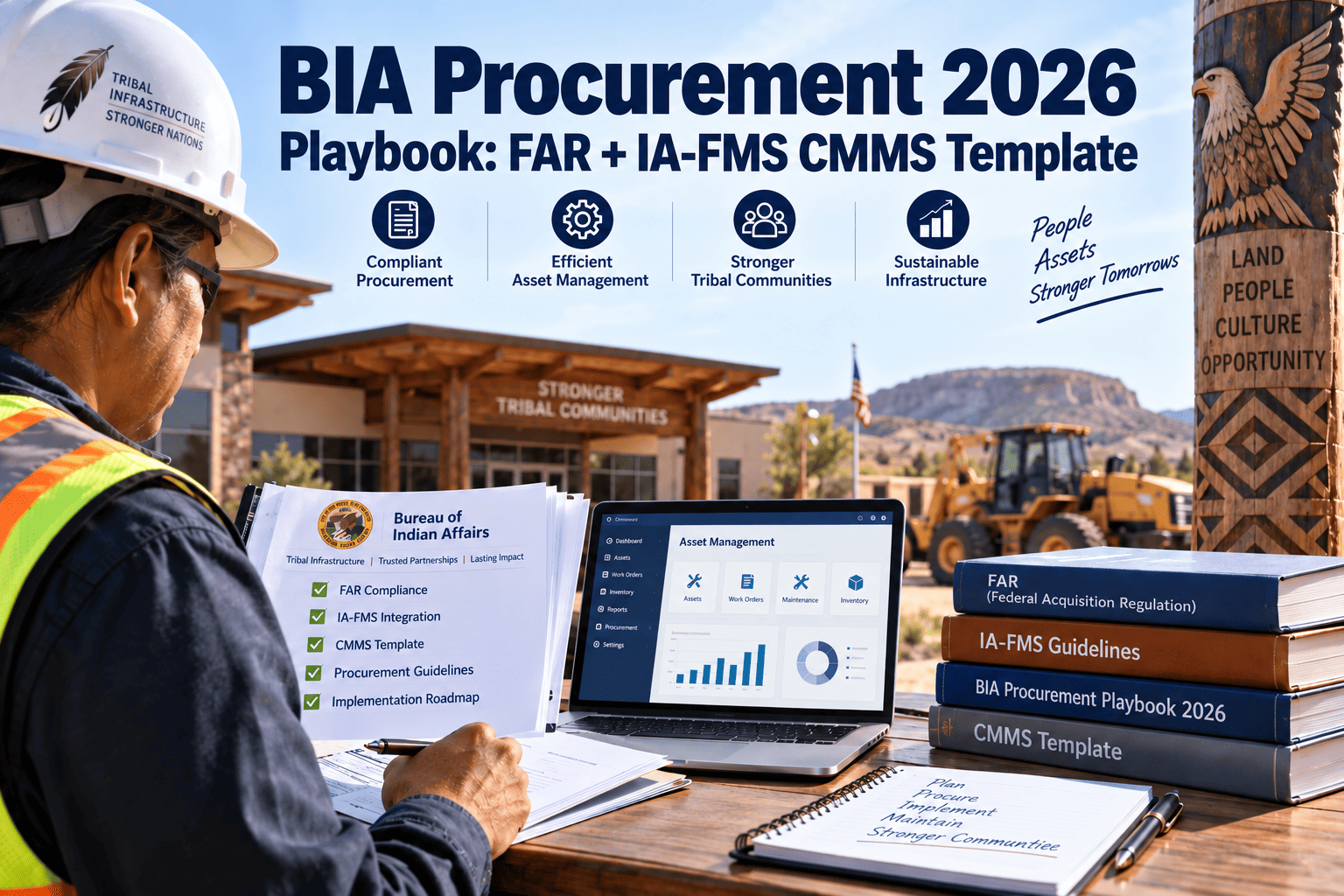
Facility procurement at the Bureau of Indian Affairs sits where three demanding systems meet: the Federal Acquisition Regulation, Interior's acquisition supplement with its Buy Indian Act preference, and the Indian Affairs Facilities Management System (IA-FMS) that holds the facility inventory and maintenance backlog. A repair that is bought correctly but never reconciled back to the facility record looks, on paper, as if it never happened. This free BIA procurement playbook gives facility managers, CORs, and maintenance leads a phase-by-phase checklist for 2026, and shows how to run the playbook as a CMMS template in Oxmaint so every step leaves an auditable record.
BIA Procurement 2026 Playbook: FAR + IA-FMS CMMS Template
One traceable path from a facility deficiency to a closed IA-FMS record, with FAR requirements, SAM.gov vendor checks, labor standards, and closeout built into every step. Built for BIA facility teams, contracting officer's representatives, and maintenance staff who carry the work from requisition to acceptance.
Where BIA Facility Procurement Breaks Down
Most procurement findings in facility work are not about bad intent. They come from handoffs: between the facility manager who knows the need, the contracting office that buys it, and the system of record that is supposed to reflect the result.
The Regulatory Stack Behind Every BIA Facility Purchase
BIA facility buys are governed by layers, not a single rulebook. Each layer narrows what the one above allows, and your playbook has to satisfy all of them at once.
2026 context: the FAR overhaul
Executive Order 14275 (April 2025) launched the Revolutionary FAR Overhaul, with rewritten FAR parts issued as model deviation text and adopted by agencies through class deviations. Some coverage has moved or been shortened. Confirm with your contracting officer which FAR text and DOI deviations apply to your action before relying on any citation in this playbook.
Tribally operated facilities are different
Where a tribe operates facilities under an ISDEAA self-determination contract or self-governance compact, 25 U.S.C. 5324(a) provides that federal contracting laws do not apply to that agreement, and the tribe follows its own procurement standards. This checklist is written for BIA-direct procurement; tribes can adapt the workflow steps without the FAR citations.
2026 Dollar Thresholds That Change the Procurement Path
Thresholds decide which procedures, clauses, and labor standards apply. The FAR inflation adjustment effective October 1, 2025 raised the two most-used thresholds, so older desk guides are now out of date.
| Threshold | Value for FY2026 | What it triggers in facility work |
|---|---|---|
| Micro-purchase threshold (general) | $15,000 | Government purchase card buys without competitive quotes; spread purchases among qualified suppliers and never split a requirement to stay under it. |
| Micro-purchase, construction subject to Davis-Bacon | $2,000 | Above this, construction, alteration, and repair work carries Davis-Bacon wage rates and certified payroll. |
| Micro-purchase, services under Service Contract Labor Standards | $2,500 | Above this, covered services such as custodial, grounds, and equipment maintenance need an SCA wage determination. |
| Simplified acquisition threshold | $350,000 | FAR Part 13 simplified procedures up to this value; above it, formal procedures and the responsibility review in FAR 9.104-6. |
| Miller Act bonding | Confirm current FAR 28.102 value | Performance and payment bonds on construction contracts above the threshold; alternative payment protections below it. |
The 2026 BIA Facility Procurement Checklist
Five phases, each with an owner and the evidence that proves the step happened. Use it as a paper checklist, or load it into your CMMS so each item becomes a required field rather than a reminder.
Requirement definition and funding
A clean procurement starts with a requirement that already knows which building, asset, and deficiency it resolves.
SAM.gov vendor verification
The contracting officer owns the responsibility determination, but facility teams feed it. Save every check with a date and time.
Make the SAM.gov Check Impossible to Skip
In Oxmaint, vendor verification can sit inside the procurement checklist as required fields: UEI, registration expiry, exclusions search date, and wage determination number. The work order does not move forward until the check is recorded.
Solicitation and award
Matching the acquisition method to the value and type of work prevents most later rework.
Execution, inspection, and payment control
This is where facility maintenance software earns its place: daily evidence captured on a phone, not rebuilt from memory at invoice time.
Acceptance, closeout, and IA-FMS reconciliation
The step most often skipped is the one that makes the facility data true again.
Keeping the CMMS and IA-FMS in Step
IA-FMS remains the Indian Affairs system of record for facility inventory, condition, and backlog. A day-to-day CMMS handles the workflow. The map below shows which record elements should be kept consistent between the two.
| Record element | Captured in the CMMS template | Why it matters on the IA-FMS side | Owner |
|---|---|---|---|
| Location and asset ID | Same building and asset identifiers as IA-FMS, stored on every work order | Lets completed work be matched to the right facility record | Facility manager |
| Deficiency reference | Backlog or deficiency number on the procurement work order | Identifies which backlog item the contract resolves | Facility manager |
| Contract and vendor | Contract number, UEI, COR, period of performance | Links spending to the facility for reporting | COR |
| Actual cost | Contract cost plus in-house labor and parts on linked work orders | Replaces estimated backlog cost with what was spent | COR, finance |
| Acceptance date | Date and accepting official from the final inspection | Sets the completion date on the deficiency | COR |
| Post-work condition | Inspection findings after acceptance | Supports the next condition assessment | Inspector |
| New or retired assets | Nameplate data, warranty dates, disposal notes | Keeps the inventory aligned with what is installed | Maintenance lead |
Spreadsheet Procurement vs. a CMMS-Run Playbook
The checklist is the same either way. What changes is whether the evidence exists when an auditor, an Inspector General review, or next year's budget call asks for it.
Tracked in email and spreadsheets
- Requirements arrive without asset or deficiency references
- SAM.gov checks live in someone's inbox, if they were saved at all
- Field inspection notes are written up days later from memory
- Change requests start as phone calls and end as ratifications
- Warranty dates sit in a binder no one opens when equipment fails
- IA-FMS is updated months later, or never
Run as an Oxmaint template
- Every request is created against an asset and location record
- Vendor checks are required checklist fields with dates and attachments
- COR inspections are captured on mobile with photos and timestamps
- Change requests are logged and routed before any extra work begins
- Warranty dates and PM schedules sit on the asset itself
- A closeout step prompts the IA-FMS update before the work order closes
Building the Procurement Template in Oxmaint
A practical setup sequence for a region, agency, or school facility team. Start with one building type, test it on a live purchase, then extend.
Load locations and assets
Import buildings and major equipment using the same identifiers as IA-FMS, so every later record lines up with the system of record.Create checklist templates per phase
Turn the five phases above into inspection and checklist templates, with owners assigned by role rather than by name.Make evidence fields mandatory
UEI, exclusions search date, wage determination number, COR letter, and acceptance date become required fields with attachments.Link contract work to work orders
Each contract line item spawns work orders on the affected assets, and in-house labor and parts are logged against the same records.Report on the pipeline
Dashboards show open procurements by phase, overdue closeouts, and completed work still waiting on an IA-FMS update.Turn This Checklist Into a Working Template
Set up assets, phase checklists, and closeout prompts in Oxmaint, then run your next facility purchase through it. See how a requisition, a COR inspection, and a closeout look side by side in one record.
A Fiscal Year 2026 Procurement Calendar for BIA Facilities
The federal fiscal year runs October 1 to September 30. Facility procurement goes smoother when the calendar, the construction season, and remote-site access are planned together.
Plan and research
Often under a continuing resolution. Finalize requirements from condition assessments, prepare IGCEs, and complete Buy Indian market research.Solicit
Release solicitations for spring and summer work, pull wage determinations, and schedule site visits around winter access limits.Award and mobilize
Award before the field season, align school projects with summer break, and start COR inspections from day one.Year-end surge
Annual funds expire September 30. Watch your acquisition office's cutoff dates, and do not let closeouts slip behind new awards.KPIs for a BIA Facility Procurement Playbook
Measure the process, not just spending. Targets below are either policy-driven or internal goals you should set after establishing a baseline.
Requirement traceability
Requests with an asset and deficiency ID divided by total requestsGoal: every requestVendor check completion
Awards with dated SAM and exclusions records divided by total awardsGoal: every awardRequirement-to-award time
Days from approved requirement to contract award, by acquisition methodGoal: set baseline, then reduceUnauthorized commitments
Ratification actions per fiscal year across facility contractsGoal: trending to zeroCloseout lag
Days from final acceptance to IA-FMS deficiency updateGoal: set internal targetNew-asset PM coverage
Newly installed assets with an active PM schedule divided by new assetsGoal: every new assetFrequently Asked Questions
Does the FAR apply to facilities operated by tribes?
Not to ISDEAA self-determination contracts or self-governance compacts. Under 25 U.S.C. 5324(a), federal contracting laws do not apply to those agreements, and the tribe follows its own procurement standards.
Which SAM.gov checks should be done before a BIA facility award?
Confirm active registration and UEI, search exclusions, review reps and certs including Section 889, and review responsibility information above the simplified acquisition threshold. You can capture each check as a required field in Oxmaint.
Why does procurement closeout matter to IA-FMS?
IA-FMS holds the facility inventory, condition, and backlog. If completed contract work is never reconciled, the backlog and condition data overstate need and weaken future funding requests.
How does the Buy Indian Act affect facility procurement?
It gives Indian Economic Enterprises a preference in Indian Affairs acquisitions, implemented through DIAR Part 1480. Market research should document that search, and the contracting officer decides how the preference applies.
Does Oxmaint replace IA-FMS?
No. IA-FMS stays the system of record, while Oxmaint runs daily work orders, inspections, checklists, and PM with records structured to reconcile. Book a demo to see the template.
Every Purchase Traced. Every Check Recorded. Every Record Closed.
Run your 2026 BIA facility procurement playbook as a living CMMS template, from the first deficiency to the final IA-FMS update, with the evidence in one place when anyone asks for it.