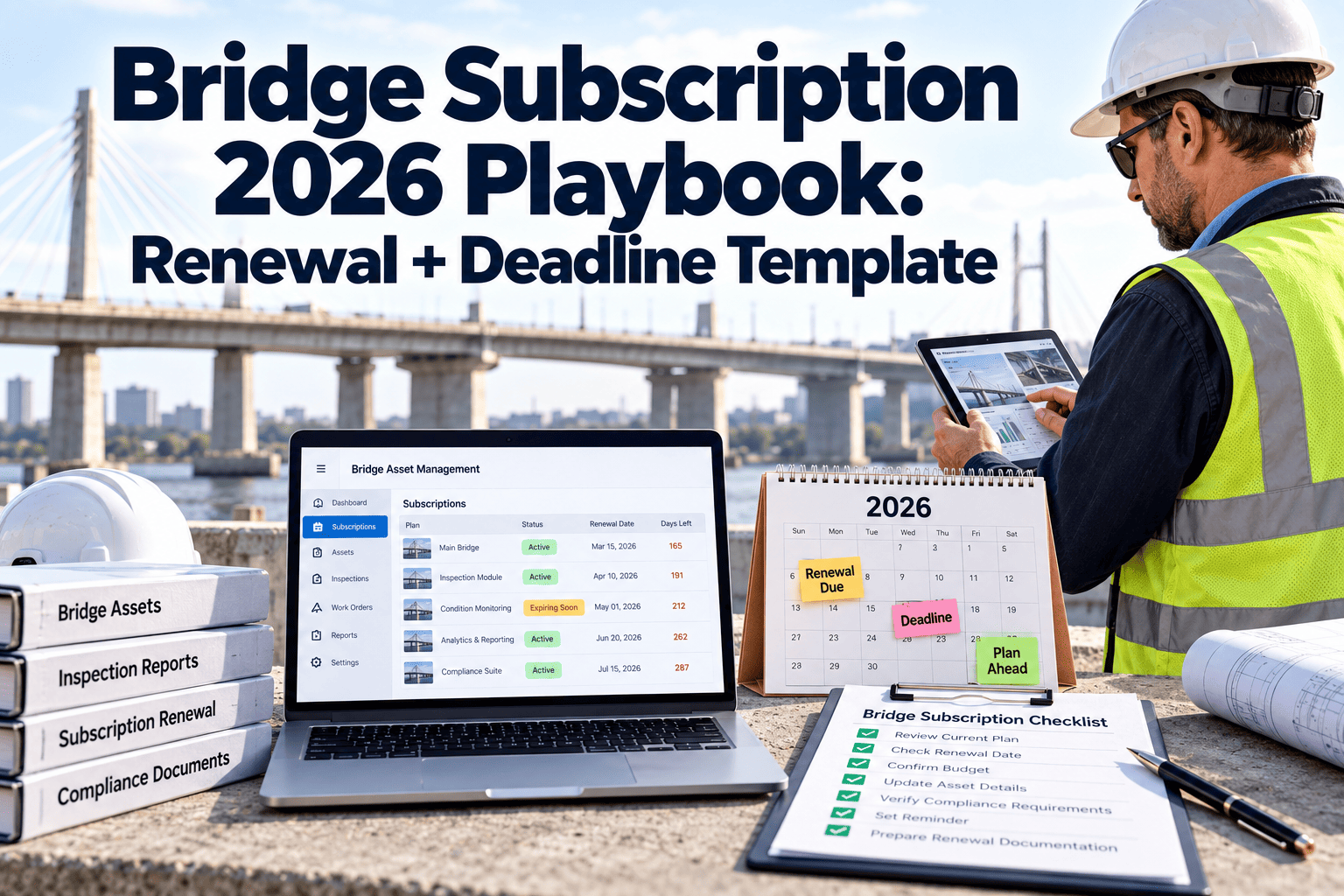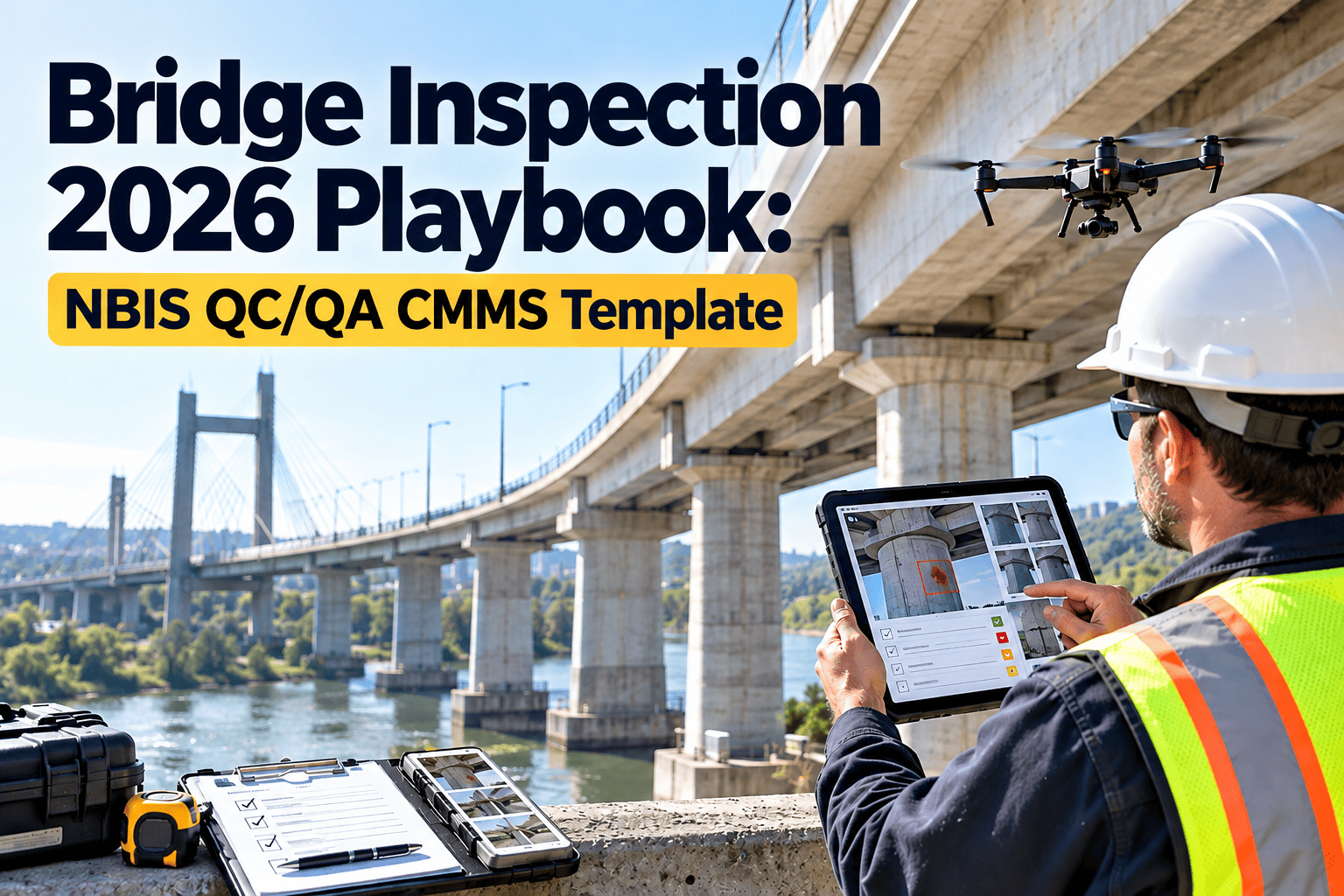
A bridge inspection program rarely fails because an inspector misses one defect. It fails later, when a finding cannot be tied to a photo, a reviewer, a date, or a repair order. The 2022 update to 23 CFR 650 Subpart C put more weight on qualified teams, independent QC and QA reviews, and documented follow-up on critical findings. This playbook turns that workflow into a free checklist template that program managers can adopt in a few weeks. It also shows how Oxmaint maintenance management software can keep the schedule, evidence, and follow-up work in one record.
Bridge Inspection 2026 Playbook: NBIS QC/QA CMMS Template
A free playbook for bridge program managers, team leaders, and reviewers. Follow one repeatable workflow from interval scheduling to QC review, QA sign-off, and repair follow-up under 23 CFR 650 Subpart C, then run it in a CMMS template so every record stays traceable.
Why 2026 Is a Records Year for Bridge Owners
FHWA's updated National Bridge Inspection Standards took effect on June 6, 2022. Several provisions, including reduced-interval routine and underwater inspections, NSTM inspections, and program manager qualifications, carried a June 6, 2024 compliance date. Those dates have passed, so reviews now test whether written procedures actually run.
Interval drift
Due dates live in a workbook maintained by one person. Reduced-interval bridges, underwater inspections, and NSTM structures each follow a different clock, and a missed month is noticed only when someone opens the file.
Reviewer independence
QC and QA reviews are meant to be performed by someone other than the originating inspector. When one person drafts, checks, and signs, the program cannot prove the review was independent.
Findings without closure
A critical finding is reported, a load restriction is discussed, and then the paper trail thins out. Months later nobody can show who accepted the interim measure or when the repair was verified.
Root causes behind most program gaps
- Inspection reports stored as PDFs on shared drives with no link to the structure record
- Photos named by camera number instead of element and location
- Team leader qualification and training dates tracked outside the schedule
- Load rating and posting status updated separately from inspection findings
- Consultant teams and in-house teams working from different templates
- No single owner for open follow-up actions after the report is submitted
The Interval Clock: What Your Schedule Must Track
Section 650.311 sets interval limits by inspection type. The table summarizes the framework so your template carries the right fields. Always confirm details against the current eCFR text and your agency's approved interval policy.
| Inspection Type | Interval Framework | Fields to Store |
|---|---|---|
| Routine, regular | Not to exceed 24 months | Last date, next due month, team leader, tolerance flag |
| Routine, reduced | Shorter than 24 months when the rule's risk criteria call for it | Reason code, criteria reference, review date |
| Routine, extended | Up to 48 months under risk-based Method 1 or Method 2, and up to 72 months for bridges meeting the rule's criteria | Method used, risk category, policy reference |
| NSTM inspection | Regular interval not to exceed 24 months, with reduced and extended options | NSTM flag, member list, hands-on access plan |
| Underwater | Regular interval of 60 months, with extended intervals up to 72 months where criteria allow | Element list, diver or remote method, waterway notes |
| Damage, in-depth, special | Triggered by an event or by a need identified in earlier inspections | Trigger, scope, requesting engineer, linked routine record |
For intervals shorter than 24 months, Section 650.311(e) allows a tolerance of up to two months after the month the inspection was due. Store the tolerance as a separate field so an overdue flag never hides a late inspection.
The QC/QA Sign-Off Lane
FHWA's response to comments points to AASHTO Manual Section 1.4: QC and QA reviews are performed by a person other than the originating inspector, and the program manager defines the extent and interval of team observations. Build that separation into the workflow instead of relying on habit.
Team leader closes the field package
Team leaderElement ratings, notes, and tagged photos are complete before the team leaves the site, and open questions are listed.
QC check inside the team
Peer inspectorA second team member checks rating logic, missing elements, photo labels, and changes since the last inspection.
QA review by an independent reviewer
QA reviewerSampled reports and field observations are checked against the program's QA plan, and results are logged against the team.
Program manager acceptance
Program managerThe package is accepted or returned with comments. Acceptance carries a name, a date, and a time stamp.
Data release and follow-up creation
Bridge engineerInventory data is prepared for submission and every recommendation becomes an assigned work order.
QC and QA at a glance
| Aspect | Quality Control | Quality Assurance |
|---|---|---|
| Purpose | Maintain quality of each inspection as it happens | Verify that QC works and the program meets the standard |
| Performed by | Someone other than the originating inspector | An independent reviewer defined by the program manager |
| Timing | Every inspection, before acceptance | Sampled at intervals set in the program |
| Evidence | Review checklist, returned comments, corrections | Observation records, sample results, corrective actions |
| Typical failure | Same person drafts and checks | Sampling plan exists but is never executed |
Technology Inputs Worth Planning For
New tools add data, but the inspection record still needs an owner. Decide in advance where each input lands so it supports the inspector's judgment instead of scattering evidence.
The Playbook Checklists
Use these five lists as your CMMS inspection template. Each item should be a required field or task so nothing depends on memory.
1. Pre-Inspection Package
2. Field Inspection
3. QC Review
4. QA Sign-Off
5. Follow-Up and Close-Out
Put the Inspection Calendar and Sign-Off Trail in One Place
Load your structures, set interval rules, and route every finding to an owner. See how a CMMS template keeps reviewers, dates, and repairs connected to each bridge.
Critical Findings: The Escalation Ladder
Section 650.313(q) sets the critical finding threshold at a condition rating of 2 (critical) on the 0 to 9 scale for superstructure and substructure ratings, among other criteria. Written reports to FHWA are required. FHWA also notes that shorter inspection intervals alone do not resolve a critical finding, because the safety issue itself must be corrected.
Rung 1: Detect
The team leader identifies a condition that meets critical finding criteria and documents it with photos, location, and measurements.
Rung 2: Notify
A same-day call reaches the program manager or delegate, and a time-stamped notification record is created on the structure.
Rung 3: Protect
An engineer selects the interim measure, such as closure, load restriction, temporary support, or monitoring, and the decision is recorded.
Rung 4: Report
The required written report goes through the agency channel, and a copy is stored with the finding for later review.
Rung 5: Correct and Verify
The repair work order closes only after a verification inspection, and restrictions are lifted only with a documented sign-off.
CMMS Template: Mapping the Playbook to Oxmaint
The template does not replace the agency's bridge inventory system. It holds the schedule, inspection evidence, sign-offs, and repair work that surround it.
| Playbook Step | Oxmaint Capability | Record Left Behind |
|---|---|---|
| Schedule intervals | Preventive maintenance scheduling and asset records | Due dates by structure and inspection type, plus an overdue list |
| Prepare package | Asset management with attached documents | Prior reports, load rating, and permits on each structure |
| Field inspection | Mobile inspection workflows | Ratings, notes, and time-stamped photos |
| QC and QA review | Inspections routed to assigned reviewers | Reviewer name, time, and returned comments |
| Follow-up | Corrective work orders | Owner, priority, target date, and completion evidence |
| Program oversight | Dashboards and reporting | Overdue inspections, open findings, and closure rates |
Bridge asset record fields to include
Before and After: The Same Program, Two Ways of Working
Spreadsheet and Shared Drive
- Due dates sit in one workbook with one editor
- Reports are PDFs named by date
- QC review happens by email and is hard to prove
- Findings stay in a report appendix
- Overdue items surface at annual review
CMMS Template
- Due dates by structure and inspection type, with reminders
- Report, photos, and ratings attached to the structure
- QC and QA sign-offs stamped with name and time
- Findings become work orders with owners
- Overdue list reviewed weekly on a dashboard
KPI Scoreboard for Bridge Program Managers
Targets below are examples. Your program manager and QA plan set the actual values.
A 90-Day Rollout Plan
Days 1 to 30: Foundation
- Load the structure inventory
- Create interval and inspection type fields
- Define roles for QC, QA, and acceptance
Days 31 to 60: Pilot
- Run a mixed group of structures, including an NSTM and an underwater bridge
- Test the critical finding ladder with a drill
- Adjust checklists from team feedback
Days 61 to 90: Scale
- Migrate remaining structures
- Start QA sampling and dashboards
- Prepare the evidence set for the annual compliance review
Frequently Asked Questions
What does 23 CFR 650 Subpart C cover?
It sets national standards for inspecting highway bridges, including inspection types, intervals, qualifications, QC/QA, critical findings, and data reporting. See how Oxmaint can hold those records.
Who can perform QC and QA reviews?
Reviews are performed by a person other than the originating inspector. The program manager defines the extent and interval of team observations.
How often must routine bridge inspections occur?
Regular intervals may not exceed 24 months, with reduced and extended options under the rule. Confirm your interval policy against the current eCFR.
What counts as a critical finding?
Section 650.313(q) defines it, including critical ratings of 2 on the 0 to 9 scale for superstructure and substructure. Prompt action and written reporting follow.
Does a CMMS replace our bridge inventory system?
No. It complements it by holding schedules, evidence, sign-offs, and repair work orders. Book a demo to review your data flow.
Run Every Bridge Inspection, Review, and Repair From One Record
Give program managers a live view of due inspections, reviewer sign-offs, and open findings, so the next audit starts with the evidence already in place.