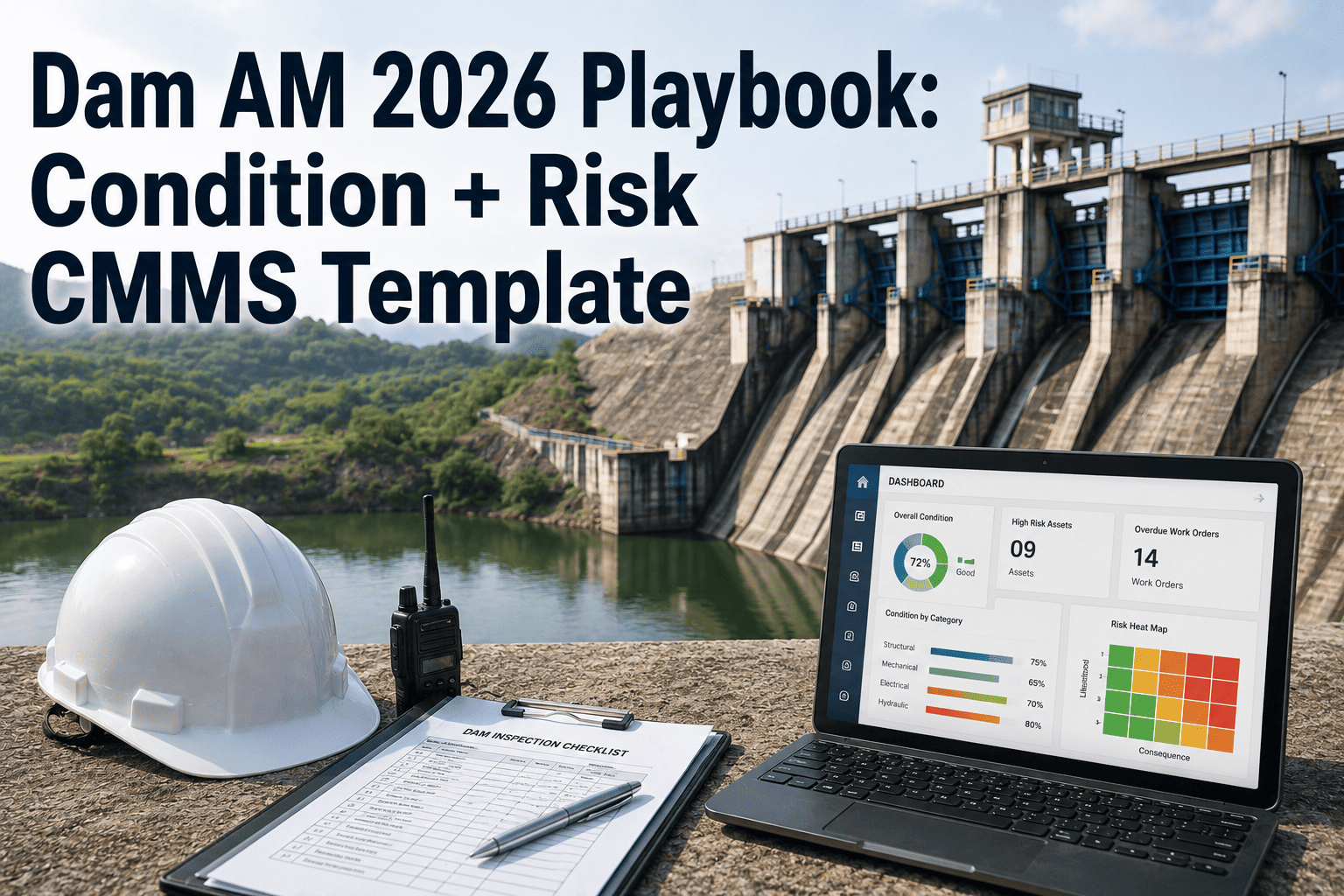
A dam carrying a DSAC 2 classification without a documented IRRM log, or a piezometer array streaming readings into an inbox instead of a versioned instrument record, is not a data problem — it is an asset management gap that turns a scheduled Periodic Inspection into a nine-figure remediation. Dam AM in 2026 is a portfolio-wide, risk-informed accounting of condition, risk, criticality, and lifecycle cost — the discipline USACE, USBR, and FERC now expect on every structure. This checklist walks the exact fields every dam AM program must populate — the CMMS template OxMaint ships out of the box.
Dam AM · 2026 Playbook · CMMS Template Checklist
Dam AM 2026 Playbook Checklist — Condition, Risk, Criticality & Lifecycle Fields for the CMMS Template
A free, field-tested checklist walking through every dam asset management field that must exist against every structure — aligned to USACE DSAC, USBR DSPR, FERC Part 12, and state dam safety frameworks, built to run inside a CMMS instead of a spreadsheet.
7
Checklist Categories
50+
Field-Level Check Points
5
DSAC Action Classes
P1
Portfolio Priority
Where Dam AM Programs Fail Without a Structured Template
Undocumented DSAC Change
Classification updated verbally without a dated CMMS record or reviewing authority
Missed Instrument Reading
Piezometer, weir, or inclinometer reading lapse creates a gap in the trend record
Open Finding Drift
Part 12 or state inspection finding without a tracked closure date or evidence type
Stale Consequence Data
Downstream population at risk not refreshed as development changes exposure
Backlog Blindness
Deferred maintenance backlog not rolled into the annual capital plan justification
Portfolio Fragmentation
Every structure recorded in its own spreadsheet with a non-uniform field schema
CContinuous
MMonthly
AAnnual
PPer Inspection
OOnce / On Change
Category 01
Asset Register & Uniform Hierarchy
The register is the first field set every structure must populate, because every downstream pillar — condition, risk, criticality, lifecycle — is queried against it. A portfolio in which Dam A calls its outlet works "low-level release" and Dam B calls the same component "bottom outlet" cannot be prioritized as a portfolio; it can only be prioritized as two spreadsheets that happen to share a folder. A uniform hierarchy is what makes the CMMS a system of record instead of a filing cabinet.
National Inventory of Dams (NID) number recorded and confirmed against the current NID release — every structure in the portfolio carries its NID identifier as the primary key; the identifier is confirmed against the current NID publication so registers and federal data reconcile on demand
ODam Safety Officer · Asset register initialization
Uniform component hierarchy applied — every dam uses the same tree: Dam > Component (Embankment / Spillway / Outlet Works / Gates / Foundation / Instrumentation) > Sub-Component > Individual Instrument; a spillway crest on Dam A is the same asset class as a spillway crest on Dam B; portfolio queries require identical schema
ODam Safety Officer · Component hierarchy validation
Ownership, operator, and regulator relationship recorded — owner entity, operating entity, and primary regulatory authority (USACE / USBR / FERC / state dam safety office) attached to the asset record; jurisdictional overlap explicitly noted where a structure sits under more than one authority
ODam Safety Officer · Regulatory relationship register
Design records and as-built drawings attached at the asset level — original design memoranda, as-built drawings, foundation reports, and every subsequent modification design attached to the dam record; documents indexed by discipline so an inspector can retrieve the relevant record without a document search
OEngineering · Design record inventory
Next scheduled inspection type and due date populated — next scheduled owner inspection, USACE Periodic Inspection, or FERC Part 12 Periodic Inspection / Comprehensive Assessment date populated; alerts triggered at 90 days, 30 days, and 7 days before the due date so no scheduled event is missed
ADam Safety Officer · Inspection schedule register
Category 02
Condition — Component States, Findings & Defects
Condition is a time series, not a snapshot. A component that has held at state 3 for four consecutive years is a different maintenance conversation than a component that dropped from state 2 to state 3 in twelve months, even though both currently read state 3. The template must capture the state, the date, the inspector, and the delta — because the delta is the leading indicator that a scheduled inspection turns into an unscheduled finding.
Component condition state recorded on a defined 1–5 ordinal scale — every component (embankment slopes, spillway crest, spillway chute, outlet works, gates, foundation, instrumentation) rated on a written 1-through-5 scale where 1 is like-new and 5 is failed or near failed; written state definitions attached per component type
PQualified Inspector · Condition state entry per inspection
Inspection date, inspector, and qualification level attributed to every state entry — every condition state entry carries the inspection date, the inspector's name, and their qualification level (registered engineer / trained inspector / operator); state changes attributed to a specific human and a specific inspection event, not a batch upload
PQualified Inspector · Attribution field on state entry
Delta from previous inspection calculated and flagged — the CMMS calculates the delta between the current condition state and the previous one; any drop of one full state or more triggers a mandatory finding creation and notification to the dam safety engineer, regardless of the current absolute state value
PCMMS · Automatic delta calculation and finding trigger
Photographic and geolocated evidence attached to every state change — a state change requires attached photographic evidence with a hash and, where field GPS is available, a geolocation tag; the evidence stays with the state record so a future inspector can compare against the current condition without a site visit
PQualified Inspector · Evidence attachment on state entry
Open findings register linked at the component level — every finding (from an owner inspection, a Periodic Inspection, a Part 12, or a state inspection) opened against the specific component with severity, responsible engineer, target closure date, and required evidence type; findings do not sit at the dam level with no component anchor
PDam Safety Engineer · Finding record creation and linkage
Finding closure countersigned and evidence-backed — a finding is not closed on a verbal update; closure requires the attached evidence type (repair record, engineering memo, verification inspection) and a countersignature from a role with authority to close findings of that severity band
PDam Safety Engineer · Countersigned closure workflow
Category 03
Instrumentation Program — Readings, Thresholds & Action Levels
Instrumentation is the only source of continuous condition data on a dam, and it is the first thing a regulator will ask to see in a Comprehensive Assessment evidence package. A piezometer whose readings live in an inbox thread and a piezometer whose readings live against an asset record with a defined action level are the same piece of hardware — but only one of them is inspection-ready. The template turns every instrument into a child asset with its own log, thresholds, and alerting chain.
Every instrument registered as a child asset with a defined reading cadence — piezometers, weirs, inclinometers, survey monuments, seepage collection points, and settlement plates each carry their own asset record with a defined reading cadence (continuous / daily / weekly / monthly) written into the record, not inherited from a general practice
CInstrumentation Technician · Instrument asset registration
Threshold and action level defined for every instrument — every instrument carries a threshold value (attention level) and an action level; the values are engineering-set and stored against the asset record so any reading is auto-compared and flagged at the point of entry, not after a manual review at the end of the month
ODam Safety Engineer · Threshold and action-level configuration
Action-level exceedance triggers alert, condition report, and work order — a reading crossing an action level automatically notifies the dam safety engineer, generates a timestamped condition report linked to the instrument record, and opens a follow-up work order; the full chain is retained against the asset for regulator review
CCMMS · Automatic alert and work-order chain
Missed reading escalation configured — a scheduled reading that is not logged by its due time triggers an automatic escalation to the instrumentation supervisor after 24 hours and to the dam safety engineer after 72 hours; missed readings appear on the portfolio dashboard as an open overdue-readings count
CCMMS · Missed-reading escalation rule
Trending analysis reviewed at defined cadence — instrument trends reviewed monthly by the dam safety engineer; any instrument showing a sustained drift toward its action level, even without crossing it, is flagged for engineering attention before the next Periodic Inspection surfaces the drift as a finding
MDam Safety Engineer · Monthly trending review
Every instrument reading, action-level alert, and finding closure is a defensible-record moment. OxMaint captures each one against the dam asset — timestamped, attributed, immutable — and rolls the portfolio into one dashboard your dam safety officer can hand to a USACE, USBR, FERC, or state regulator on request.
Category 04
Risk Classification — DSAC, IRRM & Probability-Consequence Fields
Risk is where USACE's DSAC lives, where USBR's Dam Safety Priority Rating lives, and where FERC's Semi-Quantitative Risk Assessment lands. The template must record not just the current class but the assignment date, the reviewing authority, the probability-consequence combination that drove the class, and the Interim Risk Reduction Measures the class triggered. Without the trigger fields, a classification is a label; with them, it is an operating plan.
Current DSAC or equivalent risk classification recorded with assignment date — DSAC class (1 through 5) for USACE-aligned owners, USBR Dam Safety Priority Rating band for USBR-aligned owners, or state-equivalent for state-regulated portfolios; assignment date and reviewing authority attached to the class field
ODam Safety Officer · Risk classification field on change
Probability of failure band populated — probability of failure band assigned per current risk assessment methodology; the underlying failure modes considered (piping, overtopping, foundation instability, spillway inadequacy, gate malfunction, seismic) noted so a re-scoring event can be traced back to a specific failure mode change
PDam Safety Engineer · Probability band and failure-mode notes
Life-safety, economic, and environmental consequence fields separated — the three consequence dimensions recorded as separate fields, not collapsed into a single consequence score; a change in downstream development that lifts economic consequence without changing life-safety consequence must be visible in the record
ADam Safety Engineer · Consequence field split and update
IRRM status and expiry date tracked for elevated-risk dams — every Interim Risk Reduction Measure in force on a DSAC 1, DSAC 2, or DSAC 3 structure recorded with its scope, expiry date, and responsible engineer; expiries trigger the same escalation cadence as inspection due dates so no IRRM lapses unnoticed
ADam Safety Engineer · IRRM tracking register
Risk re-scored after every Periodic Inspection, Comprehensive Assessment, and material change — the risk classification is re-scored after every scheduled assessment and after any material change in condition, downstream exposure, or hydrologic loading; the re-scoring event is timestamped even when the class does not change
PDam Safety Officer · Re-scoring event log
Category 05
Criticality — Hazard Potential, Population at Risk & Downstream Exposure
Criticality is the tie-breaker. When two dams surface with similar condition and similar risk scores, criticality is what decides which one wins the capital allocation — because a dam whose downstream population has grown 40% since the last consequence assessment is not the same dam it was, even if its condition and risk records are unchanged. The fields below are the ones that keep criticality current, not the ones that record it once and let it drift.
Hazard potential classification recorded (Low / Significant / High) — the hazard potential class assigned per the National Dam Safety Program definitions and confirmed against the current NID entry; the class is refreshed on change and any downgrade or upgrade is logged with the underlying reason
ODam Safety Officer · Hazard classification field
Population at risk downstream refreshed annually — population at risk in the inundation zone refreshed at least annually using the most recent census and municipal development data; step changes in downstream development flagged for out-of-cycle refresh so the field reflects present exposure, not the number recorded at the last EAP update
ADam Safety Engineer · Annual PAR refresh
Critical infrastructure downstream registered — critical infrastructure downstream (hospitals, schools, primary transportation corridors, other dams, water treatment plants, power generation facilities) inventoried and attached to the dam record; changes to the downstream infrastructure inventory trigger a criticality re-score
ADam Safety Engineer · Downstream critical-infrastructure inventory
Consequence-Based Top Screen tier recorded where applicable — for USACE dams, the CBTS tier assigned under the Critical Infrastructure Protection and Resilience program recorded against the dam record; the tier is refreshed on the CIPR cycle and any tier change is logged with the underlying consequence driver
ADam Safety Officer · CBTS tier field
Primary service function and system redundancy noted — primary service function (flood control / hydropower / water supply / navigation / recreation) recorded; upstream and downstream redundancy in the system noted so a dam whose failure would strand a service with no alternative is visibly different from one whose function is backed up elsewhere
ODam Safety Officer · Service-function and redundancy field
Category 06
Lifecycle Cost — Remaining Life, Rehab Forecast & Deferred Backlog
Lifecycle cost is what turns risk reduction into a defensible capital plan instead of a wish list. A dam that is inside the last decade of its original design life with a growing deferred maintenance backlog is a different capital conversation than a dam of the same DSAC class with 40 years of remaining useful life and a stable backlog. The fields below make that distinction visible in the portfolio prioritization, so the funding request writes itself from the template.
Original design service life and structure commissioning date recorded — the original design service life and the commissioning date of the structure recorded against the asset; both fields are static once set and provide the anchor from which remaining useful life is calculated on every subsequent review
OEngineering · Design life and commissioning field
Remaining useful life re-estimated annually — remaining useful life re-estimated at least annually based on the most recent condition assessment and any material events (major floods, seismic events, gate refurbishments); the estimate is engineering-signed and the underlying reasoning attached to the record
ADam Safety Engineer · Annual RUL re-estimate
Annual O&M forecast and actuals reconciled — the annual O&M forecast for the structure recorded and reconciled against actual spend at year-end; a sustained gap between forecast and actual is a signal to revisit the forecast model, not a reason to write off the difference
AFacilities Finance · O&M forecast vs actuals reconciliation
Planned rehabilitation NPV and modification cost band recorded — the NPV of planned rehabilitation activities across the forward planning horizon recorded, plus a cost band for probable modifications (e.g., spillway rehabilitation, gate replacement, foundation seepage remediation); the record feeds the annual capital plan without a separate spreadsheet
AEngineering · Rehab NPV and modification-cost fields
Deferred maintenance backlog updated quarterly — the deferred maintenance backlog updated at least quarterly, expressed both as a currency figure and as a ratio to annual O&M; a backlog-to-O&M ratio that trends upward for two consecutive quarters is escalated to the dam safety officer regardless of the absolute figure
AFacilities Finance · Quarterly backlog update
Category 07
Governance, Access Controls & Regulatory Evidence Package
The template only holds up under regulator scrutiny if the governance around it holds up. A DSAC change approved by an operator, a finding closed by whoever happened to be in the queue that day, or a piezometer reading back-dated to fill a gap — each of these is enough for a Comprehensive Assessment to find the record inadequate even if the underlying engineering is sound. Governance fields are the checklist items that keep the record defensible when it is asked for.
Role-based access controls configured to authority — dam safety engineer approvals for DSAC and risk changes; instrumentation technician entry for readings; operator entry for walkdown observations; no role can back-date a reading or edit another role's entries without a countersignature; access mirrors accountability
OSystem Administrator · RBAC configuration
Immutable audit trail enabled for all field changes — every field change (condition state, risk class, IRRM status, instrument reading, finding status) logged with user, timestamp, and prior value; the audit trail cannot be edited by any user role and is the definitive record of when a state was recorded
CSystem Administrator · Audit-trail enforcement
Portfolio dashboard published for dam safety officer and executive audiences — one dashboard aggregates DSAC distribution, open findings by severity, overdue instrumentation readings, upcoming inspection deadlines, and lifecycle pressure across every structure; the dashboard is the single view for regulator, CFO, and dam safety officer
MDam Safety Officer · Monthly dashboard review
Regulatory evidence package exportable on demand — a Part 12 Comprehensive Assessment evidence package, USACE Periodic Inspection package, or state dam safety annual report exportable from the CMMS on demand; the package is assembled from the live record rather than reconstructed from spreadsheets in the week before the inspection
PDam Safety Officer · Evidence-package export workflow
Emergency Action Plan reference and revision date attached — the current EAP for each structure attached to the dam record with its revision date; downstream inundation mapping cross-referenced to the population at risk field so a change in inundation extent flows through to a criticality re-score
ADam Safety Officer · EAP reference and revision-date field
Portfolio Prioritization Score
How the Four Pillars Combine Into One Portfolio Ranking
Once the checklist above is populated across every structure, the four pillars combine into a single prioritization score. The score is not a substitute for engineering judgement — it is what makes engineering judgement visible against every other dam in the fleet, and defensible when the capital plan is questioned.
| Component | Weighting | Basis |
|---|
| Condition | 0 — 25 | Worst component state, weighted by delta from previous inspection |
| Risk | 0 — 35 | DSAC class or equivalent, adjusted for IRRM expiry proximity |
| Criticality | 0 — 25 | Hazard potential combined with downstream PAR and critical infrastructure exposure |
| Lifecycle | 0 — 15 | Deferred backlog to annual O&M ratio, weighted by remaining useful life |
| Portfolio Score | 0 — 100 | Sum of the four components; scores above 60 lead the capital planning conversation |
FAQs
Frequently Asked Questions
What does the USACE Dam Safety Action Classification (DSAC) system cover?
USACE assigns every dam a DSAC class from 1 (Urgent and Compelling) through 5 (Normal) based on probability of failure combined with life-safety, economic, and environmental consequences. Each class triggers a defined set of monitoring, evaluation, and risk-reduction actions. See how DSAC drives the CMMS template.
How does the checklist align with FERC's revised Part 12 inspection cycle?
FERC Part 12 alternates Periodic Inspections and Comprehensive Assessments on a 10-year cycle. The condition, instrumentation, and finding fields feed the evidence package both inspection types require, exported from the CMMS on demand rather than reconstructed. Walk through a Part 12 export in a demo.
Can the template be adapted to USBR DSPR or state dam safety frameworks?
Yes. The risk classification field accepts DSAC, USBR Dam Safety Priority Rating, or state equivalents. The condition, instrumentation, criticality, and lifecycle fields are framework-agnostic and require no substitution across USACE, USBR, FERC, or state-regulated portfolios.
Does the checklist work for a single dam or only for portfolios?
Both. The same seven categories and field schema apply whether the owner runs one high-hazard structure or a 40-dam federal fleet. The portfolio dashboard simply becomes a single-structure dashboard for smaller programs.
What happens when an instrument reading crosses an action level in the CMMS?
The reading triggers an automatic alert to the dam safety engineer, a timestamped condition report is created and linked to the instrument, and a follow-up work order is opened. The full chain — reading, alert, response, resolution — is retained against the asset record.
Digitize Dam AM Compliance
Every Field Populated. Every Reading Trended. Every Finding Closed With Evidence.
OxMaint ships the seven-category dam AM checklist as a working CMMS template — DSAC-aligned risk fields, instrumentation with action-level alerts, finding-to-closure tracking, and portfolio dashboards configured for USACE, USBR, FERC, and state dam safety frameworks. Start with one structure, scale to the whole portfolio.