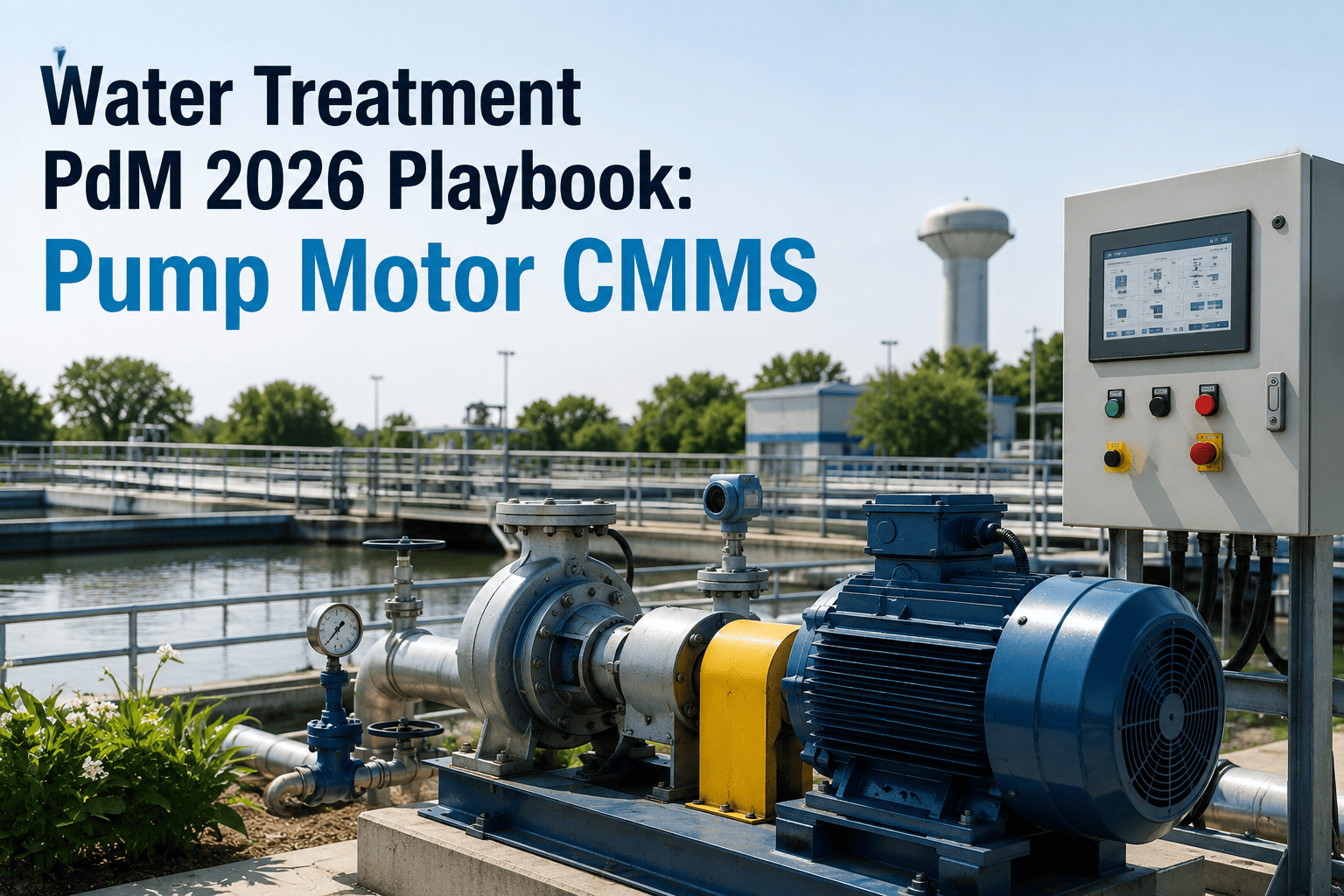
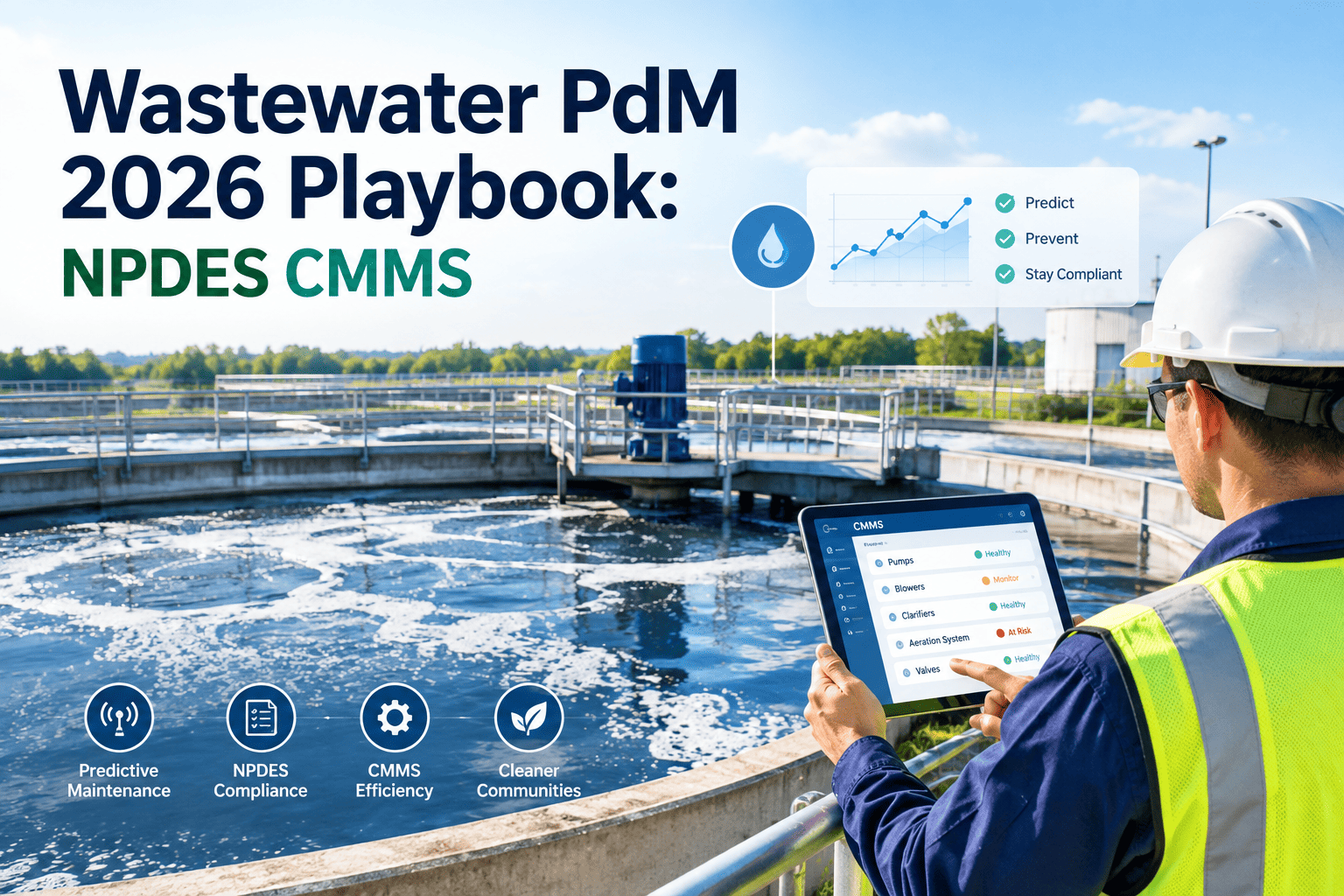
A water treatment plant does not get a grace period when a raw water pump bearing fails at four in the morning during peak demand — the plant either finds standby capacity in minutes or the community loses pressure and compliance in the same afternoon. Reactive maintenance costs the average treatment facility more than half a million dollars a year in emergency repairs, unplanned downtime, and the overtime call-outs that come with every middle-of-the-night alarm. Almost all of that cost traces back to a short, predictable list of equipment: raw water and high service pumps, motors, blowers, membrane trains, UV disinfection banks, and chemical feed systems, each with its own failure signature and its own early-warning window if someone is actually watching the data. This page is a working checklist for each of those six asset classes — the exact parameters to check, the thresholds that separate normal from alarm, and the CMMS template that runs the whole checklist automatically instead of on a clipboard. Book a demo to see this checklist running against your own SCADA data.
$680K+
Average annual cost of reactive maintenance per treatment facility
30-50%
Typical unplanned downtime reduction after adopting condition-based PdM
72 hrs
Advance warning a bearing degradation trend can give before a capacity-limiting failure
6
Critical asset checklists covered on this page — pumps, motors, blowers, membranes, UV, chemical feed
Free Download
Get the 2026 water treatment PdM checklist and the matching CMMS template — six critical asset checklists, alarm thresholds, and auto-generated work order triggers, ready to load into your maintenance program this week.
How to Use This Checklist
Run each section below on the interval marked against the asset — most critical items are checked every shift, monitor-level items on a fixed weekly or calendar cycle. Every reading logged against these checklist items is exactly what should be sitting inside your CMMS as a PM template, not a separate rounds sheet that never makes it back to maintenance planning.
Items marked Critical carry a direct consequence for capacity or compliance if missed. Items marked Monitor still matter, but a missed reading rarely causes an immediate failure on its own — it simply removes the early warning that would have caught a developing problem in time.
The Six Critical Asset Checklists
Pumps
Critical — Every Shift
Raw water, high service, and backwash pumps carry the highest consequence of failure in the plant.
Bearing vibration within ±0.5 mm/s of baseline on all critical units
Bearing temperature under 70°C, flagged for changeover above 80°C
Suction and discharge pressure differential trended against pump curve
Motor current and seal drip rate logged at every rounds check
Motors
Critical — Every Shift
Motor winding condition drives pump and blower reliability more than any single hydraulic factor.
Winding temperature trended against manufacturer insulation class rating
Insulation resistance test logged on a fixed calendar interval for standby units
Current imbalance across phases under 5 percent during normal operation
Thermal imaging scan on quarterly rounds to catch hotspots point sensors miss
Aeration blowers running continuously accumulate bearing and lobe wear faster than intermittent equipment.
Discharge air temperature and pressure trended against design specification
Bearing vibration route on a fixed weekly interval for non-instrumented units
Belt or coupling condition checked on every physical rounds inspection
Oil analysis on gearbox-driven units at the manufacturer's recommended interval
Membrane Trains
Critical — Daily
Membranes fail through fouling and plugging long before a physical breach ever occurs.
Transmembrane pressure reviewed daily and compared train to train
Permeate conductivity trended to catch integrity loss early
Clean-in-place frequency tracked against baseline for accelerating fouling
Pressure instrument calibration verified before trusting any TMP-based decision
UV Disinfection
Critical — Continuous
UV dose is a regulatory compliance parameter, not just an equipment health indicator.
UV intensity sensor readings logged continuously against validated dose
Lamp and sleeve fouling checked on a fixed cleaning cycle
Lamp hours tracked against rated life with replacement scheduled ahead of failure
UV transmittance of the water itself trended alongside lamp condition
Chemical Feed Systems
Monitor — Every Shift
Dosing accuracy failures are silent until a finished water quality result comes back out of range.
Dosing pump rate verified against jar test or online analyzer within ±5 percent
Day tank and bulk storage level trended to prevent an unplanned run-out
Diaphragm and check valve wear inspected on a fixed calendar interval
Calibration of every dosing pump verified before each new chemical batch
Quick-Reference Alarm Thresholds
These are the parameter ranges most treatment plants use as a starting baseline. Every plant should tune thresholds against its own equipment history once enough trend data has accumulated in the CMMS.
PdM Alert Levels Used Across the Checklist
Normal
Reading within the established baseline band for that asset and operating condition.
Continue standard checklist interval, no action required.
Watch
Gradual trend developing but still short of the defined alarm threshold.
Increase check frequency and log trend in the CMMS asset record.
Alarm
Threshold exceeded on a critical parameter with a known failure signature.
Auto-generate a work order and schedule inspection within the outage window.
Trip
Condition consistent with imminent failure or active regulatory exceedance risk.
Immediate standby changeover and supervisor notification, logged for compliance record.
See It Running
Every checklist item above maps directly to a work order rule inside Oxmaint — connect your SCADA feed once and the CMMS starts flagging Watch and Alarm conditions automatically.
Turning This Checklist Into a Live CMMS Program
A checklist only changes outcomes once it is running inside the system that generates work orders. These four steps take the six checklists above from a downloaded document to a live, automated maintenance program.
1
Digitize the asset and PM library
Load every pump, motor, blower, membrane train, UV bank, and chemical feed system into the CMMS with the checklist items above attached as its PM template.
2
Connect SCADA and sensor data
Feed vibration, temperature, pressure, and dosing data directly into the CMMS so checklist readings update automatically instead of being re-typed from a rounds sheet.
3
Set Watch, Alarm, and Trip thresholds
Start from the quick-reference table above, then tighten thresholds as your own equipment history builds inside the platform.
4
Auto-generate work orders and compliance records
Let every Alarm condition create a scoped work order automatically, and let every completed checklist item timestamp itself for the next SDWA or CWA audit.
Frequently Asked Questions
01
Which treatment plant assets should get continuous monitoring versus route-based checklist runs?
Continuous monitoring belongs on assets with no standby redundancy or a direct regulatory consequence — raw water pumps, UV banks, and membrane trains. Balance-of-plant equipment with an available spare can generally run on a scheduled route-based checklist.
02
How long does it take to build a working PdM program from this checklist?
Most plants load the asset library and checklist templates within a week and start seeing meaningful trend data within thirty to sixty days, once baseline readings accumulate for each asset.
03
Do we need new sensors, or can existing SCADA data drive this checklist?
Most plants already collect the core parameters — vibration, temperature, pressure, current, and dosing rate — through existing SCADA.
Sign up free to connect that feed and see which gaps, if any, remain.
04
How does this checklist support SDWA and CWA compliance reporting?
Every completed checklist item and every alarm response is timestamped and archived automatically in the CMMS, producing an audit trail without a manual search through paper logs or spreadsheets.
05
What is the realistic return on shifting from reactive to predictive maintenance?
Facilities typically report a 30 to 50 percent reduction in unplanned downtime, which on an average reactive maintenance spend of $680,000 or more per year represents a substantial and fast-recovered saving.
Start Today
Oxmaint turns this checklist into a live CMMS program — asset templates, SCADA-driven thresholds, and auto-generated work orders for every pump, motor, blower, membrane train, UV bank, and chemical feed system in your plant.